
TL;DR:
- Bank digitization involves converting manual banking processes into digital formats, but true transformation re-engineers entire operations and customer experiences. Advanced technologies like cloud-native systems, open APIs, and AI enable real-time data flows, personalized services, and back-end modernization for fully integrated banking ecosystems. Future banking shifts toward intelligent systems that orchestrate AI-driven insights and automation, moving beyond surface-level digital features to fundamentally smarter institutions.
Bank digitization is not simply scanning paper forms and calling it a day. At its core, what is bank digitization really asking? It’s asking how financial institutions are fundamentally changing the way they operate, serve customers, and compete in a technology-driven world. For high-net-worth individuals, corporate treasurers, and international business professionals, the distinction between surface-level digital features and genuine banking digital transformation determines which institutions can actually serve complex, global financial needs at the level they require.
Table of Contents
- Key Takeaways
- What bank digitization actually means
- Core technologies powering bank digitization
- Benefits of bank digitization for customers and banks
- Implementation pitfalls and smart approaches
- The global impact and future of bank digitization
- My perspective on where bank digitization actually stands
- How Prominencebank delivers on digital banking
- FAQ
Key Takeaways
| Point | Details |
|---|---|
| Digitization vs. transformation | Digitization converts processes to digital formats; transformation reshapes entire banking operations and culture. |
| Technology drives the shift | Cloud-native systems, APIs, and AI are the backbone of modern bank digitization infrastructure. |
| Benefits span both sides | Banks gain efficiency and lower costs; customers gain speed, access, and personalized service. |
| Back-end modernization is non-negotiable | Front-end upgrades without back-end changes create broken digital experiences for clients. |
| Intelligent banking is next | The future moves beyond digital channels to AI-orchestrated systems that automate complex financial processes. |
What bank digitization actually means
Most people assume bank digitization means replacing paper with PDFs or offering a mobile app. That assumption misses the bigger picture by a significant margin.
Bank digitization refers to converting analog information, paper-based records, and manual processes into digital formats. Think of a bank scanning physical loan applications, migrating client records to a database, or replacing teller forms with online input fields. It is a necessary first step, but it is not the finish line.
Banking digital transformation, by contrast, goes much further. It restructures the entire business. Processes are re-engineered from the ground up. Customer experiences are redesigned around digital behavior. Organizational culture shifts to support continuous technology adoption. Digital transformation in banking fundamentally restructures business processes and customer experiences in ways that simple digitization never could. JPMorgan Chase, for example, invests over $12 billion annually in technology initiatives to sustain this kind of transformation.
Here is where the distinction becomes practical for sophisticated banking clients:
- A bank that digitized its onboarding still runs manual compliance checks behind the scenes, which means delays.
- A bank that has undergone digital transformation processes KYC, AML checks, and account provisioning in near real-time, because the back-end matches the front-end.
- True transformation means the entire value chain, from client intake to treasury operations, operates on connected digital systems.
Pro Tip: When evaluating a bank’s digital capabilities, ask whether their account opening is fully automated end-to-end or whether your application still gets handed off to a human workflow somewhere in the middle. The answer tells you which category they belong to.
Core technologies powering bank digitization
Understanding how bank digitization works requires looking at the infrastructure underneath the interface. The client-facing app is only the visible layer.

Legacy systems and the modernization problem
Most established banks carry decades of legacy core banking software. These systems were built for batch processing in a pre-internet world. They are expensive to maintain, slow to update, and incompatible with real-time data demands. About 40% of banks report maturity in some digital core components, but none have reached full maturity yet. That gap is where competitive risk lives.
The solution is not always to rip and replace everything at once. More often, banks layer modern APIs over legacy cores, allowing new digital products to function without requiring a complete system overhaul. This approach creates functional digital channels while the back-end modernization progresses in stages.
The technology stack that makes it work
Several technologies form the backbone of modern banking digital transformation:
- Cloud-native architectures allow banks to scale computing resources dynamically, which is critical for processing spikes during high-volume events like tax season or market volatility.
- Open APIs connect internal banking systems with fintech partners, payment networks, and client-facing platforms without requiring custom code for every integration. Retail banking platforms now offer over 100 third-party integrations out of the box.
- AI and machine learning power fraud detection, credit scoring, customer segmentation, and personalized product recommendations. Banks store tens of terabytes of data, and AI-driven analytics improve fraud detection and product personalization at a scale no human team could replicate.
- Biometric KYC and digital identity verification reduce onboarding from days to minutes. Modular platforms enabling biometric onboarding have produced 4x faster development cycles for banking products.
Pro Tip: For corporate clients managing multi-entity structures across jurisdictions, the API connectivity between a bank’s core and external treasury management systems is more important than the look of the client portal. Prioritize banks that publish their API documentation openly.
Benefits of bank digitization for customers and banks
The practical advantages of bank digitization fall into two clear categories: what banks gain operationally, and what clients experience directly.
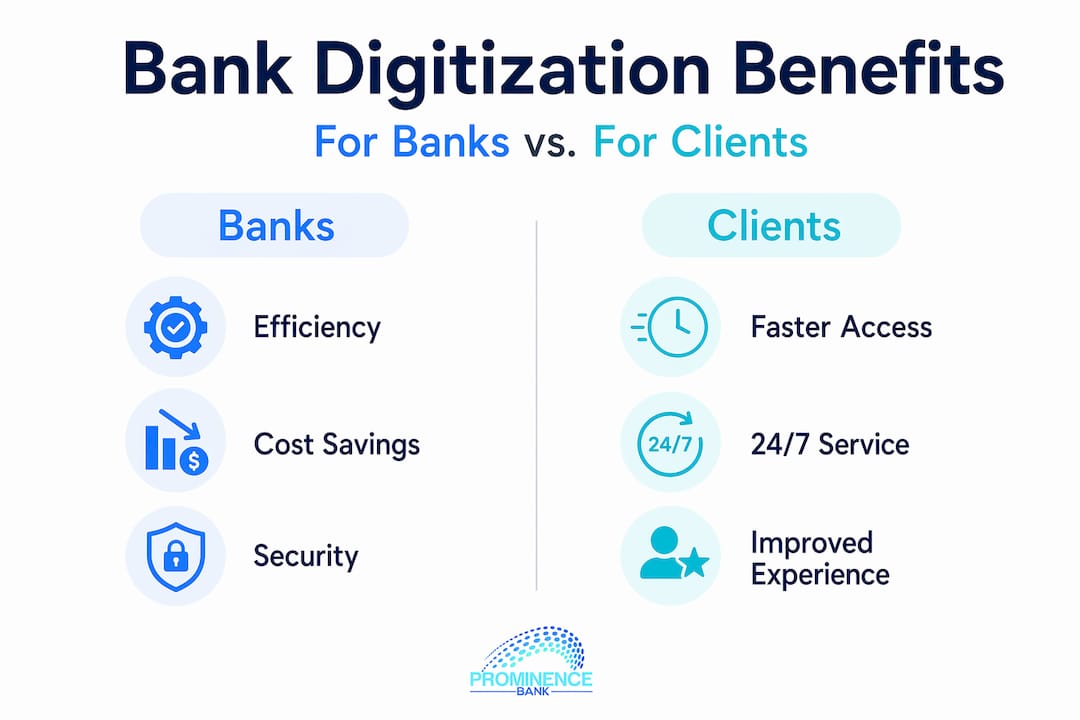
| Benefit Area | For Banks | For Clients |
|---|---|---|
| Efficiency | Lower cost-per-transaction, automated compliance | Faster processing, fewer delays |
| Accessibility | Reduced branch overhead | 24/7 access across time zones and devices |
| Personalization | Better cross-sell via data insights | Tailored products matching actual behavior |
| Risk management | Real-time fraud detection and monitoring | More secure transactions and account activity |
| Compliance | Automated AML/KYC workflows | Faster onboarding, less documentation friction |
The scale of this shift is not theoretical. 100% of eligible administrative procedures in Vietnam’s banking sector moved fully online, with digitalized records reaching nearly 45% by the first quarter of 2026, alongside high client satisfaction ratings. That is a national banking sector transforming at speed, with measurable results.
For international business clients specifically, the benefits of bank digitization translate to:
- Multi-currency accounts that update balances in real-time across locations
- Instant payment rails replacing correspondent banking delays
- Digital onboarding that completes in hours rather than weeks
- Centralized dashboards giving treasury teams visibility across all accounts and entities
The digital banking security practices that underpin these capabilities are also substantially stronger than legacy equivalents. Encrypted data transmission, behavioral analytics for fraud flagging, and multi-factor authentication are standard in digitally mature institutions, not premium add-ons.
Implementation pitfalls and smart approaches
The banks that struggle with digitization share one common mistake: they fix the front-end without touching the back-end. A polished mobile app that submits requests to a manual processing queue is not digital banking. It is a digital facade over an analog operation.
Customer-facing digital improvements fail without streamlining back-end operations like data entry and batch processing. This is the most expensive lesson in banking technology, and it gets relearned across institutions every few years.
The smarter approach follows these steps:
- Identify the highest-friction journeys first. Onboarding, payment processing, and compliance checks cause the most client dissatisfaction. Start modernization there.
- Use phased API layering. Rather than a complete core replacement, build API middleware that connects legacy systems to new digital channels. Phased modernization targeting friction points is consistently more effective than big-bang replacements.
- Build a reinvention-ready digital core. A reinvention-ready digital core is the prerequisite for adopting generative AI, embedded finance, and other emerging capabilities as they mature.
- Measure outcomes, not activity. Track time-to-onboard, transaction error rates, and client satisfaction scores, not just the number of features launched.
- Address technical debt deliberately. Legacy debt does not disappear by layering new systems on top. Allocate a fixed percentage of technology budgets to debt reduction alongside innovation spending.
Pro Tip: If you are a corporate client assessing a bank’s digital maturity, request a demonstration of the end-to-end account opening and first payment process. A genuinely transformed bank will complete this in one session without requiring callbacks or document couriers.
The global impact and future of bank digitization
The impact of digitization on banking is visible at every scale, from individual account holders to national financial systems.
Open banking frameworks are reshaping competitive dynamics. Open banking ecosystems now enable secure data sharing between financial institutions and third parties under formal legal frameworks, creating multi-utility financial experiences that were impossible a decade ago.
Future trends shaping the next phase of banking digitization include:
- Embedded finance, where banking products appear inside non-banking platforms (procurement software, ERP systems, and e-commerce infrastructure)
- Digital currency integration, connecting central bank digital currencies and private digital assets to institutional accounts
- AI-driven advisory, where personalized financial guidance is generated from real-time transaction and market data rather than periodic adviser meetings
- Omnichannel orchestration, giving clients a consistent experience whether they access services via mobile app, web portal, or API connection
The most forward-thinking institutions are already moving past digitization into what analysts call intelligent banking. This means redesigning banking architecture to orchestrate AI-driven intelligence through APIs, where chatbots and digital layers are just entry points, and automated data orchestration handles the actual complexity underneath. The technology behind secure personalized banking is evolving fast enough that institutions not investing in intelligent architecture today will face serious capability gaps within three to five years.
My perspective on where bank digitization actually stands
I have spent years watching financial institutions announce digital transformations that amount to a new app and a rebrand. The pattern is predictable and the disappointment for clients is real.
What I have learned is that the difference between a digitized bank and a truly transformed one comes down to whether the organization has rebuilt its operating model or just added technology to an existing one. Most banks are still in the middle of that journey, and that gap matters enormously for clients with complex, cross-border financial needs.
The transition to intelligent banking is the more significant shift coming. Beyond moving transactions online, this is about orchestrating data, AI, and partner ecosystems to automate genuinely complex financial processes. That is not a feature. That is a fundamentally different kind of institution.
My honest advice to professionals evaluating banking partners is this: look past the interface. Ask about the back-end architecture. Ask whether compliance is automated or manual. Ask what happens when something goes wrong at 2 a.m. across a time zone your local team does not cover. The answers will separate digital-first institutions from institutions with digital-looking front ends.
The banks that will matter in five years are building for intelligence today, not for appearances.
— Harold
How Prominencebank delivers on digital banking
Prominencebank operates as a fully digital institution built from the ground up for clients who demand real-time global access, strict confidentiality, and banking infrastructure that performs across jurisdictions. There is no legacy drag, no manual back-office bottleneck, and no branch-era thinking underneath the platform.
For corporate clients managing international operations, multi-currency global banking at Prominencebank provides real-time balance visibility and cross-border payment capability in a single account structure. For institutions and businesses exploring digital assets, Prominencebank’s digital currency solutions integrate directly with your existing banking relationship. And for complex corporate structures requiring tailored solutions, advanced corporate banking at Prominencebank is built to handle the specifics. Explore what a genuinely digitized bank looks like in practice.
FAQ
What is bank digitization in simple terms?
Bank digitization is the process of converting manual and paper-based banking processes into digital formats, and at a deeper level, rebuilding how banks operate to serve customers through fully digital channels and systems.
How does bank digitization work technically?
Banks implement cloud-native architectures, open APIs, AI analytics, and digital identity tools to replace legacy processes and connect their systems with real-time data flows and third-party platforms.
What are the main benefits of bank digitization?
The core benefits include faster transaction processing, 24/7 account access, automated compliance, improved fraud detection, and personalized financial services based on real-time data analysis.
How is bank digitization different from banking digital transformation?
Digitization converts existing processes to digital formats, while banking digital transformation restructures the entire operating model, culture, and customer experience strategy of the institution.
What is intelligent banking and how does it relate to digitization?
Intelligent banking is the next evolution beyond digitization, where AI, APIs, and data orchestration automate complex financial processes rather than simply replicating manual tasks in digital form.