TL;DR:
- Corporate banking offers specialized, complex services different from retail banking, focusing on business needs.
- Privacy, security, and compliance are key pillars that interact to protect assets and ensure regulatory adherence.
- Advanced tools like digital onboarding and regtech solutions help manage international compliance challenges efficiently.
Corporate banking is not retail banking with more zeros. The structures, risks, compliance requirements, and privacy expectations are fundamentally different, and confusing the two is a costly mistake for any serious international business or high-net-worth individual. Where retail banking handles everyday transactions for consumers, corporate banking operates in a world of layered ownership structures, cross-border treasury management, and regulatory scrutiny that changes by jurisdiction. This guide breaks down what corporate banking actually involves, which services matter most, how privacy and compliance interact, and what global clients need to know before choosing a provider.
Table of Contents
- The fundamentals: What is corporate banking?
- Core services in corporate banking: What matters most
- Privacy, security, and compliance: The three pillars
- Challenges and opportunities in international corporate banking
- Wholesale vs. retail: How corporate banking drives growth and manages risk
- A nuanced perspective: What most guides won’t tell you about corporate banking
- Unlocking corporate banking solutions with Prominence Bank
- Frequently asked questions
Key Takeaways
| Point | Details |
|---|---|
| Corporate banking defined | Corporate banking delivers specialized, large-scale solutions for businesses and HNWI that go beyond consumer services. |
| Privacy and security focus | Major banks prioritize strict data privacy, advanced security standards, and ongoing compliance for global clients. |
| Navigating complexity | International banking requires careful due diligence and clear understanding of regulations to succeed. |
| Choosing the right solution | Evaluate providers on privacy, compliance, and tailored services when selecting a corporate banking partner. |
The fundamentals: What is corporate banking?
Most people assume corporate banking is just retail banking at a larger scale. It is not. Corporate banking, also known as commercial or wholesale banking, provides specialized financial services to large corporations, international businesses, mid-sized companies, and sometimes high-net-worth individuals. The client base, risk profile, and service design are entirely distinct from what retail banks offer consumers.
Here is how the three main banking categories compare:
| Banking type | Primary clients | Core focus | Typical services |
|---|---|---|---|
| Retail banking | Individual consumers | Everyday transactions | Savings, loans, cards |
| Private banking | Wealthy individuals | Wealth management | Investments, estate planning |
| Corporate banking | Businesses, HNWIs | Business finance | Lending, FX, treasury, trade |
The clients in corporate banking are not passive. They are active, often operating across multiple jurisdictions, managing complex ownership structures, and demanding solutions that match their scale and risk tolerance. The corporate banking overview for global institutions reflects this complexity directly.
Core services in corporate banking include:
- International payments and transaction services across currencies and borders
- Lending and credit facilities structured for business needs
- Treasury solutions for liquidity management and yield optimization
- Cash management to handle multi-entity, multi-currency flows
- Trade finance for cross-border commerce
Scale matters here. A corporation moving $50 million across three currencies in a single day has needs that no retail product can address. Risk management, customization, and speed become non-negotiable. That is why secure, tailored solutions are not a luxury in this space. They are the baseline.
“The sophistication of corporate banking is not in the size of the transaction. It is in the precision of the structure built around it.”
Core services in corporate banking: What matters most
Now that you know what corporate banking is, let us examine the specific services that matter most for international businesses and HNWIs.
| Service | What it does | Why it matters |
|---|---|---|
| Multi-currency accounts | Hold and transact in multiple currencies | Reduces FX exposure and conversion costs |
| International wire transfers | Move funds globally | Essential for cross-border operations |
| Foreign exchange (FX) | Convert currencies at institutional rates | Protects margins on global transactions |
| Trade finance | Letters of credit, guarantees | Enables secure international commerce |
| Asset protection | Structured holding solutions | Shields wealth from unnecessary exposure |
| Treasury management | Liquidity and yield optimization | Maximizes idle capital efficiency |
The most sophisticated clients prioritize privacy and security alongside functionality. Solutions emphasize privacy through secure data handling, security via layered controls and cybersecurity frameworks such as ISO 27001 and NIST, and compliance with global AML/KYC standards. These are not optional features. They are structural requirements for any serious corporate banking relationship.
Here is how to evaluate a corporate banking provider in order of priority:
- Verify their AML/KYC framework and ask specifically how they handle complex ownership structures
- Confirm cybersecurity certifications such as ISO 27001 or equivalent
- Assess their multi-currency capabilities and FX pricing transparency
- Review their compliance track record in your target jurisdictions
- Test their onboarding process for speed, document requirements, and digital access
A private banking setup that skips rigorous AML/KYC screening is not a feature. It is a liability. Equally, online bank compliance frameworks must be robust enough to satisfy regulators without creating friction that slows legitimate business.
Pro Tip: Always ask a prospective corporate bank to walk you through their AML/KYC technology stack and how they handle politically exposed persons (PEPs) or complex holding structures. Their answer tells you everything about their actual capabilities.
Privacy, security, and compliance: The three pillars
The value of corporate banking services depends entirely on their ability to keep assets safe and compliant. Privacy, security, and compliance are not separate concerns. They interact constantly, and weakness in one undermines the others.

Privacy in corporate banking means more than keeping account numbers confidential. It means structured data handling, access controls that limit internal exposure, and legal frameworks that protect beneficial ownership information from unnecessary disclosure. This is especially relevant for HNWIs operating through trusts, foundations, or multi-layered holding companies.
Security operates at the technical level. Security via layered controls and cybersecurity frameworks such as ISO 27001 and NIST sets the standard for how institutions protect client data and transaction integrity. These frameworks require continuous auditing, penetration testing, and incident response planning. A bank without these certifications is not a serious option for institutional clients.
Compliance is where the landscape is shifting fastest. The EU’s AMLR and AMLD6 regulations are lowering beneficial ownership disclosure thresholds to 25% or even 15% in high-risk cases. This means more clients will trigger enhanced due diligence requirements in 2026 than ever before.
Common risks and their mitigations:
- Fraud: Mitigated by multi-factor authentication, behavioral analytics, and transaction monitoring
- Cyberattacks: Addressed through ISO 27001 certification, encrypted communications, and endpoint controls
- Regulatory fines: Prevented by proactive AML/KYC screening, sanctions list monitoring, and legal counsel integration
- Data breaches: Controlled through access segmentation and zero-trust architecture
For a deeper look at how technology supports these protections, the secure online banking process and bank security technology frameworks show what best-in-class implementation looks like.
Pro Tip: Before opening any corporate account, understand which compliance regime governs your structure. A holding company in one jurisdiction may trigger reporting obligations in three others. Get legal clarity first.
Challenges and opportunities in international corporate banking
Understanding the standards is just the first step. Global clients face unique challenges that demand innovation and careful planning.
The most demanding cases involve complex corporate structures requiring enhanced due diligence for source of wealth, source of funds, and relational network mapping. A multinational with subsidiaries across six countries does not fit neatly into a standard KYC form. Banks that cannot handle this complexity will either reject the client or create compliance gaps that create risk later.
Common KYC challenges include inconsistent document requests across jurisdictions, translation requirements, and document expiry during long onboarding timelines. These friction points cost time and, in some cases, business opportunities.
“The tension between privacy and compliance in digital banking is not a problem to be solved. It is a condition to be managed, continuously and proactively.”
Innovative solutions that are reshaping international corporate banking:
- Digital onboarding platforms that reduce document handling time significantly
- Regtech tools that automate sanctions screening and ownership verification
- AI-driven transaction monitoring that reduces false positives in AML alerts
- Blockchain-based identity verification for cross-border KYC consistency
Steps to overcome common international banking challenges:
- Prepare a complete corporate structure chart before approaching any bank
- Gather certified source-of-funds documentation in advance
- Engage a compliance advisor familiar with your target banking jurisdiction
- Choose a bank with digital onboarding to reduce paper-based delays
- Review the securing corporate banking process to understand what banks expect at each stage
The secure account opening process at a sophisticated digital bank can cut weeks off traditional timelines when clients come prepared.
Wholesale vs. retail: How corporate banking drives growth and manages risk
To truly understand the impact of corporate banking, it helps to compare it directly with retail banking and examine both the rewards and the risks.
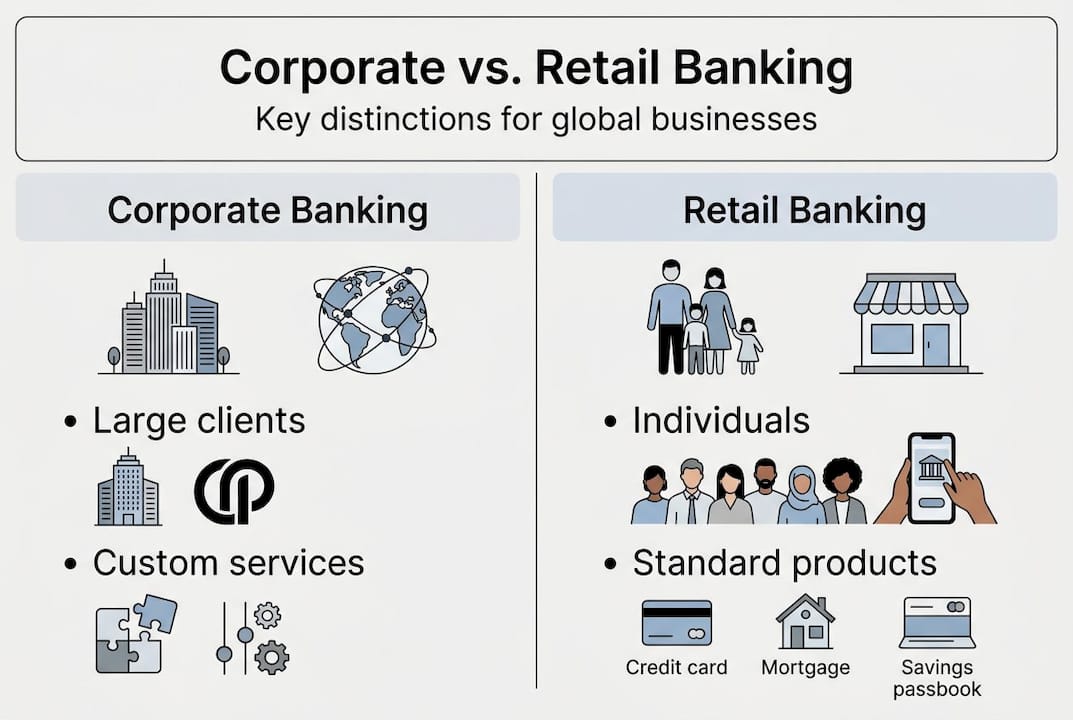
Wholesale banking, the institutional layer of corporate banking, operates on volume and relationship depth. Transactions are larger, margins per deal are thinner, but the overall revenue potential is significantly higher. Wholesale banking scale lowers costs but ties performance to economic cycles, which means corporate banks carry systemic risk that retail banks do not.
| Factor | Wholesale/corporate banking | Retail banking |
|---|---|---|
| Transaction size | Large to very large | Small to medium |
| Cost per transaction | Lower at scale | Higher per unit |
| Risk profile | Concentrated, cycle-sensitive | Distributed, consumer-driven |
| Innovation pace | Driven by compliance and tech | Driven by consumer demand |
| Customization | High, relationship-based | Low, product-based |
Key implications for corporations and HNWIs:
- Growth enablement: Corporate banking provides the credit, FX, and treasury infrastructure that allows businesses to scale internationally
- Systemic exposure: Large loan defaults in corporate portfolios can create ripple effects across financial systems
- Regulatory pressure: Privacy regulations constrain some innovative digital banking features at the corporate level
- Relationship value: Long-term banking relationships at the corporate level unlock better pricing, faster approvals, and more flexible structures
For clients weighing their options, understanding the benefits of international banking in a wholesale context makes the decision clearer and more strategic.
A nuanced perspective: What most guides won’t tell you about corporate banking
Most corporate banking guides stop at frameworks and checklists. Here is what they leave out.
True privacy in corporate banking is often overestimated. Every layer of privacy protection also requires a corresponding compliance check. The more discreet the structure, the more rigorous the due diligence. Clients who expect complete opacity are setting themselves up for account closures and regulatory scrutiny. The discreet banking advantages that sophisticated banks offer are real, but they operate within legal frameworks, not outside them.
Regulatory trends are narrowing what banks can realistically promise. As beneficial ownership thresholds drop and reporting obligations expand, the gap between what clients want and what banks can legally provide is shrinking. The smartest clients are not fighting this trend. They are working with it, building structures that are both efficient and compliant from the start.
Pro Tip: Ask your bank directly about regulatory gaps in their current compliance framework and how they plan to address upcoming changes. A bank that cannot answer this question clearly is not ready for sophisticated clients.
Growth and privacy always require calculated tradeoffs. There is no structure that maximizes both simultaneously. The goal is to find the right balance for your specific risk profile and business objectives.
Unlocking corporate banking solutions with Prominence Bank
If you are ready to apply these insights, Prominence Bank offers the kind of sophisticated, fully digital corporate banking infrastructure that serious international clients require. From multi-currency business accounts to complex corporate structures and institutional treasury solutions, the approach is built around privacy, security, and genuine global compliance.
Explore the full range of corporate banking services designed for HNWIs and international corporations. Whether you need to secure your banking process from the ground up or want to understand the offshore account advantages available through a licensed digital institution, Prominence Bank provides the structure, compliance depth, and discretion that complex global clients demand.
Frequently asked questions
How is corporate banking different from retail banking?
Corporate banking provides specialized services to businesses and institutions with complex financial needs, while retail banking serves individual consumers with standardized products like savings accounts and personal loans.
What security standards are used in corporate banking?
Top corporate banks implement ISO 27001 and NIST frameworks to protect client data and transaction integrity through layered controls, continuous auditing, and incident response protocols.
Why is enhanced due diligence required for complex corporate clients?
Complex corporate structures require enhanced due diligence to verify source of wealth, map ownership networks, and satisfy AML/KYC obligations that standard screening cannot adequately address.
What are the risks of corporate banking for global businesses?
Corporate banking carries risks including loan default exposure, regulatory fines for compliance gaps, cybersecurity threats, and performance sensitivity tied to broader economic cycles.