
TL;DR:
- The international banking process involves careful documentation, account selection, and compliance management. Accurate preparation and testing support a complete account-opening review, transfers, and ongoing regulatory compliance without guaranteeing approval or a deadline. Digital multi-currency accounts simplify cross-border transactions and streamline global fund management.
The step by step international banking process is a defined sequence of actions that enables individuals and businesses to open accounts, move funds across borders, and stay compliant with global regulations. Most people treat it as a single event. It is actually a structured workflow that spans documentation, account selection, wire transfer execution, and ongoing compliance management. Tools like the SWIFT network, KYC frameworks enforced by bodies such as FinCEN, and digital banking platforms each play a distinct role at different stages. Get the sequence right and international banking becomes a repeatable, low-friction operation.
What documents do you need for international banking?
Incomplete documentation means the estimated processing period has not started and may lead to additional follow-up or rejection. Banks operating under AML and KYC mandates require proof of identity, proof of residence, and a clear explanation of where your funds originate. KYC is legally mandated by regulatory bodies including FinCEN in the United States and the FCA in the United Kingdom, and Prominence Bank normally completes account opening within 48 to 72 hours after all required KYC/AML procedures have been completed and all requested information and documentation have been received, verified, and accepted. This is an estimated processing period, not a guaranteed deadline. Additional time may be required if further compliance, verification, or due-diligence review is necessary. Submitting an enquiry, application, or payment does not start the estimated processing period and does not guarantee account approval or activation.

The document requirements differ significantly between individuals and businesses. Corporations must produce formation documents, ownership structures, and identification for every beneficial owner. The table below shows the core differences.
| Document type | Individual | Business |
|---|---|---|
| Government-issued photo ID | Passport or national ID | Passport for all beneficial owners |
| Proof of address | Utility bill or bank statement | Registered office address document |
| Tax identification | SSN or ITIN | EIN or local equivalent |
| Source of funds | Bank statements or pay stubs | Audited financials or invoices |
| Entity formation | Not applicable | Certificate of incorporation, constitutional documents |
Prominence Bank normally completes account opening within 48 to 72 hours after all required KYC/AML procedures have been completed and all requested information and documentation have been received, verified, and accepted. This is an estimated processing period, not a guaranteed deadline. Additional time may be required if further compliance, verification, or due-diligence review is necessary. Submitting an enquiry, application, or payment does not start the estimated processing period and does not guarantee account approval or activation.
Pro Tip: Scan every document at 300 DPI minimum and save files in PDF format. Banks reject blurry or cropped images; resubmission does not restart the estimate, because the estimated processing period begins only after KYC/AML is complete and all requested information and documentation have been received, verified, and accepted.
For a detailed breakdown of what high-net-worth clients specifically need, the HNW account requirements guide at Prominencebank covers jurisdiction-specific obligations in depth.
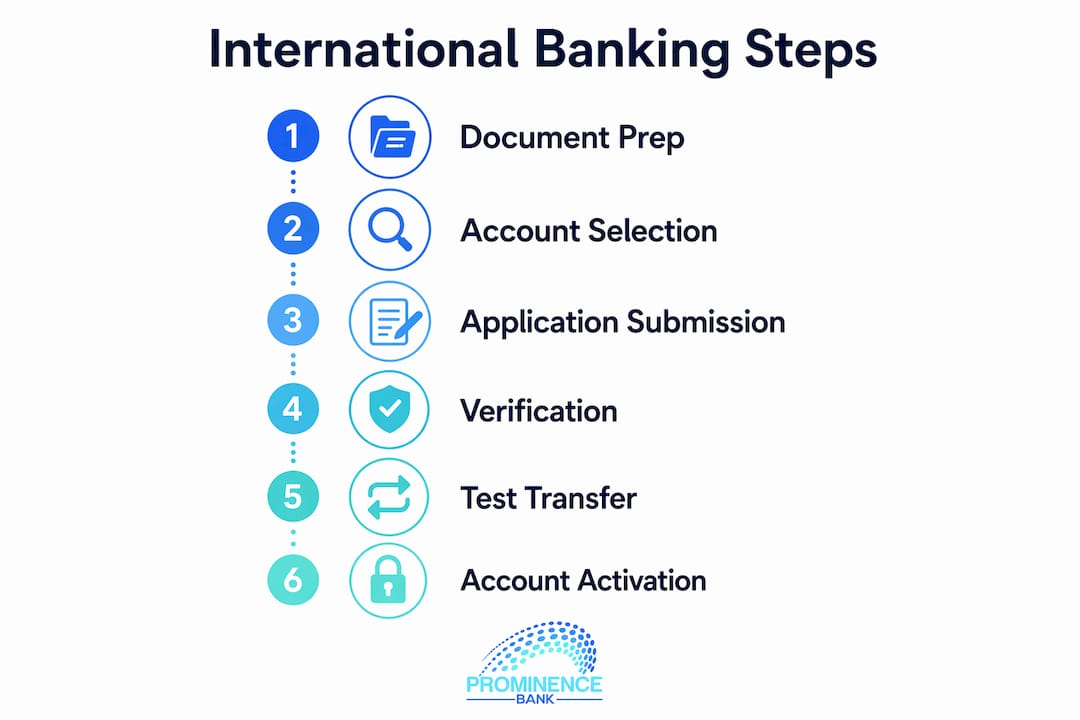
How to open an international bank account step by step
Prominence Bank normally completes account opening within 48 to 72 hours after all required KYC/AML procedures have been completed and all requested information and documentation have been received, verified, and accepted. This is an estimated processing period, not a guaranteed deadline. Additional time may be required if further compliance, verification, or due-diligence review is necessary. Submitting an enquiry, application, or payment does not start the estimated processing period and does not guarantee account approval or activation.
The process follows five clear steps.
-
Choose the right bank and account type. Decide between a local brick-and-mortar institution, a digital-first bank, or a multi-currency account provider. Multi-currency accounts are the strongest starting point for most international clients because they do not require local residency and support multiple currencies under one IBAN. Prioritizing multi-currency digital accounts before residency-dependent local accounts supports structured onboarding; the Prominence Bank estimate and approval requirements still apply.
-
Submit your application and documents. Complete the bank’s online or in-branch application. Upload every required document in the format the bank specifies. Declare the exact purpose of the account and the expected fund flows. Declaring account purpose accurately before application prevents compliance mismatches that cause rejections later.
-
Meet the initial deposit requirement. Most international banks require a minimum opening deposit. Digital banks often set this at a nominal amount. Private and offshore institutions may require substantially higher minimums. Confirm the figure before applying so the funds are ready to transfer immediately upon approval.
-
Receive and activate your account details. Once approved, the bank issues your account number, IBAN, and SWIFT/BIC code. Verify every character of these details against the confirmation documents. A single digit error in an IBAN causes transfers to fail or, worse, to land in the wrong account.
-
Run a small test transaction. Before moving significant funds, send a small cross-border transfer to and from the account. This validates routing, confirms account naming, checks daily limits, and creates an early audit trail.
Pro Tip: Send a test transfer of $50 or less before any large payment. This single step confirms that the receiving fields, account naming conventions, and settlement times all work as expected.
For a full walkthrough of the offshore account opening process, Prominencebank publishes a step-by-step guide covering documentation and regulatory obligations.
How do international wire transfers work?
A wire transfer is the standard method for moving large sums across borders. The step by step international wire transfer process starts with gathering accurate recipient details and ends with confirming settlement on both sides. Every step in between involves the SWIFT network, correspondent banks, and fee instruction codes that most senders never think about until something goes wrong.
International wire transfers typically take one to five business days. SEPA transfers within the Eurozone settle within one business day. SWIFT-based transfers take three to five days because funds pass through one or more correspondent banks before reaching the destination.
The table below summarizes transfer speeds and typical fee ranges by method.
| Transfer method | Typical speed | Who it serves |
|---|---|---|
| SEPA (Eurozone) | 1 business day | EUR transfers within Europe |
| SWIFT (international) | 3–5 business days | Global transfers in any currency |
| Digital bank transfer | Same day to 24 hours | Transfers between digital bank accounts |
Understanding SWIFT correspondent bank fees
SWIFT transfers involve correspondent banks that charge fees separately, causing variable total costs and unpredictable arrival times. Each intermediary bank may levy fees of $15 to $50 per transfer. The fee instruction code you select determines who absorbs those charges.
Fee instruction codes work as follows. OUR means the sender pays all intermediary fees and the recipient receives the full invoiced amount. SHA splits fees between sender and recipient, which can cause the recipient to receive less than the invoiced amount and create contractual problems. BEN means the recipient pays all fees, which reduces what they receive even further.
Common wire transfer mistakes to avoid
- Entering the wrong IBAN or SWIFT/BIC code. Always copy-paste from official documents, never type manually.
- Choosing SHA when a contract specifies full payment to the recipient. Use OUR for business payments where the exact amount matters.
- Ignoring currency conversion rates. Check the mid-market rate before initiating and confirm what rate the bank applies.
- Failing to include a payment reference. Missing references cause compliance holds at the receiving bank.
- Sending large amounts without a prior test transfer. Small test payments create an audit trail that eases future large transfer approvals.
For a broader view of international payment processing in 2026, Prominencebank covers the full business payments workflow in detail.
What compliance issues should you watch for in international banking?
Compliance is not a one-time checkbox. It is an ongoing obligation that runs parallel to every transaction you make. The most common reason international accounts get frozen or closed is a mismatch between the declared account purpose and the actual fund activity. Treating international accounts as part of an integrated fund flow is critical to avoiding AML-triggered account closures.
Global frameworks like the Common Reporting Standard (CRS) and FinCEN regulations require banks to monitor transaction patterns continuously. If your account suddenly receives large deposits with no documented source, the bank’s compliance team will flag it. This triggers a request for additional documentation and can freeze outgoing transfers for days or weeks.
Common compliance pitfalls and how to handle them:
- Inconsistent documentation. Your name, address, and tax ID must match exactly across all submitted documents. A middle name on one form and not another creates a flag.
- Unexplained fund patterns. Large inflows without a corresponding invoice, contract, or payroll record trigger AML reviews. Keep source-of-funds documentation for every significant deposit.
- Missing audit trail. Every transaction should have a reference, a counterparty name, and a business purpose. Banks use this data during periodic account reviews.
- Delayed responses to bank requests. When a bank requests additional documents, respond within the stated deadline. Delays extend account restrictions and signal non-cooperation to compliance officers.
- Using the account for undeclared purposes. If you opened the account for business payments and start using it for personal transfers, the activity pattern will not match the declared purpose.
Pro Tip: Keep a simple transaction log in a spreadsheet. Record the date, amount, counterparty, currency, and business purpose for every transfer. This takes two minutes per transaction and saves hours during compliance reviews.
For businesses managing complex structures, the corporate banking guide at Prominencebank covers how to maintain clean audit trails across multiple entities.
Key Takeaways
The step by step international banking process requires accurate documentation, a deliberate account selection, tested wire transfer procedures, and active compliance management to function reliably across borders.
| Point | Details |
|---|---|
| Complete documentation starts the estimate | The estimate starts only after KYC/AML is complete and all requested information and documentation are received, verified, and accepted. |
| Account type determines access | Multi-currency digital accounts support remote access; account opening remains subject to the Prominence Bank estimate and approval requirements. |
| SWIFT fees are variable | Choose the OUR fee code when recipients must receive the full invoiced amount. |
| Test before you transfer large sums | A small test payment validates routing, limits, and settlement before real money moves. |
| Compliance is continuous | Fund activity must match declared account purpose at all times to avoid freezes. |
What I have learned from years of watching international accounts go wrong
The most expensive mistake I see is treating account opening as the finish line. People carefully gather documents, get approved, and then wire $200,000 without ever running a test transfer. When the funds land in the wrong account because of a single digit error in the IBAN, the recovery process takes weeks and sometimes involves legal action.
The second mistake is choosing SHA as the default fee code because it sounds fair. In practice, SHA means your business partner receives $180 when the invoice says $200. That shortfall creates friction, damages relationships, and sometimes voids payment terms in contracts. OUR costs the sender more upfront, but it eliminates ambiguity entirely.
Multi-currency digital accounts have genuinely changed what is possible for international clients. I have watched businesses that previously needed three separate local bank accounts consolidate everything into a single multi-currency account and cut their administrative overhead significantly. The trade-off is that digital banks sometimes have lower transaction limits than traditional institutions, so testing those limits early matters.
My honest advice: map your fund flows on paper before you open a single account. Know where money comes in, where it goes out, and in what currencies. That map becomes your compliance document, your account purpose declaration, and your troubleshooting reference all at once.
— Harold
How Prominencebank simplifies global account management
Prominencebank is built for clients who need more than a standard bank account. Its multi-currency account solutions let individuals and businesses hold, send, and receive funds in multiple currencies under a single account structure, without the overhead of maintaining separate local accounts in each jurisdiction.
For corporations managing complex cross-border structures, Prominencebank’s corporate banking solutions include compliance support, KYC-ready onboarding, and direct access to global financial infrastructure. The bank operates under ETMO sovereignty with full AML/KYC compliance, making it a practical fit for high-net-worth individuals and institutional clients who need both privacy and regulatory standing. Account opening is fully online, and the platform supports digital currency alongside traditional multi-currency banking.
FAQ
What is the step by step international banking process?
The international banking process is a sequence of steps covering document preparation, account selection, application submission, initial deposit, and wire transfer execution. Each step builds on the previous one to produce a compliant, functional global account.
How long does it take to open an international bank account?
Prominence Bank normally completes account opening within 48 to 72 hours after all required KYC/AML procedures have been completed and all requested information and documentation have been received, verified, and accepted. This is an estimated processing period, not a guaranteed deadline. Additional time may be required if further compliance, verification, or due-diligence review is necessary. Submitting an enquiry, application, or payment does not start the estimated processing period and does not guarantee account approval or activation.
What is the difference between SEPA and SWIFT transfers?
SEPA transfers settle within one business day and apply only to euro transactions within Europe. SWIFT transfers take three to five business days and work for any currency globally, but involve correspondent banks that add fees and delay.
What does the OUR fee code mean in a wire transfer?
OUR means the sender pays all intermediary bank fees, so the recipient receives the full transfer amount. SHA splits fees between both parties, which can cause the recipient to receive less than the invoiced amount.
Why do international bank accounts get frozen?
Accounts get frozen when transaction activity does not match the declared account purpose, triggering AML review. Keeping source-of-funds documentation and maintaining a clear transaction log prevents most compliance holds.