
TL;DR:
- Private international banking now demands full documentation and layered compliance checks, shifting away from old secrecy models. Success relies on understanding new infrastructure, building genuine relationships, and maintaining impeccable legal and financial transparency. Choice of institution, proactive structuring, and ongoing verification are crucial for privacy, security, and long-term relationship durability.
The rules governing private international banking have shifted dramatically. What once operated in comfortable ambiguity now demands full documentation, layered compliance checks, and digital-first infrastructure. High-net-worth individuals and international corporations face a paradox: they want discretion, yet regulators demand transparency. The good news is that genuine privacy and security remain achievable, but only for clients who understand the new architecture. This guide provides a practical, evidence-backed blueprint covering preparation, execution, and verification for anyone serious about navigating private international banking in 2026.
Table of Contents
- Understanding private international banking essentials
- Preparing for account onboarding: Requirements and documentation
- Compliance and privacy: Navigating regulatory requirements
- Managing complex cross-border transactions and special cases
- Verifying ongoing security, privacy, and relationship management
- The uncomfortable truth about private international banking
- Find a private international banking solution with confidence
- Frequently asked questions
Key Takeaways
| Point | Details |
|---|---|
| Know the entry thresholds | Entry-level accounts require at least $250,000, with UHNW clients facing much higher minimums. |
| Compliance is non-negotiable | KYC, CDD, EDD, and AI monitoring are mandatory for all private international bank accounts. |
| Documentation is critical | Prepare identity, address, source of wealth, and business papers to support a complete onboarding review. |
| Privacy relies on legal and digital tools | True privacy means blending secure legal structures with advanced digital monitoring and full tax compliance. |
| Special cases demand planning | Inheritance, corporate structures, and cross-border transfers require advanced preparation and expert advice. |
Understanding private international banking essentials
Private international banking is not simply a premium checking account with a concierge number. It is a structured relationship between a licensed institution and a qualifying client, built around wealth management, multi-currency access, bespoke credit facilities, and dedicated advisory. The relationship’s value extends well beyond the deposit balance.

Entry thresholds vary significantly by service tier and region. Minimum deposits for offshore private banking range from $250,000 to $500,000 at the entry level, $1 million to $5 million for true private banking, and $10 million or more for ultra-high-net-worth (UHNW) service. These figures are not static. Coutts, for example, raised its minimum to £3 million for new UHNW clients in the UK, signaling a broader industry trend toward consolidating client books around fewer, wealthier relationships.
| Service tier | Typical minimum deposit | Core offering |
|---|---|---|
| Entry-level private banking | $250K – $500K | Multi-currency accounts, basic advisory |
| True private banking | $1M – $5M | Portfolio management, credit facilities |
| UHNW private banking | $10M+ | Family office services, bespoke structuring |
What separates a strong private banking relationship from a transactional one is relationship value, not deposit size alone. Banks assess your overall financial footprint: investable assets, business revenue, cross-border transaction volume, and long-term potential. Understanding private banking benefits at each tier helps you position yourself correctly from the first conversation.
Digital integration has also reshaped expectations. Clients now expect real-time dashboards, instant fund transfers across currencies, and secure encrypted communication with their bankers. Institutions that cannot deliver this infrastructure are losing clients to digital-first private banks regardless of their historical prestige. The offshore account setup guide walks through jurisdiction selection in detail, but the core principle is simple: match your banking structure to your actual financial activity, not to a brand name.
With the big picture clear, let’s identify what you need to prepare before entering the world of private international banking.
Preparing for account onboarding: Requirements and documentation
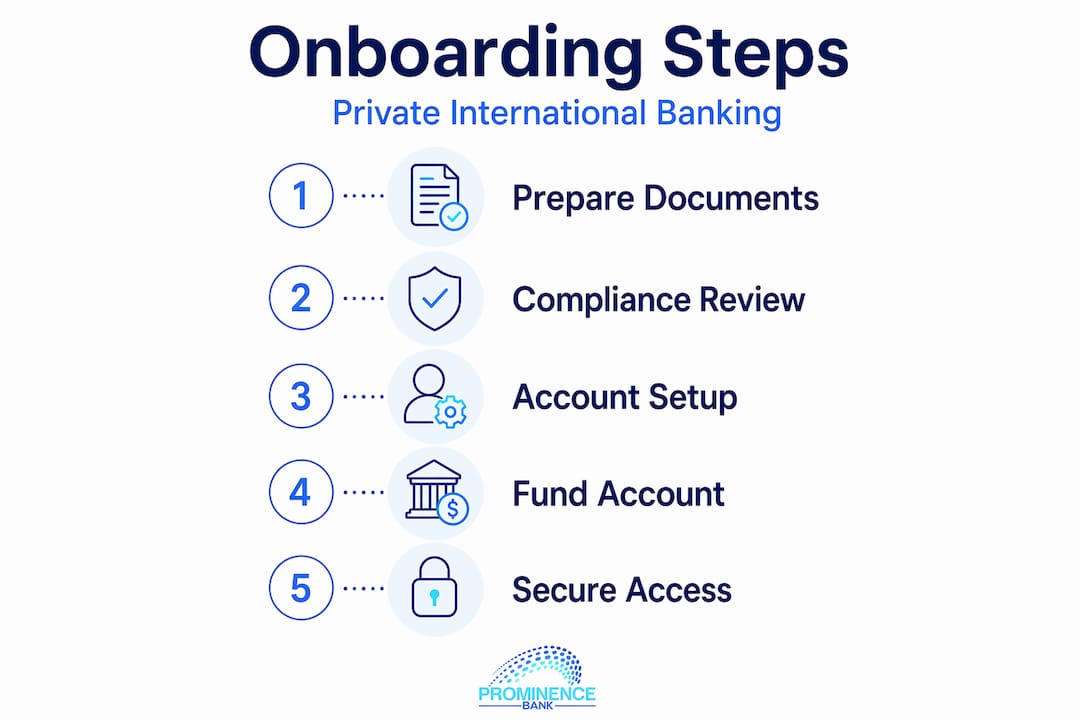
The onboarding process for private international banking is structured and sequential. Rushing any stage creates avoidable follow-up and may require additional compliance, verification, or due-diligence review. The full onboarding sequence follows six stages: profile assessment, jurisdiction and bank selection, KYC and due diligence, application and approval, account funding, and ongoing relationship management with a dedicated banker.
Prominence Bank normally completes account opening within 48 to 72 hours after all required KYC/AML procedures have been completed and all requested information and documentation have been received, verified, and accepted. This is an estimated processing period, not a guaranteed deadline. Additional time may be required if further compliance, verification, or due-diligence review is necessary. Submitting an enquiry, application, or payment does not start the estimated processing period and does not guarantee account approval or activation.
Here is what each stage demands in practice:
- Profile assessment. The bank evaluates your net worth, source of wealth, business activities, and jurisdictional risk. Be prepared to articulate your financial narrative clearly.
- Jurisdiction and bank selection. Different jurisdictions carry different regulatory burdens, tax treaty implications, and privacy protections. Selecting the wrong one creates compliance friction later.
- KYC and due diligence. You will submit certified copies of government-issued ID, proof of residential address, source of wealth documentation, and corporate structure charts for business accounts.
- Application and approval. At Prominence Bank, the account-opening estimate and its conditions are stated above; complex structures may require additional compliance or due-diligence review.
- Account funding. Initial funding must come from a verifiable, compliant source. Wire transfers from flagged jurisdictions will trigger enhanced scrutiny.
- Ongoing relationship management. Your dedicated relationship manager becomes your primary point of contact for all banking needs, advisory sessions, and compliance updates.
Corporate clients face additional layers. Ultimate Beneficial Owner (UBO) declarations, board resolutions, and certified articles of incorporation are standard. If your corporate structure spans multiple jurisdictions, each layer must be documented separately.
Pro Tip: Prepare a one-page wealth narrative before your first bank meeting. Bankers assess not just documents but your ability to explain your financial history clearly and consistently. A well-prepared narrative supports review and builds trust, but does not guarantee approval or a deadline.
Secure private banking setup and online account-opening options at digital-first institutions support remote submission for clients with clean, well-documented profiles; approval remains subject to the policy above.
Now that you’ve organized your documents and know what to expect, it’s critical to understand the compliance and privacy elements underpinning trusted private banking.
Compliance and privacy: Navigating regulatory requirements
Compliance is not the enemy of privacy. Properly structured, it is the foundation that makes legitimate privacy possible. The core compliance framework for cross-border private banking covers Know Your Customer (KYC) verification of identity and source of wealth, Customer Due Diligence (CDD) for building a risk profile, Enhanced Due Diligence (EDD) for high-risk clients, ongoing AI-powered transaction monitoring, FATCA and CRS reporting obligations, and sanctions and PEP screening.
Each layer serves a specific purpose:
- KYC establishes who you are and where your money originates.
- CDD builds a behavioral baseline so the bank can identify anomalies.
- EDD applies to politically exposed persons, clients from high-risk jurisdictions, or unusually complex structures.
- AI transaction monitoring flags deviations from your established patterns in real time, protecting you as much as the bank.
“Privacy via legal entities and jurisdictional arbitrage remains possible under CRS, but full tax compliance is essential. Avoid grey-area fund routing at all costs.” Swiss Banking Compliance
Legal entity structures, including holding companies, trusts, and foundations, can legitimately preserve confidentiality while remaining fully compliant. The key is that these structures must be established for genuine commercial or estate planning purposes, not solely to obscure beneficial ownership. Banks and regulators can distinguish between the two.
Pro Tip: Work with a qualified international tax attorney before establishing any holding structure. The cost of proper setup is a fraction of the cost of unwinding a non-compliant structure under regulatory pressure.
The online bank compliance standards at reputable digital institutions now match or exceed those at traditional private banks. Reviewing private bank confidentiality policies and using a secure banking checklist before committing to any institution helps you evaluate whether their privacy practices are genuinely robust or merely marketing language. Institutions leveraging advanced AML solutions provide an additional layer of protection for clients with complex transaction profiles.
Understanding compliance reduces risk, but international banking also requires careful handling of complex cross-border transactions, especially for corporations and specialized scenarios.
Managing complex cross-border transactions and special cases
Cross-border transactions at the private banking level involve risks that standard retail banking never encounters. The AML compliance requirements for complex structures demand real-time monitoring, rigorous UBO verification, and advanced technology to identify risk in layered corporate arrangements.
Several scenarios require particular attention:
- Restricted jurisdiction transfers. Swiss banks, for example, reject funds routed through underground networks such as fei qian or cryptocurrency channels. Legitimate transfers from mainland China require ODI and SAFE approvals, full tax returns, and business documentation, with processing timelines of three to six months.
- UBO verification for corporations. Every layer of a corporate structure must be traced to a natural person. Incomplete UBO chains are the single most common cause of application rejection for corporate clients.
- Inheritance and estate complications. Foreign bank accounts freeze upon death due to jurisdictional conflicts. Swiss banks, for instance, require a local Certificate of Inheritance, a process that takes six to twelve months and costs between $2,000 and $5,000. There is no automatic survivorship.
| Scenario | Key requirement | Typical timeline |
|---|---|---|
| Restricted jurisdiction transfer | Regulatory approvals, full documentation | 3–6 months |
| Corporate UBO verification | Full ownership chain to natural person | Included in the Prominence Bank estimate only after complete, verified, and accepted KYC/AML information and documentation; additional review may require more time. |
| Inheritance of foreign account | Local Certificate of Inheritance | 6–12 months |
Planning for these scenarios before they arise is the mark of a sophisticated client. Estate planning documents, UBO registers, and pre-approved transfer channels should be established during the onboarding phase, not after a problem surfaces. For international business banking, proactive structuring is always less costly than reactive remediation. When executing secure money transfers across borders, using verified channels and maintaining complete documentation protects both the transaction and the banking relationship.
Having mastered the technical and legal aspects, let’s put everything together: how can clients verify that their bank offers enduring privacy and responsive service?
Verifying ongoing security, privacy, and relationship management
Selecting a private bank is not a one-time decision. It requires ongoing verification that the institution continues to meet your security, privacy, and service standards. Ongoing relationship management with a dedicated banker is the baseline expectation, but it is only one component of a robust verification framework.
Use this checklist annually:
- Confirm your dedicated relationship manager is still assigned and accessible within 24 hours.
- Review the bank’s AI transaction monitoring capabilities and ask for a summary of alerts triggered on your account in the past 12 months.
- Verify that your account documentation, including UBO declarations and source of wealth files, is current and reflects any structural changes.
- Test the bank’s incident response by requesting a simulated account freeze scenario walkthrough.
- Assess whether the bank’s digital platform has kept pace with your operational needs, including multi-currency access, real-time reporting, and encrypted communication.
Pro Tip: Schedule a formal annual review with your relationship manager rather than waiting for issues to surface. Banks allocate more resources to proactive clients, and these reviews often surface optimization opportunities you would otherwise miss.
The secure banking technology deployed by leading digital private banks now includes behavioral biometrics, real-time anomaly detection, and multi-factor authentication at every access point. If your current bank cannot describe its security architecture in specific terms, that is a meaningful signal worth acting on.
With all practical steps and verifications covered, it’s time for an unvarnished expert opinion on what really works and what clients should be wary of.
The uncomfortable truth about private international banking
The clients who struggle most with private international banking are those still chasing the old model: a numbered account in a secrecy jurisdiction, minimal documentation, and a banker who asks no questions. That model is gone. It did not disappear gradually. It was dismantled systematically through FATCA, CRS, the OECD’s Base Erosion and Profit Shifting framework, and coordinated international enforcement.
The clients who thrive are those who reframe privacy entirely. True privacy in 2026 means that your financial information is shared only with the institutions and authorities legally entitled to it, nothing more and nothing less. It means your corporate structures are clean enough to withstand scrutiny, your documentation is complete, and your banker knows your financial story well enough to defend it if asked. That is a fundamentally different definition from the old secrecy model, and it is actually more protective.
The second uncomfortable truth is that relationship quality now matters more than jurisdiction. A well-connected relationship manager at a digitally capable institution will do more for your financial security than a prestigious address in a historically secretive banking center. The future of private banking belongs to institutions that combine regulatory credibility with genuine digital capability and personal advisory depth.
Clients who accept these realities early build banking relationships that last decades. Those who resist them spend those same decades managing account closures, compliance investigations, and forced restructuring.
Find a private international banking solution with confidence
Navigating private international banking requires both the right knowledge and the right institution. Prominence Bank combines digital-first infrastructure with the discretion and advisory depth that high-net-worth individuals and international corporations require.
Whether you need to streamline global banking through a multi-currency account or access personalized private banking technology that keeps pace with your evolving financial structure, Prominence Bank’s platform is built for clients who demand security and a clear compliance process. Our onboarding process follows the estimate and conditions above and is designed to be thorough, and our relationship managers bring genuine expertise in cross-border compliance, corporate structuring, and wealth protection. Contact Prominence Bank to discuss a tailored solution that matches your specific profile and goals.
Frequently asked questions
What are the minimum deposit requirements for private international banking?
Entry-level private banking requires deposits from $250,000 to $500,000, while true private banking starts at $1 to $5 million and UHNW service begins at $10 million or more.
How long does onboarding for an international private bank account take?
Prominence Bank normally completes account opening within 48 to 72 hours after all required KYC/AML procedures have been completed and all requested information and documentation have been received, verified, and accepted. This is an estimated processing period, not a guaranteed deadline. Additional time may be required if further compliance, verification, or due-diligence review is necessary. Submitting an enquiry, application, or payment does not start the estimated processing period and does not guarantee account approval or activation.
Can privacy be maintained under new global compliance standards?
Legal entities and strategic jurisdictions can preserve meaningful privacy, but FATCA and CRS reporting obligations apply universally, and full tax compliance is non-negotiable for any structure to hold up under scrutiny.
What happens to foreign bank accounts when an account holder dies?
Accounts are typically frozen due to jurisdictional conflicts, and Swiss banks require a local Certificate of Inheritance that takes six to twelve months to obtain and costs between $2,000 and $5,000, with no automatic survivorship.
Are crypto or unofficial transfers accepted by international private banks?
Reputable banks reject funds routed through underground networks or crypto channels; all transfers must come through verifiable, officially approved sources with complete supporting documentation.