TL;DR:
- High-risk banking solutions provide secure, compliant access for businesses and individuals with elevated transaction, regulatory, or reputational risks. Prominencebank specializes in offering discreet, fully digital banking services tailored for clients rejected by standard banks due to sector-specific risk factors. Effective high-risk banking depends on proactive compliance, risk assessment, transparent fee structures, multi-currency accounts, and tailored documentation aligned with relevant regulations.
High-risk banking solutions are specialized financial services designed to provide secure, compliant banking access to businesses and individuals facing elevated risk profiles due to their transaction types, regulatory environment, or reputational factors. Traditional banks routinely reject clients in sectors like forex, gaming, or adult entertainment, not because those businesses are illegal, but because standard compliance frameworks are not built to absorb their risk characteristics. The industry term for this category is “high-risk financial services,” and understanding the distinction matters: it signals to providers that you know what you’re asking for. Prominencebank operates precisely in this space, offering discreet, fully digital banking built for clients that standard institutions turn away.
1. High-risk merchant accounts
A high-risk merchant account is a payment processing arrangement that accepts elevated chargeback rates, card-not-present transactions, and sector-specific regulatory scrutiny in exchange for market access. Stripe defines these accounts by their higher fees, stricter contract terms, and mandatory fraud controls. That cost structure reflects the provider’s underwriting exposure, not a penalty for your business model. For high-net-worth operators running subscription services, nutraceutical brands, or international e-commerce, this account type is often the only viable path to card processing.

The key variables to negotiate are the rolling reserve percentage, settlement delay, and chargeback threshold. Rolling reserves typically range from 5% to 10% of monthly processing volume, held for 90 to 180 days. Knowing these numbers before you sign protects your cash flow.
Pro Tip: A pre-application chargeback and fraud mitigation strategy is critical for sustaining high-risk merchant accounts, as providers primarily underwrite operational risk signals, not just your industry label.
2. Specialized high-risk business bank accounts
High-risk business bank accounts feature stricter underwriting, enhanced due diligence, and close operational monitoring compared to standard commercial accounts. Industries like CBD, travel, and dietary supplements face this scrutiny because their chargeback rates and regulatory exposure exceed what most retail banks will absorb. These accounts stabilize operations by providing a banking relationship that already prices in the risk rather than terminating the account when a dispute spike occurs.
The practical advantage is predictability. A provider that specializes in your sector understands seasonal chargeback patterns, cross-border settlement delays, and the compliance documentation you will need to produce. That institutional knowledge reduces friction at every stage of the banking relationship.
3. Offshore and multi-currency bank accounts
Offshore banking for high-risk clients combines jurisdictional flexibility with multi-currency capability, making it the preferred structure for businesses operating across multiple regulatory environments. Providers like Offshore Gateways offer dedicated IBANs and multi-currency balances alongside rolling reserves and expedited onboarding suited for complex business structures. This matters because a single-currency domestic account creates conversion costs and settlement delays that compound at scale.
For high-net-worth individuals managing wealth across jurisdictions, an offshore account also provides a layer of structural separation between operating entities and personal assets. The compliance requirements are real and non-negotiable, but the operational benefits justify the setup investment for any business processing significant cross-border volume.
4. Payment gateway partnerships for high-risk industries
Payment gateways purpose-built for high-risk industries integrate fraud scoring, velocity checks, and 3D Secure authentication at the transaction level, not as an afterthought. This is where advanced fraud prevention tools become a direct differentiator among providers. A gateway that flags suspicious transactions in real time reduces chargebacks before they accumulate, which directly protects your merchant account standing.
The selection criteria here are integration depth and industry experience. A gateway that has processed thousands of transactions in your specific sector will have tuned its fraud models to your risk profile. Generic payment processors apply generic thresholds, which means either excessive false declines or insufficient fraud protection.
5. Risk-based AML/CTF compliance frameworks
Risk-based compliance is the regulatory foundation that determines whether a high-risk banking relationship survives long-term. AUSTRAC’s 2026 guidance requires financial institutions to assess ML/TF risk at the individual customer level for high-risk clients, not simply apply blanket industry labels. This shift is significant: it means a well-documented, low-fraud business in a nominally high-risk sector can qualify for better terms than a poorly documented business in a standard sector.
AUSTRAC also expects institutions to tailor AML/CTF controls to the nature and jurisdiction of services provided. Business model specifics, geographic corridors, and service delivery methods all affect the residual risk profile. Understanding this framework lets you present your business in terms that compliance officers recognize and can approve.
“AML/CTF policies should be tailored proportionate to customer-specific risks, not just industry risk labeling.” — AUSTRAC 2026 Guidance
Pro Tip: Tailoring your underwriting documentation to mirror a bank’s ML/TF risk evaluation framework significantly improves approval chances compared to submitting generic business registration documents.
6. Streamlined customer due diligence under FinCEN 2026
FinCEN’s 2026 order reduces repetitive beneficial-owner verification by allowing event-triggered verification rather than requiring re-verification at every account opening. Covered financial institutions no longer need to re-collect beneficial ownership data unless a risk-relevant event occurs. This reduces the compliance burden for both the institution and the client, which translates to faster onboarding and fewer documentation requests during the relationship.
For high-net-worth clients managing multiple corporate structures, this change is operationally meaningful. Maintaining a governance trail of beneficial ownership and compliance records facilitates rapid response to bank due diligence queries. The clients who benefit most are those who treat their compliance documentation as a living asset rather than a one-time submission.
The practical application is straightforward:
- Establish a centralized beneficial ownership register updated on a defined schedule.
- Document the trigger events that require re-verification under FinCEN guidelines.
- Align your internal compliance calendar with your banking provider’s review cycle.
- Store all records in a format that can be produced within 24 hours of a bank request.
7. Operational features that separate strong providers
The difference between a functional high-risk banking provider and an excellent one comes down to four operational capabilities. First, transparent fee structures that itemize rolling reserves, settlement timelines, and monthly minimums prevent cash flow surprises. Second, multi-currency treasury management that allows you to hold, convert, and deploy funds in the currencies where you operate reduces conversion costs. Third, flexible contract terms that allow volume-based renegotiation protect you as your business scales. Fourth, tech-enabled onboarding that handles document verification digitally reduces the approval timeline from weeks to days.
| Feature | Why it matters for high-risk clients |
|---|---|
| Rolling reserve transparency | Prevents unexpected cash flow gaps during high-volume periods |
| Multi-currency treasury | Reduces FX conversion costs on cross-border settlements |
| Fraud and chargeback tools | Directly protects merchant account standing and reduces fees |
| Flexible contract terms | Allows renegotiation as business volume and risk profile improve |
| Digital onboarding | Cuts approval timelines and reduces document handling errors |
Pro Tip: Ask prospective providers for their average approval timeline and their chargeback threshold before signing. Providers unwilling to share these figures upfront are signaling inflexibility that will surface later in the relationship.
8. Industries that require specialized banking solutions
Businesses in gaming, forex, adult entertainment, nutraceuticals, travel, debt collection, and CBD require specialized high-risk banking because their chargeback rates, card-not-present transaction volumes, and cross-border complexity exceed standard bank thresholds. The classification is not arbitrary. It reflects actuarial data on dispute rates, regulatory investigation frequency, and reputational exposure for the banking institution.
The critical insight is that sector classification alone does not determine your banking options. A forex business with a documented compliance program, low dispute rates, and clean beneficial ownership records will access better terms than a retail business with a high chargeback history. The sector label opens the conversation; your operational profile closes the deal.
Characteristics that drive high-risk classification include:
- Chargeback rates above 1% of monthly transaction volume
- High proportions of card-not-present or recurring billing transactions
- Cross-border payments involving jurisdictions with elevated AML risk ratings
- Products or services subject to frequent regulatory change
- Business models with subscription or continuity billing structures
For international business banking, the jurisdictional dimension adds another layer. A business operating legally in one country may face banking restrictions in another simply because of how that jurisdiction is rated by FATF or correspondent banking networks.
Key takeaways
High-risk banking solutions work when they combine customer-level risk assessment, specialized account structures, and proactive compliance documentation tailored to the specific business model and jurisdiction.
| Point | Details |
|---|---|
| Customer-level risk assessment | AUSTRAC and FinCEN both require individual risk profiling, not blanket industry labels. |
| Merchant account preparation | Fraud and chargeback mitigation strategies must be in place before applying, not after. |
| Offshore and multi-currency accounts | Dedicated IBANs and multi-currency balances reduce cross-border costs and structural risk. |
| FinCEN 2026 CDD relief | Event-triggered verification reduces onboarding friction for clients with clean compliance records. |
| Provider selection criteria | Transparent fees, fraud tools, and flexible contracts are the non-negotiable differentiators. |
What I’ve learned about securing stable high-risk banking
The most common mistake I see high-net-worth clients make is treating the banking application as a formality. They submit standard incorporation documents and expect the provider to fill in the gaps. That approach fails consistently. Banks underwriting high-risk relationships are evaluating your compliance posture, your fraud management capability, and your understanding of your own risk profile. An effective application includes a business model summary, a clear source of funds narrative, jurisdictional risk mapping, and transaction monitoring protocols aligned with AML/CTF expectations.
The second mistake is passivity after approval. A high-risk banking relationship requires ongoing maintenance. Chargeback rates need to be monitored monthly. Beneficial ownership records need to stay current. Regulatory changes in your operating jurisdictions need to be tracked and communicated to your provider before they surface in a compliance review. The clients who maintain stable banking relationships treat their bank as a compliance partner, not a utility.
The providers worth staying with are the ones who call you when something looks unusual rather than freezing your account first and asking questions later. That responsiveness is a function of relationship depth, and relationship depth is built by being transparent, organized, and proactive from day one. For clients managing complex structures, the compliance requirements for high-net-worth clients are not a burden. They are the price of access to banking infrastructure that actually serves your needs.
— Harold
How Prominencebank serves high-risk global clients
Prominencebank is built for exactly the clients that standard institutions turn away.
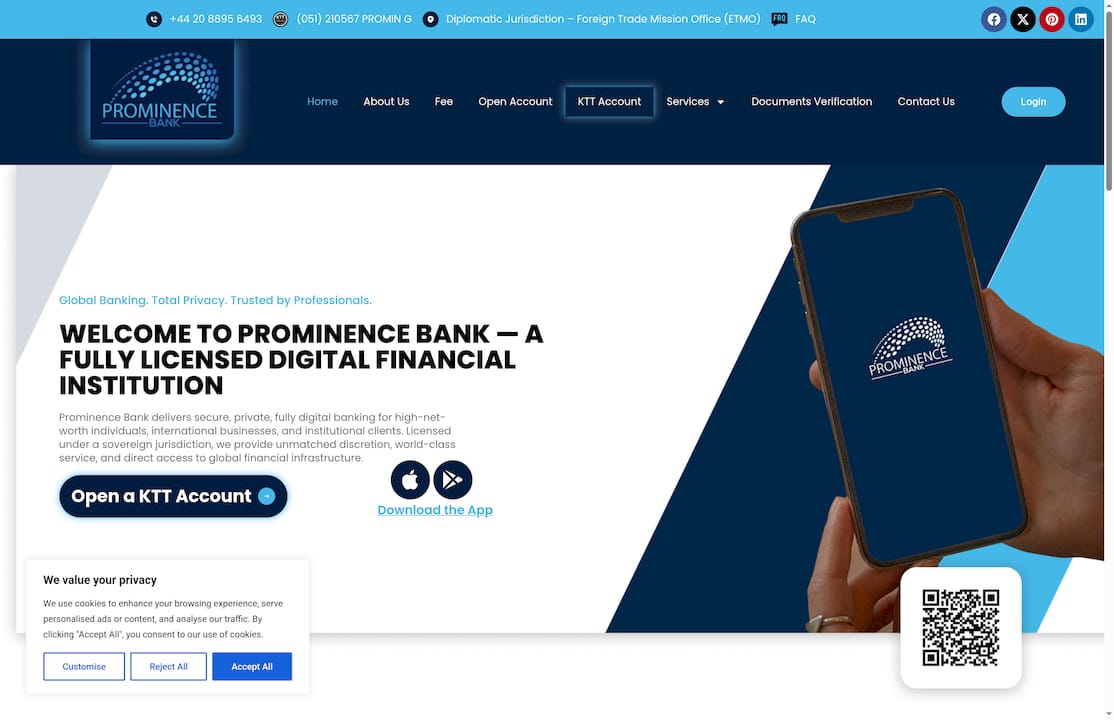
For businesses managing cross-border transactions, multi-entity structures, or digital asset flows, Prominencebank offers multi-currency account solutions designed to handle complex, high-volume financial activity with full discretion. The bank’s digital currency services extend that capability to clients operating in cryptocurrency and digital asset markets. For corporate clients requiring bespoke structures, the business banking platform provides direct access to global financial infrastructure under ETMO sovereignty, with AML/KYC compliance built into every account tier.
FAQ
What qualifies a business as high-risk for banking?
A business is classified as high-risk when its chargeback rates, transaction types, regulatory exposure, or jurisdictional factors exceed the thresholds standard banks will absorb. Sectors like gaming, forex, adult entertainment, and nutraceuticals are commonly flagged, but individual compliance records and fraud rates also determine final classification.
How do high-risk merchant accounts differ from standard accounts?
High-risk merchant accounts carry higher processing fees, rolling reserves, and stricter chargeback thresholds compared to standard merchant accounts. In exchange, they provide payment processing access to businesses that standard processors decline.
What does FinCEN’s 2026 CDD change mean for my business?
FinCEN’s 2026 order means covered financial institutions no longer need to re-verify beneficial owners at every account opening. Verification is now event-triggered, which reduces documentation requests and speeds up onboarding for clients with clean compliance records.
Can offshore accounts reduce banking risk for high-net-worth individuals?
Offshore accounts with dedicated IBANs and multi-currency balances provide structural separation between operating entities and personal assets, reducing exposure to single-jurisdiction regulatory actions. They do not eliminate compliance obligations but distribute risk across more favorable banking environments.
What documentation improves approval odds for high-risk banking?
A strong application includes a business model summary, source of funds narrative, jurisdictional risk mapping, and documented transaction monitoring protocols. Aligning these materials with the bank’s AML/CTF framework, as AUSTRAC guidance specifies, significantly improves approval outcomes.