
TL;DR:
- Foreign investment banking involves cross-border advisory, financing, and capital markets services connecting investors to global capital pools and regulatory frameworks. Success depends on selecting providers with genuine jurisdictional expertise, integrated corridor strategies, and compliance infrastructure aligned to 2026 regulations. GIFT IFSC offers significant tax advantages for cross-border deals, making it a crucial consideration in structuring international transactions.
Foreign investment banking is the specialized practice of providing cross-border advisory, corporate financing, and capital markets services that move money efficiently across national boundaries. Where domestic banking stops at the border, international investment banking begins, connecting investors and businesses to capital pools, regulatory frameworks, and financial hubs that would otherwise be inaccessible. In 2026, the field is shaped by three forces: the rise of tax-efficient financial centers like GIFT IFSC, updated FinCEN AML/KYC rules, and integrated corridor models pioneered by institutions like Mizuho and Natixis CIB. If you are an investor or business owner weighing cross-border investment options, understanding how these forces interact is the difference between a well-structured deal and an expensive mistake.
1. What defines the best foreign investment banking services?
The strongest foreign investment banking providers combine cross-border financing capability with deep regulatory expertise and a genuinely integrated service model. Choosing a partner based on brand name alone leaves money on the table. Here is what actually separates top-tier providers from the rest.
- Cross-border financing range: The bank must handle foreign currency loans, external commercial borrowings (ECBs), structured products, and trade finance. A provider limited to vanilla loans cannot serve complex international capital structures.
- Jurisdictional expertise: Regulatory knowledge across key markets, including GIFT IFSC, Singapore, Luxembourg, and the Cayman Islands, determines whether your deal gets structured efficiently or gets stuck in withholding tax drag.
- Onboarding and compliance alignment: With FinCEN’s February 2026 updates in effect, banks using risk-based verification rather than repetitive beneficial ownership checks at every account opening are faster and less burdensome to work with.
- Integrated advisory and securities: Banks that combine commercial banking, securities underwriting, and boutique advisory under one roof reduce handoffs and speed execution.
- Global network depth: Correspondent banking relationships, local regulatory licenses, and on-the-ground teams in target markets determine how quickly deals actually close.
Pro Tip: Ask any prospective investment banking partner to name the specific booking entity and jurisdiction they would use for your deal before signing anything. That single question reveals whether they have genuine regulatory channel design capability or are just selling a generic product.
2. Top foreign investment banking providers in 2026

The leading institutions in cross-border investment banking are not interchangeable. Each has built distinct advantages in specific corridors, asset classes, or regulatory environments.
Natixis CIB
Natixis CIB established a GIFT City branch specifically to deliver foreign currency structured products, ECB services, and infrastructure financing to corporate clients. This move is not symbolic. Booking deals through GIFT IFSC rather than through a standard offshore center materially reduces withholding tax on interest payments for non-resident lenders. Natixis CIB’s presence there gives clients direct access to that tax advantage without routing through a third-party intermediary.
Mizuho Financial Group
Mizuho’s acquisition of Avendus Capital created one of the most discussed investment corridors in international investment banking, linking India, Japan, the United States, and Europe through a single integrated platform. Avendus brings boutique advisory depth in India while Mizuho provides balance sheet strength and securities distribution across the other three markets. For a business raising capital in India with Japanese institutional investors as the target audience, this combination is difficult to replicate elsewhere.
Goldman Sachs and JPMorgan
Both institutions maintain the broadest global capital markets distribution networks in the industry. Goldman Sachs excels in equity capital markets and M&A advisory across emerging and developed markets. JPMorgan’s investment banking division leads in debt capital markets and leveraged finance for cross-border transactions. Neither is the cheapest option, but for large-ticket foreign mergers and acquisitions or international bond issuances, their distribution reach justifies the fee premium.
Boutique and regional specialists
For mid-market cross-border deals, regional specialists often outperform the bulge bracket banks on speed and attention. Firms like Avendus (now Mizuho-backed), Rothschild and Co., and Lazard provide overseas financial advisory with deep local market knowledge that large banks sometimes lack in secondary markets. The right choice depends on deal size, target jurisdiction, and whether you need balance sheet financing or pure advisory.
3. How financial hubs like GIFT IFSC transform cross-border economics
GIFT IFSC has become the dominant routing point for external commercial borrowings into India, and the numbers explain why. Nearly two-thirds of ECBs in FY26 were processed through GIFT IFSC, up from 36% the prior year, with $18 billion of the $27.5 billion total flowing through this single financial center between April and December 2025. That shift happened because the economics are simply better.
The Union Budget 2026 extended the tax holiday for GIFT City units to 20 consecutive years, meaning interest paid by GIFT units to non-resident lenders can be fully exempt from Indian withholding tax. Outside GIFT City, that withholding tax runs between 20% and 35%. On a $100 million loan, the difference is material enough to change a deal’s entire return profile.
Pro Tip: When evaluating any cross-border financing proposal, ask your banker to model the deal twice: once booked through GIFT IFSC or an equivalent financial center, and once through a standard offshore structure. The tax differential alone often justifies the additional setup complexity.
The table below summarizes the key advantages of GIFT IFSC compared to standard offshore booking centers.
| Feature | GIFT IFSC | Standard offshore center |
|---|---|---|
| Tax holiday duration | Up to 20 years | None or limited |
| Withholding tax on interest | Potentially zero for non-residents | 20% to 35% |
| ECB market share (FY26) | 65% of India-bound ECBs | Declining share |
| Regulatory framework | RBI and IFSCA oversight | Varies by jurisdiction |
| Major banks present | Natixis CIB, HSBC, Barclays | Varies |
The benefits of extraterritorial banking extend beyond India. Singapore’s MAS framework, Luxembourg’s UCITS structure, and the Cayman Islands’ fund domicile rules each offer comparable advantages in their respective asset classes. The principle is the same: jurisdiction selection is a financial decision, not just a legal formality.
4. Updated AML/KYC and beneficial ownership requirements in 2026
FinCEN’s February 13, 2026 order changed how financial institutions handle beneficial ownership verification at account opening, and every investor or business owner working with foreign investment banking services needs to understand what changed and what did not.
The exceptive relief allows banks to apply risk-based verification rather than repeating full beneficial ownership checks every time an existing client opens a new account. This reduces friction for established clients with clean compliance records. However, three specific scenarios still trigger a full verification requirement:
- When a client is being onboarded for the first time at any institution
- When the reliability of previously collected information is in question
- When the bank’s own risk-based ongoing due diligence procedures require a refresh
What has not changed is the underlying obligation. Ongoing AML/CFT monitoring remains fully in force, and institutions must maintain continuous customer due diligence throughout the client relationship. For you as an investor or business owner, this means preparing a thorough dossier upfront, covering beneficial ownership structure, source of funds, regulatory approvals, and deal context, pays dividends throughout the relationship. Banks that see a well-organized compliance package at onboarding move faster and assign better teams.
The compliance requirements for HNW clients in international banking contexts have become more document-intensive over the past three years, even as some procedural steps have been simplified. Treat your compliance package as a strategic asset, not a bureaucratic hurdle.
5. How corridor investment banking strategies accelerate global growth
Investment corridors are integrated banking structures that link multiple jurisdictions through a single provider’s commercial banking, securities, and advisory capabilities. The concept sounds straightforward, but the operational advantage is significant.
Mizuho’s Japan-India-US-Europe corridor is the clearest current example. By combining Avendus’s India advisory relationships with Mizuho’s Japanese institutional investor base and US capital markets distribution, the corridor reduces intermediaries and speeds execution for deals that touch multiple markets simultaneously. A company raising growth capital in India with a Japanese strategic investor does not need three separate advisors. One corridor-capable bank handles the full transaction.
For investors and business owners, the practical benefits of corridor strategies include:
- Faster deal execution because internal coordination replaces external negotiation between separate advisors
- Consistent deal structuring across jurisdictions, reducing the risk of conflicting advice from local specialists
- Single relationship management that gives you one point of accountability for a multi-market transaction
- Coordinated regulatory navigation across the corridor’s jurisdictions, which matters when booking entity decisions affect tax outcomes in multiple countries
When selecting a bank for cross-border investment, ask directly whether they operate a true corridor model or simply have offices in multiple cities. The distinction is whether the teams share deal flow, client relationships, and internal capital, or whether they are essentially separate businesses under one brand.
Key takeaways
Cross-border investment banking success depends on selecting providers with genuine jurisdictional expertise, integrated corridor capabilities, and compliance infrastructure aligned to 2026 regulatory standards.
| Point | Details |
|---|---|
| Jurisdiction selection is financial | Booking deals through GIFT IFSC can eliminate 20% to 35% withholding tax on interest payments. |
| Corridor models reduce friction | Integrated providers like Mizuho-Avendus cut intermediaries and speed multi-market deal execution. |
| AML/KYC prep pays off | A thorough onboarding dossier accelerates bank approval and secures better team assignments. |
| Financial hubs are growing fast | GIFT IFSC captured 65% of India-bound ECBs in FY26, up from 36% the prior year. |
| Compliance obligations remain strict | FinCEN’s 2026 relief reduces repetitive checks but does not relax ongoing AML/CFT monitoring. |
Why most investors underestimate the regulatory channel decision
I have watched sophisticated investors spend months negotiating interest rate spreads on cross-border loans while ignoring the booking entity question entirely. Then the deal closes, the withholding tax bill arrives, and the effective cost of the financing is 8 percentage points higher than the term sheet suggested. That is not a pricing failure. It is a structural failure that happened before the first negotiation call.
The shift in ECBs toward GIFT IFSC is not a trend driven by regulatory enthusiasm. It is driven by math. When a 20-year tax holiday eliminates withholding tax that would otherwise run at 20% to 35%, the economics of routing through a financial center are not marginal. They are decisive. The investors and business owners who understand this early in a deal’s lifecycle are the ones who build the right banking relationships before they need them urgently.
My honest advice: treat your foreign investment banking partner selection as a strategic decision with a five-year horizon, not a transactional choice made deal by deal. The banks with genuine corridor capabilities and jurisdictional depth, whether that is Mizuho’s India-Japan-US-Europe model or a boutique with specific regional expertise, will consistently outperform generalist providers on complex cross-border transactions. And when FinCEN or any other regulator updates its rules, as they did in February 2026, you want a banking partner who already has the compliance infrastructure in place rather than one scrambling to adapt.
— Harold
How Prominencebank supports your international banking needs
Prominencebank is built specifically for investors and businesses that operate across borders and cannot afford gaps in their banking infrastructure. Whether you need a multi-currency account to manage foreign currency exposures or advanced corporate banking solutions for complex international structures, Prominencebank delivers fully online access with compliance aligned to 2026 AML/KYC standards.
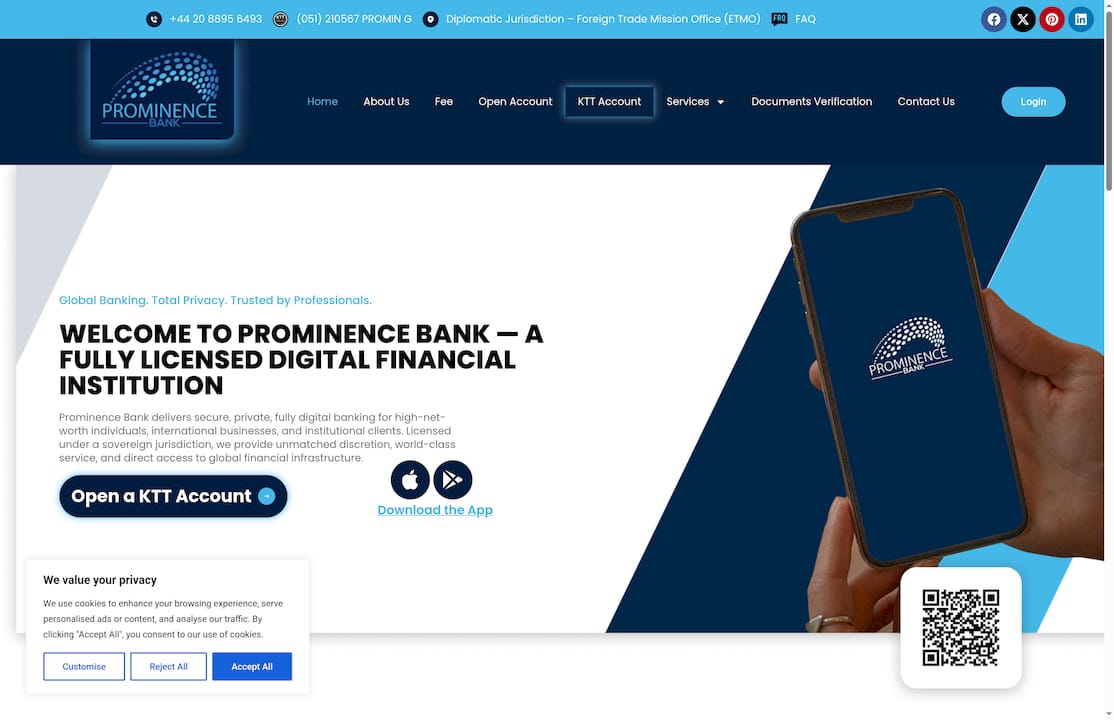
Prominencebank’s onboarding process is designed for high-net-worth individuals and institutional clients who need speed, discretion, and regulatory credibility in equal measure. Explore Prominencebank’s investment banking services to see how the platform supports cross-border capital deployment, corporate account structures, and global treasury management for clients operating in international markets.
FAQ
What is foreign investment banking?
Foreign investment banking refers to cross-border advisory, financing, and capital markets services that help investors and businesses access international capital pools, structure overseas transactions, and manage regulatory requirements across multiple jurisdictions.
How does GIFT IFSC reduce costs for cross-border deals?
GIFT IFSC offers a tax holiday of up to 20 years for qualifying units, which can eliminate the 20% to 35% withholding tax that applies to interest payments outside GIFT City, materially improving the economics of external commercial borrowings.
What documents do I need for foreign investment banking onboarding?
Expect to provide beneficial ownership structure, source of funds documentation, regulatory approvals, and deal context. FinCEN’s 2026 exceptive relief reduces repeated verification for existing clients, but first-time onboarding still requires a complete dossier.
What is an investment corridor in international banking?
An investment corridor is an integrated banking model that links commercial banking, securities, and advisory services across multiple jurisdictions through a single provider, reducing intermediaries and accelerating cross-border deal execution.
How do I choose the right foreign investment banking partner?
Prioritize providers with proven jurisdictional expertise in your target markets, integrated corridor capabilities, and compliance infrastructure aligned to current AML/KYC standards. Ask specifically which booking entity and jurisdiction they would use for your deal before committing.