
TL;DR:
- A virtual banking license allows a fully digital bank to accept deposits, lend, and operate under strict regulatory supervision. It offers full banking rights and deposit protections similar to traditional banks, enabling direct service to retail and corporate clients. The approval process can take up to 48 months and requires extensive documentation, management credibility, and compliance infrastructure.
A virtual banking license is an official regulatory authorization that permits a fully digital bank to accept deposits, extend credit, and deliver core banking services entirely through digital channels, without any physical branches. Unlike a fintech license or a payment institution permit, a virtual banking license places the holder under direct supervision by a national financial authority such as the Monetary Authority of Singapore (MAS) or the Hong Kong Monetary Authority (HKMA). Virtual banks offer 100% digital service and carry deposit protections comparable to traditional banks. That combination of full banking rights and digital-only delivery is what separates this license class from every other fintech authorization.
What is a virtual banking license and how does it work?
A virtual banking license grants the same core banking powers as a traditional bank charter, including deposit-taking, lending, and payment processing, but restricts the holder to digital delivery. The license sits within the national banking law of the issuing jurisdiction. MAS in Singapore, HKMA in Hong Kong, and the Bank of Thailand each issue their own versions, and the rights and restrictions differ by jurisdiction.

The deposit protection angle is critical for entrepreneurs evaluating this path. Deposit insurance schemes apply to virtual banks just as they do to traditional banks. Singapore protects deposits up to SGD 100,000, Hong Kong up to HKD 800,000, and Thailand up to 1 million baht. These protections give customers the same confidence they would have with a branch-based institution.
Regulated digital banking under a virtual banking license also means the institution must meet capital adequacy rules, maintain governance structures, and pass ongoing supervisory reviews. The license is not a lighter version of a bank charter. It is a full bank charter delivered through a digital-first model.
How to get a banking license: the application process
Obtaining a virtual banking license is a multi-year commitment. The process typically spans 24–48 months, broken into preparation, formal application, regulatory assessment, and a final decision phase.
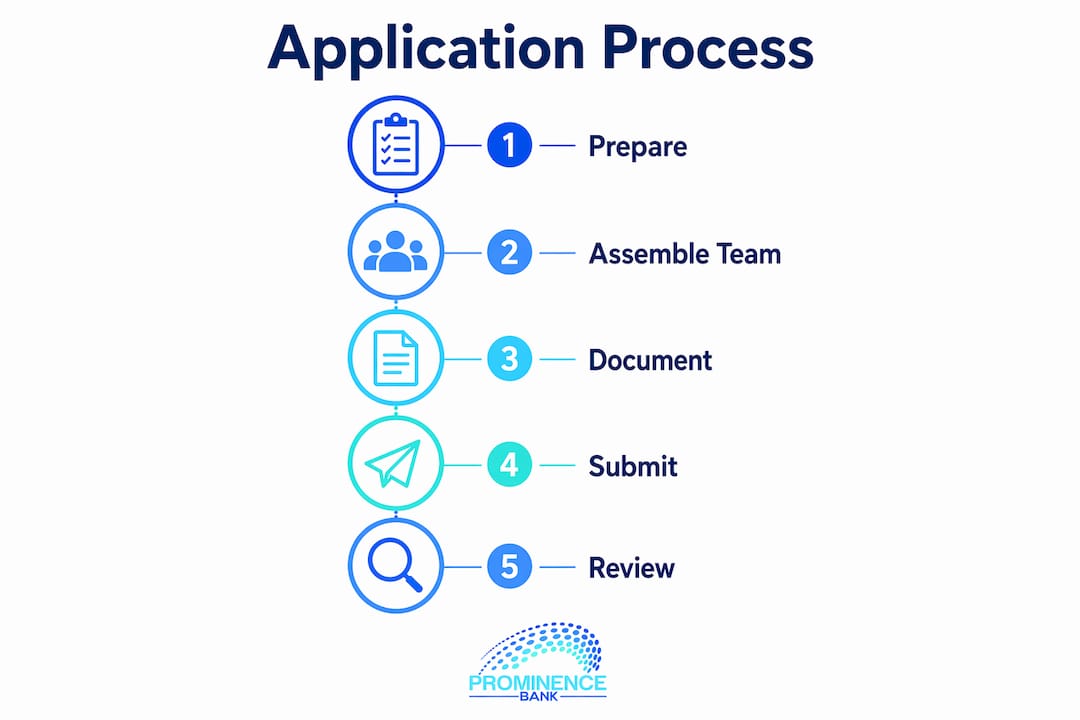
The preparation phase alone takes 6–12 months. During this time, applicants build the business plan, assemble the management team, and engage regulators in pre-application meetings. The formal regulatory review then runs 9–18 months, followed by 2–4 months for the decision and conditions setting.
The documentation demands are severe. Formal application files can span 2,000 to 4,000 pages, covering risk models such as ICAAP and ILAAP, IT infrastructure descriptions, governance frameworks, and compliance evidence. Most applicants underestimate this volume until they are deep into preparation.
The business plan itself must be 100–150 pages and cover governance, risk management, IT architecture, and capital planning in granular detail. Strict separation of financial and non-financial businesses is often required. Some applicants must restructure their corporate group or surrender unrelated licenses before regulators will advance the application.
The numbered steps below reflect the standard sequence across most jurisdictions:
- Pre-application engagement. Request meetings with the regulator to confirm eligibility and receive informal guidance before committing resources.
- Business plan and documentation preparation. Draft the full business plan, capital models, IT security architecture, and governance policies.
- Fitness and propriety assessment. Submit detailed backgrounds for all senior managers and board members. Lack of experienced banking management can delay or halt approval regardless of capital strength.
- Formal application submission. File the complete application with all supporting documentation and pay the initial application fee.
- Regulatory review and interviews. Attend regulator interviews, respond to information requests, and accommodate site visits.
- Decision and mobilization phase. Receive conditional approval and operate under a restricted license with deposit caps and service limitations until full authorization is granted.
Pro Tip: Start the management team vetting process before you finalize the business plan. Regulators treat fitness and propriety as a threshold test. A weak management team disqualifies an application faster than a capital shortfall.
How does a virtual banking license differ from other digital banking licenses?
The distinction between a virtual banking license and other digital finance authorizations is not cosmetic. Virtual banking licenses grant deposit-taking and lending rights, while neobanks and fintech companies operating under payment institution licenses cannot hold deposits on their own balance sheet. Neobanks partner with licensed banks to offer deposit-like products. The customer’s money sits on the partner bank’s books, not the neobank’s.
This structural difference has direct consequences for AML/KYC compliance obligations, capital requirements, and the range of products a company can offer. A payment institution can move money. A virtual bank can hold it, lend it, and invest it.
The table below compares the three main license types relevant to digital banking businesses:
| License type | Deposit-taking | Lending | Regulatory capital | Deposit insurance |
|---|---|---|---|---|
| Virtual banking license | Yes | Yes | Full bank capital rules | Yes |
| Neobank / fintech license | No (partner bank holds deposits) | Limited or no | Lower, varies by jurisdiction | No direct coverage |
| Payment institution license | No | No | Minimal safeguarding rules | No |
Singapore’s framework illustrates how even within virtual banking licenses, class distinctions matter. MAS issues two types: the Digital Full Bank (DFB) and the Digital Wholesale Bank (DWB). License class fundamentally restricts digital bank operations; the DFB can serve retail customers, while the DWB is limited to small and medium enterprises and other non-retail segments. Choosing the wrong class at application locks a business out of its intended market.
Key distinctions that affect business planning:
- A Digital Full Bank can accept retail deposits and offer consumer credit products.
- A Digital Wholesale Bank serves businesses and institutional clients only.
- Both classes carry full capital requirements and supervisory obligations.
- Fintech licenses carry none of the deposit-taking rights but also none of the capital burdens.
What are the benefits and challenges of holding a virtual banking license?
The primary benefit of a virtual banking license is operational freedom. A licensed virtual bank can serve retail and corporate clients directly, hold deposits on its own balance sheet, and build a full product suite including savings accounts, loans, and treasury services. No partner bank sits between the institution and its customers.
Deposit insurance coverage enhances customer trust in ways that fintech wallet providers cannot match. Customers who know their deposits are protected up to a statutory limit treat a virtual bank as a genuine bank, not a tech product. That perception difference drives acquisition and retention.
Regulators also allow virtual banks to use data analytics for credit decisions, including digital footprint analysis for borrowers without traditional credit histories. This opens lending markets that branch-based banks cannot serve efficiently.
The challenges are equally real:
- Capital requirements. Full bank capital rules apply from day one of full authorization. Raising and maintaining regulatory capital is a continuous obligation.
- Cybersecurity standards. Regulators enforce strict digital banking security requirements because a virtual bank’s entire operation runs on digital infrastructure. A breach is an existential event, not just a reputational one.
- Governance complexity. Board composition, risk committee structures, and internal audit functions must meet the same standards as traditional banks.
- Structural separation. Regulators require separation from non-financial businesses to prevent risk contagion. Applicants with diverse business portfolios face restructuring costs before approval.
Pro Tip: Build your cybersecurity architecture before you apply, not after. Regulators review IT security plans as part of the application. A credible security framework accelerates approval; a weak one triggers extended scrutiny.
How do virtual banking license frameworks vary globally?
Virtual banking regulations differ significantly by jurisdiction, and those differences shape which markets are viable for a given business model.
Singapore operates the most structured framework. MAS issues Digital Full Banks and Digital Wholesale Banks with different client eligibility rules and deposit limits during the ramp-up phase. Singapore, Hong Kong, and the UK each impose deposit caps during initial operating phases, restricting how much a new virtual bank can hold until it demonstrates operational stability.
Hong Kong issues dedicated virtual bank licenses through HKMA. Deposit protection covers up to HKD 800,000 per depositor. The HKMA framework requires virtual banks to maintain a physical presence for customer dispute resolution, even though the bank itself operates digitally.
United Kingdom uses a mobilization phase for new bank applicants. Mobilization phases allow virtual banks to operate under severe caps during testing. Failure to meet conditions within the mobilization window can result in revocation of the provisional license. The UK’s Prudential Regulation Authority (PRA) and Financial Conduct Authority (FCA) share supervisory responsibility.
Thailand launched its virtual banking licensing framework more recently. The Bank of Thailand requires applicants to demonstrate financial inclusion benefits and imposes deposit protection up to 1 million baht.
| Jurisdiction | Regulator | Deposit protection | License classes | Notable restriction |
|---|---|---|---|---|
| Singapore | MAS | SGD 100,000 | Digital Full Bank, Digital Wholesale Bank | Client eligibility by class |
| Hong Kong | HKMA | HKD 800,000 | Virtual bank license | Physical dispute resolution required |
| United Kingdom | PRA / FCA | GBP 85,000 | Restricted (mobilization) then full | Deposit cap during mobilization |
| Thailand | Bank of Thailand | 1 million baht | Virtual bank license | Financial inclusion mandate |
The jurisdiction you choose determines your capital obligations, your permissible client base, and your timeline to full operation. Market entry strategy must account for all three.
Key Takeaways
A virtual banking license grants full deposit-taking and lending rights under direct regulatory supervision, making it categorically different from fintech or payment institution licenses.
| Point | Details |
|---|---|
| Full banking rights | Virtual banking licenses permit deposit-taking, lending, and full banking services under national financial authority supervision. |
| Application timeline | The process takes 24–48 months and requires documentation files of 2,000–4,000 pages across multiple review phases. |
| Management team is decisive | Regulators treat fitness and propriety as a threshold test; weak management disqualifies applications faster than capital shortfalls. |
| License class shapes your market | Singapore’s DFB serves retail clients; its DWB serves businesses only. Choosing the wrong class locks out your intended market. |
| Deposit insurance builds trust | Virtual banks carry statutory deposit protection, giving customers the same confidence they have with traditional branch-based banks. |
Why the application workload is the real barrier most entrepreneurs miss
Most entrepreneurs entering the virtual banking space focus on capital and technology. Those are the visible costs. The real barrier is documentation and management credibility, and I have seen well-funded applications stall for 18 months because the management team lacked direct banking experience.
Fitness and propriety of management is the single most scrutinized element of any application. Regulators are not just checking for criminal records. They are assessing whether the team has operated inside a regulated bank, managed a credit book, or run a compliance function at scale. Technology founders with no banking background face a steep credibility gap that capital alone cannot close.
The documentation volume surprises everyone. A 3,000-page application file is not unusual, and every page must be internally consistent. A risk model that contradicts the capital plan, or an IT architecture that does not align with the governance structure, triggers information requests that add months to the review.
My honest view is that the jurisdictions with the most demanding application processes produce the most credible virtual banks. Singapore and the UK are hard to get into for a reason. The rigor filters out underprepared entrants and creates a licensing environment where approval carries genuine market weight. If you are serious about this path, treat the application as a product build, not a compliance exercise.
— Harold
Banking solutions for businesses operating in the virtual banking space
Businesses building toward or operating alongside licensed virtual banks need banking infrastructure that matches their global reach and compliance obligations. Prominencebank serves international businesses and high-net-worth clients with multi-currency account solutions designed for cross-border operations, multi-entity structures, and jurisdictions where standard banking access is limited.
Prominencebank operates under full regulatory oversight with AML/KYC compliance built into every account structure. Its corporate banking services cover complex ownership structures, treasury management, and institutional-grade security for businesses that cannot afford operational banking gaps. Whether you are preparing for a virtual banking license application or running a licensed digital bank, the right banking partner handles the infrastructure so you can focus on building the business.
FAQ
What is a virtual banking license in simple terms?
A virtual banking license is a government-issued authorization that lets a fully digital bank accept deposits, make loans, and offer core banking services without physical branches. It carries the same regulatory weight as a traditional bank charter.
How long does it take to get a virtual banking license?
The process typically takes 24–48 months from preparation through final regulatory decision. Preparation alone takes 6–12 months before the formal application is even submitted.
What is the difference between a neobank and a virtual bank?
A neobank operates under a fintech or payment license and relies on a partner bank to hold customer deposits. A virtual bank holds a full banking license, takes deposits directly, and lends from its own balance sheet.
What are digital banking licenses and how many types exist?
Digital banking licenses are regulatory authorizations for banks that operate without physical branches. Singapore alone issues two types: the Digital Full Bank for retail clients and the Digital Wholesale Bank for business clients, each with different operational scopes.
What are the main benefits of virtual banking for businesses?
Virtual banks can serve retail and corporate clients directly, access deposit insurance schemes, and use digital data analytics for credit decisions. These capabilities go well beyond what a standard fintech or payment institution license permits.