
TL;DR:
- Understanding digital banking jurisdiction involves multiple overlapping legal systems based on location, data storage, and service delivery.
- Managing cross-border operations requires careful consideration of evolving regulations, technology, and licensing to mitigate compliance risks and safeguard assets.
Most people assume that where you open a bank account determines the rules that govern it. That assumption is wrong, and acting on it has cost businesses real money. Understanding what is digital banking jurisdiction means recognizing that your banking relationship can be subject to multiple, overlapping legal systems at once — covering where the bank operates, where you are located, where your data is stored, and where transactions are processed. This guide cuts through the complexity so you can make smarter, compliant financial decisions.
Table of Contents
- Key takeaways
- What is digital banking jurisdiction
- Cross-border digital banking: the real challenges
- Recent regulatory shifts you cannot ignore
- How jurisdiction shapes your actual banking experience
- Strategies for managing jurisdictional risk
- My take on where most businesses go wrong
- Banking compliantly across borders with Prominencebank
- FAQ
Key takeaways
| Point | Details |
|---|---|
| Jurisdiction is multidimensional | Digital banking jurisdiction depends on geography, data location, customer residence, and service delivery point simultaneously. |
| Overlapping laws create real risk | Banks and clients can face criminal liability in one jurisdiction while staying fully compliant in another. |
| EU rules are tightening sharply | From January 2027, non-EU banks must establish licensed branches to serve EU customers under CRD VI. |
| Technology shapes compliance | Encryption key management and data residency are now legal, not just technical, requirements across major jurisdictions. |
| Your provider’s license matters | The jurisdiction where your bank holds its license directly determines your legal protections and recourse options. |
What is digital banking jurisdiction
At its core, digital banking jurisdiction refers to the legal authority that a government or regulatory body holds over a bank’s operations, its customers, and the financial transactions that flow through it. The concept sounds simple. In practice, it spans three distinct layers that every business and high-net-worth individual should understand.
The first layer is geographic registration. A digital bank is licensed by the authority of the country or sovereign territory where it is incorporated. That regulator sets capital requirements, audit standards, and customer protection rules. For example, RBI-regulated banks must hold cybersecurity certifications and receive prior approval before offering transactional digital banking channels, as of January 2026. Every licensed institution operates inside a framework like this.
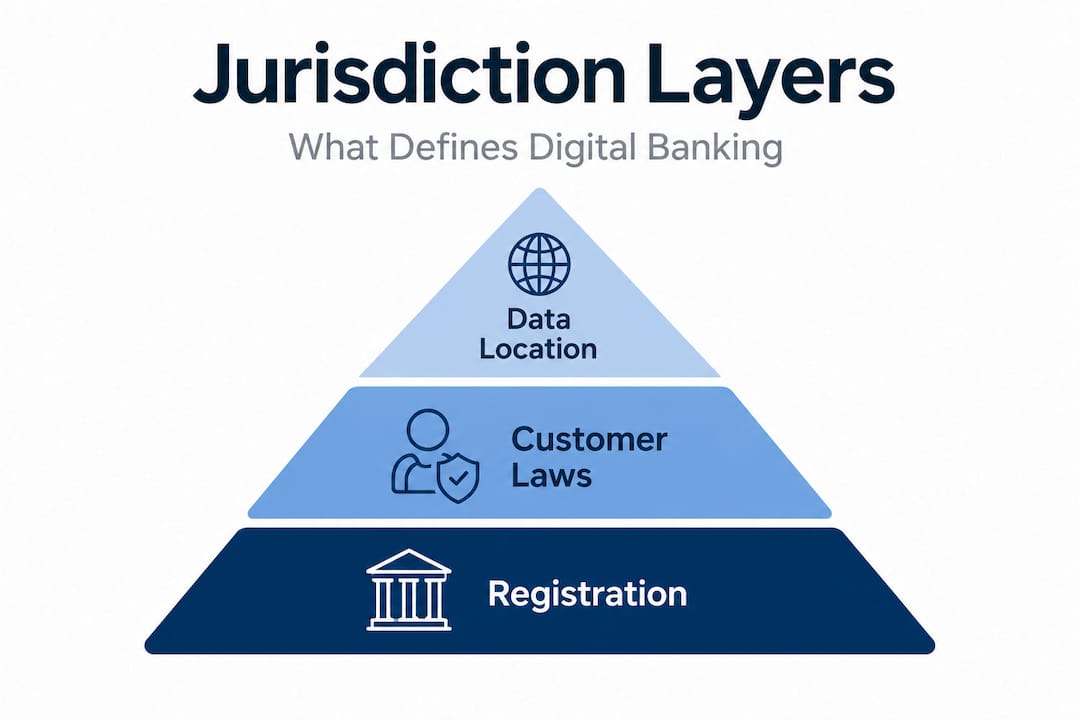
The second layer is customer jurisdiction. Even if a bank is licensed in one country, the laws of your country can apply to the services you receive. The European Union’s General Data Protection Regulation is a clear example: it follows the EU resident, not the bank’s postal address. A bank headquartered outside the EU can still be bound by GDPR if it serves EU customers. The same logic applies to anti-money-laundering rules in the U.S., Singapore, and Australia.
The third layer is data jurisdiction. Where your financial data is stored and processed creates its own legal obligations. This is where many businesses get surprised.
Here is what determines banking jurisdiction in most regulatory frameworks:
- The physical location of the bank’s servers and data centers
- The nationality or residence of the customer
- The currency in which transactions are denominated
- The location from which the service is actively marketed
- Whether the bank has agents, employees, or infrastructure inside a territory
Pro Tip: Before opening any digital bank account for international business, request the bank’s licensing documentation and ask specifically which regulatory authority supervises its deposit-taking activities. This single document tells you which legal system protects your funds.
Cross-border digital banking: the real challenges
Operating across borders is where digital banking compliance gets genuinely complicated. You are not just managing one set of rules. You are managing a stack of them, and they do not always agree.

Consider data sovereignty. Banking secrecy laws in Switzerland, Luxembourg, and France impose criminal penalties for unauthorized disclosure of financial data, completely separate from GDPR. A bank could be fully compliant with civil data protection law and still commit a criminal offense if a cloud provider in another jurisdiction accesses that data without authorization. This is not a theoretical risk. It is an active compliance gap that firms using multi-cloud infrastructure face right now.
The jurisdictional exposure runs deeper than data. Courts in different countries define their own authority very differently:
-
Correspondent banking contacts are not jurisdiction. The Second Circuit Court of Appeals ruled in the Bank Audi case that simply using U.S. correspondent bank accounts is insufficient to establish personal jurisdiction in U.S. courts. Jurisdiction requires a direct nexus between wrongful conduct and in-jurisdiction activity.
-
Civil and criminal liability can stack. A transaction that triggers a civil fine under EU regulations might simultaneously constitute a criminal offense under a member state’s banking secrecy statute. You face both exposures independently.
-
Regulatory arbitrage has a shelf life. Structuring operations across friendly jurisdictions to avoid tougher rules is becoming less viable as regulators coordinate globally through bodies like the Financial Action Task Force.
-
Compliance thresholds vary dramatically. The U.S. maximum civil penalty for International Emergency Economic Powers Act violations runs to $377,700 per transaction or twice the transaction amount, whichever is greater. FinCEN requires suspicious activity reports for transactions aggregating just $2,000. These thresholds are not negotiable.
“Regulators across EU member states apply uniform directives such as CRD VI differently, leading to complex, multi-layered compliance requirements for any institution serving European clients.” This reality means that passing compliance in one EU state does not guarantee smooth operations in another.
Recent regulatory shifts you cannot ignore
Global digital banking regulations are moving fast, and the changes coming between now and 2027 will redefine what it means to operate compliantly across borders.
EU: CRD VI and DORA change everything
The most significant structural shift for international banks is the EU’s Capital Requirements Directive VI. Starting January 11, 2027, non-EEA banks can no longer rely on informal exemptions to provide core banking services inside the EU. Deposit-taking, lending, and guarantees will require a fully authorized branch or subsidiary in the relevant member state. Businesses banking with non-EU institutions that serve EU clients need to verify how their provider is adapting to this requirement now, not in 2027.
Alongside CRD VI, the Digital Operational Resilience Act mandates specific controls on cloud infrastructure and encryption key management. Vendors unable to demonstrate customer-managed encryption risk exclusion from EU financial services procurement entirely. Technology competence is now a licensing criterion.
U.S. and Asia: diverging but demanding
| Region | Key regulatory body | Notable 2025/2026 development | Practical impact |
|---|---|---|---|
| United States | FinCEN / OFAC | IEEPA penalty cap at $377,700 per violation | High cost of non-reporting for cross-border payments |
| European Union | EBA / ECB | CRD VI branch requirement from January 2027 | Non-EU banks must restructure EU market access |
| Kansas, U.S. | State Legislature | HB 2591 virtual currency kiosk licensing from May 2026 | State-level digital asset rules proliferate |
| Singapore | MAS | Enhanced digital bank licensing framework | Strict capitalization and operational criteria |
| Australia | APRA | Digital banking prudential standards updates | Cloud and outsourcing controls tightened |
Pro Tip: Do not rely on your bank’s assurances alone. Request documented proof of its licensing status in the jurisdictions where you conduct business, and review it with a legal advisor who specializes in international banking laws before you move significant capital.
The Federal Reserve has flagged that smaller institutions face disproportionate compliance burdens from rules designed for large institutions. This matters when you are choosing a digital bank: smaller providers may carry jurisdictional risks that their larger counterparts have already resolved through dedicated compliance teams.
How jurisdiction shapes your actual banking experience
When you move money, store data, or open corporate accounts across borders, jurisdiction stops being abstract. It becomes the reason a wire gets held, an account gets frozen, or a transaction triggers a report you did not expect. Understanding how jurisdictions affect digital banking is ultimately about understanding where your risk sits.
Here is what jurisdiction directly controls in your day-to-day banking:
- Account protection limits. Deposit guarantee schemes are jurisdiction-specific. Your coverage depends entirely on where your bank holds its primary license, not where you live.
- Privacy and confidentiality rights. A bank licensed in a jurisdiction with strong banking secrecy laws offers a different level of protection than one operating under a lighter regime. Review the global privacy considerations before committing assets.
- AML and KYC obligations. Banks must apply the rules of the jurisdictions where they operate and, in many cases, where their customers reside. Your documentation requirements change depending on which legal systems are active in your transaction.
- Corporate structure and subsidiary licensing. If your business has entities in multiple countries, each entity may fall under different jurisdictional rules, which affects everything from account opening to transaction reporting.
- Digital currency exposure. Cryptocurrency and digital asset transactions carry jurisdiction-specific rules that are evolving at state, national, and supranational levels simultaneously. The online bank compliance standards for high-net-worth clients highlight exactly how these layers interact.
Strategies for managing jurisdictional risk
You do not need to become a regulatory lawyer to manage digital banking jurisdiction effectively. You need a structured approach that covers the key exposure points before you commit to a provider or structure.
Start with these priorities:
- Verify the license first. Confirm the exact regulatory authority behind your bank’s license. Ask which activities that license covers and which it does not. A payment institution license is not the same as a full banking license.
- Understand data residency. Ask where your account data is stored and processed. If it crosses borders, identify which jurisdiction’s laws apply to that data in transit and at rest. Technology and customer-managed encryption key custody is becoming a critical factor in multi-jurisdiction compliance.
- Map your own jurisdictional footprint. If you operate in multiple countries, each business entity you own creates a potential compliance obligation in that country’s banking system.
- Work with specialists before incidents, not after. Legal and compliance advisors who specialize in international banking laws can identify gaps that are invisible without industry-specific knowledge.
- Audit your provider’s resilience controls. Ask about cloud infrastructure policies, vendor access restrictions, and incident response procedures. Under DORA and similar frameworks, these are legal requirements, not optional extras.
Pro Tip: When evaluating a digital bank for corporate use, ask for its last regulatory audit summary and whether it has received any enforcement actions in the past 36 months. A reputable institution will answer this question directly.
For a practical starting point, the digital banking best practices resource covers key security and compliance steps for global transactions in plain language.
My take on where most businesses go wrong
I have seen clients lose significant time, money, and occasionally accounts because they treated banking jurisdiction as a one-time checkbox rather than an ongoing operational concern. They chose a provider, completed the KYC process, and assumed they were covered. They were not.
What I have learned from working with multinational clients is that jurisdiction is fluid. Regulatory frameworks change, licensing conditions evolve, and a provider that was compliant last year may be operating in a grey zone this year. The EU’s CRD VI deadline is a perfect example. Banks that fail to establish proper EU branches or subsidiaries by January 2027 will be cut off from serving EU clients in core banking functions, and their clients will face disruption they did not anticipate.
The other mistake I see is treating technology as a separate concern from compliance. It is not. Where your data sits, who holds the encryption keys, and which government can compel access to your financial records are legal questions disguised as technical ones. The institutions that understand this are building genuine competitive advantages. The ones that do not are accumulating hidden liabilities.
My honest advice: treat your digital bank’s jurisdictional status the way you treat your corporate structure. Review it annually, get qualified input, and do not wait for a regulatory event to force the conversation.
— Harold
Banking compliantly across borders with Prominencebank
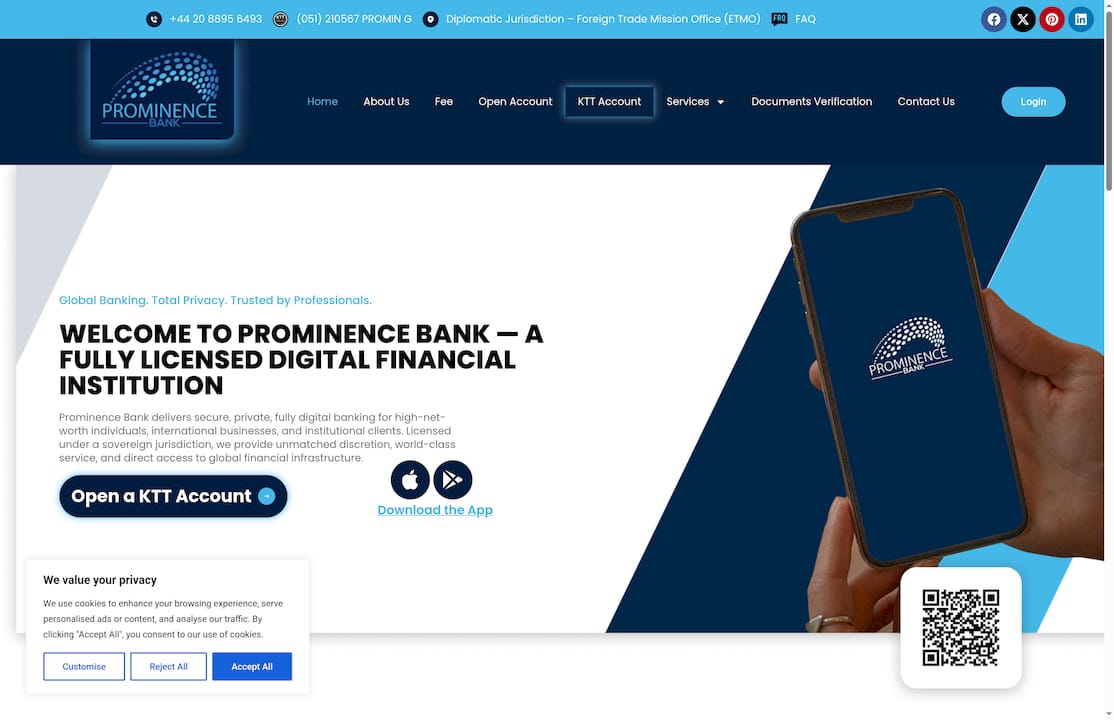
Prominencebank is built specifically for clients who cannot afford jurisdictional ambiguity. Operating under the sovereignty of the Extraterritorial Trade Mission Office (ETMO), the bank provides fully licensed digital banking services with a clear, documented compliance framework that holds up to scrutiny in multiple markets. For businesses and high-net-worth individuals managing assets across borders, Prominencebank offers multi-currency global accounts designed to handle cross-border transactions with full AML/KYC compliance built in. For clients with digital asset exposure, the bank’s digital currency solutions and cryptocurrency account options provide jurisdictionally aware access to crypto banking within a licensed framework. If you are ready to bank with an institution that takes compliance as seriously as you do, Prominencebank is worth a direct conversation.
FAQ
What defines banking jurisdiction for a digital bank?
Banking jurisdiction is defined by where a bank is licensed, where its customers reside, where its data is stored, and where its services are actively delivered. All four factors can apply simultaneously, creating overlapping regulatory obligations.
Does my location affect which banking laws apply to me?
Yes. Even if your bank is licensed abroad, your country of residence can impose its own rules on the services you receive, particularly around data protection, AML reporting, and consumer protection rights.
What is the EU’s CRD VI and how does it affect digital banking?
CRD VI requires non-EEA banks to establish authorized EU branches or subsidiaries to offer core banking services inside the EU from January 2027, removing the informal exemptions many institutions previously relied on.
Can a bank be compliant with GDPR but still break banking laws?
Yes. Banking secrecy laws in jurisdictions like Switzerland and Luxembourg impose criminal penalties for unauthorized financial data disclosure, independently of GDPR civil compliance. Both obligations apply at once.
Is using a U.S. correspondent bank account enough to create U.S. jurisdiction?
No. The Second Circuit ruled in 2025 that incidental correspondent banking contacts are insufficient to establish personal jurisdiction. A direct connection between the alleged conduct and U.S. activity is required.