
TL;DR:
- Digital governance in banking involves systematized policies, roles, and technology controls that manage digital services and data. It serves as the structural backbone necessary for regulatory compliance, operational resilience, and customer trust.
Digital governance in banking is the structured system of policies, roles, and technologies that manage, secure, and regulate digital banking services and data usage across every customer touchpoint. Most compliance officers treat it as a reporting obligation. The banks that get it right treat it as architecture. Explaining digital governance in banking requires understanding that it covers everything from how customer consent is captured during onboarding to how an AI model justifies a loan denial under regulatory scrutiny. The Reserve Bank of India’s January 2026 digital banking framework, the OECD AI Governance Playbook, and cross-jurisdictional studies from the US, EU, UK, Singapore, and Hong Kong all point to the same conclusion: governance is now the structural backbone of every credible digital banking operation.
What is digital governance in banking, and why does it matter?
Digital governance in banking is defined as the overarching system of accountability structures, technology controls, and policy frameworks that determine how a bank collects, uses, protects, and acts on data across digital channels. It is not a single regulation or a software platform. It is the connective tissue between your compliance team, your IT architecture, your risk function, and your customer-facing products.
The scope is broader than most practitioners realize. Digital governance covers:
- Data governance: How customer and transaction data is classified, stored, accessed, and shared
- AI and model governance: How automated decisions in credit, fraud, and onboarding are documented, tested, and explained
- Channel governance: How digital banking channels like mobile apps and internet portals are authorized, monitored, and controlled
- Customer consent and grievance systems: How banks obtain, record, and honor consent, and how they resolve digital service complaints
- Third-party and vendor governance: How banks manage risk from fintech partners, cloud providers, and API integrations
The RBI’s 2026 digital banking framework mandates explicit channel authorization, secure onboarding, and grievance redressal systems, with a compliance window running through 2028. That framework is a useful model for any bank operating in a regulated digital environment, regardless of jurisdiction. It makes the point clearly: governance is not optional infrastructure. It is the condition under which digital banking is permitted to operate.
Pro Tip: Start your governance mapping exercise at the customer consent layer. If you cannot trace exactly when, how, and why a customer authorized a digital interaction, every downstream process built on that interaction is exposed.
How does digital governance work through frameworks and architecture?
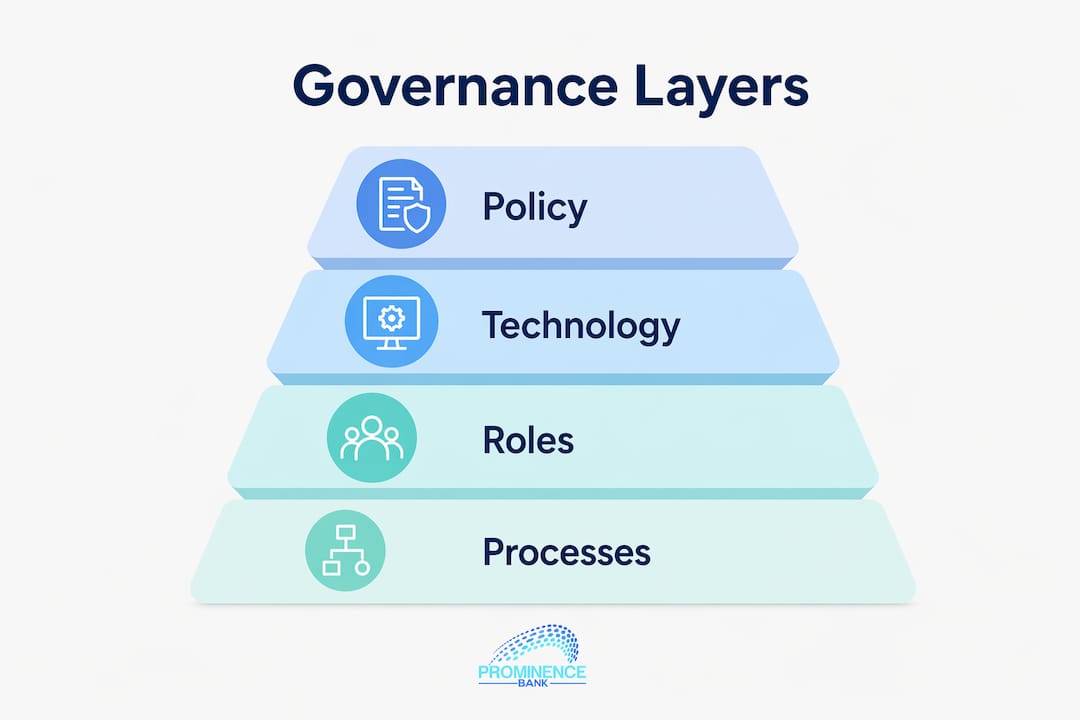
The architecture of a digital governance framework has four interlocking layers: policy, technology, roles, and process. Each layer must be designed to work with the others. A policy without a technology control to enforce it is a document. A technology control without a defined owner is an orphan.

Policy and accountability structures
Policy defines what is permitted, what is prohibited, and who is responsible. In banking, this means documented standards for data classification, AI model use, channel authorization, and incident escalation. Accountability structures assign ownership. Digital Governance Committees using a RACI matrix to define ownership across IT, Legal, Risk, and Operations reduce accountability gaps and the hidden exposures that siloed teams routinely miss. A RACI matrix (Responsible, Accountable, Consulted, Informed) is not bureaucracy. It is the difference between knowing who owns a governance failure and discovering it during a regulatory examination.
Technology and data architecture
The technology layer is where governance either scales or collapses. Banks using unified digital platforms with open APIs and centralized data cut implementation time by 50% and operational costs by 20% compared to fragmented legacy solutions. That efficiency gain is a direct result of governance design. When data flows through a single, auditable architecture rather than across disconnected departmental systems, compliance reporting becomes a query rather than a project.
Centralized data architecture also enables real-time monitoring, which is now a baseline expectation from regulators in the US, EU, and UK. Collibra, a widely used data governance platform, demonstrates how metadata management and data lineage tracking can be embedded directly into banking workflows, making audit readiness a continuous state rather than a quarterly scramble.
Customer-facing governance controls
Governance is not only internal. Customer consent management, secure digital onboarding, and grievance redressal systems are all governance controls that face outward. The RBI’s 2026 framework treats these as non-negotiable. Banks must obtain explicit authorization before offering digital channels, and they must provide customers with a clear mechanism to raise and resolve complaints. These requirements reflect a broader global trend: regulators now view customer-facing governance controls as a direct indicator of institutional integrity.
How does digital governance support regulatory compliance?
Regulatory compliance is the most visible output of a well-designed governance framework, but it is not the only one. Governance also determines how quickly a bank can respond to a new regulatory requirement, how defensible its AI-driven decisions are under scrutiny, and how resilient its operations are when a third-party vendor fails.
Cross-jurisdictional research shows convergence on three AI governance control families across the US, EU, UK, Singapore, and Hong Kong: lifecycle governance, customer protection and explainability, and operational resilience with third-party accountability. That convergence matters because it means banks operating across multiple jurisdictions can build a single governance architecture that satisfies regulators in all of them, rather than maintaining separate compliance programs for each market.
Here is how a compliance-aligned governance program addresses each control family:
- Lifecycle governance: Document every stage of an AI model’s development, validation, deployment, and retirement. Assign a model owner. Schedule periodic reviews. Maintain version histories.
- Customer protection and explainability: Build the ability to generate plain-language explanations of AI-driven decisions into the model itself. A loan denial driven by an algorithm must be explainable to the customer and defensible to the regulator.
- Operational resilience and third-party accountability: Map every critical digital process to its dependencies, including cloud providers, API partners, and fintech integrations. Define recovery time objectives and test them.
Banks must reconstruct, document, and defend AI-influenced material decisions under regulatory scrutiny or face significant risk exposure. This is not a future requirement. It is the current standard in the EU under the AI Act and in the UK under the FCA’s model risk management guidance.
Pro Tip: Form a cross-functional Digital Governance Committee with representatives from IT, Legal, Risk, and Operations. Use a RACI matrix to assign ownership of every governance control. Review the matrix quarterly, not annually.
Traditional vs. modern digital governance: what has changed?
The shift from traditional to modern digital governance is not primarily a technology story. It is an architectural and cultural story. Traditional governance treated IT, Legal, and Risk as separate functions with separate governance programs. Modern governance treats them as nodes in a single, integrated system.
| Feature | Traditional Governance | Modern Digital Governance |
|---|---|---|
| Structure | Siloed by department | Unified across IT, Legal, Risk, Operations |
| Data management | Departmental ownership | Centralized, API-accessible data architecture |
| Compliance approach | Periodic audits and reporting | Continuous monitoring and real-time alerts |
| AI oversight | Ad hoc model reviews | Lifecycle governance with documented approvals |
| Audit readiness | Quarterly preparation | Embedded traceability and always-on audit trails |
| Modernization strategy | Full legacy replacement | Phased, API-driven capability exposure |
Phased modernization strategies that expose core banking functions via APIs let banks prove value incrementally and manage risk better than full legacy replacements. This approach treats data as a corporate resource rather than departmental property. The practical implication is that you do not need to replace your core banking system to achieve modern governance. You need to expose its capabilities through a governed, auditable API layer and build your compliance controls on top of that layer.
The hidden cost of traditional governance is not the audit findings. It is the decisions that were never documented, the AI outputs that were never explained, and the vendor dependencies that were never mapped. Those gaps are where regulatory exposure lives.
Best practices and emerging trends in bank digital governance
The most significant emerging challenge in digital governance is not regulatory complexity. It is shadow AI: the use of AI tools by employees outside of any approved governance framework. Shadow AI produces decisions that cannot be reconstructed, documented, or defended. It is the governance equivalent of an undisclosed trading position.
Effective governance programs address this through a combination of policy, monitoring, and culture:
- Continuous monitoring: Deploy automated tools to detect unauthorized AI usage, unusual data access patterns, and policy exceptions in real time
- Incident escalation protocols: Define clear thresholds for when a governance exception becomes a reportable incident, and assign ownership of the escalation process
- Transparency requirements: Require that any AI-assisted decision in a customer-facing process be logged, attributed, and explainable
- Change fatigue management: Governance programs that layer new requirements on top of existing ones without retiring outdated controls create employee resistance. Audit your control inventory annually and retire controls that no longer address active risks.
- Executive sponsorship: The OECD AI Governance Playbook advises shifting AI governance from static compliance to strategic advantage, with executive sponsorship and cross-functional alignment as the primary enablers. Governance programs without a C-suite champion consistently underperform.
The impact of digital governance on strategic advantage is measurable when governance frameworks move beyond checklists to incorporate culture, continuous iteration, and executive alignment. Banks that treat governance as a dynamic capability rather than a compliance program consistently demonstrate faster regulatory response times, lower operational risk incidents, and stronger audit outcomes.
For banking professionals managing AI-driven processes like loan approvals and fraud detection, the governance requirement is specific: every model decision must be traceable to a documented, approved model version. You can learn more about digital banking best practices that support this level of governance integration.
Pro Tip: Move your governance program off checklists and onto metrics. Track model decision traceability rates, consent capture completeness, and third-party risk review cadence. Metrics create accountability. Checklists create the appearance of it.
Key takeaways
Digital governance in banking succeeds when it is built into the architecture of digital operations, not layered on top of them as a compliance afterthought.
| Point | Details |
|---|---|
| Governance is architecture | Build consent, traceability, and audit controls into systems from the start, not after deployment. |
| Unified platforms cut costs | Centralized data and open APIs reduce implementation time by 50% and operational costs by 20%. |
| AI decisions must be defensible | Every AI-influenced material decision must be reconstructable and documented under regulatory scrutiny. |
| Cross-functional ownership is required | RACI matrices across IT, Legal, Risk, and Operations prevent the accountability gaps that create hidden exposure. |
| Phased modernization outperforms big-bang replacement | API-driven capability exposure lets banks prove governance value incrementally without replacing core systems. |
Why governance failures are always an architecture problem
I have reviewed governance programs at institutions ranging from regional banks to global custodians, and the pattern is consistent. When governance fails, the root cause is almost never a missing policy. It is a missing connection between the policy and the system that was supposed to enforce it.
The most common failure mode I see is treating governance as a communication exercise. A committee meets, a policy is approved, an email is sent. Six months later, a model is making credit decisions that no one can explain, a vendor has access to customer data that no one authorized, and the audit team is reconstructing a paper trail that was never designed to exist.
The institutions that get this right build explainability and traceability into their systems before those systems go live. They treat compliance-by-design not as a constraint but as a quality standard. They also invest in cross-functional governance ownership, because the moment governance lives only in the compliance department, every other department treats it as someone else’s problem.
The other mistake I see repeatedly is the big-bang modernization approach. Banks that attempt to replace their entire governance infrastructure simultaneously almost always underdeliver. The banks that succeed take a phased approach, expose one capability at a time through a governed API layer, measure the outcome, and build from there. Governance is not a project with a completion date. It is an operating discipline that compounds over time.
— Harold
How Prominencebank supports governance-aligned digital banking
Prominencebank is built on the governance principles this article describes: centralized data architecture, documented compliance controls, and full AML/KYC alignment across every digital channel. For high-net-worth individuals and international businesses operating across multiple jurisdictions, that architecture is not a feature. It is the foundation of every transaction.

Prominencebank’s corporate banking solutions are designed for complex structures that require defensible, auditable financial operations. The bank’s multi-currency account infrastructure supports global businesses that need governance-compliant access to multiple financial markets from a single, secure platform. For clients exploring digital asset integration, Prominencebank’s digital currency services operate within the same governance framework, giving institutional clients the traceability and control that regulators now require.
FAQ
What is digital governance in banking?
Digital governance in banking is the system of policies, accountability structures, and technology controls that manage how a bank operates, secures, and regulates its digital channels and data. It covers AI oversight, customer consent, data architecture, and third-party risk management.
How does digital governance differ from traditional compliance?
Traditional compliance focuses on periodic audits and regulatory reporting. Digital governance embeds controls directly into systems and processes, enabling continuous monitoring, real-time audit readiness, and documented AI decision traceability.
What are the core components of a digital governance framework?
A digital governance framework includes data governance, AI and model governance, channel authorization controls, customer consent management, and third-party accountability structures. Each component requires defined ownership and technology enforcement.
Why is AI governance critical for banks in 2026?
Banks must be able to reconstruct and defend every AI-influenced material decision under regulatory scrutiny. The EU AI Act, FCA model risk guidance, and RBI’s 2026 framework all require documented, explainable AI decision processes.
What is the best starting point for digital governance modernization?
Start with a phased, API-driven modernization approach that exposes core banking capabilities incrementally. Establish a cross-functional Digital Governance Committee, assign RACI ownership, and build audit trails into every new digital capability before it goes live.