
TL;DR:
- High-net-worth individuals and executives face heightened risks from sophisticated cyber threats in managing global assets.
- Implementing multi-factor authentication, end-to-end encryption, and AI-driven fraud monitoring is essential for security.
- Proactive security practices, including device separation and incident planning, are critical for safeguarding assets worldwide.
Managing significant wealth across multiple jurisdictions while fending off increasingly sophisticated cyber threats is no longer a background concern for high-net-worth individuals and global executives — it is a front-line operational challenge. Global online banking fraud losses reached $12.33 billion in 2023, and digital fraud rates in Europe alone climbed 43% in 2024. The stakes are high, the threat landscape is evolving fast, and outdated security habits are simply not acceptable. This article lays out a practical, evidence-based framework so you can protect assets, stay compliant, and operate efficiently across global markets.
Table of Contents
- Criteria for evaluating digital banking best practices
- Top 5 digital banking practices for high-net-worth clients
- Security solutions compared: Features and effectiveness
- Personalization, regulatory compliance, and white-glove security
- What most experts overlook about digital banking security
- Taking the next step: Secure and streamline your global banking
- Frequently asked questions
Key Takeaways
| Point | Details |
|---|---|
| MFA is non-negotiable | Multi-factor authentication and biometrics drastically reduce banking fraud risk. |
| Proactive fraud detection | AI-powered monitoring identifies and stops suspicious activity in real time. |
| Personalization with compliance | Integrated wealth dashboards must be paired with rigorous KYC and AML checks. |
| Layered security frameworks | Combining Zero Trust, encryption, and device hygiene offers the strongest protection. |
| Stay ahead of regulations | Know the latest DORA, FATF, and compliance standards for global banking. |
Criteria for evaluating digital banking best practices
Choosing the right digital banking strategy starts long before you select a platform or sign an agreement. You need a clear set of criteria to evaluate every tool, process, and policy your financial infrastructure depends on.
The foundation is authentication. MFA including biometrics and context-based checks is essential for preventing unauthorized access at the executive and HNWI level. A single username-password combination is a liability, not a safeguard. Biometric authentication, behavioral analysis, and adaptive authentication layers that respond to unusual login contexts are the minimum standard.
Encryption and data privacy form the second pillar. Any platform transmitting sensitive financial data must use end-to-end encryption and enforce strict data residency policies. This matters especially when you are moving capital across jurisdictions with differing regulatory environments.
Fraud detection and real-time monitoring round out the technical baseline. Systems need the ability to flag anomalies immediately — not after a transaction has already cleared. And regulatory alignment is non-negotiable. DORA mandates ICT resilience for financial entities operating in the EU, while FATF requires enhanced due diligence for high-risk clients including politically exposed persons and ultra-high-net-worth individuals. Keeping pace with both frameworks is a strategic requirement, and your institution’s approach to bank compliance essentials should reflect that reality.
Key evaluation criteria to examine before selecting any digital banking solution:
- Authentication depth: Does the platform support hardware tokens, biometrics, and behavioral context checks?
- Encryption standards: Is AES-256 or equivalent used for data at rest and in transit?
- Fraud monitoring: Are alerts generated in real time, and is there a 24/7 escalation path?
- Regulatory scope: Does the bank align with DORA, FATF, and regional AML requirements?
- Privacy controls: Are client data and transaction details compartmentalized and access-restricted?
- Incident response: Is there a documented and tested breach response plan in place?
“Innovation in authentication must advance alongside compliance — the cost of getting it wrong falls directly on institutions and their clients.” — Financier Worldwide
Pro Tip: When vetting a digital banking partner, ask specifically about device separation policies and continuous authentication protocols. Platforms that require re-authentication during dormancy periods and flag new device logins instantly are demonstrating a meaningful commitment to top security features rather than just advertising them.
Top 5 digital banking practices for high-net-worth clients
With evaluation criteria in hand, here are the top best practices trusted by industry leaders and cybersecurity experts.
1. Deploy MFA and biometric authentication across all access points
MFA prevents 99.9% of automated account takeover attacks, and biometrics reduce password-based fraud by 40%. For HNWIs and executives managing accounts in multiple countries, these numbers translate directly into risk avoidance at scale. Configure MFA for every login, every transaction approval, and every administrative change. Do not allow exceptions — not for convenience, not for speed.
2. Enforce end-to-end encryption and mandatory VPN usage
End-to-end encryption, tokenization, and VPN usage protect data during global transactions, particularly when accessing accounts over unfamiliar or unsecured networks while traveling. Many high-profile breaches originate in hotel lobbies and airport lounges. A corporate-grade VPN combined with tokenized transaction data eliminates most of that exposure. For practical guidance on implementing these layers when operating internationally, reviewing safe international banking tips is a productive starting point.

3. Integrate AI-powered fraud monitoring with behavioral profiling
Static fraud rules catch known patterns. AI-driven systems catch the patterns no one expected. Modern behavioral profiling builds a baseline of your typical transaction behavior — amount, timing, geography, counterparty — and flags deviations immediately. This is no longer a premium add-on; it is baseline infrastructure for any client moving significant capital globally. The underlying technology powering these systems is well worth understanding, and resources on secure private banking technology explain how these tools work in practice.
4. Conduct regular KYC refreshes and AML screening
Enhanced due diligence, annual KYC refreshes, PEP/sanctions screening, and source-of-wealth verification are not bureaucratic formalities — they are required for AML compliance when global transactions are involved. For ultra-high-net-worth individuals, regulators apply heightened scrutiny. Letting KYC documentation lapse or failing to update source-of-wealth declarations creates compliance gaps that can freeze transactions at the worst possible moments. Use the privacy and wealth protection checklist to stay ahead of documentation requirements.
5. Practice disciplined device and network hygiene
Dedicated devices for banking — not shared laptops or personal smartphones — significantly reduce attack surfaces. Keep operating systems patched, use separate email accounts for financial correspondence, and never approve transactions from unfamiliar devices without secondary verification. These habits are simple but consistently underestimated.
Key statistic: MFA alone blocks 99.9% of automated account takeover attacks. Combined with biometrics and AI monitoring, the protection profile becomes exponentially stronger.
Pro Tip: Add dark web monitoring to your security stack. Services that continuously scan for leaked credentials tied to your email addresses, corporate domains, or financial accounts give you early warning before attackers can act on stolen data.
Security solutions compared: Features and effectiveness
The best practices above rely on robust solutions. Here is how the top tools and frameworks measure up side by side.
| Security solution | Core features | Effectiveness | Complexity |
|---|---|---|---|
| Multi-Factor Authentication | OTP, biometrics, hardware tokens | Blocks 99.9% of automated attacks | Low to moderate |
| Biometric authentication | Fingerprint, facial recognition, voice | Reduces password fraud by 40% | Low |
| Zero Trust Architecture | Micro-segmentation, least privilege, continuous auth | Limits breach lateral movement | High |
| AI fraud detection | Behavioral profiling, pattern analysis, real-time alerts | Catches novel attack patterns | Moderate |
| VPN with encryption | Encrypted tunnels, tokenization, data masking | Protects data in transit | Low to moderate |
| End-to-end encryption | AES-256, TLS protocols, key management | Prevents interception of data | Moderate |
Zero Trust Architecture with micro-segmentation, continuous authentication, and least privilege access limits the lateral movement attackers can achieve after a breach. Instead of assuming anyone inside the network perimeter is trustworthy, ZTA treats every request as a potential threat until verified. For institutions managing HNWI portfolios, this is particularly powerful because it contains the blast radius of any single compromised credential.
AI-powered real-time fraud detection analyzes transaction patterns, behavioral profiling, and cross-channel activity to surface anomalies that rule-based systems would miss entirely. When AI flags a wire transfer attempt at 3 AM from an unfamiliar IP address to a new beneficiary in a high-risk jurisdiction, it does so within seconds rather than days.
Layering these solutions effectively means:
- Running MFA and biometrics at the access layer
- Applying Zero Trust policies at the network and application layer
- Using AI monitoring at the transaction layer
- Encrypting everything at rest and in transit
- Reviewing banking security options regularly as threat vectors evolve
“Proactive, multi-pronged security strategies consistently outperform reactive defenses — especially for clients who represent high-value targets.” — Industry consensus among digital security architects
Personalization, regulatory compliance, and white-glove security
Strong security is only part of the equation — ultra-high-net-worth clients also demand seamless, bespoke experiences, tightly coupled with compliance.
Integrated platforms for wealth aggregation and customizable dashboards are now standard expectations among UHNW banking clients. The ability to view consolidated positions across multiple accounts, currencies, and asset classes from a single interface is not a luxury — it is an operational necessity for complex portfolios. But that consolidation must be paired with white-glove security to earn and maintain trust. Understanding the growth in digital banking for HNWIs helps contextualize why these personalization expectations have risen so sharply.
| Personalization feature | Compliance requirement | Security pairing |
|---|---|---|
| Wealth aggregation dashboard | Data residency and privacy compliance | Role-based access controls |
| Multi-currency real-time views | Cross-border AML monitoring | Transaction-level encryption |
| Customizable alert thresholds | Regulatory reporting obligations | AI anomaly detection |
| Dedicated relationship manager access | KYC refresh and EDD documentation | Identity verification at each session |
| Bespoke reporting and analytics | FATF source-of-wealth verification | Audit trails and access logs |
The table above reflects a core truth: every personalization feature a sophisticated client demands also carries a corresponding compliance and security requirement. These are not in tension with each other — they are designed to work together within a properly structured platform. For deeper guidance on how personalized digital banking achieves this balance, the architecture is worth studying directly.
Three compliance and trust elements every global private banking client should require:
- Documented incident response plans that are tested regularly and include client notification protocols
- Transparent audit trails accessible to account holders for all login events and transaction approvals
- Proactive regulatory updates from your banking partner whenever DORA, FATF, or regional rules change in ways that affect your accounts
DORA and FATF are not static frameworks. Both have evolved substantially in recent years and will continue to do so. Your banking institution should be tracking these changes actively and updating their internal policies without waiting for a regulatory penalty to force action.
What most experts overlook about digital banking security
Most best practice articles stop at tools and frameworks. Implement MFA, use encryption, enable fraud monitoring — and you are done. That advice is necessary, but it is not sufficient. And for globally mobile, high-profile clients, the gap between necessary and sufficient is precisely where serious breaches happen.
The uncomfortable truth is that most cyber incidents targeting HNWIs and executives are not defeated by technology alone. They are defeated by preparation. Proactive measures like dark web monitoring, device separation, and pre-tested incident response plans consistently outperform reactive defenses for clients conducting global transactions. When a threat actor has already purchased your credentials on a dark web marketplace, your fraud detection system is playing catch-up. Continuous monitoring means you get the alert before the attacker acts.
Device separation deserves specific emphasis. Using a dedicated device for banking and financial correspondence — one that never touches personal email, streaming services, or browser extensions — eliminates entire categories of malware risk. It sounds operationally inconvenient. It is. But the alternative is a shared device with dozens of potential attack vectors sitting between you and your financial accounts.
“The clients who invest beyond baseline protocols are not being paranoid — they are calibrating their security posture to match the actual value of what they are protecting.”
Pre-planned incident response is the element most often missing from HNWI security frameworks. Knowing exactly who to call, what accounts to freeze, how to revoke compromised credentials, and what documentation regulators require in the event of a breach — all of this needs to exist in a documented plan before anything goes wrong. Review your current approach against the advanced security tips framework and identify the gaps honestly.
Pro Tip: Schedule a formal security review of your entire digital banking footprint at least twice per year. This should include credential audits, device inventory checks, beneficiary list reviews, and a walkthrough of your incident response plan with your banking partner.
The financial industry talks extensively about layered security. Far fewer institutions actually implement it consistently for their most valuable clients. That gap is an opportunity — and a risk, depending on which side of it you find yourself on.
Taking the next step: Secure and streamline your global banking
The framework this article outlines reflects exactly the philosophy behind how Prominence Bank approaches client security. Every element discussed — MFA, Zero Trust Architecture, AI fraud detection, enhanced KYC/AML, and white-glove personalization — is built into the bank’s infrastructure by design, not as an afterthought.
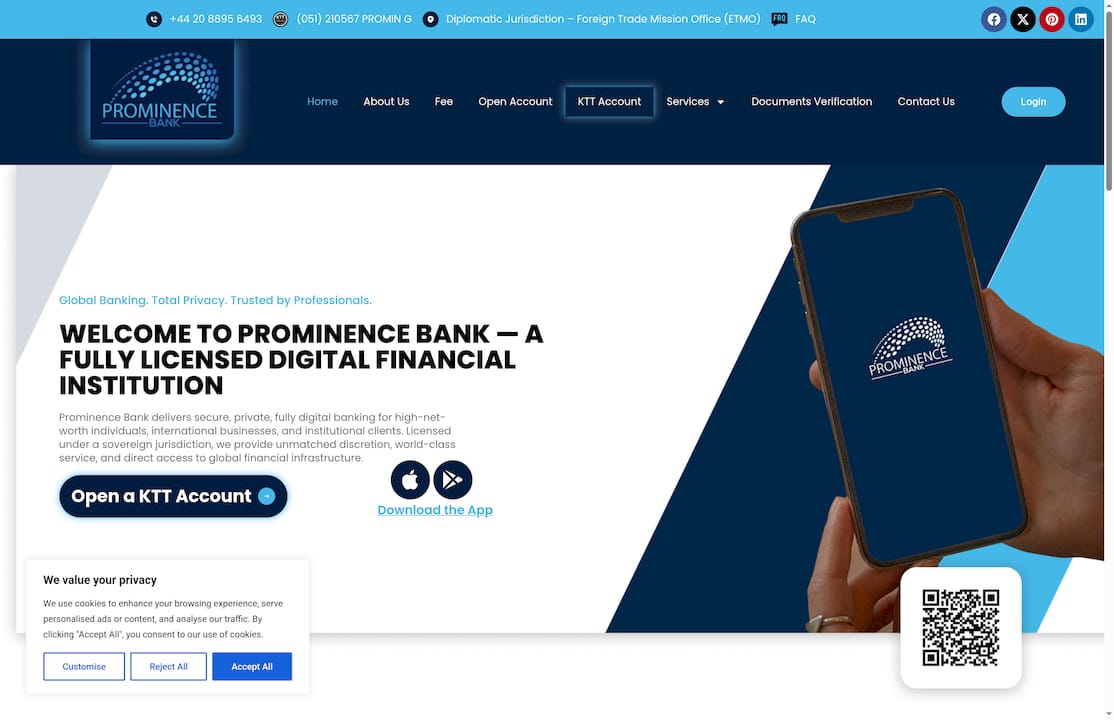
Prominence Bank’s multi-currency accounts give high-net-worth clients and global businesses the ability to hold, transact, and convert across currencies without sacrificing security or compliance. For organizations with complex structures, corporate accounts for global business provide tailored solutions that meet the demands of cross-border operations at scale. And if you want a clear, step-by-step view of how institutional-grade protection works in practice, the corporate banking security guide is a practical resource worth reviewing. The next step is a conversation with a banking specialist who understands both the security requirements and the operational demands of managing wealth globally.
Frequently asked questions
How effective is MFA in stopping banking fraud?
MFA blocks 99.9% of automated account takeover attacks, making it the single most impactful authentication control available for digital banking security today.
What is the role of AI in modern digital banking?
AI detects fraud in real time by continuously analyzing transaction patterns, user behavior baselines, and cross-channel anomalies that static rule-based systems are not designed to catch.
Why do HNWIs require enhanced due diligence?
FATF rules require that HNWIs complete EDD, KYC refreshes, PEP/sanctions screening, and source-of-wealth verification to satisfy AML compliance obligations for global transactions.
What makes Zero Trust Architecture effective for banking?
ZTA uses continuous authentication and least privilege access principles to contain the damage from any single compromised credential, preventing attackers from moving laterally through connected systems.
Which personalization features should UHNW clients prioritize?
UHNW clients should prioritize integrated wealth aggregation platforms with customizable dashboards, provided those features are matched with role-based access controls, audit logs, and advanced security layers.