
TL;DR:
- Multi-factor authentication, especially biometric methods, is essential for protecting high-value banking assets.
- Secure multi-bank connectivity protocols like SWIFT gpi and EBICS are critical for safe cross-border transactions.
- Regulatory compliance frameworks such as KYC, AML, and GDPR form the foundation of institutional security.
When your assets span multiple jurisdictions and your financial activity demands absolute discretion, the stakes of a single security failure are catastrophic. High-net-worth individuals and multinational corporations face a threat landscape that most retail banking clients never encounter: targeted social engineering, sophisticated account takeovers, and cross-border transaction fraud. This article breaks down the specific security features that matter most at the elite level, from biometric authentication and multi-bank connectivity protocols to regulatory compliance frameworks. You will leave with a clear, evidence-based framework for evaluating whether your current bank is truly equipped to protect your wealth.
Table of Contents
- Multi-factor authentication: The new foundation
- Multi-bank connectivity with secure protocols
- Biometric technologies: Comparing the methods
- Regulatory compliance as a security backbone
- Why security features alone aren’t enough: Real-world lessons
- Discover advanced banking solutions tailored to you
- Frequently asked questions
Key Takeaways
| Point | Details |
|---|---|
| MFA is essential | Biometric MFA blocks over 99.9% of compromise attempts in banking. |
| Secure protocols matter | Protocols like SWIFT gpi and EBICS ensure safe multi-bank global payments. |
| Choose robust biometrics | Palm vein and iris scans provide top-notch spoof resistance for high-value accounts. |
| Compliance protects assets | Strict adherence to regulations means data is safe and clients are protected by law. |
Multi-factor authentication: The new foundation
Authentication is the first line of defense, and for high-value accounts, the margin for error is zero. Multi-factor authentication (MFA) requires users to verify identity through two or more independent factors: something you know (a PIN or password), something you have (a physical token or registered device), or something you are (a biometric trait). Not all MFA is equal, and the differences matter enormously when you are protecting eight or nine-figure portfolios.
The most basic form, SMS one-time passwords (OTP), sends a numeric code to your registered phone. It is better than a password alone, but it is vulnerable to SIM-swapping attacks, where criminals convince a carrier to transfer your number to their device. Push notifications improve on this by requiring approval from a registered app, but biometric MFA is where the real protection begins.
Biometric authentication methods used in banking today include:
- Fingerprint scanning: Fast and widely adopted, integrated into most smartphones
- Facial recognition: Increasingly accurate, now used in onboarding and transaction approval
- Iris scanning: Extremely high accuracy, difficult to spoof
- Palm vein recognition: Near-zero false acceptance rate, used in high-security environments
- Voice recognition: Useful for phone-based banking but more vulnerable to replay attacks
The performance gap between OTP and biometric MFA is not marginal. MFA prevents over 99.9% of account compromise attempts when properly implemented. Despite this, roughly 33% of institutions still rely primarily on OTP, while approximately 60% are actively integrating biometric layers into their authentication stack.
For clients operating across borders, a bank that still defaults to SMS OTP for high-value transaction approval is not meeting the standard you should demand.
Our secure online banking guide outlines what a properly secured digital banking experience looks like in practice, including the specific checkpoints you should verify before trusting any institution with significant assets.
Pro Tip: Do not settle for a single biometric factor. Insist on multi-modal biometric MFA, combining at least two biometric methods, for any account holding substantial assets or granting access to treasury functions.
Multi-bank connectivity with secure protocols
For corporations managing treasury operations across multiple institutions, and for HNWIs with diversified holdings in several countries, multi-bank connectivity is not a convenience feature. It is a critical security requirement. The question is not whether your bank connects to others, but how it connects.
There are three primary models for multi-bank integration:
- API-based connectivity: Real-time data exchange between your bank and third-party platforms via secured application programming interfaces
- Host-to-host (H2H) connections: Direct, encrypted file transfers between your corporate ERP system and the bank’s infrastructure
- SWIFT network integration: The global messaging standard for interbank communication, now enhanced by the gpi (global payments innovation) layer
The protocols that govern these connections determine how well your transactions are protected. Multi-bank connectivity uses protocols like SWIFT gpi and EBICS with end-to-end encryption to secure financial data in transit. EBICS (Electronic Banking Internet Communication Standard) is widely used in Europe for corporate banking and adds a layer of digital signature verification that prevents transaction tampering.
| Protocol | Primary use | Key security feature |
|---|---|---|
| SWIFT gpi | International wire transfers | Real-time tracking, end-to-end encryption |
| EBICS | Corporate batch payments | Digital signatures, multi-user authorization |
| ISO 20022 | Global payment messaging | Structured data, reduced fraud surface |
| API (OAuth 2.0) | Real-time account access | Token-based authentication, scope-limited access |
Here is how a secure international payment is typically executed in a properly configured system:
- The initiating user authenticates via biometric MFA
- The payment instruction is digitally signed using the user’s registered credentials
- The instruction travels via an encrypted channel (SWIFT gpi or EBICS) to the receiving institution
- A second authorized user confirms the transaction (dual-control protocol)
- The receiving bank validates the digital signature before processing
- Both parties receive real-time confirmation via the gpi tracker
Learn more about SWIFT gpi benefits and why they are essential for international treasury operations. For corporations managing complex structures, global banking solutions that support these protocols are non-negotiable. You can also explore direct SWIFT transfers to understand how direct access to the SWIFT network removes intermediary risk.
Pro Tip: Always insist that your bank supports SWIFT gpi for international payments. The real-time tracking capability alone eliminates a significant category of fraud risk by making every transfer fully visible from initiation to settlement.
Biometric technologies: Comparing the methods
Not every biometric is built for high-stakes banking. The technology you rely on to approve a $50 retail purchase is not the same standard required for a seven-figure wire transfer. Understanding the differences helps you ask the right questions when evaluating a banking partner.

Here is how the major biometric methods compare across the criteria that matter most for banking:
| Biometric type | Spoof resistance | Accuracy | Convenience | Best use case |
|---|---|---|---|---|
| Fingerprint | Moderate | High | Very high | Everyday login |
| Facial recognition | Moderate to high | High | High | Onboarding, transaction approval |
| Iris scanning | Very high | Very high | Moderate | High-value transaction signing |
| Palm vein | Very high | Very high | Moderate | Branch and secure terminal access |
| Voice | Low to moderate | Moderate | High | Phone banking, low-risk actions |
Palm vein and iris biometrics offer very high spoof resistance, and multi-modal biometrics combining two or more methods is the recognized gold standard for reducing false acceptance rates and defeating spoofing attempts. A false acceptance occurs when the system incorrectly grants access to an unauthorized user, and in banking, even a single such event can be devastating.
Key considerations when evaluating banking biometrics for high-value accounts:
- Liveness detection: Ensures the system cannot be fooled by a photograph or a recording
- Template storage security: Biometric data should be stored as encrypted mathematical templates, never as raw images
- On-device vs. server-side processing: On-device processing keeps biometric data off central servers, reducing breach exposure
- Fallback protocols: What happens when biometric verification fails? The fallback method must be equally secure
For cross-border transactions and accounts with complex authorization structures, multi-modal biometrics should be considered a baseline requirement, not a premium add-on.
Regulatory compliance as a security backbone
Technology features protect against external threats. Regulatory compliance protects you from institutional failures, data misuse, and systemic vulnerabilities. For high-net-worth clients and corporations, compliance is not just a legal checkbox. It is a structural guarantee of how your data and assets are handled.
The core frameworks that govern banking security include:
- KYC (Know Your Customer): Identity verification protocols that prevent unauthorized account creation and protect against impersonation
- AML (Anti-Money Laundering): Transaction monitoring systems that flag suspicious activity and protect the integrity of your accounts
- GDPR (General Data Protection Regulation): Governs how banks collect, store, and process personal data, giving clients rights over their own information
- PCI DSS (Payment Card Industry Data Security Standard): Sets technical and operational requirements for any institution handling card payment data
Banks comply with PCI DSS, GLBA, and GDPR through regular third-party audits, penetration testing, and strict data minimization policies. Data minimization means the bank only retains what it legally needs, reducing the value of your data to any potential attacker.
Compliance without transparency is just paperwork. The right bank will show you its audit history, explain its data retention policies, and answer your questions directly.
For HNWIs and corporations, understanding bank compliance essentials is critical to selecting the right institution. You should also understand how regulatory technology is reshaping compliance monitoring in real time, making it faster and more accurate than traditional manual review processes.
What to request from your banking relationship manager: documented audit schedules, data retention and deletion policies, incident response procedures, and confirmation of which specific regulatory frameworks the institution operates under.
Why security features alone aren’t enough: Real-world lessons
Here is the uncomfortable truth we have observed across clients managing significant global wealth: the most sophisticated security stack in the world cannot compensate for a bank that treats you like a number. Technology sets the floor, not the ceiling.
The clients who experience the most serious security incidents are rarely victims of brute-force attacks. They are victims of process failures: a relationship manager who bypassed verification for convenience, a bank that did not proactively alert them to unusual activity, or an institution that never explained what their security protocols actually covered.
Real security at the elite level requires three things that no software can provide: transparency from your bank about what they do and why, education so you understand your own exposure, and a bespoke protocol built around your specific asset structure and risk profile.
Ask your relationship manager these questions: What triggers a manual review of my transactions? Who has access to my account data internally? How are security incidents communicated to me?
Our guidance for securing corporate banking goes deeper into the operational questions that separate a genuinely secure banking relationship from one that only appears secure on paper.
Pro Tip: Build a security partnership with your bank, not just an account. The relationship manager who knows your transaction patterns is your first line of defense against anomalies.
Discover advanced banking solutions tailored to you
Understanding what elite-level banking security looks like is the first step. Acting on it is the next.
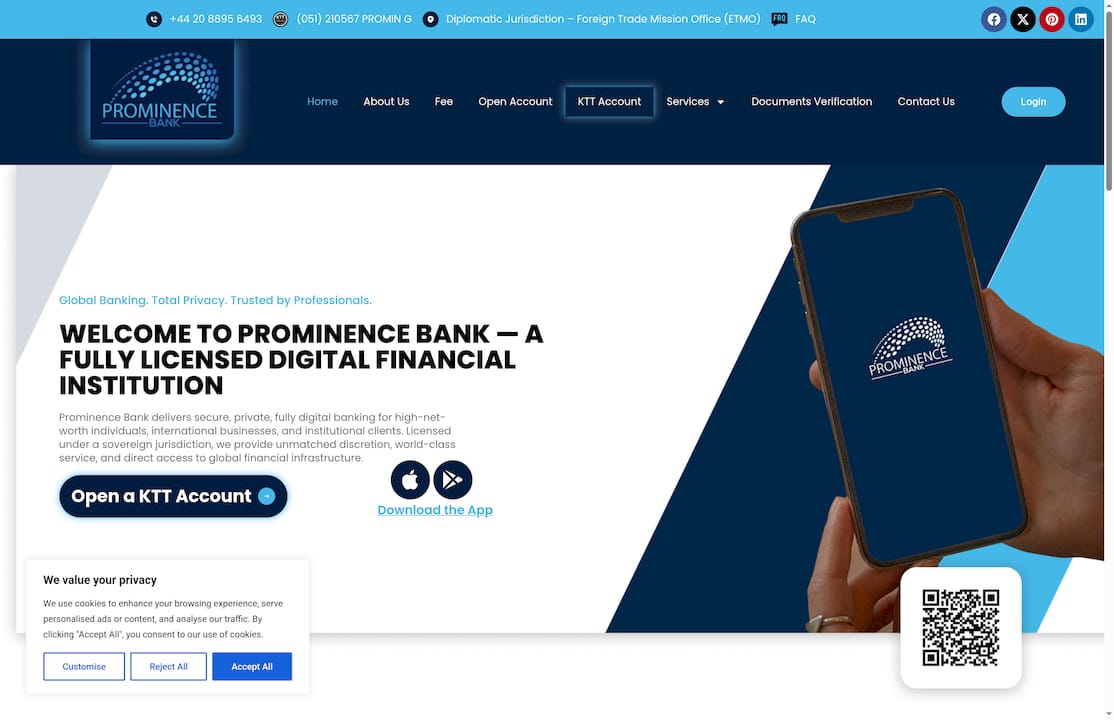
At Prominence Bank, our corporate banking solutions are built from the ground up for clients who cannot afford compromise. From multi-modal biometric authentication to direct SWIFT connectivity and full regulatory compliance under ETMO sovereignty, every feature is designed around the specific demands of high-net-worth individuals and multinational corporations. If you are ready to move beyond standard banking and into a structure built for your level of complexity, explore our corporate banking security guide or connect directly with our team at Prominence Bank to discuss your requirements.
Frequently asked questions
What is the most secure form of banking authentication?
Multi-factor authentication using multi-modal biometrics is the highest standard available, combining two or more biometric methods to minimize false acceptance rates and eliminate spoofing vulnerabilities.
How do banks ensure safe international payments?
Secure institutions use SWIFT gpi and EBICS alongside digital signatures and dual-control authorization to protect real-time international transactions from initiation through settlement.
What regulations do banks follow for data security?
Bank platforms comply with PCI DSS, GDPR, AML, and KYC requirements, enforced through regular third-party audits, penetration testing, and strict data minimization policies.
Can high-net-worth individuals require extra security measures?
Yes. Elite clients can and should request additional authentication controls including multi-modal biometrics, custom transaction alert thresholds, dual-authorization requirements, and dedicated account monitoring protocols.