
TL;DR:
- Business transfer solutions enable owners to pass ownership or assets securely through various paths like third-party sales, MBOs, family transfers, or ESOPs, each with distinct timelines and risks. Preparing 12 to 24 months in advance, especially legal and financial documentation, is crucial to maximize the final valuation and avoid deal-breakers. Engaging experienced legal, financial, and advisory teams early ensures smooth closures and mitigates post-closing disputes.
Business transfer solutions are structured methods that enable owners to pass ownership, assets, and operational control to new parties securely and efficiently. The industry term for this process is “business transition,” though practitioners also use mergers and acquisitions (M&A) terminology depending on deal size and complexity. Whether you are selling to a third party, passing the company to family, or executing a management buyout, the path you choose determines your tax exposure, timeline, and final proceeds. This article covers the four primary transfer paths, the preparation steps that protect your valuation, and the legal mechanics that separate clean closings from costly disputes.
What are the main types of business transfer solutions?
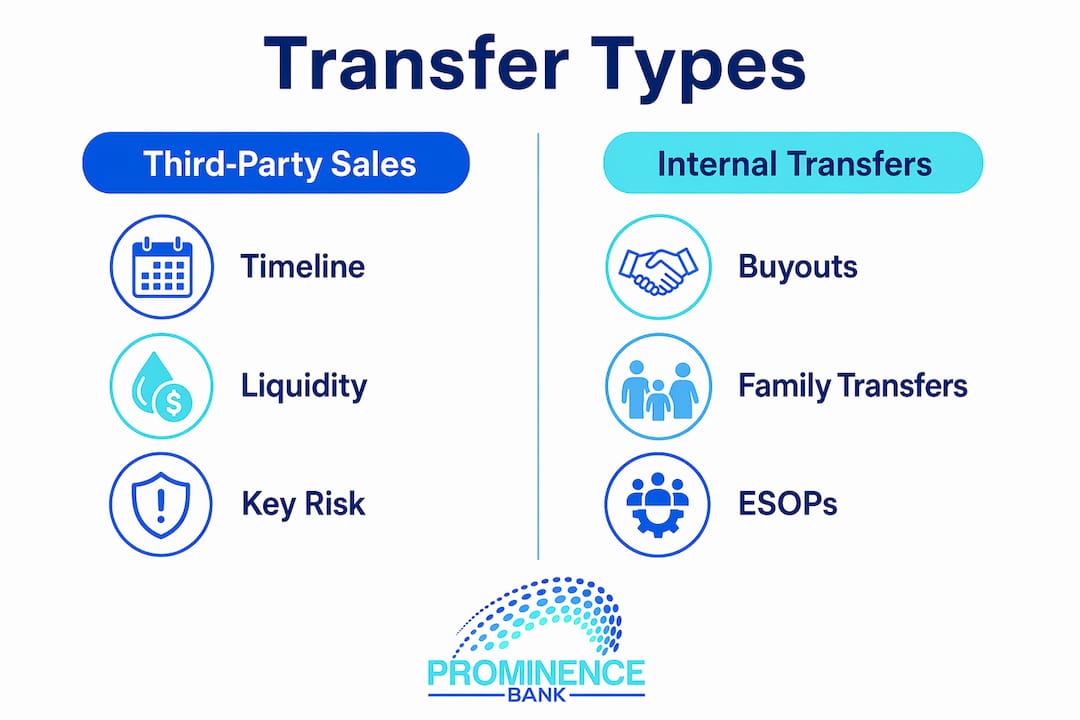
Four primary transfer paths exist for business owners: third-party sales, internal buyouts, family transfers, and Employee Stock Ownership Plans (ESOPs). Each path carries distinct legal structures, tax consequences, and liquidity profiles.

Third-party sales deliver the highest immediate liquidity. A strategic buyer or private equity firm pays cash at closing, with typical deal structures running 70 to 90 percent cash plus holdbacks and earn-outs. Valuations generally range from 4x to 8x EBITDA, meaning a business generating $2 million in annual EBITDA could fetch $8 million to $16 million. This path suits owners who want a clean exit and have no succession candidate inside the company.
Internal buyouts and management buyouts (MBOs) transfer ownership to existing managers or employees. These deals are often structured via promissory notes paid over five to seven years, which means the seller carries financing risk. The upside is continuity: the buyer already knows the business, reducing transition friction. MBOs work best when a capable management team is in place and the owner is willing to accept deferred payment.
Family transfers prioritize legacy over price. Gifting shares, using grantor retained annuity trusts (GRATs), or installment sales to family members can minimize gift and estate taxes, but they require careful coordination between an estate attorney and a CPA. The risk is that family dynamics can complicate governance after the transfer.
ESOPs sell ownership to a trust that holds shares on behalf of employees. They offer significant tax advantages for C-corporations and create a built-in buyer without a market search. The trade-off is administrative complexity and the cost of establishing the plan, which typically runs $100,000 or more in setup fees.
| Transfer Type | Timeline | Liquidity | Key Risk |
|---|---|---|---|
| Third-party sale | 9 to 18 months | High, immediate | Confidentiality breach |
| Management buyout | 6 to 12 months | Deferred | Seller financing default |
| Family transfer | 12 to 24 months | Low to medium | Tax and governance disputes |
| ESOP | 12 to 18 months | Structured payout | Setup cost and complexity |
The choice between an asset sale and a stock sale also matters here. Asset versus stock sales affect tax and liability exposure differently, and the right structure depends on deal size and jurisdiction. Buyers generally prefer asset sales to limit inherited liabilities; sellers often prefer stock sales for capital gains treatment.
How to prepare your business for a successful transfer
Preparation is the single greatest lever on your final sale price. Starting 12 to 24 months before your target close date gives you time to eliminate the deal-killers that compress valuations.
The most common deal-killers are:
- Owner dependency. If the business cannot operate without you for 30 days, buyers will discount the price or require a long earnout period.
- Customer concentration. A single customer representing more than 20 percent of revenue is a red flag. Buyers see that as a single point of failure, not a business asset.
- Undocumented processes. Standard operating procedures, employee handbooks, and vendor contracts must be written down and organized before due diligence begins.
- Messy financials. Three years of clean, audited or reviewed financial statements are the minimum expectation for any serious buyer.
Assembling the right advisory team early is not optional. You need an M&A attorney to draft and review the letter of intent and purchase agreement, a CPA to model tax scenarios across deal structures, and a business broker or investment banker to manage buyer outreach. Trying to run a sale process without this team costs more in lost value than it saves in fees.
Confidentiality discipline protects deal value throughout the process. Public or aggressive listings risk employee panic, customer defection, and competitive intelligence leaks. Targeted introductions to pre-qualified buyers, protected by non-disclosure agreements signed before any financial data is shared, are the standard practice among experienced M&A advisors.
Pro Tip: Have your M&A attorney review all material contracts before you go to market. Contracts with change-of-control clauses or assignment restrictions can stall a deal at closing. Identifying them early gives you time to renegotiate or obtain consent from counterparties.
What does the step-by-step business transfer process look like?
Executing a transfer follows a predictable sequence, though the timeline varies significantly by method. Direct buyer-seller transfers close in 30 to 90 days; broker-run auctions span 9 to 18 months. Understanding each phase prevents surprises.
- Prepare the business. Complete financial restatements, resolve legal issues, and document operations. This phase takes the longest and has the most impact on price.
- Identify and qualify buyers. Your broker or banker creates a target list of strategic and financial buyers. Each signs an NDA before receiving a confidential information memorandum (CIM).
- Negotiate the Letter of Intent (LOI). The LOI sets the commercial framework including price, exclusivity period, and key conditions. Most sellers treat it as a formality. It is not. The LOI is a soft but functionally binding document that shapes every negotiation that follows.
- Manage due diligence. The buyer’s team reviews financials, legal documents, customer contracts, and operational data. Your job is to respond quickly and completely. Delays in due diligence signal disorganization and give buyers leverage to renegotiate.
- Draft and sign the definitive purchase agreement. This is the binding legal contract. It covers representations and warranties, indemnification caps, working capital targets, and closing conditions.
- Close the deal. Funds move through escrow, ownership transfers, and transition service agreements (TSAs) take effect. TSAs define how long you will support the buyer post-closing and under what terms.
Pro Tip: Model your working capital peg before signing the LOI. Working capital adjustments at closing are one of the most common sources of post-closing disputes, and they directly reduce your net proceeds if the target is set too high.
| Phase | Typical Duration | Key Output |
|---|---|---|
| Preparation | 12 to 24 months | Clean financials, documented operations |
| Buyer outreach | 1 to 3 months | Signed NDAs, qualified buyer list |
| LOI negotiation | 2 to 4 weeks | Signed LOI with exclusivity |
| Due diligence | 60 to 90 days | Buyer approval, issue resolution |
| Closing | 2 to 4 weeks | Signed purchase agreement, fund transfer |
Common challenges in business transfers and how to avoid them
Even well-prepared transactions hit obstacles. Knowing where deals break down lets you build defenses before they become problems.
Working capital disputes are the most frequent source of post-closing friction. The purchase agreement sets a working capital target, and the final amount is calculated at closing. If actual working capital falls short, the seller writes a check back to the buyer. Precise modeling before signing prevents this from becoming a surprise.
Earn-out disputes are the second most common issue. Earn-outs cause post-closing disputes when performance metrics are vague or when the buyer controls the inputs that determine the payout. Sellers should insist on objective, independently verifiable metrics and accounting methodology protections written into the purchase agreement.
Contract consent mechanics create timing risk. Complex legal migration of contracts and licenses requires third-party consent in many cases. A software license, a key vendor agreement, or a government permit may not transfer automatically. Missing a consent requirement can delay closing by weeks or void the transfer entirely.
Confidentiality failures are harder to recover from than most owners expect. Once employees learn the business is for sale, turnover accelerates and morale drops. Once competitors know, they use it in sales conversations. Maintaining confidentiality is often more critical than deal structure for preserving deal success.
“Owners consistently underestimate post-closing involvement. Indemnification claims, consulting obligations, and integration support can keep a seller engaged for 12 to 24 months after the deal closes.” This reality should be factored into your transition planning from day one.
For international business transfers, currency risk and cross-border regulatory requirements add another layer of complexity. Multi-currency accounts and foreign exchange planning should be part of your deal structure, not an afterthought.
Key takeaways
Successful business transfers require selecting the right path, preparing 12 to 24 months in advance, and building a qualified advisory team before going to market.
| Point | Details |
|---|---|
| Choose the right transfer type | Third-party sales, MBOs, family transfers, and ESOPs each carry different tax, timeline, and liquidity profiles. |
| Start preparation early | Eliminating owner dependency and customer concentration 12 to 24 months before sale protects your valuation. |
| Treat the LOI seriously | The Letter of Intent sets the commercial framework and shapes every negotiation that follows. |
| Model working capital before signing | Working capital adjustments at closing directly reduce net proceeds if the target is not set correctly. |
| Plan for post-closing obligations | Indemnification claims and consulting requirements can keep sellers engaged for up to two years after close. |
Why I think most sellers underestimate the legal side of transfers
Most owners I have worked with spend 80 percent of their preparation time on financials and almost none on contract review. That is the wrong ratio. The financial story matters, but it is the legal architecture of a deal that determines whether it actually closes and at what price.
The LOI is the clearest example. Sellers sign it quickly because they want to lock in the buyer. But the LOI’s exclusivity clause, working capital definition, and indemnification framework become the baseline for every subsequent negotiation. Walking it back after signing is possible but expensive in time and goodwill.
I have also seen deals collapse at the finish line because of a single contract with a change-of-control clause that nobody caught until due diligence. The buyer used it as leverage to renegotiate the price down by 15 percent. That outcome was entirely preventable with a contract audit six months earlier.
The non-financial factors matter too. A seller who is emotionally unprepared for post-closing life often sabotages the transition, consciously or not. The best transfers I have observed involve sellers who have a clear plan for what comes next, whether that is a new venture, retirement, or a board role. Clarity of purpose makes you a better negotiator and a more reliable transition partner.
Engage your M&A attorney before you talk to a single buyer. The cost is minimal compared to the value it protects.
— Harold
How Prominencebank supports your business transfer process
Executing a business transfer involves more than legal agreements. The financial infrastructure behind the deal, including fund transfers, escrow management, and multi-currency settlements, determines how smoothly capital moves from buyer to seller.
Prominencebank offers corporate banking solutions built for the complexity of business ownership transfers. Its multi-currency accounts handle cross-border settlements without the friction of correspondent banking delays, and its mergers and acquisitions services provide the financial infrastructure that institutional and high-net-worth clients need during complex transactions. For sellers and buyers managing international deal flows, Prominencebank’s global banking capabilities reduce currency risk and keep capital moving on closing day. Contact Prominencebank directly to discuss how its private banking infrastructure can support your specific transfer structure.
FAQ
What is the fastest business transfer solution?
Direct buyer-seller transfers close in 30 to 90 days and represent the fastest path to ownership change. Broker-run auction processes take 9 to 18 months but typically generate higher sale prices through competitive bidding.
How is a business valued for a transfer?
Business valuations generally range from 4x to 8x EBITDA, depending on industry, growth rate, and risk profile. Factors like customer concentration and owner dependency reduce the multiple; documented processes and recurring revenue increase it.
What is an LOI and why does it matter?
A Letter of Intent (LOI) is a pre-binding document that sets the commercial framework for a business transfer, including price, exclusivity, and key conditions. Its terms shape every negotiation that follows, making careful legal review before signing critical.
What is the difference between an asset sale and a stock sale?
An asset sale transfers specific business assets and liabilities, giving buyers protection from unknown liabilities. A stock sale transfers ownership of the entire legal entity, which sellers often prefer for capital gains tax treatment.
How do earn-outs work in a business transfer?
An earn-out ties a portion of the purchase price to post-closing performance metrics, such as revenue or EBITDA targets. Disputes arise when metrics are vague or buyer-controlled, so sellers should require objective, independently verifiable terms in the purchase agreement.