TL;DR:
- Corporate banking’s structure is crucial for efficient credit routing, client segmentation, and compliance management.
- Understanding internal roles and decision flows allows businesses to leverage banking relationships effectively.
- Evolving trends like embedded finance and AI-driven workflows are transforming banking structures and service delivery.
Most executives treat their corporate bank the way they treat their internet provider: essential, largely invisible, and only top of mind when something breaks. But corporate banking generates over $1.5 trillion in global financial intermediation revenues annually, representing roughly 28% of the entire sector. That scale is not accidental. It reflects a deeply engineered system of roles, risk controls, and structural design that shapes how international businesses access capital, manage cash, and stay compliant. This guide cuts through the complexity and delivers a practical map of how corporate banking structures actually work, who runs them, and how your organization can extract far more value from those relationships.
Table of Contents
- What is corporate banking and why does structure matter?
- Inside a corporate bank: Roles, responsibilities, and organization
- The corporate banking value chain and how banks create value
- Risk management and compliance: The backbone of modern banking
- Current trends and strategic shifts: How corporate banking structures are evolving
- Rethinking banking structure: What most executives overlook
- Partnering for optimized banking structure and growth
- Frequently asked questions
Key Takeaways
| Point | Details |
|---|---|
| Corporate banking specialization | Corporate banks offer specialized structures and services, distinct from retail and investment banking. |
| Value chain impact | A bank’s structure critically shapes its ability to deliver funding, product, and risk services efficiently to businesses. |
| Role clarity matters | Understanding key bank roles and reporting lines enables better engagement and negotiations for executives. |
| Compliance at the core | Embedded risk management and compliance protect business interests and ensure smooth international operations. |
| Adapting to trends | Staying aware of banking structure trends can accelerate partnerships and optimize global banking value. |
What is corporate banking and why does structure matter?
Corporate banking is frequently lumped together with “banking” as a category, but the distinction matters enormously for how you engage with your financial institution. Corporate banking provides specialized services to mid-sized to large businesses, including lending, cash management, trade finance, and risk management. It is also called wholesale or commercial banking. This is fundamentally different from retail banking or investment banking, both in the clients served and the products deployed.
Here is a direct comparison to make the distinctions concrete:
| Dimension | Corporate banking | Retail banking | Investment banking |
|---|---|---|---|
| Clients | Mid to large businesses | Individual consumers | Corporations, governments |
| Core products | Loans, cash mgmt, trade finance | Mortgages, deposits, credit cards | M&A advisory, IPOs, securities |
| Risk profile | Credit, counterparty, operational | Consumer default, fraud | Market, liquidity, reputational |
| Revenue share | ~28% of intermediation revenue | ~45% | ~27% |
The critical insight executives often miss is that structure is not bureaucracy. It is functional architecture. A bank’s organizational structure determines how it:
- Routes credit decisions to qualified approvers without delay
- Segments clients to match them with the right relationship and product expertise
- Manages regulatory exposure across jurisdictions with different compliance regimes
- Integrates new technology without disrupting core operations
“Structure is not the enemy of agility in banking. It is the precondition for it. Without clear lines of authority and accountability, risk accumulates invisibly.”
With advanced solutions in corporate banking evolving rapidly, those who understand the structural logic of their bank can identify bottlenecks, escalate appropriately, and build relationships that yield real results. Global corporate and public deposits exceed $50 trillion, making retail banking look modest by comparison in terms of balance sheet significance.
Inside a corporate bank: Roles, responsibilities, and organization
A corporate bank looks deceptively simple from the outside. One relationship manager, one phone number. Inside, it is a layered organism. The typical hierarchy runs from the Board and CEO through an executive team, then down into specialized departments covering business lending, treasury, operations, risk, and compliance.

| Level | Role | Primary function |
|---|---|---|
| Board/CEO | Governance | Strategy, capital allocation, regulatory accountability |
| Executive team | Business heads | P&L leadership by division |
| Department leads | Managing directors | Client coverage, product delivery |
| Middle management | Relationship managers/VPs | Day-to-day client relationship and deal execution |
| Entry level | Credit/financial analysts | Underwriting, modeling, compliance review |
Key roles in corporate banking include credit analysts, relationship managers, risk and compliance officers, and treasury managers. Each has a specific lane that directly affects how your business is served, how fast approvals move, and how problems get resolved.
Here is how a client’s needs typically travel through the organization:
- Initial contact with a relationship manager who assesses your business profile and risk tier
- Credit review by an analyst team that underwrites your lending or facility request
- Treasury/cash management specialists who design your liquidity solutions
- Risk and compliance officers who conduct KYC, AML screening, and approve account structures
- Operations who implement account setup, transaction processing, and ongoing reporting
For international businesses pursuing account setup for global businesses, knowing this journey prevents missteps and accelerates onboarding.
Pro Tip: When starting a new banking relationship, ask your relationship manager explicitly which tier your business is classified in and who the escalation contact is above them. Banks prioritize clients differently based on revenue contribution, and knowing your classification tells you how much leverage you have.
The corporate banking value chain and how banks create value
Banks do not just hold money. They build structured value chains that transform funding into financial products, client relationships, and risk-adjusted returns. Understanding this chain gives you a sharper view of where your business fits and how to optimize your position within it.
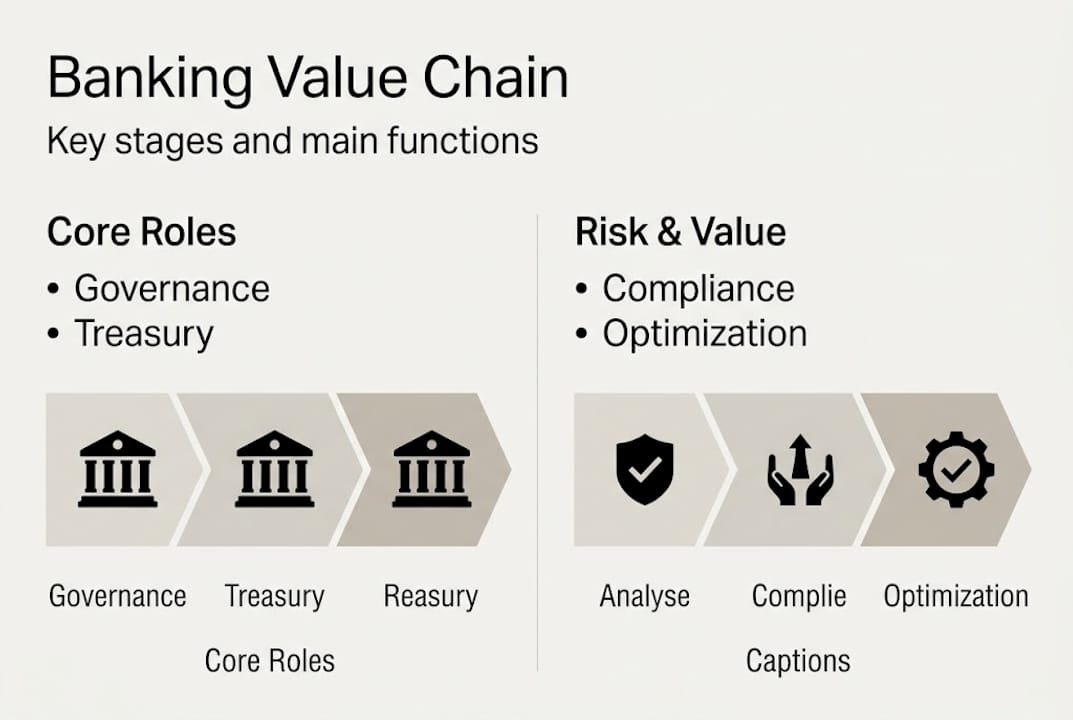
The five core stages of the banking value chain are:
- Funding acquisition: Banks gather deposits and wholesale funding from corporate and public sources, a pool exceeding $50 trillion globally
- Product and platform development: Proprietary platforms, lending products, and treasury tools are built and maintained
- Client origination and coverage: Relationship managers and sector specialists identify and acquire clients, then deepen those relationships over time
- Risk management: Credit underwriting, market risk assessment, and regulatory compliance filter every deal before capital is deployed
- Capital deployment: Loans, trade facilities, and cash management programs generate fee income and net interest margin
The structural link between these stages is where most value is created or destroyed. Treasury operations generate approximately 8% of group net interest income, and top-performing cash management programs add 87 basis points to loan revenue. That is not a rounding error. It is a structural advantage available to businesses that engage meaningfully with the treasury function rather than treating it as a back-office service.
For executives engaging with banking product strategies, the implication is direct: your most valuable banking conversations happen not just at the relationship manager level but with treasury and product specialists who can customize structures for your cash flow complexity.
Risk management and compliance: The backbone of modern banking
If the value chain is the bank’s engine, risk and compliance is the chassis. Without it, nothing stays on the road. Risk management encompasses KYC and AML screening, credit risk underwriting, and interest rate risk controls, and these functions are now embedded structurally at every level of a corporate bank rather than isolated in a back-office department.
For international businesses, compliance readiness is not optional. Here are the core areas you must understand:
- KYC (Know Your Customer): Documentation of ownership, beneficial controllers, and business purpose
- AML (Anti-Money Laundering): Transaction monitoring, source-of-funds verification, and suspicious activity reporting
- Credit risk controls: Covenants, collateral requirements, and ongoing financial reporting obligations
- Operational risk: Continuity planning, cybersecurity protocols, and third-party vendor oversight
- Basel III compliance: Capital adequacy standards that shape how banks price risk and allocate credit
“Basel III increases capital requirements for trading desks and CVA risk exposure, fundamentally reshaping how global banks structure their balance sheets and manage client-facing credit facilities.”
Basel III’s capital regime also introduces systemic risk concerns tied to bank lending to non-bank financial institutions, which affects how corporate borrowers are categorized and priced.
Pro Tip: Maintain transparent, pre-organized business disclosures before approaching any bank. Delays in KYC almost always trace back to incomplete documentation, not bank slowness.
For businesses pursuing secure banking steps, proactive compliance positioning shortens onboarding timelines significantly. You can also explore online bank compliance frameworks tailored for high-net-worth clients and international structures. Resources like language services for banking compliance can also ease documentation challenges for cross-border operations.
Current trends and strategic shifts: How corporate banking structures are evolving
The corporate banking structure you see today is not the one that will serve your business in three years. Leading banks are actively restructuring in response to three powerful forces that every executive should track.
The three biggest structural shifts underway:
- Embedded finance and banking-as-a-service: Banks are moving beyond traditional product delivery to embedding financial services directly into client ERP systems, supply chains, and payment platforms. This transition reflects the broader shift from transactional banking to financial infrastructure, with competition from private credit and non-bank financial institutions now accounting for over 15% of corporate and investment banking revenues.
- Agentic AI and workflow automation: Underwriting, KYC processing, and treasury forecasting are being automated through AI-driven workflows, compressing timelines and reducing human error at scale
- Precision coverage models: Rather than broad relationship banking, top-tier institutions are deploying specialist coverage teams by sector, geography, and product need. Structured coverage models can increase transaction banking value by up to 50%, while fintech partnerships yield a 3 to 5% profit impact
For international firms, these shifts have direct operational implications. If your bank cannot articulate its fintech partnership strategy, its AI adoption roadmap, or how it covers cross-border clients with specialized teams, that is a red flag about structural agility.
Explore how technology in banking is reshaping service delivery, and understand the full range of digital banking benefits available to globally active businesses today.
Rethinking banking structure: What most executives overlook
Here is the uncomfortable reality: most banking reviews conducted by finance teams focus almost entirely on price. Loan spreads, treasury yields, fee schedules. Those numbers matter, but they are the last 20% of the decision, not the first 80%.
The structural alignment of your bank to your business determines responsiveness during a crisis, the speed of compliance escalations, and whether your relationship manager actually has the authority to solve problems or just takes messages. A well-organized bank with clear vertical ownership brings cross-border synergy, faster technology adoption, and genuinely reliable risk controls.
Most RFPs and banking reviews we see never ask a single question about organizational design. They do not ask who leads the treasury vertical or whether that person has mandate authority. They do not ask how compliance decisions are escalated for international structures. These questions separate a transactional vendor from a strategic partner.
Pro Tip: In your next banking review, ask specifically who leads each service vertical and what their authority level is. That conversation reveals more about structural fit than any product brochure.
Executives who engage at this level access structural best practices and negotiate measurably better terms, faster resolutions, and stronger crisis support.
Partnering for optimized banking structure and growth
Understanding how corporate banking structures work is step one. Applying that knowledge to choose and manage the right banking partner is where the real gain happens.
Prominence Bank is built specifically for international businesses and high-net-worth clients who need more than a generic banking relationship. Our structure is designed for transparency, compliance agility, and cross-border efficiency. Whether you need tailored treasury solutions, multi-currency account management, or guidance through complex KYC frameworks, we deliver it with direct access and zero opacity. Explore advanced corporate banking solutions, learn how to secure your corporate banking, or go straight to explore our corporate banking services to see what a structurally sound banking partnership looks like in practice.
Frequently asked questions
What makes corporate banking structures different from retail or investment banking?
Corporate banking is structured around business clients, specialized products, and distinct risk departments, unlike retail banking’s consumer focus or investment banking’s capital markets orientation.
Who are the key decision-makers within a corporate bank for large client relationships?
Relationship managers are your primary contact, but credit, treasury, and risk departments each hold authority over specific decisions, all reporting upward to managing directors and executive leadership.
How do compliance and risk management interact with everyday banking operations?
KYC, AML, and Basel III controls are embedded into account opening, ongoing transaction monitoring, and every major credit or partnership decision, not confined to a separate compliance team.
What new trends are reshaping corporate banking structures in 2026?
Embedded finance, AI-driven workflows, and fintech partnerships are the dominant forces, enabling banks to deliver faster, more specialized service while managing growing competition from non-bank lenders.
How can my business optimize its corporate banking relationship?
Structured coverage models that align your needs with specialist teams can yield up to 50% more value in transaction banking, making organizational fit as important as product pricing.