
TL;DR:
- Extraterritorial banking is a regulated and legitimate practice that offers legal asset protection, currency diversification, and access to international financial infrastructure. It is not about secrecy but about placing assets in jurisdictions with stronger legal protections and better banking services, fully compliant with international standards like CRS. High-net-worth individuals and businesses benefit from these accounts by improving asset security, reducing political and legal risks, and expanding operational flexibility across borders.
Extraterritorial banking is one of the most misunderstood tools in global wealth management. Many people hear the phrase and assume it means hiding money from governments, but the benefits of extraterritorial banking have nothing to do with secrecy and everything to do with legal protection, currency diversification, and access to international financial infrastructure. For high-net-worth individuals and global businesses, these accounts operate within a tightly regulated, internationally transparent framework that is more scrutinized than most domestic banking. The real question is not whether it is legal. It is whether you are using it to its full potential.
Table of Contents
- What is extraterritorial banking and why it matters
- Core benefits for high-net-worth individuals
- Advantages for international businesses and global connectivity
- Navigating regulations and ensuring tax compliance in extraterritorial banking
- Leading offshore banking jurisdictions: comparison and choosing what fits your needs
- Rethinking extraterritorial banking: expert insights and practical wisdom
- How Prominence Bank supports your extraterritorial banking needs
- Frequently asked questions
Key Takeaways
| Point | Details |
|---|---|
| Legal and compliant | Extraterritorial banking is fully legal when you comply with tax reporting and international standards like CRS. |
| Asset protection | Using offshore trusts and companies creates legal obstacles protecting wealth from claims and government actions. |
| Global connectivity | Multi-currency accounts and cross-border services enable businesses and individuals to operate internationally with ease. |
| Choose the right jurisdiction | Consider minimum deposits, privacy, regulatory environment, and financial sophistication when selecting your banking location. |
| Compliance is essential | Following AML, KYC, and sanction regulations avoids risks and unlocks secure extraterritorial banking benefits. |
What is extraterritorial banking and why it matters
Understanding what is extraterritorial banking starts with one clean definition: holding bank accounts or financial assets in a jurisdiction other than your home country, fully within international compliance standards. This is not a gray area. It is a recognized, regulated practice underpinning trillions of dollars in legitimate global finance.
The mechanism keeping it legitimate is the Common Reporting Standard (CRS), developed by the Organisation for Economic Co-operation and Development (OECD). CRS requires participating financial institutions to automatically share account data with the tax authorities of account holders’ home countries. There is no hiding accounts from your government under CRS. What you gain instead is legal access to superior financial infrastructure, stronger asset protection, and multi-jurisdictional diversification.
The scale of this system is worth noting. Tax authorities from 116 jurisdictions have commenced exchanges of information under the Automatic Exchange of Information Standard, covering 171 million accounts worth nearly EUR 13 trillion. This is not an underground market. It is a global financial network operating in daylight.
Key reasons why extraterritorial banking matters for your financial strategy:
- Cross-border businesses need banking infrastructure that matches the geography of their operations, not just their home country
- HNWI face legal and political risks in their home jurisdictions that foreign accounts can legitimately mitigate
- Currency risk from home-country inflation or capital controls demands diversification at the banking level
- International investment products are often inaccessible through purely domestic banking relationships
The benefits of international banking extend well beyond simple account holding. You gain access to a different tier of financial services. For a deeper legal lens on what confidentiality looks like in practice within compliant frameworks, Swiss banking confidentiality insights offer a useful starting point for understanding how privacy and transparency coexist.
Core benefits for high-net-worth individuals
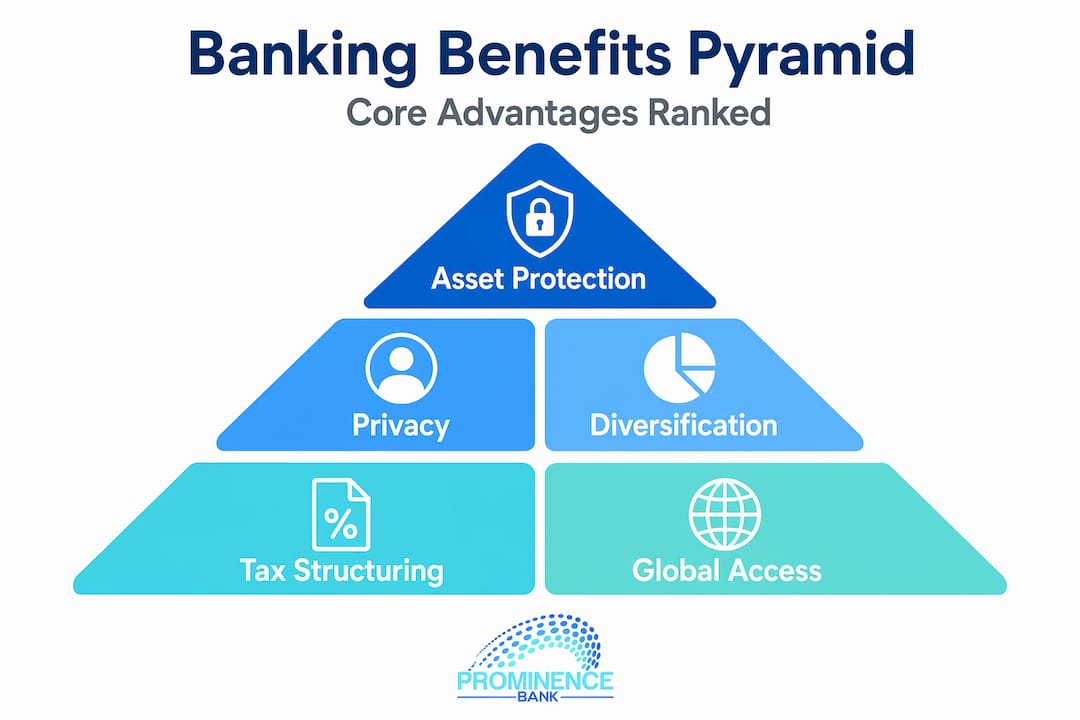
The extraterritorial banking advantages for high-net-worth individuals cluster around four pillars: asset protection, privacy within compliance, currency diversification, and tax efficiency. None of these require you to break any law. All of them require you to understand how the system actually works.
Asset protection is the most immediate draw. Offshore asset protection creates legal barriers that make your assets difficult to seize, shielding wealth from lawsuits and government interference without requiring relocation. Placing assets inside an offshore trust or company structure in a foreign jurisdiction means a creditor pursuing you domestically faces a foreign legal system with different rules, higher costs, and often no recognition of your home country’s court judgments. That friction alone deters many claims.

Privacy within compliance is equally valuable and frequently mischaracterized. Privacy here means protection from identity theft, targeted fraud, and political exposure, not concealment from tax authorities. Many HNWI, particularly those in politically unstable home countries or high-profile industries, face very real risks from public exposure of their financial holdings. Extraterritorial accounts in jurisdictions with strong banking privacy laws reduce that exposure without violating CRS reporting requirements.
Currency diversification at the banking level protects against scenarios most domestic advisors underestimate. If your home currency devalues significantly or your government imposes capital controls (both of which have happened in multiple G20 countries within the last decade), accounts denominated in USD, EUR, or CHF held offshore are simply beyond the reach of those restrictions.
Tax structuring through extraterritorial accounts allows for legal deferral and, in some cases, reduction of tax liability. This includes using foreign earned income exclusions, establishing genuine tax residency in lower-tax jurisdictions, and timing income recognition across tax years. None of this is evasion. It is planning. For a detailed look at how corporate structures abroad amplify these benefits, explore corporate bank accounts abroad and the role of discreet banking in protecting global wealth.
Pro Tip: Many HNWI assume they must apply directly and individually to access premier banking hubs like Singapore. Singapore’s major banks often decline direct applications from US and UK citizens. The solution is opening accounts through an offshore holding company, such as a Hong Kong entity, which sidesteps those regulatory constraints entirely and unlocks access to some of the best private banking infrastructure in Asia. You can also read about Switzerland’s asset protection benefits for an alternative European angle.
Advantages for international businesses and global connectivity
For businesses operating across multiple countries, extraterritorial banking advantages are less about protection and more about operational reality. You cannot run a business that invoices in EUR, pays suppliers in SGD, and receives revenue in USD while banking exclusively through a single domestic account. The friction alone will cost you money.
Offshore banking for companies functions as a financial buffer against litigation and economic crises, enhancing flexibility through multi-currency accounts and compliance-first structures. Here are the stepwise benefits in order of impact:
- Compliance and risk management: Operating through a compliant offshore banking structure means your business has already done the AML and KYC work that correspondent banks require. This speeds up cross-border transactions and reduces the risk of payment blocks.
- Operational flexibility: Multi-currency accounts eliminate the need for multiple domestic banking relationships in each country of operation. You hold, send, and receive in any major currency without conversion delays or excessive fees.
- Capital and market access: Offshore corporate accounts unlock access to international credit facilities, foreign investment products, and institutional counterparties that simply do not engage with purely domestic banking structures.
One risk deserves direct mention. Extraterritorial sanctions violations carry devastating consequences. BNP Paribas was fined $8.9 billion for breaching US sanctions laws that applied to its non-US operations. The fine was not for banking offshore. It was for banking with sanctioned parties while doing so. This distinction matters. Compliant extraterritorial banking is safe. Careless extraterritorial banking is not.
| Jurisdiction | Min. deposit (approx.) | Privacy level | Tax treaties | Notable feature |
|---|---|---|---|---|
| Luxembourg | USD 3,000,000 | High | Full EU treaty network | Ultra-HNWI and institutional focus |
| Singapore | USD 250,000 | High | 90+ treaties | FinTech and digital onboarding leader |
| Switzerland | USD 1,000,000+ | Very high | Broad global network | Legacy private banking infrastructure |
Explore the international business banking solutions and the practical setup of multi-currency accounts that make cross-border operations manageable at scale.
Navigating regulations and ensuring tax compliance in extraterritorial banking
The compliance side of extraterritorial banking is not optional, and it is not as complicated as many advisors make it sound. The foundation is CRS. Under CRS, your offshore bank reports your account balance, interest, dividends, and sales proceeds to the tax authority where you are a tax resident, not where you hold citizenship. This is a critical distinction.
“Over 116 jurisdictions participate in CRS automatic exchange, covering 171 million accounts worth nearly EUR 13 trillion by 2025, reinforcing tax compliance across all major financial centers.”
Core compliance steps every account holder must follow:
- Declare offshore accounts to your home country tax authority annually, including reporting forms like FBAR in the US or equivalent in EU countries
- Complete full KYC documentation including source of funds, proof of address, and corporate structure charts for business accounts
- Monitor sanctions lists continuously if your business involves counterparties in regions subject to US or EU restrictions
- Maintain genuine economic substance in any jurisdiction you claim as your tax residency
The rule on residency is where many clients make expensive mistakes. CRS reports to the jurisdiction where you are a tax resident, not where you were born or hold a passport. Establishing genuine residency in a favorable jurisdiction such as the UAE, Singapore, or Portugal can significantly change what gets reported where and to whom, entirely within legal boundaries. Learn the practical steps in this guide to opening an offshore bank account.
Pro Tip: Before you move any assets offshore, confirm your tax residency status with a qualified international tax advisor. Citizenship-based taxation, as practiced by the US, creates a different compliance profile than residency-based taxation used by most other countries. The strategy that works for a German client may expose a US citizen to additional reporting obligations.
Leading offshore banking jurisdictions: comparison and choosing what fits your needs
Not every offshore hub suits every client profile. Choosing the right jurisdiction requires matching your capital size, objectives, and geographic focus to the specific strengths of each banking environment.
| Jurisdiction | Min. deposit | Privacy level | Currency options | Best for |
|---|---|---|---|---|
| Switzerland | USD 1M+ | Very high | CHF, EUR, USD, GBP | Legacy wealth preservation, ultra-HNWI |
| Luxembourg | USD 3,000,000 | High | EUR, USD, GBP | EU-based institutions, family offices |
| Singapore | USD 250,000 | High | SGD, USD, EUR, AUD | Asia-Pacific businesses, tech-forward HNWI |
| Hong Kong | USD 100,000+ | Moderate-high | HKD, USD, CNY | China-linked businesses, regional trade |
| Cayman Islands | Varies | High | USD | Investment fund structures, alternatives |
Factors to evaluate before selecting your jurisdiction:
- Political stability: A high-privacy jurisdiction with political risk is still a risk. Switzerland, Singapore, and Luxembourg consistently rank at the top for institutional stability.
- Compliance reputation: Jurisdictions with poor FATF ratings face correspondent banking restrictions that will slow or block your transactions.
- Privacy laws: Look for jurisdictions where banking privacy is codified in law, not just practice.
- Banking infrastructure: Technology and service sophistication matter. Singapore leads in digital onboarding and FinTech integration.
- Accessibility: Some jurisdictions are better reached through professional intermediaries than direct applications, particularly for US persons.
Read more on private banking benefits for global wealth in 2026, and explore the full picture of offshore banking for HNWI across different jurisdictions.
Rethinking extraterritorial banking: expert insights and practical wisdom
Here is the perspective most financial advisors will not give you, because they either do not know it or it challenges the products they sell.
The secrecy era of offshore banking ended before most people realized it was gone. CRS launched in earnest in 2017. By 2025, it covers 116 jurisdictions and EUR 13 trillion in accounts. Anyone who opened an offshore account believing it was invisible to their tax authority has been wrong for nearly a decade. What surprises us is how many HNWI still operate under the old mental model.
The modern extraterritorial banking advantage is structural, not secretive. You are not hiding assets. You are placing them in jurisdictions with superior legal protection, more sophisticated banking infrastructure, and stronger insulation from the political and economic volatility of your home country. That is a fundamentally different value proposition.
The residency point is where most clients leave money on the table. CRS reports to your tax residency. Establishing genuine residency in a favorable jurisdiction is the most powerful, most legal, and most underused tool in international wealth planning. It is not about citizenship. It is not about where you keep your passport. It is about where you actually live and pay taxes.
Spreading assets across multiple banking licenses also matters more than most realize. Domestic deposit protection schemes typically cover relatively modest amounts per institution. By distributing assets across several jurisdictions, each with their own deposit guarantee programs, you create a coverage structure no single domestic bank can replicate.
And for US and UK citizens locked out of direct Singapore banking relationships, corporate accounts abroad through offshore holding companies are not a workaround. They are the intended pathway for sophisticated clients. Banks in Singapore are not hostile to foreign wealth. They are structured to receive it through the correct vehicle.
How Prominence Bank supports your extraterritorial banking needs
Prominence Bank operates under the sovereignty of the Extraterritorial Trade Mission Office (ETMO), making it uniquely positioned to serve clients who need genuine extraterritorial banking capabilities with full compliance, not just an offshore account label.
Our multi-currency account solutions are built specifically for HNWI and international businesses that need real cross-border functionality. We handle the regulatory complexity so your focus stays on your business and your wealth. From corporate account setup for complex holding structures to personalized private banking with institutional-grade privacy, our services match the sophistication your financial life requires.
Key services we provide:
- Global payment processing across major currencies with no unnecessary intermediary delays
- Regulatory compliance support including AML, KYC, and sanctions screening built into every account structure
- Flexible corporate banking for holding companies, trusts, and international operating entities
- Premium wealth management with access to international investment products and treasury solutions
Explore our full range of international business banking solutions and see exactly how we translate extraterritorial banking theory into practical, working financial infrastructure for clients like you.
Frequently asked questions
Is extraterritorial banking legal and compliant with tax regulations?
Yes, extraterritorial banking is fully legal when you declare accounts to your home tax authorities and follow international standards. The OECD CRS framework covers 116 jurisdictions and enforces automatic exchange of financial account information, making compliant offshore banking fully transparent to relevant tax authorities.
What are the minimum deposit requirements for offshore banking in major jurisdictions?
Minimum deposits vary considerably by jurisdiction and bank. Luxembourg offshore private banking typically requires USD 3 million, Singapore generally starts around USD 250,000, and Switzerland varies by institution but usually falls above USD 1 million for private banking relationships.
Can US and UK citizens open offshore bank accounts directly in Singapore?
Generally no. Singapore banks typically reject direct individual applications from US and UK citizens due to regulatory compliance burdens but accept offshore holding companies as clients, making a corporate structure such as a Hong Kong entity the standard access route with a USD 250,000 minimum balance.
How does extraterritorial banking help protect assets from legal claims?
By placing assets inside offshore trusts or companies in stable foreign jurisdictions, you create legal barriers that make those assets difficult and expensive for creditors to pursue. Offshore trusts under CRS protect assets by rendering many foreign judgments unenforceable and forcing litigants to navigate entirely separate legal systems.
What risks come from ignoring extraterritorial sanctions laws?
Ignoring US or EU extraterritorial sanctions can result in catastrophic fines and loss of correspondent banking access. BNP Paribas was fined $8.9 billion for sanctions violations in non-US operations, demonstrating that extraterritorial compliance obligations apply regardless of where your banking relationship is physically located.