
TL;DR:
- Virtual bank accounts are digital sub-accounts linked to a single master account, enabling cost-efficient, real-time payment management. They automate reconciliation, support multiple currencies, and improve cash visibility, but do not replace traditional banking services like credit products. Using a hybrid approach maximizes speed, automation, and access to credit while reducing international payment costs and operational friction.
A virtual bank account is a digital sub-account linked to a single physical master account, enabling automated reconciliation, multi-currency handling, and real-time cash visibility without opening multiple traditional accounts. Understanding why use virtual bank accounts matters now more than ever, as businesses and individuals face rising international payment costs, complex compliance requirements, and growing demand for financial privacy. Providers like Transferra, Clear Junction, Statrys, and fintech platforms have made these accounts mainstream tools for exporters, marketplaces, and high-net-worth individuals managing funds across borders.
Why use virtual bank accounts: the core benefits
The primary reason businesses and individuals choose virtual accounts is cost. Businesses save 50–75% on international payment fees by routing transactions through local rails like ACH, SEPA, or Faster Payments instead of SWIFT. That difference is not marginal. For an exporter moving $10,000 internationally, the savings can reach $25,000 per transaction when measured in local currency equivalents.
Beyond cost, the benefits of virtual bank accounts extend to speed, security, and operational control. Here is what sets them apart:
- Lower fees across the board. Digital-first platforms average $35 per customer annually in fees, compared to $280 at traditional banks. That is an 87% reduction in baseline costs.
- Automated reconciliation. Unique virtual IBANs route each incoming payment directly to the correct sub-account, eliminating manual matching and back-office labor.
- Fraud protection. Virtual accounts isolate funds and limit exposure of master account details, reducing the attack surface for unauthorized transactions.
- Multi-currency management. One login handles receipts, conversions, and settlements across USD, EUR, GBP, and dozens of other currencies without opening separate accounts per currency.
- Cash flow visibility. Segregating funds by project, client, or department gives you an accurate, real-time picture of where money sits and where it moves.
Pro Tip: Use virtual account segregation to separate tax reserves from operating funds. When tax season arrives, the money is already set aside and clearly labeled, with no manual sorting required.
How do virtual bank accounts work technically?

Virtual accounts are not separate banking relationships. They are sub-ledger records linked to one master physical account, functioning as accounting constructs that group and sort payments at scale. Think of the master account as a central warehouse, and each virtual account as a labeled shelf inside it. Payments arrive at the warehouse and go directly to the correct shelf based on the unique identifier attached to each transaction.
Here is how the operational flow works in practice:
- Master account setup. You open one physical account with a licensed provider. KYC and AML checks apply once at this stage only.
- Virtual IBAN issuance. The provider generates unique virtual IBANs or routing identifiers. Additional virtual IBANs are sub-ledger identifiers issued only after the master account has been approved; their issuance does not change the master-account opening policy below. Prominence Bank normally completes account opening within 48 to 72 hours after all required KYC/AML procedures have been completed and all requested information and documentation have been received, verified, and accepted. This is an estimated processing period, not a guaranteed deadline. Additional time may be required if further compliance, verification, or due-diligence review is necessary. Submitting an enquiry, application, or payment does not start the estimated processing period and does not guarantee account approval or activation.
- Payment routing. A client or counterparty sends a payment to your virtual IBAN. The system automatically attributes the funds to the correct sub-account and logs the transaction.
- Reconciliation. Because each virtual IBAN maps to a specific payer or purpose, the system matches incoming funds without human intervention. This is what Clear Junction calls “moving reconciliation upstream.”
- Reporting and access. You view all sub-accounts from one dashboard, with consolidated balances and transaction histories available in real time.
Common use cases include marketplace platforms assigning a virtual account to each vendor, exporters managing multi-currency receivables, and SaaS businesses collecting payments from clients across different countries. Marketplace platforms use virtual accounts to segregate vendor funds without opening thousands of separate bank accounts. That approach keeps the liquidity pool consolidated while maintaining clean fund separation for settlements.
One important limitation: virtual accounts rarely offer credit products. Overdrafts, loans, and lines of credit are not part of the virtual account model. They function as transactional and sorting layers, not full banking replacements.
Virtual account vs traditional bank: what actually differs?
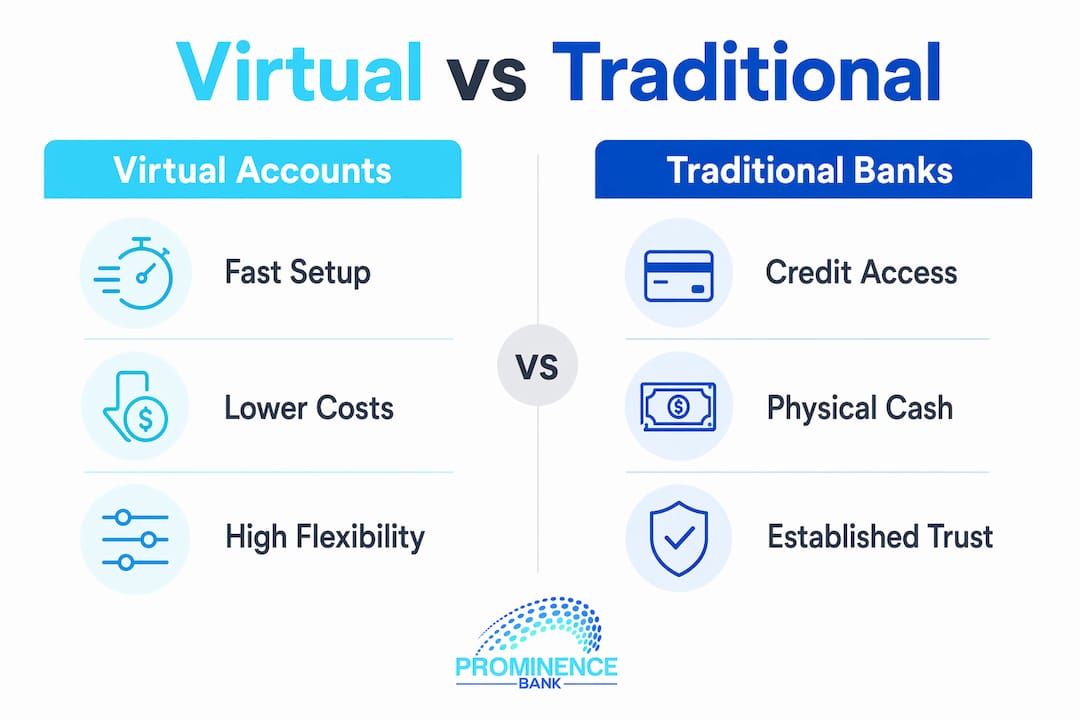
The virtual account vs traditional bank comparison comes down to four dimensions: speed, cost, flexibility, and credit access.
| Feature | Virtual bank account | Traditional bank account |
|---|---|---|
| Account-opening policy | Prominence Bank 48–72-hour estimate after complete, verified, and accepted KYC/AML information and documentation* | Prominence Bank 48–72-hour estimate after complete, verified, and accepted KYC/AML information and documentation* |
| International payment fees | 50–75% lower via local rails | Higher via SWIFT correspondent network |
| Multi-currency support | One login, multiple currencies | Typically requires separate accounts |
| Reconciliation | Automated via unique identifiers | Manual or semi-manual processes |
| Credit products | Not available (overdrafts, loans) | Full credit product suite available |
| Physical cash handling | Not supported | Supported at branches |
| Customer service speed | 70% faster resolution | Slower, branch-dependent |
| Net promoter score | 52 (digital-first average) | 18 (traditional bank average) |
Prominence Bank normally completes account opening within 48 to 72 hours after all required KYC/AML procedures have been completed and all requested information and documentation have been received, verified, and accepted. This is an estimated processing period, not a guaranteed deadline. Additional time may be required if further compliance, verification, or due-diligence review is necessary. Submitting an enquiry, application, or payment does not start the estimated processing period and does not guarantee account approval or activation.
The customer experience gap is significant. J.D. Power’s survey of 90,000 retail banking customers found that digital-first providers resolve issues 70% faster than traditional banks. That speed advantage translates directly into higher satisfaction scores and lower operational friction for businesses managing high transaction volumes.
Traditional banks still hold the advantage in credit access and physical cash handling. For businesses that need overdraft facilities or regularly deposit physical currency, a traditional account remains necessary. The practical answer for most businesses is not one or the other. It is both, used for what each does best.
Pro Tip: When evaluating providers, check whether they offer local bank details for your key markets. Receiving payments via a US routing number or UK sort code instead of a SWIFT code reduces rejection rates and cuts conversion costs significantly.
How to use virtual bank accounts effectively
Getting value from virtual accounts requires more than just opening them. The setup decisions you make at the start determine how much automation and visibility you actually get.
- Map your payment flows first. Before creating virtual accounts, list every recurring payment type: client invoices, vendor payments, tax reserves, payroll. Each category becomes a candidate for its own virtual account or identifier.
- Integrate with your accounting software. Most providers offer API connections to platforms like Xero, QuickBooks, or NetSuite. Connecting these systems means transactions post automatically, with no manual data entry.
- Use account segmentation for fraud control. Keeping operational funds, reserves, and client funds in separate virtual accounts limits the damage if one account is compromised. The master account details stay private, and exposure is contained.
- Choose a licensed provider. Verify that your provider holds the appropriate e-money license or banking license for your jurisdiction. Unlicensed providers carry regulatory risk that can freeze your funds without warning.
- Leverage dashboards for real-time decisions. The best providers offer live dashboards showing balances, pending transactions, and FX rates across all virtual accounts simultaneously. This visibility is the core operational advantage over traditional banking.
Multi-currency support is one of the most practical features for freelancers, exporters, and SaaS businesses. Holding USD, EUR, and GBP in separate virtual accounts under one login means you convert only when rates are favorable, not because a payment arrived in the wrong currency.
For businesses thinking about digital banking best practices, the virtual account layer is where most of the day-to-day efficiency gains live. Automation at the payment receipt stage reduces the reconciliation burden that typically consumes hours of finance team time each week.
The advantages of using virtual accounts compound over time. As transaction volume grows, the manual work at a traditional bank scales with it. With virtual accounts, the system handles attribution automatically, so the operational cost stays flat even as the business expands.
Key takeaways
Virtual bank accounts deliver the most value when used as an automated reconciliation and cash management layer above a traditional banking relationship, not as a full replacement.
| Point | Details |
|---|---|
| Cost savings are substantial | Virtual accounts cut international payment fees by 50–75% using local payment rails instead of SWIFT. |
| Reconciliation becomes automatic | Unique virtual IBANs attribute every incoming payment instantly, eliminating manual back-office work. |
| Master-account approval comes first | KYC/AML applies to the master account; additional virtual IBANs are sub-ledger identifiers and do not alter the account-opening estimate or approval requirements. |
| Credit products are not included | Virtual accounts handle transactions and sorting only; overdrafts and loans still require a traditional bank. |
| Hybrid banking is the practical standard | Combining virtual accounts with traditional banking gives you speed, automation, and full credit access. |
The case for hybrid banking, not either-or
I have spent years watching businesses make the same mistake: they treat virtual accounts as a replacement for traditional banking and then hit a wall when they need a credit facility or a physical cash deposit. The smarter approach is to treat them as two layers of the same system.
Virtual accounts handle the high-frequency, high-volume work: reconciliation, multi-currency receipts, client fund segregation, and automated reporting. Traditional banks handle the structural work: credit lines, physical banking, and complex lending. When you assign each tool to what it does well, the friction disappears.
The other thing I see underused is the fraud protection angle. Most finance teams think about virtual accounts purely as a cost or efficiency play. But isolating funds in separate virtual accounts, with the master account details never exposed to counterparties, is one of the most practical fraud controls available to a mid-size business. You can also monitor AI-driven fraud patterns through resources like fraud signal tracking to stay ahead of emerging threats.
The future of this space is broader API integration and faster cross-border settlement. Providers are already moving toward real-time FX conversion and instant settlement across more currency corridors. Businesses that build their treasury infrastructure around virtual accounts now will absorb those upgrades without rebuilding their systems. Those still running manual reconciliation on traditional accounts will face a growing gap in both cost and speed. The hybrid banking model is not a compromise. It is the most efficient structure available right now.
— Harold
Explore multi-currency corporate banking with Prominencebank
Prominencebank is built for businesses and high-net-worth individuals who need more than a standard account. Its multi-currency account solutions are designed for clients managing funds across multiple jurisdictions, with full online access, advanced privacy controls, and direct connectivity to global payment infrastructure.
For businesses operating across borders, Prominencebank’s corporate banking solutions cover everything from account setup to treasury management, with compliance built in from the start. If you are ready to move beyond the limitations of traditional banking and put a structured, automated cash management system in place, Prominencebank offers the infrastructure to do it at scale.
FAQ
What is a virtual bank account?
A virtual bank account is a digital sub-account linked to a master physical account, used to receive, sort, and track payments automatically. It is not a separate banking relationship but an accounting construct that enables fund segregation and automated reconciliation.
How much can businesses save with virtual accounts?
Businesses save 50–75% on international payment fees by using local payment rails like ACH and SEPA instead of SWIFT. For high-volume exporters, that difference adds up to thousands of dollars per transaction.
Are virtual bank accounts safe?
Virtual accounts improve security by isolating funds and keeping master account details private from counterparties. This limits exposure and reduces the risk of unauthorized access to the primary account.
Can virtual accounts replace traditional bank accounts?
Virtual accounts do not offer credit products like overdrafts or loans, so they cannot fully replace traditional banks. The most effective approach combines both: virtual accounts for transaction management and traditional banks for credit and physical banking needs.
How quickly can you open a virtual bank account?
A virtual account is a sub-ledger identifier linked to an approved master account, not a separate banking relationship. The master account follows this policy: Prominence Bank normally completes account opening within 48 to 72 hours after all required KYC/AML procedures have been completed and all requested information and documentation have been received, verified, and accepted. This is an estimated processing period, not a guaranteed deadline. Additional time may be required if further compliance, verification, or due-diligence review is necessary. Submitting an enquiry, application, or payment does not start the estimated processing period and does not guarantee account approval or activation.