
TL;DR:
- Obtaining international corporate accounts is challenging due to strict KYC and economic substance requirements.
- Proper documentation, jurisdiction understanding, and strategic planning are essential to avoid rejection delays.
- Centralized treasury structures like RTCs improve efficiency but require genuine substance and compliance.
Getting a corporate account approved for an international business is harder than most executives expect. Up to 60% of international companies face initial rejection because of incomplete KYC documentation or insufficient economic substance. That rejection is not just a paperwork inconvenience. It stalls operations, delays payroll, and signals compliance risk to future banking partners. This guide walks you through every stage of the setup process, from documentation requirements and jurisdictional nuances to advanced treasury structures and regulatory edge cases, so your organization can move forward without costly interruptions.
Table of Contents
- Understanding corporate account requirements across borders
- Step-by-step process for setting up a corporate account
- Managing advanced structures: Regional treasury centers and cash pooling
- Navigating regulatory edge cases and jurisdictional pitfalls
- Our take: The untold barriers to smooth corporate account setup
- Build your global corporate account setup with Prominence Bank
- Frequently asked questions
Key Takeaways
| Point | Details |
|---|---|
| Preparation prevents rejection | Carefully prepare documents and address local requirements to avoid the high initial rejection rates common for international corporate accounts. |
| Tailor approach to structure | Complex structures may benefit from treasury centers or cash pooling, but require more compliance and substance. |
| Know your industry risk | High-risk businesses face extra due diligence and may need local licenses and resident signatories. |
| Leverage technology for onboarding | Digital onboarding tools support remote submission but must be matched to each jurisdiction’s acceptance policies. |
| Centralize with caution | Centralization drives control and efficiency, but only where organizational substance and local expertise are strong. |
Understanding corporate account requirements across borders
Before you submit a single document, you need to understand what banks and regulators are actually evaluating. The bar for international corporate accounts is significantly higher than for domestic ones, and the standards vary by jurisdiction in ways that catch even experienced finance teams off guard.
At the core of every application is the KYC and AML review. Banks need to verify who owns the business, where its money comes from, and whether its operations are real. For multinational companies, economic substance requirements go further, including proof of a physical office, employees, detailed business plans, financial statements, UBO verification, and source of funds documentation. In jurisdictions like Saudi Arabia, you may also need MISA registration. In Singapore and EU countries, substance rules are strictly enforced.
Here is a summary of the core documentation most international corporate accounts require:
| Document category | Examples | Risk if missing |
|---|---|---|
| Company registration | Certificate of incorporation, articles | Instant rejection |
| UBO verification | Shareholder registry, passport copies | AML flag |
| Financial statements | Audited accounts, bank statements | Substance doubt |
| Business purpose | Business plan, contracts, invoices | Rejection or delay |
| Source of funds | Transaction records, investment docs | Enhanced scrutiny |
| Jurisdiction-specific | MISA (Saudi), substance proof (EU/SG) | Local non-compliance |
The most common mistakes executives make include submitting vague business purpose descriptions, omitting local directorship details, and providing financial statements that do not match the declared source of funds. Banks are not just checking boxes. They are building a risk profile, and gaps in your submission tell a story you do not want told.
- Ensure UBO documentation covers all ownership layers above 10% or 25% depending on jurisdiction
- Match financial statement dates to your declared operational period
- Provide corporate account documents in Europe in the language of the jurisdiction where possible
- Confirm substance requirements before selecting your banking jurisdiction
For executives managing asset protection abroad, understanding these requirements before choosing a jurisdiction can reduce avoidable rework but does not guarantee approval or a deadline. The secure banking steps that matter most happen before the application is even submitted.
Pro Tip: Build a master documentation pack for each jurisdiction you operate in and update it quarterly. Banks often request documents dated within the last three to six months, so stale files are a silent killer of applications.
Step-by-step process for setting up a corporate account
Once your documentation is in order, execution becomes a process you can manage systematically. The five-stage setup process covers bank and account type selection, document preparation, application submission, initial funding, and activating online controls. Each stage has its own failure points.
Step 1: Choose the right bank and account type. Local accounts offer the deepest integration with domestic payment rails. International accounts provide multi-currency flexibility. Offshore accounts add privacy and asset protection but require stronger substance documentation. Match the account type to your operational model, not just your tax strategy.
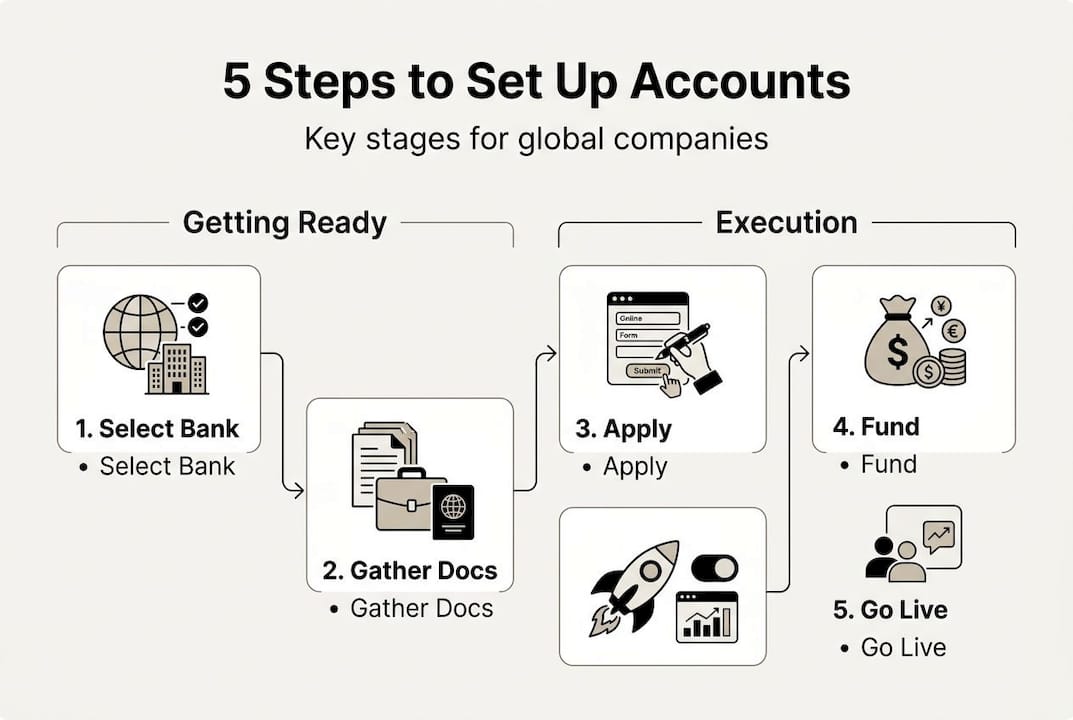
Step 2: Prepare your full documentation pack. Do not gather documents reactively. Prepare everything before you contact a bank. Include certified translations where required and ensure all documents are notarized or apostilled as needed by the target jurisdiction.
Step 3: Submit your application. Online applications support remote submission but remain subject to the same compliance review and approval requirements. In-branch applications allow relationship managers to flag issues before formal submission. For complex structures, in-branch or relationship-led onboarding is almost always worth the extra effort.
Step 4: Fund the account. Minimum deposit requirements vary widely. Some digital banks require as little as $1. Correspondent banks may require $10,000 or more. An unfunded account is often closed automatically after 30 to 90 days.
Step 5: Activate controls. Set up multi-factor authentication, user access roles, payment approval workflows, and transaction alerts before you process a single transaction.
| Account type | Best for | Key risk |
|---|---|---|
| Local corporate | Domestic operations | Limited FX capability |
| International multi-currency | Global trade | Higher KYC threshold |
| Offshore corporate | Asset protection, privacy | Substance scrutiny |
For a detailed walkthrough of the offshore account setup process, including jurisdiction-specific requirements, the steps differ meaningfully from standard corporate onboarding. If your team is handling secure online account opening, the following Prominence Bank policy applies.
Prominence Bank normally completes account opening within 48 to 72 hours after all required KYC/AML procedures have been completed and all requested information and documentation have been received, verified, and accepted. This is an estimated processing period, not a guaranteed deadline. Additional time may be required if further compliance, verification, or due-diligence review is necessary. Submitting an enquiry, application, or payment does not start the estimated processing period and does not guarantee account approval or activation.
Pro Tip: Prepare documentation packs for at least two backup jurisdictions before you start. If your primary application is delayed, having a secondary option ready prevents operational paralysis.
Managing advanced structures: Regional treasury centers and cash pooling
For multinationals operating across five or more countries, a single corporate account is rarely enough. The real efficiency gains come from centralized treasury structures, specifically Regional Treasury Centers (RTCs) and cash pooling arrangements.

An RTC is a dedicated entity that centralizes cash management, FX hedging, intercompany lending, and risk management for a corporate group. Setting up an RTC requires defining your treasury strategy, selecting a location, choosing banking partners, implementing cash pooling, integrating FX and risk management, connecting your TMS or ERP, and building a compliant local team. Singapore, the UAE, and Dubai are the most popular RTC destinations in 2026.
Singapore alone accounts for 14% of Southeast Asia’s GDP and offers a mature regulatory environment, deep banking infrastructure, and favorable treasury incentives. It remains Asia’s leading RTC destination for a reason.
Cash pooling is the mechanism that makes RTCs operationally powerful. Physical pooling sweeps actual cash balances into a master account daily, maximizing interest and minimizing idle liquidity. Notional pooling offsets balances mathematically without moving funds, preserving local liquidity while reducing net interest costs. Citi alone manages over $2 trillion in annual cash pooling flows, which illustrates the scale at which these structures operate.
- Physical pooling: best for groups with predictable intercompany flows
- Notional pooling: preferred where local regulations restrict cash movement
- Hybrid structures: used by large multinationals with mixed jurisdictional profiles
| RTC element | Key decision | Common pitfall |
|---|---|---|
| Location | Tax, substance, banking access | Choosing for tax only |
| Cash pooling type | Physical vs. notional | Ignoring FX impact |
| Technology | TMS/ERP integration | Underestimating setup time |
| Compliance | AML, transfer pricing | Reactive rather than proactive |
“Centralization creates efficiency at scale, but only when the underlying substance, technology, and talent are genuinely in place. A hollow RTC is a compliance liability, not an asset.”
For executives managing FX risk management within a centralized structure, the RTC model provides the best framework for systematic hedging and liquidity optimization.
Navigating regulatory edge cases and jurisdictional pitfalls
Even a well-prepared application can fail when it runs into regulatory edge cases. These are the scenarios that standard checklists do not cover and that experienced teams still get wrong.
High-risk sectors such as crypto and fintech require operating licenses before any bank will engage, plus enhanced due diligence that goes deeper into UBO source-of-funds chains. Complex ownership structures with multiple layers of holding companies trigger the same depth of scrutiny. Banks want to see the ultimate human being behind every entity, and they want documented proof of how wealth was generated.
Remote account opening is increasingly common but carries real risks. Many jurisdictions require a resident signatory or local director before an account can be activated. Singapore and Saudi Arabia are two markets where this requirement is strictly enforced. Attempting to bypass it through nominee arrangements without genuine substance is a fast track to rejection or account closure.
- Unfunded accounts are closed automatically in most jurisdictions within 30 to 90 days
- Nominee directors without real authority are flagged during enhanced due diligence
- Inconsistent addresses across documents trigger manual review
- Missing apostilles on foreign-issued documents cause delays at the verification stage
“Incomplete KYC is not just a paperwork problem. It signals to the bank that the applicant either does not understand the requirements or is deliberately obscuring information. Either interpretation leads to the same outcome: refusal.”
For difficult jurisdictions KYC, engaging a local advisor before submission is not optional. It can reduce avoidable follow-up, but it does not change or guarantee the Prominence Bank estimate. The remote account setup process works best when local requirements are mapped in advance.
Pro Tip: Before submitting in any new jurisdiction, run your documentation pack through a local legal or compliance advisor. A $500 review can prevent a $50,000 delay.
If your organization is ready to move forward, you can open an account with a provider that understands these complexities from the ground up.
Our take: The untold barriers to smooth corporate account setup
Most rejections are not really about missing paperwork. They are about failing to demonstrate genuine economic substance and credible business intent. Banks have seen every variation of a shell structure dressed up as an operating company. What they respond to is a coherent narrative backed by consistent, verifiable evidence.
The push toward centralized RTCs is real and often valuable, but we have seen it backfire when companies rush the setup. An RTC with two employees, no local banking relationships, and a TMS that was never fully integrated is not a treasury center. It is a compliance gap waiting to be discovered.
Decentralization has its own logic. Local entities with genuine operational footprints often present stronger evidence during KYC reviews than centralized structures do. The trade-off is coordination complexity, but in highly regulated markets, local substance is worth the overhead.
In 2026, real-time treasury means AI-powered cash forecasting, tokenized payment controls, and more efficient onboarding workflows. But those tools only work when the foundational substance and compliance architecture are already solid. Technology supports what is already working. It does not fix what is structurally broken. For executives seeking tailored solutions for international banking, the priority should always be getting the fundamentals right before layering on automation.
Prominence Bank normally completes account opening within 48 to 72 hours after all required KYC/AML procedures have been completed and all requested information and documentation have been received, verified, and accepted. This is an estimated processing period, not a guaranteed deadline. Additional time may be required if further compliance, verification, or due-diligence review is necessary. Submitting an enquiry, application, or payment does not start the estimated processing period and does not guarantee account approval or activation.
Build your global corporate account setup with Prominence Bank
Setting up corporate accounts across multiple jurisdictions demands more than a checklist. It requires a banking partner that understands complex structures, substance requirements, and the clear compliance process that global businesses need.
Prominence Bank offers advanced global corporate banking built for exactly this environment. From multi-currency accounts and treasury solutions to digital currency integration and fully online onboarding, our platform is designed for executives who need clear compliance requirements and dependable operational support. Explore our full range of corporate banking services and see how a purpose-built digital institution can support international banking with security, clear compliance requirements, and genuine advisory support.
Frequently asked questions
What are the most common reasons corporate account applications are rejected?
Up to 60% of rejections stem from incomplete KYC documentation or insufficient proof of economic substance, not from structural ineligibility.
Can a corporate account be set up remotely in another country?
Remote setup is possible in many jurisdictions, but higher refusal rates and requirements for a local signatory or resident director often apply, especially in Singapore and Saudi Arabia.
What documentation is essential for an international corporate account?
The critical documents include business registration, UBO verification, audited financials and substance proof, a detailed business plan, and jurisdiction-specific filings such as MISA registration or EU substance evidence.
Are there special considerations for high-risk industries like crypto or fintech?
Yes. High-risk sectors require licenses and enhanced due diligence that includes deep UBO and source-of-funds verification before any bank will proceed with onboarding.
What is a Regional Treasury Center and should my company use one?
An RTC centralizes cash management, FX hedging, and risk controls for a corporate group. It is worth building when cash pooling and compliance infrastructure can be properly resourced, not as a cost-cutting shortcut.