
TL;DR:
- Corporate treasury now functions as a strategic, real-time financial backbone rather than a back-office task.
- Advanced technology and disciplined policies enable global treasury teams to manage risk and optimize liquidity effectively.
- Underinvestment in treasury can lead to missed opportunities, increased risks, and slower organizational growth.
Corporate treasury is one of the most misunderstood functions in global finance. Most professionals assume it is simply about keeping cash on hand and paying bills on time. In reality, as treasury evolves from transactional to strategic, leveraging real-time technology to navigate volatility, it has become the financial backbone of multinational organizations. This guide explains what corporate treasury actually does, how it differs from related functions, what modern treasury teams prioritize, and why finance leaders who still treat it as a back-office cost center are leaving serious value on the table.
Table of Contents
- Defining corporate treasury: Core functions in modern organizations
- How corporate treasury differs from bank treasury and financial management
- Operational pillars: Key processes and priorities for treasury teams
- Technology, best practices, and the future of corporate treasury
- Perspective: Why treating treasury as an afterthought holds companies back
- Unlocking advanced corporate treasury with the right banking partner
- Frequently asked questions
Key Takeaways
| Point | Details |
|---|---|
| More than cash handling | Corporate treasury is a strategic partner managing risk, liquidity, and global finance activities. |
| Distinct from bank treasury | Corporate treasury supports business operations, while a bank’s treasury manages the bank’s own assets and risks. |
| Rising role of technology | Tools like TMS and AI are transforming treasury from a reactive to a proactive, data-driven function. |
| Best practices matter | Centralization, clear policies, and hedging aligned with risk appetite drive world-class treasury performance. |
| Choose the right partner | Selecting advanced banking solutions ensures robust treasury management for global businesses. |
Defining corporate treasury: Core functions in modern organizations
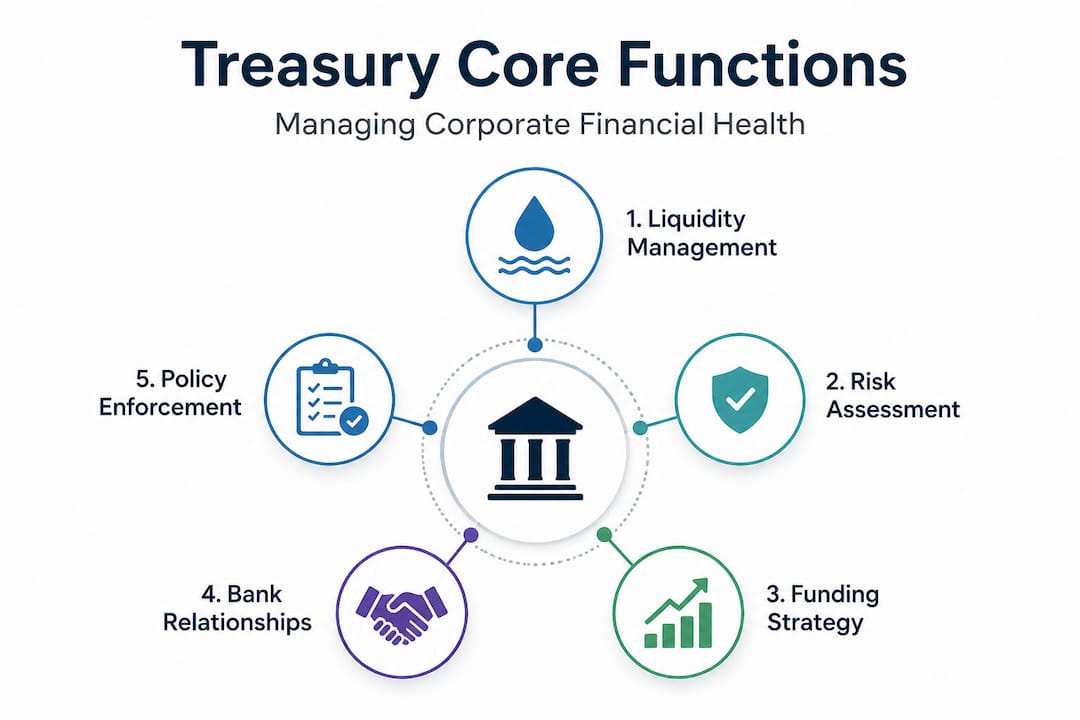
Corporate treasury is not a single task. It is a set of interconnected financial disciplines that together protect a company’s financial health and enable strategic growth. Think of it as the nerve center where capital flows, risk exposure, and financial obligations all converge.
At its core, treasury is responsible for ensuring the company has the right amount of money, in the right currency, in the right place, at the right time. That sounds simple until you multiply it across dozens of subsidiaries, multiple time zones, and currencies that shift by the hour. The mechanics involve cash forecasting, pooling for multinationals, hedging strategies, intercompany netting and loans, and the use of TMS for visibility and automation. Each of these elements requires specialized knowledge and coordinated execution.
Core treasury activities include:
- Cash forecasting: Projecting short and medium-term cash positions to avoid shortfalls or idle surplus
- Liquidity management: Ensuring the business can meet its obligations at all times, without over-borrowing or underutilizing cash
- Foreign exchange risk management: Identifying and hedging currency exposures created by cross-border transactions
- Intercompany funding: Moving capital efficiently between group entities to minimize external borrowing costs
- Bank relationship management: Negotiating credit facilities, services, and pricing across the company’s banking partners
- Working capital optimization: Partnering with procurement and sales to improve cash conversion cycles
Treasury also plays a critical role during M&A activity, where it must model funding structures, assess foreign exchange implications, and manage post-deal integration of financial systems. In large multinationals, treasury often has direct input on corporate finance decisions, including capital structure and dividend policy.
A treasury management system (TMS) is the operational engine that makes all of this possible at scale. Modern TMS platforms pull live bank data, automate cash positioning, flag currency exposures, and produce forecasts automatically. Without one, global treasury teams are working off spreadsheets that are outdated the moment they are printed.
Pro Tip: Set clear, written treasury policies before investing in technology. Technology amplifies both good and bad processes. If your cash management or hedging rules are ambiguous, automation will just execute the ambiguity faster.
How corporate treasury differs from bank treasury and financial management
One of the most persistent sources of confusion is treating corporate treasury, bank treasury, and financial management as interchangeable. They are not. Each has a distinct scope, purpose, and relationship to risk.
Corporate treasury vs. bank treasury vs. financial management:
| Dimension | Corporate treasury | Bank treasury | Financial management |
|---|---|---|---|
| Primary role | Supports business operations | Core revenue-generating activity | Operational financial control |
| Risk exposure | Managed to minimize impact | Managed to generate returns | Primarily cost and budget control |
| Focus | Liquidity, FX, funding | ALM, capital markets, NIM | P&L, reporting, compliance |
| Decision horizon | Short to medium term | Short to long term | Primarily short term |
| Technology reliance | TMS, ERP integration | Sophisticated trading platforms | ERP, accounting systems |
As experts note, bank treasury is a core business function, generating profit through asset/liability management and capital markets activity. Corporate treasury, by contrast, is a support function. Its job is to protect, not speculate. It preserves the company’s ability to execute its business strategy, not to generate trading income.
The distinction from financial management is equally important. Finance handles the past: reporting what happened, managing budgets, and ensuring compliance. Treasury handles the future: making sure the organization has the resources it needs to act on what comes next. Both are essential, but confusing them leads to gaps in accountability.
“The treasury function is no longer just a back-office operation managing cash. It is increasingly a strategic partner to the CFO and CEO, providing real-time intelligence on financial risk, capital efficiency, and market positioning.” — Industry consensus, echoed across leading corporate banking structures
This shift is not just philosophical. Real-time treasury capability, driven by technology, has changed what is operationally possible. Treasurers can now see their global cash position in seconds, not days. AI is starting to generate FX hedging recommendations based on live market data and company exposure. ESG considerations are increasingly shaping treasury decisions around green financing and sustainable supply chain funding.
The organizations that have absorbed this shift are pulling away from those that have not. If you still equate corporate finance and treasury with bill payment and cash balancing, you are measuring the function by standards that are roughly a decade out of date.
Operational pillars: Key processes and priorities for treasury teams
Understanding what treasury does conceptually is one thing. Understanding how the function actually spends its time tells a different story.
According to BCG benchmarking data, treasury teams allocate approximately 25% of their time to liquidity and cash management, 18% to bank relationship management, and 17% to financial risk management. The remaining time is distributed across working capital, regulatory compliance, technology management, and internal reporting.

Treasury time allocation (benchmark data):
| Treasury activity | Share of time |
|---|---|
| Liquidity and cash management | ~25% |
| Bank relationship management | ~18% |
| Financial risk management | ~17% |
| Working capital optimization | ~15% |
| Regulatory and compliance | ~13% |
| Technology and reporting | ~12% |
What is notable is that 70% of organizations see optimization potential in their treasury operations. Top priorities for treasury leaders include AI and automation investments, cited by 54% of respondents, and working capital improvement, cited by 43%. These figures reveal that even well-resourced treasury teams know they are operating below capacity.
A typical treasury monthly cycle in a multinational looks roughly like this:
- Week 1: Reconcile month-end bank statements, update 13-week cash forecast, review covenant compliance across credit facilities
- Week 2: Run intercompany netting cycle, settle intercompany positions, confirm FX hedge book against underlying exposures
- Week 3: Conduct bank relationship reviews, assess funding pipeline for upcoming capex or M&A, review short-term investment positions
- Week 4: Update board-level treasury report, stress-test liquidity under adverse scenarios, sign off on upcoming debt or commercial paper maturities
Each of these steps requires coordination across finance, accounting, legal, and banking partners. Delays in one area cascade quickly. For example, a late intercompany netting cycle can force a subsidiary to draw on a local credit facility at a higher cost, effectively wasting money that was sitting idle elsewhere in the group. Secure banking processes are critical at every stage, particularly when authorizing large transfers or managing access across multiple banking platforms.
Large organizations typically centralize treasury into a shared service structure, with a corporate treasury center managing global operations and regional hubs handling local market nuances. This structure allows advanced treasury management disciplines to be applied consistently across all entities, regardless of geography or currency. The policy framework that governs this is usually documented in a Treasury Policy Manual, which defines risk appetite, approved instruments, counterparty limits, and reporting requirements. Without this document, even a well-staffed treasury team will make inconsistent decisions under pressure.
For multinationals managing operations across emerging markets, advanced banking solutions that offer multi-currency accounts and real-time cross-border payment infrastructure are not optional. They are the foundation on which the treasury cycle depends.
Technology, best practices, and the future of corporate treasury
If there is a single theme defining treasury transformation in 2026, it is the shift from reactive to proactive. For decades, treasury operated on yesterday’s data. Spreadsheets, manual reconciliation, and batch-processed bank statements meant that by the time a treasurer knew what their cash position was, it had already changed. That model is being replaced.
Real-time treasury now means exactly that. Live bank feeds, automated cash positioning engines, and AI-driven forecasting tools mean treasurers can model liquidity scenarios on demand. This is not incremental improvement. It fundamentally changes the treasury team’s ability to advise the CFO, engage with lenders, and respond to market events.
Practices that define high-performing treasury teams today:
- Centralized treasury operations with a single, consolidated view of global cash and risk
- Documented risk appetite that governs hedging decisions, counterparty exposure, and investment policy
- Technology roadmaps that include TMS upgrades, ERP integration, and AI-assisted forecasting
- Cross-functional partnerships with procurement, sales, and investor relations to align financial flows
- ESG-aligned treasury policy covering green bond issuance, sustainable supply chain financing, and responsible investment mandates
- Scenario planning and stress testing built into the regular treasury calendar, not just used during crises
The AFP’s treasury and banking benchmarks consistently reinforce that best practices emphasize clear policies, centralization, and hedging strategies that align tightly with the organization’s actual risk appetite. There is no one-size-fits-all hedging ratio. A company with 80% of revenues in dollars and costs in euros needs a fundamentally different hedging approach than one with a naturally matched currency book.
AI deserves particular attention here. Many treasury teams are piloting machine learning models that analyze historical cash patterns, seasonal trends, and macroeconomic signals to produce forecasts that outperform rule-based models. The practical impact is fewer surprises, lower precautionary cash buffers, and better investment of surplus funds.
Pro Tip: Treat your TMS as a strategic investment, not an IT project. The most effective treasury transformations are led by the CFO and treasurer, with IT in a supporting role. When IT leads, the system gets built. When treasury leads, the system gets used.
Setting up global account infrastructure correctly from the start significantly reduces the friction that prevents technology from delivering its full value. Treasury systems are only as good as the banking data feeding them.
Perspective: Why treating treasury as an afterthought holds companies back
Let us be direct about something most treasury articles will not say plainly. A significant number of multinational companies are underinvesting in treasury, and they are paying for it in ways they cannot always see.
When treasury is resourced as a cost center and staffed primarily to keep transactions moving, the organization loses something harder to quantify: optionality. The ability to act fast during an acquisition. The capacity to restructure debt when rates shift favorably. The intelligence to know when a currency hedge is being taken at the wrong point in the cycle. These are not theoretical losses. They show up in earnings calls, in credit ratings, and in the stress that ripples through organizations during financial shocks.
The companies that navigated the 2020 liquidity crisis better than their peers had one thing in common: treasuries that had already built real-time visibility into their cash positions and had documented contingency funding plans. They were not smarter. They were better prepared, because they had invested in the function before the crisis demanded it.
What truly separates world-class treasury functions is not technology. It is discipline. The willingness to enforce policy when a business unit pushes back. The commitment to upskilling the team continuously. The organizational mandate that allows the treasurer to sit at the strategic table, not just execute instructions from it. These are cultural decisions made by CFOs and boards.
The advanced treasury tips that finance leaders often seek are less about exotic instruments and more about consistency: consistent forecasting, consistent policy application, and consistent investment in the people and systems that make the function work under pressure. The organizations that get this right do not just manage risk better. They grow faster, borrow cheaper, and operate with more confidence in uncertain markets.
Unlocking advanced corporate treasury with the right banking partner
Corporate treasury at the multinational level demands a banking partner who understands the complexity you manage every day. Not a generalist provider who treats your multi-currency structure as a niche edge case.
Prominence Bank was built for exactly this environment. Our advanced corporate banking solutions support multi-currency accounts, real-time cross-border transfers, and the kind of institutional-grade infrastructure that global treasury teams require. Whether you are optimizing cash pooling, managing FX exposure, or establishing a new entity structure, our corporate account setup process is designed to move at the pace your business demands. Explore our full range of corporate banking offerings to see how we support treasury teams operating across markets, currencies, and time zones.
Frequently asked questions
What are the main risks managed by a corporate treasury?
A corporate treasury controls liquidity, currency, interest rate, and counterparty risk for multinational firms. These risks span cash forecasting, hedging strategies, and intercompany funding across all group entities.
How is a treasury management system (TMS) used in corporates?
A TMS automates cash visibility, forecasting, currency exposure management, and treasury workflows across global entities. It integrates live bank feeds and intercompany netting to give treasurers a consolidated real-time view.
Why is centralization important in corporate treasury?
Centralization gives treasury leaders better control, risk oversight, and consistency across all business units. Best practices emphasize centralization as a foundation for effective hedging and policy enforcement at scale.
How does AI impact treasury operations?
AI enables real-time forecasting, faster decision making, and improved treasury efficiency through automation. With AI and automation a priority for 54% of treasury leaders, adoption is accelerating rapidly across global organizations.
Is corporate treasury more strategic or operational today?
Corporate treasury is now firmly a strategic partner, shaping global financial resilience and business growth. The shift from transactional to strategic reflects treasury’s growing role in advising the CFO on capital structure, risk, and market positioning.