
TL;DR:
- Proper preparation, including accurate recipient details and understanding fee options, ensures smoother offshore wire transfers.
- Comprehending total costs, regulatory compliance, and secure procedures helps prevent delays, hidden fees, and fraud.
Sending money across borders sounds straightforward until you discover a $60 intermediary fee nobody mentioned, your transfer is frozen pending compliance review, or the recipient gets less than expected because of an unfavorable exchange rate applied mid-route. Offshore wire transfers involve more moving parts than most people realize, and the gap between a smooth transaction and a costly, delayed one often comes down to preparation. This guide covers what you actually need to know: how to prepare, how to execute transfers securely, how to manage fees, and how to stay on the right side of international compliance requirements.
Table of Contents
- Key takeaways
- What you need before sending offshore wire transfers
- How to execute offshore wire transfers step by step
- Understanding and managing wire transfer fees
- Compliance and security essentials
- Troubleshooting common transfer problems
- My honest take on offshore wire transfers
- How Prominencebank supports your offshore transfers
- FAQ
Key takeaways
| Point | Details |
|---|---|
| Preparation prevents delays | Collect full recipient banking details including SWIFT/BIC codes and IBAN before initiating any transfer. |
| Hidden fees exceed flat fees | Total transfer costs include FX markups that often cost more than advertised flat fees. |
| Compliance is non-negotiable | Wire transfers over $10,000 trigger mandatory FinCEN reporting for US banks regardless of sender type. |
| Fee allocation choice matters | Selecting OUR fee allocation covers all intermediary costs upfront and protects the recipient’s received amount. |
| Security requires active diligence | Verify counterparties through secure channels and monitor transfers end-to-end to prevent fraud and scams. |
What you need before sending offshore wire transfers
Getting this part right is the single biggest factor in whether your transfer arrives on time and at full value. Most delays and compliance holds trace back to incomplete or inaccurate information provided at the initiation stage.
Recipient banking details you must have
Before you touch a transfer form, collect every piece of information your bank will require:
- Full legal name of the account holder, exactly as it appears at their bank
- IBAN (International Bank Account Number) for European and many other international banks
- SWIFT/BIC code of the recipient’s bank and, if required, the branch
- Full bank name and address, including country
- Recipient’s physical address for compliance verification
- Purpose of payment description, which many banks require to satisfy AML screening
Missing even one of these can cause a transfer to be returned or held for manual review, adding days to the process.
Regulatory and compliance prerequisites
US banks must report transfers exceeding $10,000 to FinCEN, and that threshold applies regardless of whether you are an individual or a business. If you are sending from a US account to an offshore institution, expect your bank to ask about the transfer’s purpose, source of funds, and the recipient’s relationship to you. Having documentation prepared, such as a contract, invoice, or gift letter, speeds this process considerably.
You also need to understand your bank’s per-transfer and daily limits. Some institutions cap outbound international transfers at $50,000 per day unless you request a temporary increase in advance. For larger amounts, that conversation with your bank needs to happen before the transfer date, not the morning you try to send.
| Document type | Why it is required |
|---|---|
| Government-issued ID | AML/KYC identity verification |
| Source of funds evidence | Compliance and anti-money laundering screening |
| Invoice or contract | Purpose of payment confirmation |
| Recipient bank letter | Confirms account ownership and banking details |
Pro Tip: Call your recipient bank directly to verify SWIFT and IBAN details rather than relying solely on what your payee tells you. Fraudsters have intercepted business email chains and substituted their own banking details, a scheme known as business email compromise.
How to execute offshore wire transfers step by step
Once your documentation is ready, the actual process is more structured than complex. The errors people make here are usually about rushing, which leads to mistyped account numbers or skipped fields.
-
Log in to your bank or transfer provider and locate the international or wire transfer section. For large amounts or corporate transfers, calling your relationship manager rather than using the online portal can reduce friction.
-
Enter recipient details exactly. Any discrepancy between the name you enter and the name on the receiving account can trigger a hold or rejection. Avoid abbreviations unless your recipient’s bank uses them officially.
-
Enter the transfer amount and currency. Decide whether you want your recipient to receive a specific amount in their currency or whether you are sending a fixed amount and they receive whatever converts to. This decision affects which fee allocation option you should choose.
-
Select your fee payment option. Banks typically offer three options:
- OUR: You pay all fees, including intermediary bank fees. Recipient receives the full amount.
- SHA (shared): You pay your bank’s outgoing fee; the recipient pays any fees deducted by their bank or intermediaries.
- BEN (beneficiary): Recipient pays all fees. You pay nothing upfront beyond the exchange rate cost.
Selecting OUR allocation costs more upfront but produces a predictable net amount for the recipient. For business payments where invoice amounts must match exactly, OUR is usually the right choice.
-
Add a payment reference. Include a clear reference such as an invoice number or contract ID. This protects both you and your recipient if there is ever a reconciliation dispute.
-
Review and confirm. Check every field before submitting. Once sent, corrections require contacting your bank immediately and may not always be possible before the transfer begins routing.
-
Save your transfer confirmation. Record the SWIFT reference number (also called an UETR, Unique End-to-End Transaction Reference). You will use this to track the transfer if it does not arrive on schedule.
Pro Tip: International wire transfers typically take 1 to 5 business days, with North America to Europe connections generally running faster. If you have a payment deadline, initiate at least 3 business days early to account for compliance screening and time zone gaps between correspondent banks.
Understanding and managing wire transfer fees

This is where most people get surprised. The advertised fee on your bank’s website is rarely the actual cost of sending money abroad.
The full cost breakdown
A typical offshore wire transfer involves four layers of cost:
- Sender bank fee: A flat outgoing wire fee, usually $25 to $50 for personal accounts and up to $100 for business accounts.
- Intermediary (correspondent) bank fees: Each bank in the routing chain can deduct $10 to $30 from the transfer principal. A transfer often passes through one to three correspondent banks depending on the destination.
- Receiver bank fee: The recipient’s bank may charge an incoming wire fee, typically $10 to $25.
- FX markup: The exchange rate your bank applies includes a margin above the mid-market rate, typically 2 to 4%. In emerging markets, receiver-side FX margins can reach 3 to 5%.
For a $5,000 transfer, total fees can realistically run between $140 and $300 once you account for all layers. That range matters a lot for businesses processing payments regularly.
Why the exchange rate costs more than you think
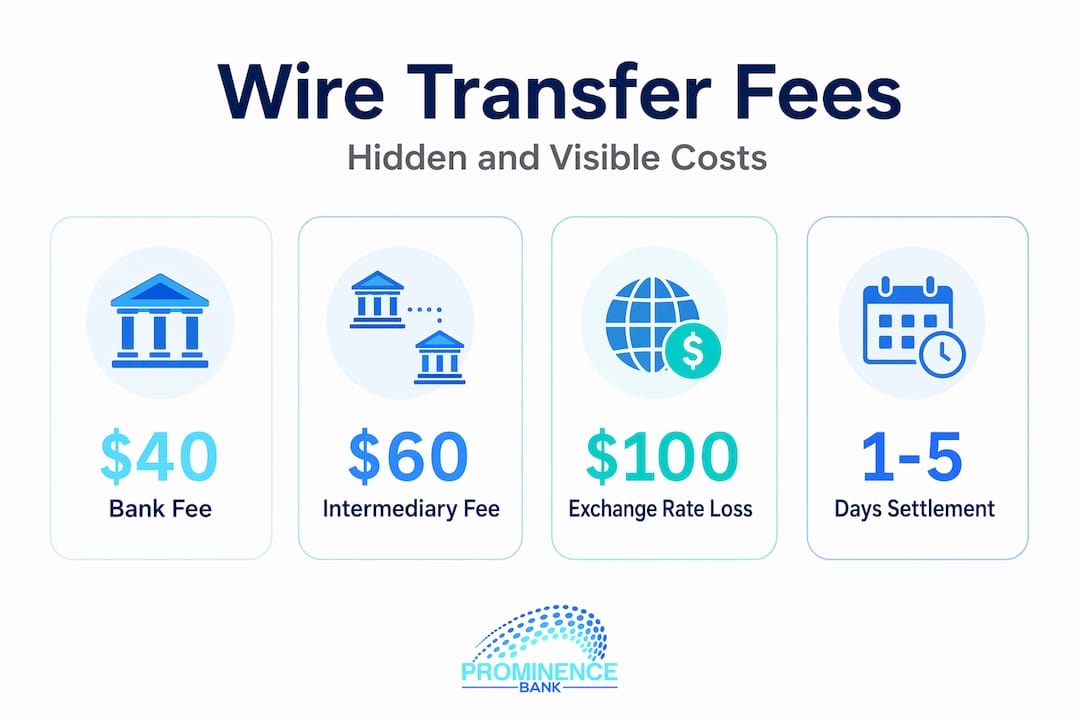
The exchange rate markup often surpasses the upfront transfer fee entirely. A 2% rate difference costs $20 on a $1,000 transfer and $200 on a $10,000 transfer. Comparing total costs including both the flat fee and the FX rate is more useful than looking at advertised transfer fees alone.
Pro Tip: Businesses paying multiple beneficiaries can reduce costs significantly by batching payments into a single transfer where possible. Flat fees are fixed per transaction, so consolidating reduces that fixed cost as a proportion of the total amount sent. Starting in 2026, transfers funded via cash, money orders, or cashier’s checks may also trigger a 1% federal excise tax, while electronically funded transfers remain exempt.
To reduce your wire transfer costs, work with transfer fee structures that offer transparent pricing and direct correspondent relationships rather than routing through multiple intermediaries.
Compliance and security essentials
Offshore wire transfers exist in a heavily scrutinized regulatory environment. That scrutiny is legitimate. Offshore transfers involving secrecy jurisdictions are among the most common mechanisms in money laundering schemes, and compliance failures expose both senders and their banks to serious consequences.
What regulators look for
When a transfer triggers review, regulators and banks examine a set of risk factors:
- Transfers to high-risk or secrecy jurisdictions
- Transactions that lack a clear business or personal justification
- Structuring, which means splitting one large transfer into smaller ones to avoid reporting thresholds
- Rapid movement of funds through multiple accounts or jurisdictions, known as layering
- Inconsistencies between stated purpose and the parties involved
Financial institutions now use graph analytics and NLP tools to detect suspicious offshore transfer patterns by analyzing transaction networks and flagging messaging inconsistencies. The technology behind compliance screening is far more sophisticated than most senders realize.
Compliance is not a bureaucratic inconvenience. It is the framework that protects your assets, your reputation, and your banking relationships. Approaching it proactively rather than reactively is always worth the effort. For a deeper look at what high-net-worth clients specifically need to understand, the compliance guidance for online banking at Prominencebank is a practical starting point.
Security practices that actually prevent fraud
Beyond regulatory compliance, protecting your transfers from fraud requires specific habits:
- Always verify payee banking details directly via phone or in-person confirmation, never via email alone.
- Use secure international banking practices including two-factor authentication and encrypted communication channels.
- Never initiate a wire transfer based on an urgent verbal or email request without independent verification, regardless of how legitimate it appears.
- Keep records of every transfer including confirmation numbers, exchange rates applied, and correspondence with the receiving party.
Pro Tip: For FBAR and Form 8938 reporting purposes, use the official Treasury reporting exchange rates when converting foreign account balances. Using the wrong rate is a common and easily avoidable compliance error.
Troubleshooting common transfer problems
Even well-prepared transfers run into issues. Knowing how to respond quickly limits the damage.
The most common cause of delays is a mismatch between the recipient name you entered and the name registered at the receiving bank. Banks are required to verify that these match, and any discrepancy will trigger a manual review or outright rejection. If you realize there is an error after submitting, call your bank immediately and ask them to send a SWIFT MT199 amendment message to the correspondent bank before the transfer progresses further.
If your transfer does not arrive within the expected window, request a SWIFT trace using your UETR number. Your bank can query the SWIFT network to identify which institution is holding the transfer and why. Most banks will do this at no charge after 3 to 5 business days.
Fee disputes are trickier. If the recipient receives less than expected due to intermediary deductions and you selected SHA, those deductions are technically correct. You can request a refund of the difference from your own bank if you believe the fee disclosure was unclear, but outcomes vary. Selecting OUR on future transfers eliminates this issue entirely.
Pro Tip: Keep your banking relationship active and communicative. Banks process transfers faster and extend more flexibility on holds and corrections to clients who communicate regularly and maintain account activity. An account that looks dormant or inconsistent in its transaction patterns is more likely to trigger friction when a large transfer appears.
My honest take on offshore wire transfers
I have seen clients lose thousands of dollars not to fraud or illegal activity, but to avoidable mistakes: the wrong fee option, a missing IBAN digit, or a transfer sent to a high-risk jurisdiction without the documentation to back it up. What surprises me most is how few people factor in the full cost of a transfer before sending it. They focus on the flat fee and ignore the exchange rate margin, which at scale is where the real money goes.
The second lesson I have picked up from working with international clients is that direct correspondent banking relationships matter more than most people know. When your bank has a direct relationship with the destination bank, transfers are faster, cheaper, and far less likely to be flagged by automated AML screening. Routing through three correspondent banks to reach a destination where a direct relationship exists is entirely avoidable with the right banking partner. That insight alone has saved clients significant amounts annually.
The misconception I hear most often is that offshore banking is inherently suspicious or legally risky. It is not. Offshore transfers are a normal part of global commerce, international employment, and cross-border investment. The risk comes from ignoring the compliance framework, not from using the tools themselves. If you approach international transfers with documentation, transparency, and a bank that understands the terrain, the process becomes routine rather than stressful.
— Harold
How Prominencebank supports your offshore transfers
Prominencebank is built specifically for clients who move money internationally as a regular part of their financial lives. Its multi-currency account solutions allow you to hold, send, and receive funds in multiple currencies without converting at unfavorable rates on every transaction. For businesses managing corporate structures across jurisdictions, the corporate banking platform provides direct correspondent banking access, AML/KYC-compliant onboarding, and transparent fee structures. Whether you are an individual managing offshore assets or a business processing regular international payments, Prominencebank’s infrastructure is designed to reduce friction, cost, and compliance exposure at every step.
FAQ
What information do I need to send an offshore wire transfer?
You need the recipient’s full legal name, IBAN or account number, SWIFT/BIC code, bank name and address, and a stated purpose of payment. Missing any of these commonly causes delays or rejections.
How long does an offshore wire transfer take?
Most international wire transfers take 1 to 5 business days, with transfers between North America and Europe often settling faster due to direct banking connections.
What does OUR, SHA, and BEN mean on a wire transfer?
These are fee allocation options. OUR means the sender pays all fees; SHA means fees are split; BEN means the recipient absorbs all fees. OUR protects the recipient’s received amount but costs the sender more upfront.
Do I need to report offshore wire transfers to the IRS?
US banks must report outgoing international transfers over $10,000 to FinCEN. Individuals with foreign accounts may also need to file FBAR or Form 8938 depending on account balances and activity.
How can I reduce fees on international wire transfers?
Compare total costs including both flat fees and exchange rate markups, choose providers with direct correspondent relationships, and use OUR fee allocation to prevent intermediary deductions from reducing the recipient’s amount.