
SWIFT GPI tracking gives you a UETR-backed, bank-updated view of a cross-border payment’s status, timing, and any deductions along the way. In practice, it means you can see whether your wire has left the sending bank, which intermediary touched it, and whether it landed at the beneficiary bank, all traced against a single reference number. You access this through your own bank, not through a public tracking site, and the level of detail you get depends on how much your bank chooses to expose.
TL;DR:
- Most banks offer basic SWIFT GPI status updates through their portals, but full transparency requires requesting a formal trace with the UETR.
- Trace requests should include amount, currency, value date, beneficiary details, and the UETR to speed up resolution and avoid delays.
- Fees and hold reasons, such as compliance checks, are often visible in Tracker updates but may not be explained due to regulatory restrictions.
- Banks that participate in API or ERP integration provide faster, automated status updates, reducing manual follow-up and reconciliation issues.
- Prominence Bank offers UETR-backed confirmation, multi-currency reporting, and transparent fee handling as part of its digital wire services for high-volume clients.
Table of Contents
- What Is SWIFT GPI Tracking and How Does It Work?
- How Do You Track a SWIFT Payment Right Now?
- How Do You Read Swift Tracker Results?
- What Won’t SWIFT GPI Tracking Fix?
- What Should You Ask Your Bank About GPI Tracking?
- How Prominence Bank Handles Swift GPI Tracking
- A Treasurer’s Take on Operational GPI Tracking
- Get UETR-Backed Tracking on Every Transfer
- Where to Read More on Swift Gpi
- Sources
- FAQ
What Is SWIFT GPI Tracking and How Does It Work?
Every SWIFT GPI payment carries a Unique End-to-End Transaction Reference, or UETR, a 36-character code generated the moment the payment instruction is created. It sits in field 121 of an MT103 message or in the equivalent tag of an ISO 20022 pacs.008 message, and it travels unchanged with the payment through every bank it passes on the way to the beneficiary. Think of it as a VIN number for a wire transfer: unique, permanent, and useless to anyone who doesn’t know where to look for it.
That reference feeds into the Swift Tracker, a central system that participating banks update as the payment moves. Each bank in the chain confirms receipt, applies its processing, and reports the outcome back into the Tracker, largely because SWIFT’s Universal Confirmations rulebook obligates GPI member banks to report a final credit or rejection for every payment, not just the ones that go smoothly.
Here’s the distinction that trips people up: the Tracker itself is a bank-to-bank tool. Your bank, and every intermediary bank, can query it directly using the Basic Tracker, which is free to SWIFT members. You, as the customer, don’t log into that system. Instead, your bank pulls the status and repackages it into whatever client-facing portal, app, or email update it offers. Two banks can look at the exact same UETR in the Tracker and give their customers very different levels of detail, because the client experience is a layer your bank builds on top of the network, not the network itself.
How Do You Track a SWIFT Payment Right Now?
If you’re waiting on a wire, don’t wait for it to “show up.” Run these steps instead.
- Find the UETR. It’s on your payment confirmation slip, in your online banking transaction detail, or buried in the MT103 or pacs.008 message your bank can pull up for you. It looks like a long string of letters and numbers, something like
12a34b56c789d012ef34ab567890c123. - Check your bank’s portal first. Most GPI member banks surface a basic status (initiated, in progress, credited) inside online banking without you having to ask anyone.
- Call customer service if the portal is thin. Give them the UETR and ask them to run a GPI trace. This pulls live status from the Tracker rather than relying on cached data.
- If you’re a corporate treasurer, push further. Ask about API access or Pay & Trace activation, which feeds Tracker updates directly into your treasury or ERP system instead of forcing someone to log into a portal every time.
- If a beneficiary claims the money never arrived, escalate through your own bank, not theirs. A UETR handed over by the receiving party isn’t enough on its own; your bank has to submit the official trace request.
When you request a trace, have the amount, currency, value date, and beneficiary details ready alongside the UETR. Banks move faster when they don’t have to hunt for context.
Pro Tip: Save the UETR the moment you send a wire, not after something looks wrong. If a payment stalls three days later, you’ll want that reference in hand immediately instead of digging through old emails while a beneficiary is asking where their money is.
How Do You Read Swift Tracker Results?
Tracker output generally falls into a handful of statuses: in flight (moving through the network), on hold (usually a compliance or documentation stop at one of the banks), rejected (returned, often with a reason code), and credited (funds posted to the beneficiary’s account). “Credited” is the status that actually matters, since “delivered to beneficiary bank” and “credited to beneficiary account” are not the same thing. A payment can sit at the beneficiary bank for a day before it actually posts to the account.
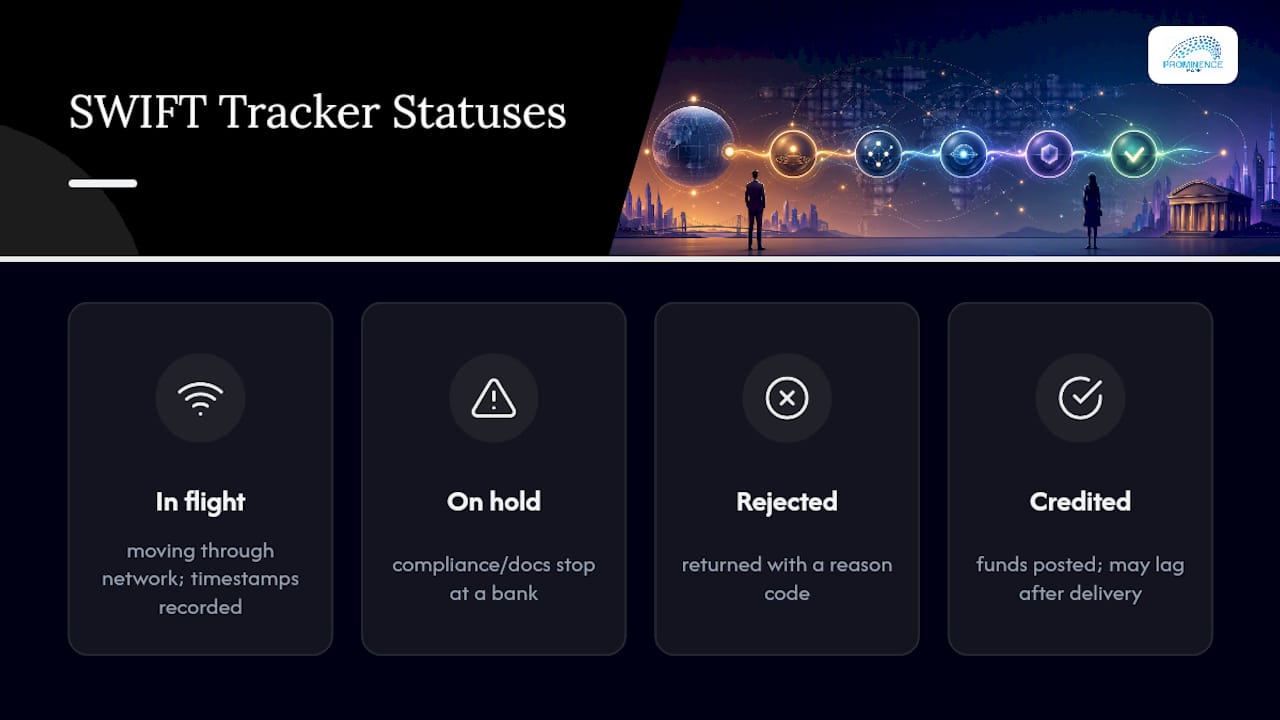
Intermediary hops show up as separate confirmation entries, each with its own timestamp, and this is where fee deductions usually surface. If you sent $10,000 and the beneficiary received $9,965, the Tracker often shows which bank in the chain took the $35, letting you reconcile the gap instead of guessing. Timing varies, but SWIFT’s own network statistics show a large share of GPI payments reaching the beneficiary bank within 30 minutes, with most credited within 24 hours. The gap between “reached the bank” and “credited” is almost always the receiving bank’s internal processing, not the network.
What Won’t SWIFT GPI Tracking Fix?
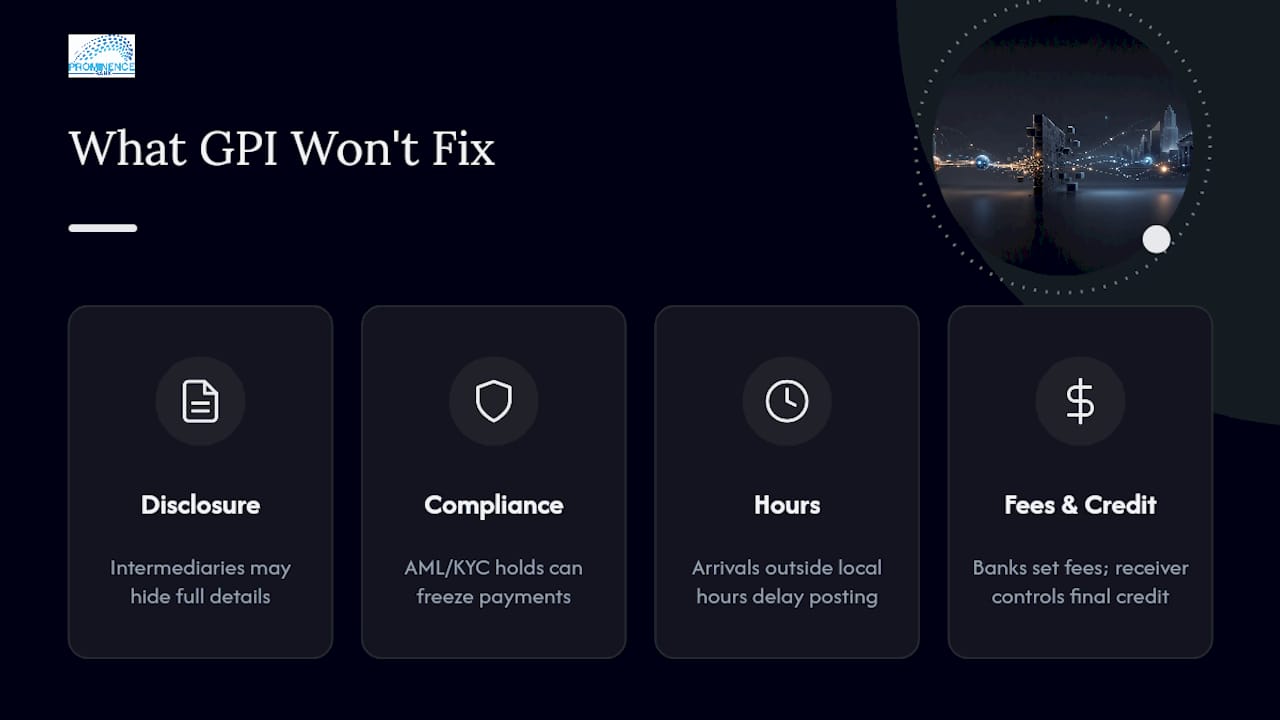
Tracking visibility and payment speed are two different things, and GPI only guarantees the first one. Some correspondent banks in the chain don’t expose full detail to the client-facing side, so your bank might show you “in progress” for hours while the Tracker itself has more granular information sitting one layer up. That’s a bank-side limitation, not a network failure.
Compliance holds are the most common real delay. AML and KYC checks can freeze a payment at any hop, and GPI tracking will tell you a payment is on hold without necessarily telling you why, since that detail often can’t be shared for regulatory reasons. Time zones and local banking hours add another layer: a payment that “arrives” on a Friday afternoon at a bank in a different hemisphere may not post until Monday. GPI also shows you fee deductions after the fact, but it never controls them; each bank in the chain sets its own charges, and ACI Worldwide notes that final credit timing always depends on the receiving bank’s own processing, not the tracking layer.
What Should You Ask Your Bank About GPI Tracking?
Getting reliable visibility comes down to what you demand upfront, not what you hope for after a payment stalls.
- Require the UETR on every outgoing confirmation, and ask for proof-of-credit documentation as a standard part of the service, not a special favor.
- If you’re moving volume, request API or ERP integration through Pay & Trace rather than relying on manual portal checks; treasury-grade setups typically ingest Tracker data automatically to keep reconciliation from becoming a full-time job.
- Nail down fee handling before you send: OUR (sender pays all fees), SHA (shared), or BEN (beneficiary absorbs them). Ask for the fee breakdown at the time of instruction, not after the money’s gone.
- Ask whether your bank participates in SWIFT’s analytics and observer programs, and get a stated turnaround time for trace requests in writing.
Pro Tip: If your bank can’t tell you its fee-handling default without checking, that’s a sign its GPI reporting probably isn’t granular either. The two usually go together.
How Prominence Bank Handles Swift GPI Tracking
Prominence Bank issues SWIFT GPI-enabled transfers with UETR-backed confirmation delivered as standard, not as an add-on request. Corporate and institutional clients get API-ready integration for status updates, which matters if you’re running multi-currency flows and need reconciliation data feeding your own systems rather than a portal you have to check manually. Every transfer sits within the bank’s AML/KYC compliance framework, and clients can request proof-of-credit documentation directly, which keeps disputes over “was it sent” from turning into weeks of back-and-forth.
A Treasurer’s Take on Operational GPI Tracking
Manual portal checks work fine for occasional wires. Past a certain volume, they become a liability. If you’re moving payments weekly, push for API integration and don’t accept “check the portal” as your only option. One anonymized case that sticks with me: a mid-size exporter recovered a stuck six-figure payment in under a day because the UETR let their bank file an immediate trace instead of starting from scratch.
— Harold
Get UETR-Backed Tracking on Every Transfer
Manual bank portals and phone traces work until your payment volume outgrows them, and that’s exactly where most of the friction in cross-border transfers actually lives. Prominence Bank builds UETR-backed confirmation and API-ready reporting into its multi-currency account infrastructure from account opening, so treasury teams and high-net-worth clients aren’t stuck requesting basic status updates by phone.

If reconciliation delays or fee surprises have cost you time on past wires, that’s usually a sign your current bank isn’t exposing enough Tracker detail. Prominence Bank’s digital banking services for high-net-worth clients are built around direct SWIFT connectivity and transparent fee handling from the first transfer. Start by requesting an account setup consultation to see what UETR-backed reporting looks like on your own transaction volume.
Where to Read More on Swift Gpi
For the technical detail: SWIFT’s GPI product overview, the Basic Tracker documentation, and the GPI service rulebook.
This article is general information, not a substitute for advice from a qualified financial advisor. Consult a qualified financial professional about your own circumstances before acting on anything here.
Sources
FAQ
What Is GPI Tracking?
GPI tracking is the system SWIFT built around the UETR and the Swift Tracker, letting participating banks report a payment’s status at every hop until it’s confirmed credited to the beneficiary.
How Can I Track a SWIFT Money Transfer?
Get the UETR from your payment confirmation, check your bank’s online portal for status, and if it’s not showing enough detail, call your bank and ask them to run a formal GPI trace using that reference.
What Is the SWIFT GPI System?
It’s SWIFT’s global tracking and confirmation framework for cross-border payments, built on the UETR identifier, the bank-facing Tracker, and the Universal Confirmations rule requiring every member bank to report a final outcome.
How Can I Track My International Money Transfer?
Your bank is the access point, not a public website; ask for the UETR, request a trace if status seems stalled, and for high-volume transfers, ask about API integration so status updates flow automatically into your own systems.