
TL;DR:
- Targeted, sophisticated cyberattacks require layered security including MFA encryption and behavioral biometrics.
- Daily security practices like device verification, MFA use, and out-of-band transaction confirmation are essential.
- Building resilience relies on continuous monitoring, incident response planning, and security culture leadership.
Cyberattacks on wealthy individuals and corporations are not random. They are targeted, patient, and increasingly sophisticated. 43% of family offices experienced a cyberattack in the last 12 to 24 months, with phishing leading the charge. For high-net-worth individuals and corporate clients managing significant cross-border assets, a single lapse in your online banking process can expose accounts, compromise privacy, and trigger regulatory consequences. This guide walks you through a structured, step-by-step secure online banking process built specifically for clients who cannot afford to treat security as an afterthought.
Table of Contents
- Setting up a secure online banking environment
- Implementing the secure online banking process: Step-by-step
- Building resilience: Monitoring, incident response, and threat intelligence
- Advanced protections for privacy and global connectivity
- Why technology alone isn’t enough for online banking security
- Elevate your security with tailored banking solutions
- Frequently asked questions
Key Takeaways
| Point | Details |
|---|---|
| Layered security is crucial | Combine technology and user awareness for maximum protection. |
| Incident readiness matters | Have an incident response plan and strong frameworks to reduce loss. |
| Global access demands advanced privacy | Secure cross-border banking requires specialized tools and settings. |
| Continuous training pays off | Invest in ongoing user education to prevent most breaches. |
Setting up a secure online banking environment
Security starts before you ever log in. The foundation of a protected online banking experience is a layered technology stack that makes unauthorized access exponentially harder at every entry point.
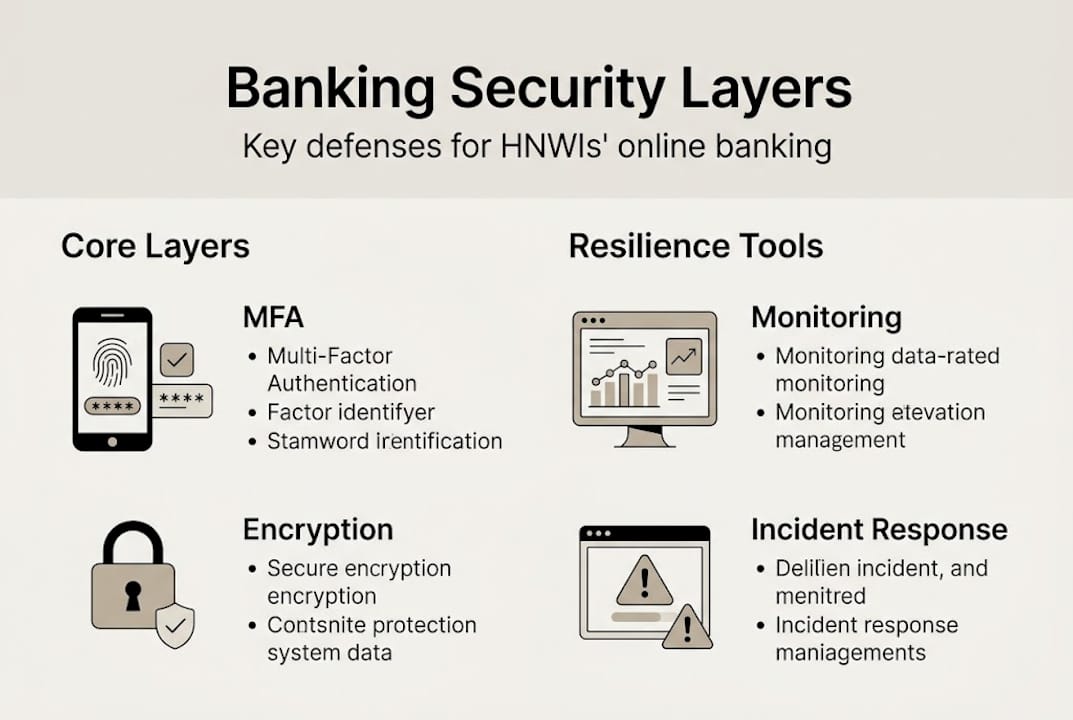
The core technologies every sophisticated client should require from their banking environment include:
- Multi-factor authentication (MFA): Requires two or more verification steps before granting access. This alone eliminates most automated intrusion attempts.
- End-to-end encryption: Ensures data in transit and at rest cannot be read by third parties, even if intercepted.
- Zero-trust architecture: Treats every access request as potentially hostile, requiring continuous verification regardless of network location.
- Behavioral biometrics: Analyzes how you type, scroll, and interact with your device to detect account takeover attempts in real time.
- Anti-malware and endpoint detection: Protects devices from keyloggers, spyware, and credential-harvesting tools.
- Secure password managers: Eliminate weak, reused passwords across banking platforms without sacrificing convenience.
- VPN with dedicated IP: Masks your network location and prevents man-in-the-middle attacks on public or shared networks.
These are not optional upgrades. MFA, encryption, and behavioral biometrics block 99.9% of automated attacks. The gap between banks that implement all of these layers and those that implement only some is enormous.
| Security layer | Primary function | Best for |
|---|---|---|
| MFA | Identity verification | All account access |
| End-to-end encryption | Data protection in transit | Transactions, messaging |
| Zero-trust architecture | Continuous access control | Corporate networks |
| Behavioral biometrics | Anomaly detection | High-value accounts |
| VPN with dedicated IP | Network privacy | Remote and international access |
| Secure password manager | Credential hygiene | Multi-platform users |
When evaluating secure banking technology, look beyond the feature list. Ask how each layer integrates with the others and whether the bank’s infrastructure is independently audited. The digital bank security benefits of a properly integrated stack far exceed what any single tool can offer alone. For those beginning the process, a secure account opening experience should already reflect these standards before you fund a single account.
Pro Tip: Prioritize financial platforms that combine certified encryption with behavioral biometrics. The combination catches threats that static credentials simply cannot detect.
Implementing the secure online banking process: Step-by-step
Once your environment is configured, the daily process matters just as much as the underlying technology. Human behavior is where most security frameworks succeed or fail.
- Verify your device before logging in. Only use devices you personally control and that have current anti-malware protection. Never access banking accounts from shared or public computers.
- Authenticate through MFA on every session. Do not disable or bypass MFA for convenience. Use an authenticator app rather than SMS-based codes, which are vulnerable to SIM-swapping attacks.
- Confirm the URL and certificate. Before entering credentials, verify the banking URL is correct and the connection is secured with a valid SSL certificate. Phishing sites often replicate legitimate interfaces precisely.
- Review pending alerts before transacting. Check for any unauthorized access notifications or flagged activity before initiating transfers or approvals.
- Validate all transaction details out-of-band. For high-value or international transfers, confirm recipient details through a separate, verified communication channel, not through the same platform or email thread.
- Log out completely after every session. Do not rely on session timeouts. Manually close authenticated sessions, especially on mobile devices.
- Review your access log regularly. Most secure banking platforms provide a log of recent logins and device activity. Check it weekly.
“Human factors like phishing training and multi-step verification processes prevent 80% of breaches. Technology sets the ceiling; your team’s behavior determines whether you reach it.”
| Secure process step | Common mistake to avoid |
|---|---|
| MFA on every login | Disabling MFA for speed |
| Out-of-band transaction verification | Confirming via the same email chain |
| Dedicated device use | Accessing accounts on shared devices |
| Regular access log review | Ignoring login history |
| Full logout after sessions | Relying solely on auto-timeout |
For securing corporate banking environments with multiple authorized users, role-based access controls and approval workflows add another layer of protection. Each user should have only the permissions their role requires, nothing more. Online bank compliance standards increasingly require documented access policies for corporate accounts.

Pro Tip: Always use out-of-band verification for high-value or overseas transactions. A quick call to a verified contact number takes 60 seconds and can prevent six-figure losses.
Building resilience: Monitoring, incident response, and threat intelligence
Even the most disciplined daily process cannot guarantee zero incidents. What separates resilient organizations from vulnerable ones is preparation for the moment something goes wrong.
Continuous monitoring is not optional for sophisticated clients. Real-time anomaly detection, automated alerts for unusual transaction patterns, and periodic third-party audits form the minimum standard. The following elements should be part of every incident response plan:
- Identify: Detect the breach or anomaly through automated monitoring or user reporting.
- Contain: Immediately restrict access to affected accounts or systems to prevent further exposure.
- Eradicate: Remove the threat vector, whether that is a compromised credential, device, or access point.
- Recover: Restore normal operations from verified, clean backups and confirm data integrity.
- Review: Conduct a post-incident analysis to update protocols and close the gap that allowed the breach.
Integrated risk frameworks per ISO 27001/NIST and threat intelligence sharing boost resilience by 37%. That figure represents a measurable, structural advantage for organizations that adopt these standards versus those that rely on ad hoc responses.
| Security framework | Core function | Key benefit |
|---|---|---|
| ISO 27001 | Information security management | Systematic risk assessment |
| NIST Cybersecurity Framework | Threat identification and response | Structured incident handling |
| SOC 2 Type II | Operational security controls | Third-party audit verification |
| PCI DSS | Payment data protection | Transaction security compliance |
Threat intelligence sharing, where institutions exchange anonymized attack data to improve collective defenses, is increasingly standard among top-tier banks. Ask your institution whether they participate in any formal intelligence-sharing programs.
For clients managing resilient banking transfers across multiple jurisdictions, backup systems and tested recovery procedures are critical. Downtime during a transfer window can have real financial consequences. Those managing digital assets should also ensure crypto account security is integrated into the same incident response framework, not treated as a separate silo.
Advanced protections for privacy and global connectivity
For clients operating across multiple jurisdictions or managing complex asset structures, baseline security is a starting point, not a finish line. Advanced privacy and connectivity protections address threats that standard configurations simply do not anticipate.
Key advanced privacy tools and strategies include:
- Dedicated VPN infrastructure: Unlike shared commercial VPNs, a dedicated VPN provides a private, encrypted tunnel tied exclusively to your organization, eliminating the risk of shared-server vulnerabilities.
- Private banking channels: Secure, encrypted communication lines between you and your banking team, separate from standard email or messaging platforms.
- Device isolation: Maintain dedicated devices used exclusively for banking activity, never for general browsing, email, or third-party applications.
- Segmented access controls: For complex organizations, divide banking access by function, geography, or asset class so that a breach in one area cannot cascade across the entire structure.
- Least-privilege access policies: Every user, including senior executives, should access only what their specific role requires. This limits the blast radius of any compromised account.
- Jurisdiction-specific compliance layers: Clients operating across multiple regulatory environments need controls that adapt to local requirements without creating gaps at the intersection of different legal frameworks.
Comprehensive frameworks reduce incident impact by 60% and response time by 45%, with family offices that prioritize cyber leading resilience benchmarks across the sector. That is not a marginal improvement. It is the difference between a contained incident and a reputational crisis.
For clients seeking global secure banking across multiple time zones and regulatory frameworks, the architecture must be designed for that complexity from the start. Retrofitting global security onto a domestic-first platform creates structural vulnerabilities. Explore exclusive privacy services designed specifically for clients whose privacy requirements exceed what standard retail banking can accommodate.
Pro Tip: Request customizable security settings for each region or asset class you operate in. A single global security profile rarely accounts for the specific regulatory and threat landscape of each jurisdiction.
Why technology alone isn’t enough for online banking security
Here is the uncomfortable reality most vendors will not tell you: the best security stack in the world underperforms when the people using it are not engaged, trained, and supported by leadership that takes security seriously.
We have seen sophisticated clients invest heavily in enterprise-grade tools, then lose six figures because a senior executive clicked a convincing phishing email. Human factors drive 80% of breaches. That statistic has not changed meaningfully in a decade, despite massive increases in technology spending.
The firms that get the best return on their security investment are not necessarily the ones with the most advanced tools. They are the ones where security is treated as a leadership responsibility, not an IT department problem. Regular training, simulated phishing exercises, and clear escalation protocols transform technology from a passive barrier into an active defense system.
For security culture in banking to take hold, it needs visible commitment from the top. When principals and C-suite executives participate in training and enforce protocols without exception, the entire organization follows. Technology sets the ceiling. Culture determines whether you reach it.
Elevate your security with tailored banking solutions
The strategies covered here reflect what genuinely secure, globally connected banking looks like in practice. Putting them into action requires a banking partner built for exactly this level of complexity.
Prominence Bank’s corporate banking services are designed for high-net-worth individuals and institutional clients who require more than standard security assurances. From multi-currency accounts with layered access controls to digital currency solutions integrated within a compliant, private framework, every service reflects the standards outlined in this guide. Review our banking security process to understand how Prominence Bank operationalizes security at every layer of client engagement.
Frequently asked questions
What is the most effective way to prevent online banking fraud?
Deploying MFA, ongoing phishing awareness training, and strict device hygiene together blocks 99.9% of automated attacks. No single measure is sufficient; the combination is what creates a genuinely resilient defense.
Which compliance frameworks should sophisticated clients require from their bank?
Global leaders rely on ISO 27001 and NIST frameworks for systematic threat assessment, structured incident response, and independently verified security controls. These are the benchmarks worth demanding from any banking partner.
How fast can incident response limit financial loss in online banking?
When comprehensive frameworks are in place, incident impact drops by 60% and response time improves by 45%. Speed of containment is the single most important variable once a breach is detected.
Are advanced privacy features necessary if standard security is strong?
Yes. Dedicated privacy features, private banking channels, and jurisdiction-specific controls protect high-value clients from targeted attacks and regulatory exposure that standard security configurations are not designed to address.
Why is user training as important as technology?
Human error causes 80% of breaches, making consistent training and leadership accountability the highest-leverage investment in any security program. Technology amplifies a trained team; it cannot replace one.