
TL;DR:
- International payment processing involves cross-border transactions that rely on gateways, currency conversion, and compliance protocols to ensure reliable global fund transfers. Utilizing local acquiring, interchange-plus fees, and multi-provider orchestration reduces costs, declines, and downtime, supporting scalable international business operations. Treating global payment infrastructure as essential operational infrastructure rather than a cost-saving measure is key to successful cross-border growth.
International payment processing is the infrastructure by which businesses send and receive funds across national borders, involving payment gateways, currency conversion, compliance protocols, and fraud controls to execute global transactions reliably. For any company operating beyond its home market, the mechanics of cross-border payments directly affect cash flow, customer experience, and regulatory standing. Providers like Stripe, BlueSnap, and PayPal have made entry-level access easier, but the real complexity lies in fees, declined transactions, and regulatory fragmentation across jurisdictions. Understanding how these systems work is the prerequisite for building a payment operation that scales.
What are the primary types of international payment processing methods?
Cross-border payment infrastructure falls into four broad categories: card networks, bank transfers, digital wallets, and local acquiring. Each carries different cost profiles, approval rates, and regional acceptance levels. Choosing the wrong method for a given market is one of the most common and expensive mistakes international businesses make.

Card networks like Visa and Mastercard remain the dominant rails for consumer and B2B e-commerce payment processing globally. Bank transfers, including SWIFT and SEPA, are preferred for high-value B2B transactions where speed matters less than cost certainty. Digital wallets such as Apple Pay, Google Pay, and Alipay dominate specific regions, with Alipay holding commanding share across Southeast Asia and China. Ignoring regional wallet preferences in those markets means accepting a structurally lower conversion rate.
Online payment gateways sit on top of these rails and determine how transactions are routed, authorized, and settled. The key distinction between providers is depth versus simplicity:
- Stripe: Developer-first, strong API, excellent for businesses building custom checkout flows across multiple currencies
- BlueSnap: Built specifically for global merchants, with local acquiring in 50+ countries that routes transactions as domestic to reduce fees
- PayPal: Widest consumer recognition globally, preferred by smaller merchants and marketplaces for its trust factor
Payment orchestration platforms, offered by companies like ACI Worldwide, go beyond what a basic gateway provides. Orchestration enables automatic failover and multi-channel management from a single integration point, which is essential for businesses running transactions across multiple regions simultaneously. A basic gateway processes payments through one provider. An orchestration platform manages several providers at once, switching between them based on cost, approval rate, or availability.
Pro Tip: If your business processes payments in more than three countries, evaluate an orchestration platform before committing to a single gateway. The integration overhead is higher upfront, but the long-term control over routing and redundancy is worth it.
How do international payment processing fee structures work?
Fee structures in cross-border transactions are layered, and most merchants only see the total charge without understanding what drives it. The three core cost components are interchange fees (paid to the card-issuing bank), scheme fees (paid to Visa or Mastercard), and processor margins. Cross-border transactions add a fourth layer: up to 2% additional cross-border fee on top of standard interchange, applied by card networks to account for perceived settlement risk.
Flat-rate vs. interchange-plus pricing
Flat-rate pricing charges a single percentage per transaction regardless of card type or geography. It is simple to forecast but expensive at scale. Interchange-plus pricing passes the actual interchange cost through to the merchant and adds a fixed processor margin on top. The difference compounds quickly with volume.
A merchant processing $250,000 monthly could save $13,500 annually by switching from flat-rate to interchange-plus pricing. That figure represents real margin, not a rounding error. For high-volume businesses, flat-rate costs escalate at scale in ways that marketing materials rarely disclose.
| Fee Type | Typical Range | Notes |
|---|---|---|
| Interchange | 0.5% to 2.5% | Varies by card type, issuing country |
| Cross-border surcharge | Up to 2% | Applied by card networks on foreign-issued cards |
| Processor margin (flat-rate) | 2.9% + $0.30 | Fixed regardless of card type |
| Processor margin (interchange-plus) | Interchange + 0.2% to 0.5% | Lower at volume |
| FX conversion | 0.5% to 3% | Depends on provider and currency pair |
Cost optimization strategies worth implementing immediately:
- Use local acquiring in your primary markets to eliminate cross-border surcharges entirely
- Negotiate interchange-plus pricing once monthly volume exceeds $80,000
- Analyze your actual card mix before estimating fees. A high proportion of corporate or rewards cards carries significantly higher interchange than standard consumer cards
- Explore fee structure comparisons across flat-rate, interchange-plus, and network offset pricing models before signing contracts
Pro Tip: Request a sample statement analysis from any prospective processor. They apply your actual transaction history to their pricing model so you see real projected costs, not hypothetical averages.
What technical and security considerations matter for global payments?
Security and compliance are not optional layers in international payment processing. They are structural requirements that determine whether transactions complete, accounts stay active, and businesses avoid regulatory penalties. The technical baseline starts with PCI DSS compliance, which governs how cardholder data is stored, transmitted, and processed. Every gateway you use must be PCI DSS Level 1 certified.
Beyond PCI DSS, regional regulations add complexity. The EU’s Strong Customer Authentication (SCA) requirement under PSD2 mandates two-factor verification for most online transactions, directly affecting checkout conversion rates if not implemented correctly. GDPR governs how customer payment data is stored and shared across borders. Strong compliance support reduces transaction declines and regulatory risk when operating internationally, and businesses that treat compliance as an afterthought pay for it in declined transactions and remediation costs.
The following technical standards are worth building into your payment infrastructure from the start:
- PCI DSS Level 1 certification for all payment gateways and processors in your stack
- ISO 20022 messaging standards for B2B cross-border transfers, which enable richer transaction data and faster exception resolution
- Verification of Payee (VOP) protocols that validate payee details before funds move, eliminating settlement exceptions and misdirected payments
- Multi-provider redundancy, where 90% of currency flows are supported by four or more providers to minimize downtime during outages
- Dynamic routing via orchestration platforms that automatically switch processors when one fails, maintaining transaction continuity without manual intervention
Businesses with complex supply chains benefit most from ISO 20022 and VOP adoption. Pre-movement validation removes the friction that causes B2B payment delays, which often run into days rather than hours under legacy SWIFT messaging.
Pro Tip: Review your international banking security practices annually. Regulatory requirements in the EU, UK, and APAC shift frequently, and a compliance gap in one jurisdiction can freeze your entire payment operation.
How to choose and implement an international payment solution
Selecting a cross-border payment solution is a scoping exercise before it is a vendor comparison. Businesses that skip the scoping phase end up paying for capabilities they do not need or missing ones they do. Start by defining four parameters: monthly transaction volume, target regions and currencies, required payment methods per market, and integration complexity your technical team can support.
With those parameters defined, evaluate providers against this framework:
- Coverage: Does the provider support local acquiring in your top three markets? Local acquiring is the single highest-impact cost lever available.
- Fee structure: At your projected volume, does interchange-plus pricing deliver meaningful savings over flat-rate? Run the numbers with your actual card mix.
- Integration: Does the provider offer a hosted payment page, a full API, or both? Hosted pages reduce PCI scope; full APIs offer more control.
- Redundancy: Does the provider support multi-gateway failover, or do you need an orchestration layer on top?
- Support: Does the provider offer dedicated account management, or is support ticket-based? For high-volume merchants, response time on payment failures is a revenue issue.
The right provider also depends on business size. Smaller businesses prefer PayPal for its simplicity and consumer trust, while B2B firms with complex global networks require more advanced infrastructure. A single-gateway strategy works for businesses operating in one or two markets with predictable volume. Businesses scaling across five or more markets need a multi-gateway strategy managed through an orchestration platform.
Express processing innovations now allow nearly 100% of payments to settle within 24 hours, with many completing within seconds. Settlement speed matters for working capital. Businesses that previously waited three to five days for cross-border settlements can now treat international receipts as near-immediate liquidity.
Pro Tip: Build your monitoring stack before you go live, not after. Track authorization rates, decline reasons, and settlement times by market from day one. Patterns in decline data reveal whether you have a routing problem, a compliance gap, or a fraud exposure before they become material.
Key takeaways
Effective international payment processing requires local acquiring, interchange-plus pricing at scale, and multi-provider redundancy to minimize costs, declines, and downtime across global markets.
| Point | Details |
|---|---|
| Local acquiring cuts costs | Routing transactions as domestic eliminates cross-border surcharges and improves approval rates. |
| Interchange-plus saves money at scale | Merchants over $80,000 monthly should model interchange-plus against flat-rate using their actual card mix. |
| Compliance is structural, not optional | PCI DSS, SCA, and ISO 20022 compliance directly affect transaction approval rates and regulatory standing. |
| Orchestration beats single gateways | Multi-provider orchestration platforms provide failover, dynamic routing, and unified reporting across markets. |
| Settlement speed affects working capital | Near-instant settlement options now exist and should factor into provider selection for cash-flow-sensitive businesses. |
Why I stopped optimizing for the lowest fee first
After years of watching businesses build their payment infrastructure around the cheapest transaction fee they could find, I have come to a firm conclusion: fee minimization as a primary strategy is a trap. The businesses that optimize for the lowest headline rate almost always end up with a provider that lacks local acquiring in their growth markets, has no meaningful failover capability, and charges for every support interaction. The savings on paper evaporate the first time a major market goes offline during peak trading.
The smarter frame is total cost of operation, not cost per transaction. That includes decline rates (a 5% higher decline rate on a $1 million monthly volume is $50,000 in lost revenue), settlement delays that tie up working capital, and the engineering hours spent maintaining a fragile single-gateway integration. Payment orchestration platforms are critical for growing businesses precisely because they convert what would be a series of individual vendor relationships into a managed, redundant system.
I also think the compliance conversation gets underweighted. Businesses entering the EU market without proper SCA implementation, or operating in APAC without understanding local data residency requirements, are not just risking fines. They are risking account termination by their processor. That is an existential operational risk, not a compliance checkbox. The businesses I have seen scale cross-border payments successfully all share one trait: they treat global payment solutions as infrastructure, not as a cost center to be minimized.
— Harold
How Prominencebank supports your cross-border payment operations
Prominencebank is built for businesses that operate across borders and cannot afford payment infrastructure that fails under complexity. Its multi-currency business accounts hold and transact in multiple currencies simultaneously, eliminating the conversion friction that erodes margins on every cross-border receipt. For businesses managing complex corporate structures, Prominencebank’s corporate banking solutions integrate directly with leading payment gateways and orchestration platforms, giving treasury teams a single point of control over global payment flows. Compliance support, AML/KYC infrastructure, and direct access to global financial rails are built into the account, not sold as add-ons.
FAQ
What is international payment processing?
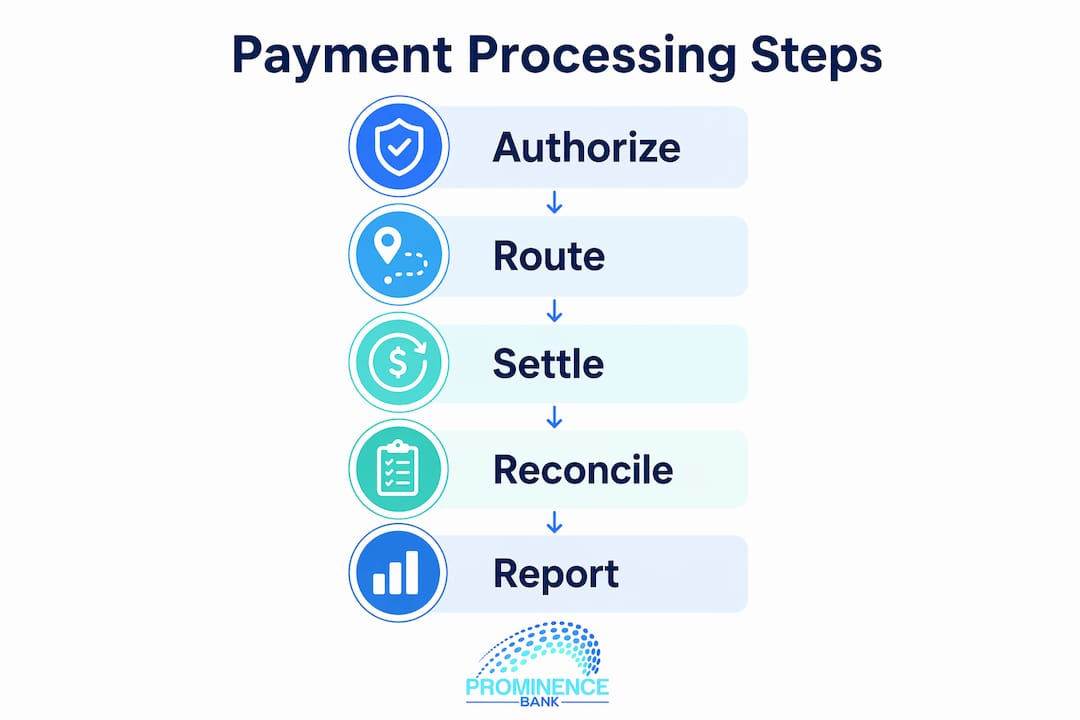
International payment processing is the system by which businesses authorize, route, and settle transactions across national borders, involving payment gateways, currency conversion, and compliance with local regulations.
What are the main fees in cross-border transactions?
The primary fees are interchange (paid to the card-issuing bank), cross-border surcharges of up to 2% added by card networks, processor margins, and foreign exchange conversion costs ranging from 0.5% to 3%.
When does interchange-plus pricing make sense?
Interchange-plus pricing delivers meaningful savings for merchants processing more than $80,000 monthly. A merchant at $250,000 per month can save approximately $13,500 annually compared to flat-rate pricing.
What is local acquiring and why does it matter?
Local acquiring routes international transactions through a bank account in the customer’s country, making the payment appear domestic. This eliminates cross-border surcharges and improves authorization rates in that market.
How do orchestration platforms differ from standard gateways?
A standard gateway routes transactions through a single processor. An orchestration platform manages multiple processors simultaneously, enabling dynamic routing, automatic failover, and unified reporting across all payment channels.