
TL;DR:
- International banking compliance requires strict adherence to global and jurisdictional regulations, including AML, KYC, data privacy, and capital requirements. Effective frameworks embed controls into business operations from the outset and leverage technology, governance, and culture to manage cross-border complexities and regulatory fragmentation. Proactive, compliance-by-design strategies build trust, reduce costs, and provide a competitive edge in the evolving financial landscape.
International banking compliance is defined as the systematic adherence to global and jurisdictional regulations governing financial crime prevention, data protection, capital adequacy, and cross-border reporting. Global regulators imposed over $31 billion in fines in 2023, with roughly 40% tied to cross-border violations. That figure tells you exactly what the stakes are. This guide covers the core regulatory frameworks, implementation strategies, and technology tools financial professionals and international business leaders need to maintain full compliance in 2026 and beyond.
What core international banking regulations apply in 2026?
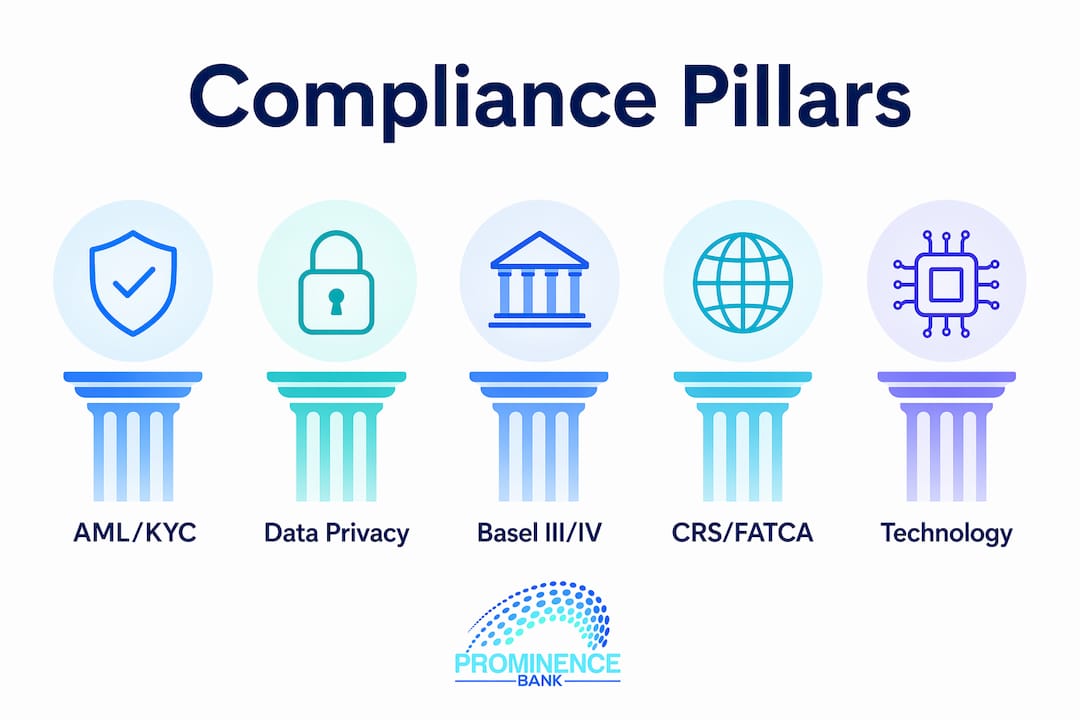
The five core compliance areas every institution must address are Anti-Money Laundering (AML), Know Your Customer (KYC), data privacy, Basel III/IV capital adequacy, and cross-border tax reporting under CRS and FATCA. Each area carries its own enforcement regime, and failure in any one of them creates systemic exposure across the others.

AML and KYC: the FATF foundation
The Financial Action Task Force (FATF) sets the global standard for AML and KYC through its 40 Recommendations, which over 200 jurisdictions have adopted in some form. The EU’s latest AML package, adopted in 2024, created a new EU-level Anti-Money Laundering Authority (AMLA) with direct supervisory powers over high-risk financial institutions. This is a structural shift, not a procedural update. Institutions operating in Europe now face a supranational regulator with authority to override national supervisors.
Basel iii/iv capital adequacy
Basel III requires banks to hold higher quality capital buffers and introduces the Net Stable Funding Ratio (NSFR) and Liquidity Coverage Ratio (LCR) as mandatory metrics. The European Commission delayed FRTB market risk requirements until January 2027, giving institutions additional runway but also creating a temporary divergence from U.S. and UK timelines. That divergence itself creates compliance complexity for banks operating across those jurisdictions simultaneously.
Data privacy, CRS, and FATCA
GDPR governs how European customer data is collected, stored, and transferred, with fines reaching 4% of global annual turnover. The Common Reporting Standard (CRS), developed by the OECD, and the U.S. Foreign Account Tax Compliance Act (FATCA) together require financial institutions to identify and report foreign account holders to their home tax authorities. Non-compliance with either framework triggers both regulatory penalties and reputational damage with correspondent banks.
| Regulation | Governing Body | Primary Scope | Key Requirement |
|---|---|---|---|
| FATF AML/KYC | FATF | Global | Customer due diligence, transaction monitoring |
| Basel III/IV | Basel Committee | Global (banks) | Capital buffers, liquidity ratios |
| GDPR | EU Commission | EU and data subjects | Data processing, breach notification |
| CRS | OECD | 100+ jurisdictions | Foreign account reporting |
| FATCA | U.S. Treasury/IRS | Global (U.S. persons) | U.S. account holder disclosure |
How do banks build an effective compliance framework?
Compliance-by-design integrates regulatory controls directly into business process development, preventing the costly remediation that follows post-launch fixes. Leading institutions do not bolt compliance onto existing workflows. They architect it into the operating model from day one.
A structured framework development process follows these steps:
- Map your regulatory universe. Identify every jurisdiction where you operate, hold assets, or serve clients. Document the applicable regulations and their enforcement bodies for each.
- Define your risk appetite. Set explicit thresholds for acceptable compliance risk across AML, credit, operational, and reputational categories. This is not a generic statement. It is a board-approved document with quantified limits.
- Establish governance structures. Assign a Chief Compliance Officer (CCO) with direct board access. Create a compliance committee that includes legal, operations, technology, and finance leads.
- Build your policy library. Draft and maintain written policies covering AML, KYC, data privacy, sanctions screening, and whistleblower protections. Policies must be reviewed at least annually.
- Deploy technology tools. Implement transaction monitoring systems, automated KYC platforms, and regulatory mapping tools that track rule changes in real time across jurisdictions.
- Train continuously. Compliance training is not a one-time onboarding event. Role-specific training tied to actual job functions reduces the internal risk of protocol failures.
- Test and audit. Run independent compliance audits quarterly. Use findings to update policies and retrain staff before regulators identify the same gaps.
Integrated risk frameworks with clear risk taxonomies align compliance with enterprise risk strategy, making the compliance function a business input rather than a back-office cost.
Pro Tip: Automate repetitive screening and monitoring tasks, but keep human reviewers in the loop for high-risk alerts. AI flags anomalies at scale. Experienced compliance officers make the judgment calls that protect the institution.
What are the biggest challenges in cross-border banking compliance?
Regulatory fragmentation traps capital and liquidity locally when divergent Basel III/IV implementations force institutions to hold buffers in each jurisdiction separately rather than managing them as a unified pool. This is one of the most underappreciated costs in international banking. Institutions that are technically compliant in every market still suffer operational inefficiency because the rules do not align across borders.
The most common compliance challenges financial institutions face include:
- Divergent national implementations of global standards like Basel III, where the U.S., EU, and UK each apply different timelines and calibrations
- Data management failures that prevent accurate, timely reporting across multiple regulatory regimes simultaneously
- Siloed compliance functions that operate independently from risk, finance, and technology teams, creating blind spots
- Employee non-compliance, which extends compliance risk beyond external penalties into internal operational failures
- Overlapping reporting obligations under CRS, FATCA, GDPR, and local AML laws that require the same underlying data in different formats
“Effective compliance requires embedding a compliance culture in daily operations rather than isolating compliance functions.” DialNexa Banking Compliance Research
The solution to fragmentation is not more compliance staff. It is a unified data architecture that feeds a single source of truth into every reporting obligation. Institutions that invest in centralized data governance reduce both the cost and the error rate of multi-jurisdictional reporting. You can review a practical banking compliance checklist to identify gaps in your current data and reporting structure.
Pro Tip: Map every regulatory reporting obligation to a single data field in your core system. When the underlying data is clean and centralized, generating jurisdiction-specific reports becomes a configuration task, not a manual project.
Which technologies are reshaping compliance in 2026?
Automated data management and regulatory mapping are the defining characteristics of high-performing compliance programs in 2026. Manual processes cannot keep pace with the volume of regulatory changes, transaction alerts, and reporting deadlines that modern international banking generates.
The technology tools delivering the most measurable impact include:
- AI-powered transaction monitoring that screens millions of transactions daily against sanctions lists, behavioral baselines, and typology libraries
- Generative AI (GenAI) tools that draft regulatory change summaries, policy updates, and training materials faster than human teams can produce them
- Automated KYC platforms that verify identity documents, screen against PEP and sanctions databases, and flag high-risk customers without manual review
- Real-time regulatory mapping software that tracks rule changes across jurisdictions and alerts compliance teams before effective dates
- Digital asset risk frameworks that address the compliance requirements for digital asset operations, an area where regulatory clarity is still developing
AI carries its own risks in compliance contexts. Algorithmic bias can produce discriminatory screening outcomes. Data privacy rules under GDPR restrict how AI models can process personal data. Institutions deploying AI in compliance workflows need a governance framework that includes model validation, bias testing, and audit trails. The technology accelerates compliance. It does not replace the accountability structure around it.
For institutions navigating regulatory risk in digital assets, the same principles apply. Governance must precede automation. Understanding the jurisdictional issues in digital banking is a prerequisite before deploying any automated compliance tool across borders.
Pro Tip: Adopt compliance technology in phases. Start with transaction monitoring and KYC automation, where ROI is immediate and measurable. Add GenAI and predictive analytics once your data infrastructure is clean and your team understands how to validate AI outputs.
Key takeaways
Effective international banking compliance requires integrating governance, technology, and culture into a single operating model rather than treating each as a separate function.
| Point | Details |
|---|---|
| Five core compliance pillars | AML, KYC, data privacy, Basel III/IV capital adequacy, and CRS/FATCA reporting are non-negotiable for any international institution. |
| Compliance-by-design reduces cost | Embedding controls into business processes from the start prevents expensive post-launch remediation. |
| Regulatory fragmentation is a hidden burden | Divergent national implementations of global standards trap capital and create operational inefficiency even when institutions are technically compliant. |
| Technology requires governance | AI and automation accelerate compliance workflows, but model validation, bias testing, and audit trails must accompany every deployment. |
| Culture is a compliance control | Internal employee failures represent a compliance risk category as significant as external regulatory penalties. |
Compliance as strategy, not overhead
After years of working with institutions across multiple jurisdictions, the pattern I see most often is this: organizations that treat compliance as a cost center are always reactive. They chase regulatory deadlines, scramble after audits, and spend disproportionate resources on remediation. The institutions that outperform them have made a different choice.
Compliance-by-design is not a methodology. It is a mindset. When your product team cannot launch a new account structure without a compliance sign-off baked into the sprint, you have built something durable. When your CCO sits at the same table as your CFO during strategic planning, you have aligned incentives correctly.
The cost-benefit calculation is straightforward once you run it honestly. A robust compliance investment costs a fraction of a single major enforcement action. The $31 billion in global fines from 2023 did not fall on institutions with strong compliance cultures. They fell on institutions that treated compliance as a checkbox.
My strongest recommendation is this: do not wait for a regulatory examination to tell you where your gaps are. Commission an independent compliance audit now, map your findings to your risk appetite framework, and prioritize technology investments that give you real-time visibility. Proactive compliance is not just risk management. It is a competitive advantage that builds trust with regulators, correspondent banks, and clients simultaneously.
— Harold
How Prominencebank supports your compliance operations
Prominencebank is built for institutions and businesses that cannot afford compliance gaps. Its corporate banking solutions are designed for complex international structures, with multi-currency accounts, AML/KYC-compliant onboarding, and direct access to global financial infrastructure. Whether you are managing cross-border reporting obligations or structuring accounts for multinational operations, Prominencebank provides the infrastructure to do it securely and with full regulatory alignment.
For businesses ready to formalize their international banking structure, Prominencebank’s step-by-step corporate banking guide walks through the security and compliance protocols that protect your operations at every layer. Explore how a purpose-built digital banking institution can turn your compliance obligations into a structured, manageable framework.
FAQ
What is international banking compliance?
International banking compliance is the process of adhering to global and local regulations governing financial crime prevention, data protection, capital adequacy, and cross-border tax reporting. It covers frameworks including FATF, Basel III/IV, GDPR, CRS, and FATCA.
What are the penalties for non-compliance in international banking?
Global regulators imposed over $31 billion in fines in 2023, with approximately 40% tied to cross-border compliance violations. Penalties include monetary fines, license revocations, and restrictions on correspondent banking relationships.
How does compliance-by-design differ from traditional compliance?
Compliance-by-design embeds regulatory controls directly into business processes during development, preventing costly post-launch remediation. Traditional compliance adds controls after products or workflows are already built, which is slower and more expensive to fix.
Which technology tools are most effective for banking compliance?
AI-powered transaction monitoring, automated KYC platforms, and real-time regulatory mapping software are the highest-impact tools in 2026. Each requires a governance framework that includes model validation and audit trails to manage AI-specific risks.
How should banks handle regulatory fragmentation across jurisdictions?
Banks should build a centralized data architecture that feeds a single source of truth into all jurisdiction-specific reporting obligations. Unified risk frameworks with clear taxonomies reduce the operational burden created by divergent national implementations of global standards like Basel III/IV.