
TL;DR:
- Private financial services offer personalized, integrated wealth management and banking solutions tailored for high-net-worth individuals and business owners. They emphasize coordinated advisory teams, rigorous privacy standards, and access to exclusive investment options across global platforms. Selecting the right provider requires assessing service breadth, data governance policies, and team integration to maximize value and privacy.
Private financial services are defined as relationship-managed banking, wealth planning, investment management, and trust solutions delivered exclusively to high-net-worth individuals and business owners who require both personalized advisory access and institutional-grade privacy. These services go well beyond standard retail banking. Integrated advisory teams in private banks include relationship strategists, investment advisors, wealth strategists, banking advisors, and fiduciary advisors working as a single unit around your financial life. The result is a coordinated architecture that treats your personal wealth and business balance sheet as one interconnected system, not two separate problems.
1. What private financial services actually cover
Private financial services, known in the industry as private banking or private wealth management, deliver five core service pillars under one relationship. PNC Private Bank exemplifies this model with offerings spanning wealth planning, investment management, banking, trust and estate planning, and business-owner solutions. Each pillar is managed by a specialist, but coordinated by a single relationship team that knows your full picture.

The table below compares how leading private banking providers structure these service components.
| Service component | What it includes | Why it matters for HNW clients |
|---|---|---|
| Wealth planning | Scenario planning, tax strategy, legacy goals | Proactive, not reactive financial decisions |
| Investment management | Broad asset access, risk controls, portfolio design | Institutional-grade options beyond retail funds |
| Banking services | Credit, cash management, balance-sheet optimization | Liquidity and leverage aligned with your goals |
| Trust and estate planning | Fiduciary oversight, succession structures | Protects generational wealth transfer |
| Business-owner solutions | Corporate banking, lending, fiduciary integration | Bridges personal and business financial complexity |
Investment programs within private financial services provide access to asset classes that retail clients simply cannot reach, including private equity, structured credit, and alternative investment vehicles. Risk management is built into the portfolio design process, not added as an afterthought. This is the distinction that separates genuine wealth management services from glorified brokerage accounts.
Pro Tip: Ask any prospective private bank to show you the specific team members assigned to your account before you sign anything. A named relationship strategist, investment advisor, and banking advisor should all be identified upfront. If they cannot name the team, the “personalized service” is marketing language, not a structural commitment.
2. Services tailored specifically for business owners
Business owners face a financial complexity that salaried employees do not. Your personal net worth is often tied directly to your company’s balance sheet, which means your private banking strategies must address both simultaneously. PNC advises treating your banking team as part of your family and balance-sheet architecture, coordinating cash, lending, and fiduciary services as one integrated system.
The most effective private financial services for business owners include:
- Corporate banking access for complex entity structures, including multi-entity cash pooling and treasury management
- Lending solutions tailored to business cycles, including revolving credit, acquisition financing, and asset-backed facilities
- Fiduciary services covering business succession planning, buy-sell agreement funding, and key-person insurance structures
- Trust planning that separates personal and business assets while preserving family wealth across generations
- Balance-sheet optimization that coordinates business retained earnings with personal investment strategy
- Integrated wealth and business advisory so that a liquidity event, sale, or recapitalization is planned years in advance, not managed reactively
The specialized advisory roles within these offerings matter as much as the products themselves. A banking advisor who understands your operating cycle can structure credit facilities that a generalist banker would never propose. A fiduciary advisor who knows your succession timeline can design trust structures that reduce estate tax exposure by millions. For guidance on setting up business banking as part of a broader private financial strategy, the structural decisions made at account opening have long-term consequences.
Pro Tip: If your private bank keeps your business banking and personal wealth planning in separate silos with no shared communication, you are leaving significant planning value on the table. Demand a joint review meeting at least twice per year where both teams are present.
3. How privacy actually works in private banking
Privacy in private banking is not absolute secrecy. It is an operational discipline. According to Banque Internationale à Luxembourg’s data protection officer, data collection in private banking requires documented justification, a defined purpose, a retention period, and transparency with the client. That framework is what separates professional discretion from legal liability.
The core privacy practices that define credible private financial services include:
- Purpose limitation: Data is collected only for specific, documented business purposes, not stored speculatively
- Retention controls: Client data is deleted or anonymized once the defined retention period expires
- Transparency obligations: Clients are informed about what data is held, why it is held, and who can access it
- Minimal sensitive data recording: Informal notes about a client’s personal life or sensitive circumstances are avoided in formal records, reducing audit and leak exposure
- Regulatory balance: DLA Piper lawyers have flagged that over-communication under FATCA beyond strict legal requirements can itself trigger GDPR violations
This last point is counterintuitive and worth understanding. A bank that shares more information than legally required in an attempt to appear cooperative with regulators may actually be violating European data protection law. Discretion and compliance are not opposites. They are the same discipline applied from different directions. For a deeper look at advanced banking privacy strategies, the operational controls that protect your data in 2026 are more specific than most clients realize.
4. International banking and digital solutions for private clients
Digital banking for high-net-worth portfolios has grown 4.2%, driven by demand for secure, personalized platforms that offer multi-currency access and real-time portfolio visibility. This growth reflects a structural shift. High-net-worth individuals no longer accept the trade-off between privacy and digital convenience. They expect both.
The table below compares traditional and digital private banking across the features that matter most to this audience.
| Feature | Traditional private banking | Digital private banking |
|---|---|---|
| Account access | Branch or relationship manager call | Instant, 24/7 online access |
| Multi-currency management | Manual FX conversion, limited currencies | Real-time multi-currency accounts |
| Privacy controls | Relationship-based discretion | Encrypted platforms with documented data governance |
| Cryptocurrency integration | Rarely available | Available through specialized providers |
| International transfers | Correspondent banking, 1-3 days | Direct global network access, same-day |
| Onboarding speed | Weeks, in-person requirements | Days, fully digital KYC/AML |
Multi-currency accounts are the practical foundation of international private banking. If your wealth spans multiple jurisdictions, holding assets in a single currency exposes you to unnecessary FX risk and limits your ability to transact globally without friction. A step-by-step guide to private international banking covers the compliance and structural considerations that apply when you open accounts across borders.
Cryptocurrency integration within private banking is no longer a niche request. Institutional clients and business owners increasingly hold digital assets as part of a diversified portfolio, and the expectation is that a private bank can custody, manage, and report on those assets with the same rigor applied to traditional holdings. Providers that cannot accommodate this are already behind the curve.
5. How to choose the right private financial services provider
Choosing a private financial services provider is a decision that shapes your financial life for years. The criteria that matter most are not the ones featured in marketing materials. Start with service breadth. A provider that excels at investment management but cannot handle your business banking or estate planning forces you to manage multiple relationships, which creates coordination gaps that cost you money and time.
Assess the provider’s transparency about privacy and data handling before you share any sensitive information. Ask directly: what data do you collect, how long do you retain it, and who has access? A credible provider answers these questions with documented policies, not reassurances. Providers that deflect or generalize on privacy questions are signaling that their data governance is informal, which is a risk you should not accept.
Evaluate the advisory team structure. High-net-worth clients benefit most when investment management is integrated with complex banking and balance-sheet operations, not treated as a separate engagement. Ask whether the investment advisor and the banking advisor communicate regularly about your account. If the answer is no, the “integrated” service model is organizational chart fiction.
Finally, assess alignment with your legacy and business goals. A private bank that specializes in liquid investment portfolios may be poorly equipped to advise on a family business succession or a cross-border trust structure. Match the provider’s demonstrated expertise to your actual financial complexity, not their general reputation.
Key takeaways
Private financial services deliver the most value when wealth planning, banking, privacy governance, and business-owner solutions are managed as a single integrated system rather than separate products.
| Point | Details |
|---|---|
| Integration drives value | Investment management and banking must be coordinated, not siloed, to optimize your balance sheet. |
| Privacy is operational | Credible providers document data purpose, retention, and access. Ask for the policy in writing. |
| Business owners need dual coverage | Personal wealth and business balance-sheet planning must be managed by a connected advisory team. |
| Digital banking is now standard | Multi-currency accounts and 24/7 digital access are baseline expectations, not premium features. |
| Team structure matters | Named specialists across investment, banking, and fiduciary roles define genuine private banking. |
Why the conventional wisdom on private banking still gets it wrong
Most articles about how to choose financial advisors focus almost entirely on investment performance. That framing misses the point for anyone with real financial complexity. I have spent years reviewing how high-net-worth individuals and business owners actually use private financial services, and the clients who get the most value are not the ones chasing the best-performing portfolio. They are the ones who treat their private bank as a financial architecture firm.
The business owners who come to private banking late, after a liquidity event or a business sale, almost universally say the same thing: they wish they had integrated their personal and business financial planning years earlier. The tax exposure, the estate planning gaps, the missed succession structures. These are not investment problems. They are coordination problems that a genuine private banking relationship solves before they become expensive.
Privacy is the other area where conventional wisdom falls short. Most clients assume privacy means their banker will not talk about them. The real question is whether the bank has documented data governance that limits what is recorded, how long it is retained, and who can access it. Discretion without documentation is not a privacy policy. It is a promise, and promises do not survive staff turnover or regulatory audits.
The providers worth your time are the ones who can answer specific questions about their data practices, name the specialists on your team, and demonstrate that your business banking and personal wealth planning are actively coordinated. Everything else is a retail product with a private label.
— Harold
How Prominencebank supports your private financial strategy
Prominencebank is built for clients who require more than a standard banking relationship. The bank operates as a fully licensed digital institution with direct access to global financial infrastructure, serving high-net-worth individuals, international businesses, and institutional clients who prioritize privacy, security, and global reach.
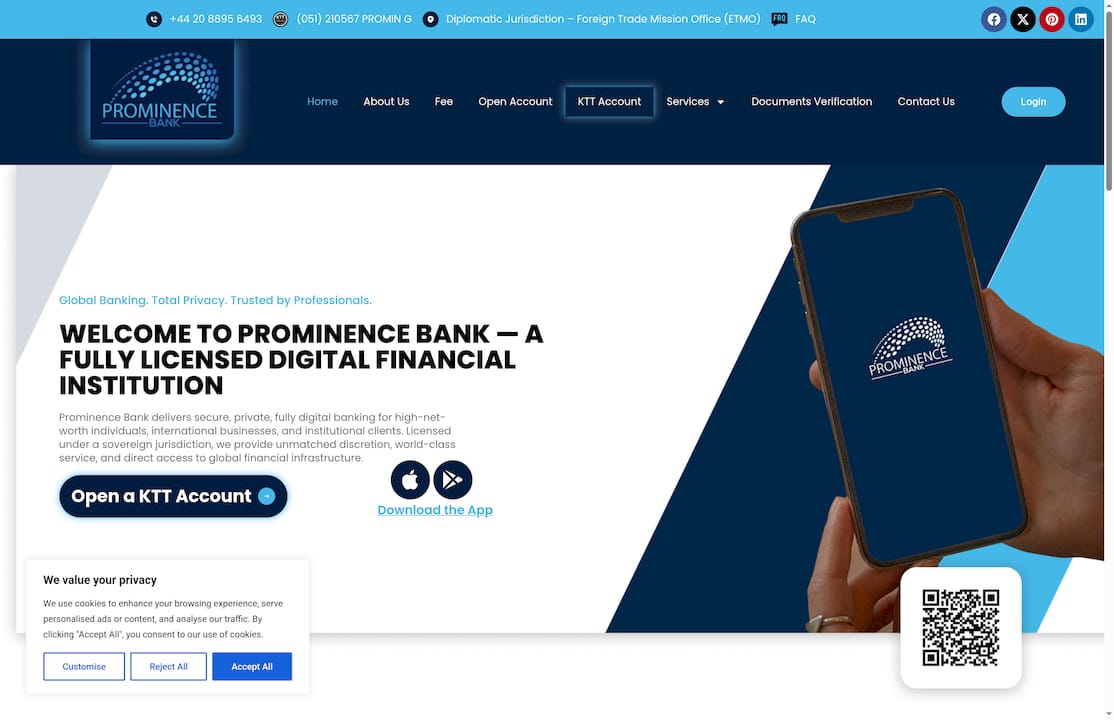
For clients managing wealth across multiple currencies and jurisdictions, Prominencebank’s multi-currency account provides real-time access to global banking without the friction of correspondent banking delays. The bank also supports cryptocurrency account integration for clients holding digital assets alongside traditional holdings. Explore business banking solutions designed for complex corporate structures and the privacy standards that serious private clients demand.
FAQ
What are private financial services?
Private financial services are relationship-managed banking, wealth planning, investment management, and trust solutions delivered to high-net-worth individuals and business owners. They differ from retail banking by providing dedicated advisory teams, broader asset access, and coordinated personal and business financial planning.
How do private banks protect client privacy?
Privacy in private banking is governed by documented data policies covering legal basis, purpose, retention period, and client transparency. Banks limit data collection to necessary business use and avoid recording informal or sensitive personal details to reduce audit and leak exposure.
What services do private banks offer business owners?
Business owner solutions within private banking include corporate banking, lending, fiduciary services, trust planning, and integrated balance-sheet management. The goal is to coordinate personal wealth and business finances through a single advisory team.
Is digital private banking as secure as traditional private banking?
Digital private banking platforms use encrypted infrastructure, documented data governance, and AML/KYC compliance to match or exceed traditional security standards. The added benefit is 24/7 access, multi-currency management, and faster international transfers without sacrificing confidentiality.
How do I choose the right private financial services provider?
Assess service breadth, privacy documentation, advisory team structure, and alignment with your specific financial complexity. A provider that integrates investment management with banking and fiduciary services under one coordinated team delivers significantly more value than one that manages each service independently.