
TL;DR:
- Numbered accounts provide operational privacy by restricting staff access but do not ensure complete anonymity under regulated jurisdictions.
- Legal transparency and compliance obligations remain; authorities can access your identity through proper legal channels, regardless of account numbering.
Most people who ask about numbered accounts believe they’ve found the ultimate financial shield, a vault so secure that even the bank itself doesn’t know who you are. That belief is wrong, and acting on it can lead to serious legal exposure. Numbered accounts do offer meaningful privacy, but the protection they provide is operational, not absolute. This guide cuts through the mythology to explain exactly how numbered accounts work, what privacy they realistically deliver, where they shine for high-net-worth individuals and global corporations, and how to use them strategically within today’s compliance landscape.
Table of Contents
- What is a numbered account and how does it work?
- Privacy, anonymity, and legal limits of numbered accounts
- Swiss numbered accounts: Practices, requirements, and international transfers
- Who benefits: Use cases and considerations for numbered accounts
- The real value of numbered accounts: Discretion, not invisibility
- Take your privacy and global banking further
- Frequently asked questions
Key Takeaways
| Point | Details |
|---|---|
| Not true anonymity | Numbered accounts do not provide anonymous banking; legal identity is always recorded and shared on request. |
| Privacy is operational | The main benefit is restricting which bank staff see your identity, not hiding from authorities. |
| Global compliance applies | Banks follow anti–money laundering and tax transparency rules for numbered accounts just like any other account. |
| Swiss accounts set precedent | Swiss numbered accounts are subject to strict privacy, yet comply with regulatory and tax requirements. |
| Best for discretion needs | Numbered accounts serve those needing day-to-day discretion, not those seeking to evade regulatory oversight. |
What is a numbered account and how does it work?
The term “numbered account” gets thrown around loosely, which creates confusion about what these accounts actually do. At their core, they are a specific type of banking relationship structure, not a separate account category with magical properties.
A numbered bank account is a banking arrangement where the account is identified internally by a code or number rather than routinely displaying the client’s legal name to most bank staff. According to LegalClarity, a numbered account “is a banking relationship where the account is identified by a code/number rather than routinely displaying the client’s name to most bank staff; the bank still records the holder’s real legal identity for compliance.” That last clause is the critical part most people overlook.
The bank always knows who you are. The numbered structure simply limits how many internal staff members can see your name during routine processing. Think of it as a restricted access protocol, not a cloak of invisibility.

How numbered accounts differ from standard account numbers
Every bank account has an account number. That’s a basic operational identifier used for routing transactions. A numbered account is something different: it’s a deliberate privacy architecture where the name-to-number link is sealed off from general staff visibility and accessible only to a small group of authorized personnel, typically senior private bankers or compliance officers.
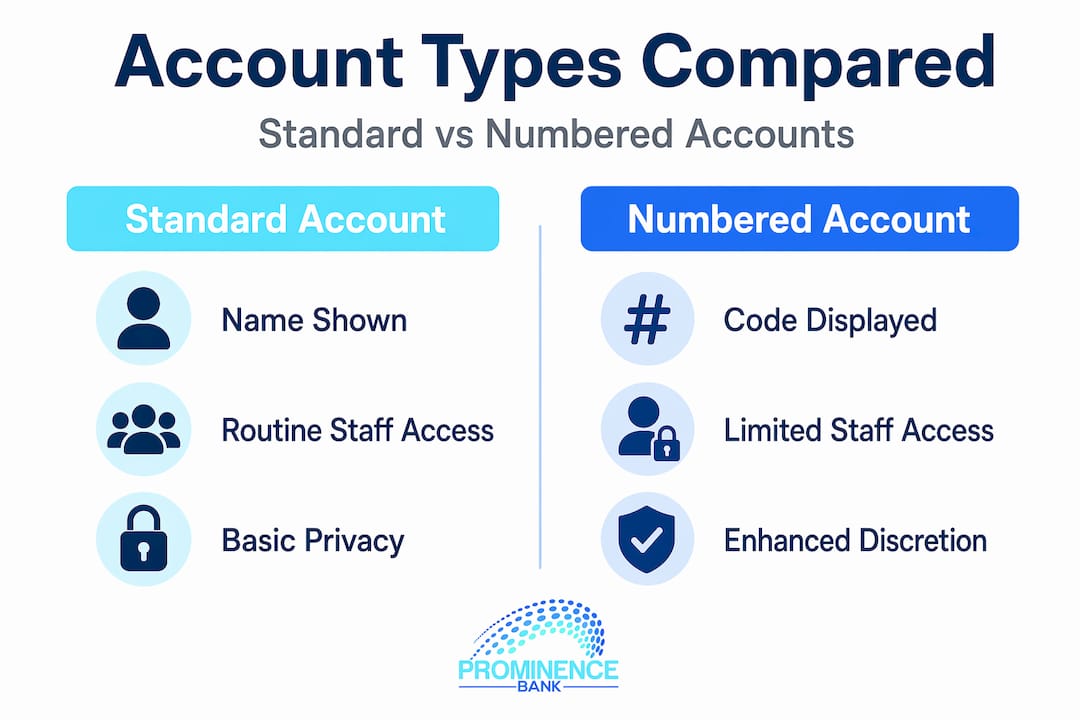
Here’s a side-by-side comparison to make the distinction clear:
| Feature | Standard account | Numbered account |
|---|---|---|
| Account identifier | Name + number visible to most staff | Number only visible to most staff |
| Identity on file | Yes | Yes (mandatory) |
| KYC/AML compliance | Required | Required |
| Staff access to name | Broad | Restricted to senior/authorized staff |
| Regulatory reporting | Standard | Same obligations apply |
| Typical client profile | General public | High-net-worth, institutional |
Key operational characteristics of numbered accounts include:
- Restricted internal access: Only a small group of authorized staff can link the number to a name
- Full compliance records: The bank maintains a complete identity file for regulatory purposes
- Standard transaction processing: Payments and transfers function identically to regular accounts
- Premium service tier: Numbered accounts typically come with dedicated relationship managers
- Higher minimum balances: Most institutions require significant asset thresholds to qualify
Understanding regular account numbers vs. numbered accounts helps clarify that the “number” in a numbered account refers to a privacy protocol, not just a standard banking identifier.
Privacy, anonymity, and legal limits of numbered accounts
This is where the mythology collapses. Many clients approach numbered accounts expecting a level of secrecy that simply does not exist in any regulated financial jurisdiction. The global regulatory environment has fundamentally changed what banks can and cannot offer in terms of privacy.
Numbered accounts are not truly anonymous. Identity verification and AML/KYC obligations still apply universally, and tax and financial authorities can obtain your identity information through legal processes. This is not a loophole that clever structuring can close.
In the United States, the Customer Identification Program (CIP) rules under 31 CFR 1020.220 require banks to collect and verify identifying information before opening any account, using risk-based procedures. A numbered code used operationally does nothing to change this obligation. The bank must know you, verify you, and retain records that can be produced under legal demand.
The real distinction: A numbered account protects your identity from other customers, low-level staff, and routine processing exposure. It does not protect your identity from regulators, law enforcement, or tax authorities operating under proper legal authority.
Here’s a practical breakdown of what numbered account privacy actually covers:
| Privacy dimension | Protected? | Notes |
|---|---|---|
| From other bank customers | Yes | Name not visible in standard processing |
| From general bank staff | Yes | Access restricted to authorized personnel |
| From senior bank compliance | No | Full records maintained |
| From tax authorities | No | Reporting obligations apply |
| From law enforcement (with warrant) | No | Banks must comply with legal orders |
| From AML investigators | No | Suspicious activity reporting still applies |
Pro Tip: When evaluating any banking arrangement that promises privacy, ask specifically what “privacy” means in writing. Operational discretion (limiting internal staff access) is legitimate and valuable. Claims of immunity from regulatory oversight are a red flag, not a feature.
Understanding the full picture of privacy in private banking requires separating the legitimate operational benefits from the compliance realities that sophisticated clients must navigate. For high-net-worth individuals, banking compliance is not an obstacle to work around but a framework to work within intelligently.
Swiss numbered accounts: Practices, requirements, and international transfers
Switzerland remains the most referenced jurisdiction for numbered accounts, and for good reason. Swiss private banking has centuries of tradition around client confidentiality, and the numbered account structure was refined there to a high degree of operational sophistication. But Switzerland has also undergone dramatic regulatory transformation over the past two decades.
Swiss numbered accounts operate under strict internal protocols. According to The Local Switzerland, numbered accounts in Switzerland are permitted but come with strict conditions: limited internal access to identity information, mandatory information sharing with tax authorities under applicable treaties, and specific operational requirements for cross-border transactions.
Here’s how the Swiss numbered account structure typically works in practice:
- Initial onboarding: Full identity verification is completed by a senior private banker. Documents are sealed and stored separately from the operational account file.
- Internal access controls: The account number is used for all routine transactions. Only a designated small group, often just two or three senior staff members, can access the identity link.
- Relationship management: A dedicated relationship manager handles all client communications, acting as the interface between the client and the broader institution.
- Regulatory compliance: Swiss banks participate in automatic exchange of information (AEOI) frameworks, including the Common Reporting Standard (CRS), which means account holder information is shared with tax authorities in participating countries.
- Transaction monitoring: AML screening applies to all transactions regardless of the numbered structure. Suspicious activity triggers the same reporting obligations as any other account.
The cross-border dimension is particularly important for international clients. Even when an account is structured as “numbered,” transfers to foreign institutions may trigger identity sharing with the receiving bank in another jurisdiction, often requiring explicit consent from the account holder. This is a significant operational consideration for clients who move assets internationally.
Pro Tip: If your primary goal is cross-border asset movement, work with your private banker to map out exactly which jurisdictions your transfers will touch and what disclosure requirements apply at each leg of the transaction. Surprises in this area are costly.
For clients considering how to structure international holdings, understanding the full offshore account setup process is essential before committing to any specific account structure.
Who benefits: Use cases and considerations for numbered accounts
With the regulatory reality established, the practical question becomes: who actually benefits from a numbered account, and under what circumstances does the structure add genuine value?
Numbered accounts are best understood as an operational discretion model rather than a secrecy mechanism. Banks can restrict which staff members see your name while still maintaining a complete internal master record. That operational discretion has real value in specific situations.
Ideal client profiles for numbered accounts:
- High-net-worth individuals in public life: Executives, politicians, celebrities, and public figures who face legitimate risks from staff-level information leaks or social engineering attacks targeting financial institutions
- Family offices managing multigenerational wealth: Complex structures where limiting internal exposure reduces the risk of information spreading across large institutional staff populations
- International corporations with sensitive M&A activity: Companies executing confidential transactions where premature disclosure of financial positioning could affect deal outcomes
- Clients in politically sensitive environments: Individuals operating in jurisdictions where financial information can be weaponized by political actors or corrupt officials
- Institutional investors managing proprietary strategies: Firms whose investment positioning constitutes competitive intelligence worth protecting from routine staff exposure
The meaningful tradeoff for high-net-worth and international clients is typically between internal staff access restrictions on one side, and regulatory and tax transparency requirements that remain fully in place on the other. The privacy benefit is real but limited to routine processing visibility, not immunity from compliance obligations.
Key advantages of numbered accounts:
- Reduced risk of internal information leaks from lower-level bank staff
- Protection against social engineering attacks that target bank employees
- Enhanced discretion during sensitive financial transactions
- Dedicated relationship management with senior private bankers
- Reduced routine exposure of identity during standard processing
Real limitations to factor into your planning:
- Full regulatory transparency remains in place regardless of account structure
- International transfers often require identity disclosure to receiving institutions
- Higher costs and minimum balance requirements compared to standard accounts
- Not available at most retail banks; requires private banking relationships
- Compliance obligations on the client side remain identical to standard accounts
For a complete picture of how to protect your financial position, reviewing security tips for HNWIs alongside understanding discreet global wealth banking gives you the full strategic framework. A secure banking checklist is also a practical starting point for evaluating your current exposure.
Pro Tip: The most sophisticated clients don’t rely on a single privacy mechanism. They layer operational discretion (numbered accounts), jurisdictional diversification, proper legal structuring, and compliance-ready documentation into a coherent strategy. No single tool does everything.
The real value of numbered accounts: Discretion, not invisibility
Here’s what most guides on numbered accounts get fundamentally wrong: they treat privacy as binary. Either you’re visible or you’re hidden. That framing is outdated and, frankly, dangerous for clients who act on it.
The shift in the global regulatory environment since the early 2000s has been seismic. The FATF recommendations, the US Foreign Account Tax Compliance Act (FATCA), the OECD’s Common Reporting Standard, and successive waves of AML legislation have collectively eliminated the concept of financial invisibility from any reputable jurisdiction. Switzerland, Liechtenstein, Luxembourg, Singapore, and every other major private banking center now operates under frameworks that require identity disclosure to regulators under defined legal processes.
What remains, and what still has genuine value, is operational discretion. The ability to limit which bank staff members can see your name during routine processing is not trivial. Financial institutions employ thousands of people. Data breaches happen. Social engineering attacks on bank employees are a documented and growing threat vector. For a high-profile executive or a family managing generational wealth, reducing the number of people who can casually access their financial identity is a legitimate risk management strategy.
The mistake we see sophisticated clients make is overestimating what that discretion delivers. They structure their affairs around the assumption of secrecy, fail to declare accounts properly, and then face consequences that dwarf whatever benefit the numbered structure provided. The compliance obligation doesn’t disappear because the account has a number instead of a name on the internal processing screen.
The smarter approach is to treat numbered accounts as one component of a broader privacy architecture. Technology in private banking has created new tools for managing financial privacy that complement the traditional numbered account structure, including encrypted communication channels, biometric authentication, and advanced audit trail management. The clients who benefit most from numbered accounts are those who understand exactly what protection they’re buying and build their overall strategy accordingly.
Take your privacy and global banking further
Operational discretion in banking requires the right institutional partner, not just the right account structure.
Prominence Bank offers multi-currency account solutions designed for clients who move assets across borders without sacrificing confidentiality or compliance integrity. For corporations managing complex international structures, our advanced corporate banking services provide the layered privacy architecture that sophisticated operations require. Every solution we offer is built on full AML/KYC compliance, so your privacy strategy is also your legal protection. Explore the full scope of discreet banking advantages available through Prominence Bank and take the next step toward a banking relationship built for your actual needs.
Frequently asked questions
Are numbered accounts truly anonymous in any country?
No. Numbered accounts are not truly anonymous in any regulated jurisdiction. Identity verification and AML/KYC obligations apply universally, and authorities can obtain your identity through legal processes regardless of how the account is structured internally.
What information do I need to provide to open a numbered account?
You must provide your full legal identity and pass standard AML and KYC checks before any account is opened. US CIP rules require banks to obtain and verify identifying information using risk-based procedures, and similar requirements apply across all major banking jurisdictions.
Can I make international wire transfers without revealing my name if I use a numbered account?
No. Transfers from numbered accounts to foreign banks typically trigger identity sharing with the receiving institution, often requiring your explicit consent. The numbered structure applies internally within the originating bank, not across the international payment network.
Are there legal risks in opening a numbered account?
Holding a numbered account is entirely legal, but banks are required to report to authorities under tax and AML regulations. Failing to declare the account or its income to your home jurisdiction’s tax authority can result in serious civil and criminal consequences that far outweigh any privacy benefit the account structure provides.