
TL;DR:
- Foreign exchange banking involves managing currency exchange, international payments, and FX risk to support global financial operations. Specialists often charge lower fees and provide advanced hedging tools, saving businesses significant costs compared to traditional banks. Using multi-currency accounts and modern digital platforms enhances speed, reduces fees, and improves international transaction efficiency.
Foreign exchange banking is the specialized practice of managing currency exchange, international payments, and FX risk to support global financial operations efficiently. Whether you run a multinational corporation or hold assets across borders, the difference between a bank’s embedded spread and a specialist provider’s transparent fee can cost or save tens of thousands of dollars per transaction. Key players in this space include traditional banks, fintech platforms like Wise, and specialist corporate FX providers such as Lucid and MTFX. Understanding how each model works, and which tools protect your margins, is the foundation of any serious international financial strategy.
1. What foreign exchange banking actually covers
Foreign exchange banking is the industry term for a cluster of services: spot currency trades, forward contracts, options, swaps, multi-currency accounts, and cross-border payment execution. Most people encounter only the surface layer, converting currency at a bank branch or sending money through a mobile app. The full scope runs much deeper, covering structured hedging programs, treasury management, and dedicated FX advisory for corporations managing exposure across dozens of currencies. Recognizing the full range of global payment solutions available is the first step toward using them strategically.

2. Spot transactions: the baseline of currency exchange services
A spot transaction is the simplest form of foreign currency exchange. You agree on a rate today, and the trade settles within two business days. Spot trades are the default for individuals sending money abroad and for businesses making one-off supplier payments. The problem is that spot rates fluctuate constantly, so relying on them exclusively exposes you to unpredictable costs. For low-volume, non-time-sensitive transfers, bank transfers offer the best value despite being slower than card payments. That tradeoff matters when you are moving large sums.
3. Forward contracts: locking in rates before you need them
A forward contract lets you fix an exchange rate today for a payment due weeks or months from now. Forward contracts lock rates for up to 12 months ahead, and most CFOs use them to hedge 50 to 70 percent of their FX exposure. That predictability is not a luxury. It is a cash flow management tool. A U.S. importer paying a European supplier in euros six months from now can fix the cost today, removing exchange rate volatility from the equation entirely. For businesses with recurring international obligations, forwards are the single most practical hedging instrument available.
Pro Tip: Set a calendar reminder 30 days before each forward contract matures. This gives you time to roll the contract forward or adjust your hedge ratio if your payment schedule changes.
4. Options and swaps: flexible hedging for complex exposures
Currency options give you the right, but not the obligation, to exchange at a set rate. Unlike forwards, they preserve upside potential if the market moves in your favor. Risk mitigation tools including forward contracts, currency swaps, and FX options allow companies to lock rates while retaining flexibility. Swaps are used when a business needs to exchange currencies for a defined period and then reverse the transaction, common in cross-border intercompany lending. Options carry a premium cost, so they suit businesses with uncertain payment timing or those unwilling to fully commit to a fixed rate.
5. Multi-currency accounts: reducing fees on every transaction
A multi-currency account holds balances in several currencies under a single account structure. Multi-currency accounts with local IBANs reduce complexity, intermediary fees, and settlement times compared to maintaining separate foreign bank accounts in each country. For a business collecting revenue in British pounds, euros, and Australian dollars, this means receiving funds locally without triggering a conversion on every inflow. The savings compound quickly. Fewer intermediary banks mean fewer correspondent banking fees, faster settlement, and cleaner reconciliation. Prominencebank offers multi-currency account solutions designed specifically for high-net-worth individuals and international businesses with complex currency needs.
6. How banks, fintechs, and specialist FX providers compare
The pricing gap between providers is larger than most clients realize. Specialist FX providers charge fees of 0.1 to 0.8 percent, while traditional banks embed spreads of 1.5 to 3 percent in their exchange rates. On a $500,000 transaction, that difference translates to $7,000 to $12,500 in additional cost when using a bank. That is not a rounding error. It is a material line item.
| Provider type | Typical spread | Best suited for | Hedging tools |
|---|---|---|---|
| Traditional banks | 1.5–3% | Existing banking relationships | Basic forwards |
| Fintech platforms (e.g., Wise) | 0.3–0.8% | Individuals, SME transfers | Spot only |
| Specialist FX providers | 0.1–0.5% | Corporates, large volumes | Full suite |
Fintech platforms win on speed and transparency for straightforward transfers. Specialist providers win on cost and sophistication for businesses with structured hedging needs. Traditional banks remain relevant when FX is bundled into a broader corporate banking relationship, but they rarely win on price alone.
Pro Tip: Request a full cost breakdown from any provider before committing. Ask specifically for the mid-market rate comparison, not just the quoted rate. The difference reveals the true cost of the transaction.
7. Currency risk management strategies that actually work
Currency volatility is not a background risk. It directly erodes margins, distorts revenue forecasts, and creates cash flow gaps. A U.S. exporter billing in euros faces a direct hit to dollar revenue if the euro weakens between invoice date and payment receipt. The strategies below address this systematically.
- Natural hedging: Match revenue and costs in the same currency wherever possible. A business earning euros and paying European suppliers in euros carries zero net FX exposure on that portion of its operations.
- Forward contracts for predictable payments: Fix rates on known future obligations. This is the most widely used tool because it requires no premium and delivers certainty.
- Options for uncertain timing: When you know the amount but not the exact payment date, an option preserves flexibility without full rate exposure.
- Active monitoring with a dedicated FX desk: Dedicated FX account managers improve rate optimization and timing, providing a strategic advantage in volatile markets that automated platforms cannot replicate.
- Layered hedging: Rather than hedging 100 percent of exposure at once, layer contracts over time to average into rates. This reduces the risk of locking in at a poor rate.
Businesses that hedge proactively, rather than reacting to rate moves after the fact, consistently report more stable margins and fewer budget surprises. The discipline is straightforward. The execution requires the right partner.
8. Technology driving faster global money transfers
Speed and cost in cross-border transactions have improved dramatically. Digital transfer platforms enable 74 percent of transfers in under 20 seconds and 95 percent within one day, depending on payment method. That benchmark has reset client expectations across the industry. SWIFT remains the backbone for many institutional and high-value transfers, but its correspondent banking model adds both time and cost compared to modern alternatives. You can learn more about how SWIFT-based transfers function within a broader FX banking architecture.
Modern platforms improve on SWIFT in three specific ways. First, they reduce the number of intermediary banks in the payment chain, cutting correspondent fees. Second, they provide real-time tracking so both sender and recipient know exactly where funds are. Third, they offer multi-currency account structures that eliminate conversion at every step. The mechanics of international money transfers have changed enough in recent years that businesses relying on bank wire instructions from five years ago are likely overpaying.
Pro Tip: For time-sensitive transfers, compare the total landed cost including fees and exchange rate spread, not just the headline transfer fee. A “free” transfer with a 2% spread costs more than a $15 fee with a 0.3% spread on any amount above $750.
9. Choosing the right FX banking solution for your situation
The right foreign exchange banking setup depends on three variables: transaction volume, currency complexity, and risk tolerance. Matching the solution to your actual profile avoids both overpaying for features you do not use and underprotecting exposures that matter.
- Individuals and expats: Prioritize low fees, fast settlement, and ease of use. Fintech platforms deliver on all three for personal transfers and foreign currency accounts. The fastest international transfer methods in 2026 are almost exclusively digital.
- Small and medium businesses: Multi-currency accounts reduce friction on recurring international payments. Adding a forward contract program for predictable supplier payments costs little and removes significant budget uncertainty.
- Large corporates and institutions: Require a full FX desk with proactive hedging, options structuring, and treasury integration. Specialist providers acting as an outsourced FX desk offer proactive hedging and dedicated dealers, which differentiates them from banks that provide execution only.
- High-net-worth individuals with global assets: Need multi-currency accounts, discreet banking relationships, and access to structured products. Privacy, compliance, and global connectivity matter as much as pricing.
The most common mistake is defaulting to a bank simply out of convenience. Banks serve a purpose, but for anyone moving more than $50,000 internationally on a recurring basis, a specialist provider or a digital banking institution with FX capabilities will almost always deliver better outcomes.
Key takeaways
Foreign exchange banking delivers the most value when you combine transparent pricing, structured hedging, and multi-currency account infrastructure rather than relying on a single provider for all needs.
| Point | Details |
|---|---|
| Specialist providers save real money | Switching from a bank to a specialist FX provider can save $7,500 to $12,500 on a $500,000 transaction. |
| Forward contracts reduce budget risk | Locking rates up to 12 months ahead removes exchange rate volatility from cash flow planning. |
| Multi-currency accounts cut fees | Local IBANs eliminate intermediary banks and reduce conversion costs on recurring international payments. |
| Technology has reset speed expectations | 74% of digital transfers now complete in under 20 seconds, making slow wire transfers a choice, not a necessity. |
| Provider selection drives outcomes | Match your provider to transaction volume and complexity. Fintechs suit individuals; specialists suit corporates. |
Why I stopped defaulting to the bank for FX
After years of watching clients absorb unnecessary costs on international transactions, the pattern is clear. The bank is almost never the best answer for foreign exchange, and yet it remains the default choice for most businesses simply because it is familiar. The embedded spread is invisible in a way that a wire fee is not. Clients see the $25 transfer fee and miss the $3,000 spread baked into the rate.
What I have found genuinely useful is treating FX banking the way you would treat any other procurement decision. Get three quotes, compare against the mid-market rate, and ask specifically what hedging tools are included. Specialist providers like those offering dedicated FX advisory bring market context that a bank’s automated rate engine simply cannot. A dealer who knows your payment calendar can tell you when to lock a forward and when to wait. That timing judgment, applied consistently, compounds into meaningful savings over a year.
Even small businesses with modest international exposure benefit from a structured approach. A quarterly forward contract on supplier payments, combined with a multi-currency account for receivables, costs almost nothing to set up and eliminates the budget variance that makes international operations feel unpredictable. The tools exist. The question is whether you use them.
— Harold
How Prominencebank supports your FX banking needs
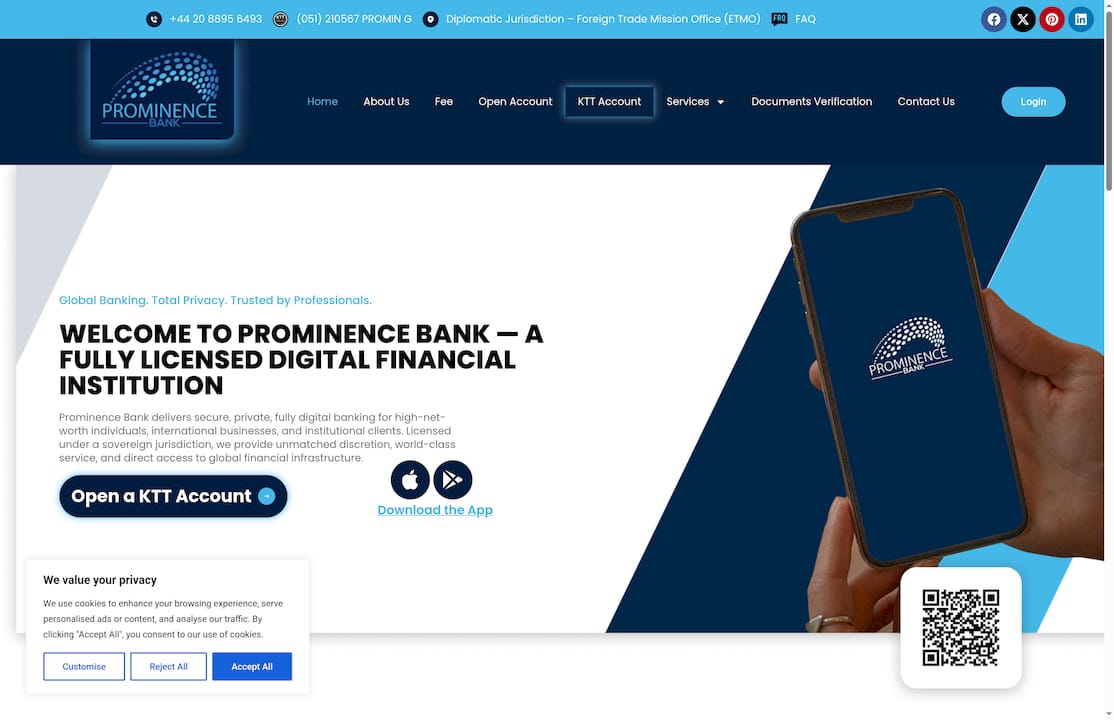
Prominencebank is built for clients who take international finance seriously. Its multi-currency account platform lets high-net-worth individuals and international businesses hold, receive, and convert currencies under a single account structure, with transparent pricing and no hidden spreads. For corporate clients managing complex cross-border operations, Prominencebank provides access to advanced corporate banking solutions including treasury management, structured FX products, and dedicated account support. Operating under ETMO sovereignty with full AML/KYC compliance, Prominencebank combines the discretion of private banking with the speed and accessibility of a modern digital institution.
FAQ
What is foreign exchange banking?
Foreign exchange banking covers the full range of services for managing currency exchange, international payments, and FX risk. It includes spot trades, forward contracts, options, swaps, and multi-currency accounts.
How do specialist FX providers differ from banks?
Specialist providers charge 0.1 to 0.8 percent compared to bank spreads of 1.5 to 3 percent, and they offer dedicated dealers and proactive hedging rather than execution-only services.
What is a forward contract in FX banking?
A forward contract fixes an exchange rate today for a payment due up to 12 months in the future, removing exchange rate uncertainty from budgeting and cash flow planning.
Are multi-currency accounts worth it for small businesses?
Yes. Multi-currency accounts with local IBANs reduce intermediary fees and settlement times, making them cost-effective for any business with recurring international payments in two or more currencies.
How fast are international transfers in 2026?
Digital platforms now complete 74 percent of transfers in under 20 seconds and 95 percent within one day, making same-day international settlement the standard rather than the exception.