
What every essential crypto banking term actually means
Crypto banking terminology is the specialized vocabulary you need to move safely between cryptocurrency and traditional finance. Get it wrong, and you misread a wallet type, misunderstand an insurance limit, or hand your seed phrase to the wrong person. This guide covers every major term across blockchain basics, custody models, regulatory compliance, DeFi, and common slang, anchored in the 2026 U.S. regulatory context.
Cryptocurrency and blockchain basics
- Bitcoin (BTC): The first and largest cryptocurrency by market capitalization, operating on a decentralized blockchain without a central issuer.
- Ethereum (ETH): A programmable blockchain that supports smart contracts and is the primary network for DeFi applications and tokenized assets.
- Blockchain: A distributed digital ledger where transactions are recorded across many computers simultaneously, making records tamper-resistant without a central authority.
- Smart contract: A self-executing program stored on a blockchain that automatically enforces agreed-upon rules, no intermediary required.
- Crypto wallet: A device or application that stores your cryptographic public and private keys, giving you access to your crypto assets on the blockchain.
- Public key: Functions like a bank account number. Share it freely so others can send you crypto.
- Private key: The password that authorizes you to spend or move your crypto. Anyone who has it controls your funds. Public and private keys work together: one receives, one controls.
- Seed phrase: A sequence of 12 to 24 words that acts as the master private key to your entire wallet. Lose it and you lose access permanently. Share it and you lose everything.
Banking terms relevant to crypto
- Custodial account: An account where a third party, typically an exchange or custodian wallet provider, holds your private keys on your behalf.
- Self-custody: You hold your own private keys with no intermediary. Full control, full responsibility.
- Custodian wallet provider: A firm that safeguards private keys and crypto assets for clients, similar to how a bank holds cash deposits.
- Tokenized deposits: Digital representations of traditional bank liabilities on a blockchain. Unlike standalone cryptocurrencies, tokenized deposits are reserve-backed and tied to the issuing bank’s balance sheet.
- FDIC insurance: The Federal Deposit Insurance Corporation insures traditional U.S. bank deposits up to $250,000 per depositor per institution. Crypto holdings are not covered.
- SIPC protection: The Securities Investor Protection Corporation covers brokerage accounts up to $500,000 against firm failure, excluding market losses. Crypto assets generally fall outside SIPC coverage as well.
- Crypto savings account: A product offered by some platforms that pays interest or yield on deposited crypto, similar to a high-yield savings account but without FDIC backing.
- Crypto loan: A loan collateralized by crypto assets. You keep your crypto exposure while accessing cash, but a price drop can trigger a margin call or liquidation.
- Crypto credit card: A payment card that rewards spending in cryptocurrency instead of cash back or airline miles.
Transaction processing terms
- Gas fee: The cost paid to compensate network validators for processing a transaction on Ethereum and similar blockchains. Gas fees spike during periods of high network congestion.
- Mempool: Short for “memory pool.” The waiting room where unconfirmed transactions sit before validators pick them up and add them to a block.
- Confirmation time: The time it takes for a transaction to be included in a block and accepted by the network. Bitcoin typically requires six confirmations for a transaction to be considered final.
- APY vs. APR: Annual Percentage Yield accounts for compounding; Annual Percentage Rate does not. Crypto savings products often advertise APY, which looks higher than the equivalent APR.
- Market capitalization: Total value of all coins in circulation, calculated as price multiplied by supply. A common shorthand for a cryptocurrency’s relative size in the market.
- Volatility: The degree to which a crypto asset’s price swings over time. Bitcoin and Ethereum are volatile relative to the U.S. dollar, which is why crypto loans carry liquidation risk.
DeFi-specific banking terms
- DeFi (Decentralized Finance): An ecosystem of peer-to-peer financial services built on blockchain networks like Ethereum, replicating banking functions without banks.
- Liquidity pool: A smart contract holding pairs of tokens that users can trade against. Liquidity providers deposit tokens and earn a share of trading fees.
- Yield farming: Moving crypto across DeFi protocols to maximize returns, often by providing liquidity or lending assets to earn rewards.
- Staking: Locking crypto assets to support a blockchain network’s transaction validation process, earning rewards in return.
What you need to know about security and regulatory compliance
Seed phrases are not passwords
A seed phrase is not a login credential you can reset. It is the actual master private key, and whoever holds it controls the wallet permanently. Most people who lose crypto to theft did not have their exchange hacked. They stored their seed phrase in a screenshot, a cloud note, or an email draft. The only safe storage is physical, offline, and in a location only you control.
Hot wallets vs. cold wallets
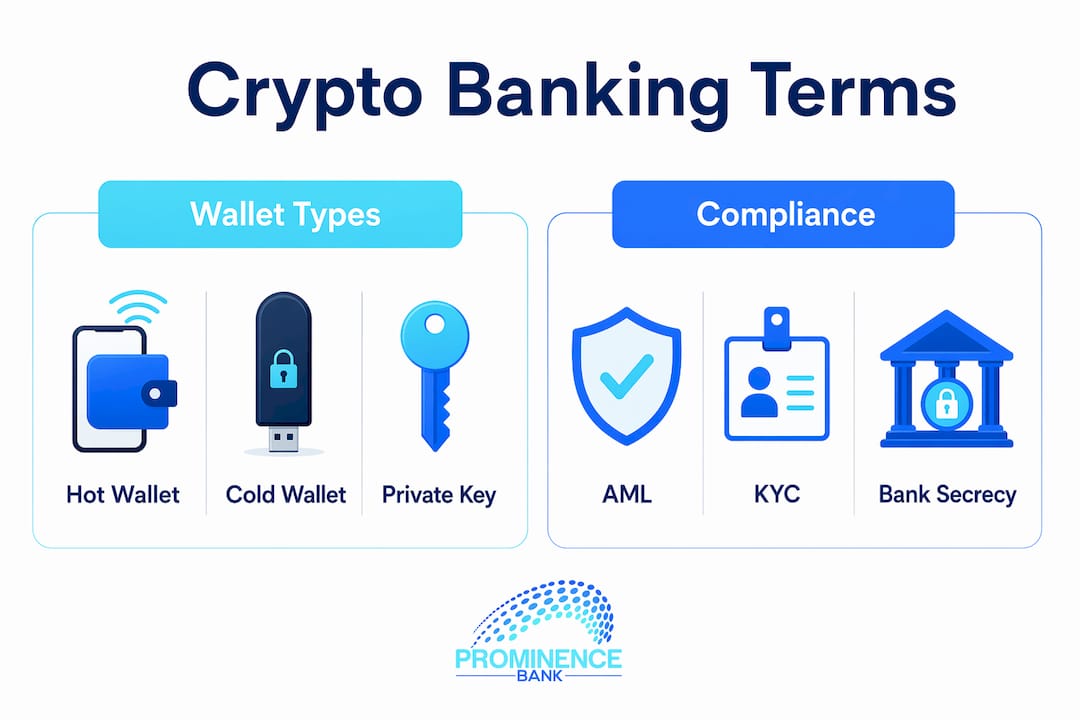
Hot wallets stay connected to the internet, which makes them convenient for frequent transactions but more exposed to hacks. Think of them like a checking account: accessible, but not where you park large balances. Cold wallets store private keys entirely offline, closer to a vault than a wallet. For any amount you would not want to lose, cold storage is the standard practice among serious holders.

FDIC and SIPC limits in crypto banking
Traditional bank deposits carry FDIC coverage per depositor per institution, and SIPC covers brokerage accounts against firm insolvency. Neither protection extends to crypto assets held at exchanges or custodian wallet providers. Some platforms carry private insurance, but coverage terms vary and are not standardized the way FDIC protection is. Before depositing crypto with any custodian, check exactly what insurance, if any, applies to your holdings.
AML, KYC, and the Bank Secrecy Act
The Bank Secrecy Act requires regulated financial institutions to implement Anti-Money Laundering (AML) programs and Know Your Customer (KYC) verification. As of 2026, this obligation increasingly applies to crypto exchanges and custodian wallet providers operating in the U.S. KYC means verifying your identity before you can open an account. AML means the platform monitors transactions for suspicious patterns and reports them to regulators. For a deeper look at how these obligations apply to digital banking clients, the compliance requirements for high-net-worth clients are worth reviewing.
Crypto as property in divorce
Blockchain privacy does not make crypto invisible to courts. Under U.S. law, cryptocurrency is treated as property and subject to equitable distribution in divorce proceedings. Courts can compel disclosure of wallet addresses and transaction histories. The assumption that crypto holdings are untraceable in legal proceedings is legally incorrect.
Pro Tip: Review the 2026 fintech compliance checklist before opening any crypto account to confirm the platform meets current AML and KYC standards.
Common crypto slang you will actually encounter
Crypto culture runs on shorthand. These terms show up in forums, trading chats, and news headlines, and misreading them can lead to bad decisions.
- HODL: Originally a typo for “hold,” now a deliberate term meaning to hold crypto through price swings rather than sell; it signals long-term conviction over short-term trading.
- FUD: Fear, Uncertainty, and Doubt. Refers to negative information, sometimes accurate, sometimes deliberately spread, that drives prices down or shakes investor confidence.
- FOMO: Fear of Missing Out. The impulse to buy a rapidly rising asset because you fear being left behind. FOMO-driven purchases often happen near price peaks.
- Whale: A holder of a very large amount of a particular cryptocurrency. When a whale moves funds, it can shift market prices noticeably.
- Rekt: Slang for suffering a severe financial loss, usually from a bad trade or a liquidated position.
- Rug pull: A scam where developers abandon a project and take investor funds, leaving token holders with worthless assets.
- Altcoin: Any cryptocurrency other than Bitcoin. Ethereum is technically an altcoin, though it is often treated as a category of its own.
- Gas war: When many users compete to get transactions processed quickly, all raising their gas fees simultaneously, driving costs sharply higher.
Common slang terms like HODL, FUD, and whale encode real investor behavior and sentiment shifts. Knowing them helps you read market mood, not just price charts.
How to use this crypto finance terminology knowledge effectively
Understanding the terms is step one. Using them correctly when making decisions is where it counts.
- Verify custody before depositing. Ask whether the platform is a custodian wallet provider or whether you retain self-custody. The answer determines who controls your private keys and what happens if the platform fails.
- Match wallet type to your use case. Use a hot wallet for active trading and small balances. Use a cold wallet for long-term storage of any amount you cannot afford to lose.
- Read APY disclosures carefully. Crypto savings products often advertise high APY figures. Confirm whether the rate is fixed or variable, what asset it is paid in, and whether any insurance applies.
- Check gas fees before transacting. On Ethereum, gas fees can exceed the value of a small transaction during peak congestion. Use a gas tracker to time transactions when fees are lower.
- Understand what KYC means for your privacy. Every regulated platform will collect your identity documents. That is a legal requirement, not optional, for any U.S.-regulated crypto service.
- Know the difference between AML flags and account freezes. An AML flag triggers a review; an account freeze means funds are held pending investigation. Both are legal tools regulators use, and both can happen to legitimate users.
Pro Tip: Write your seed phrase on paper and store it in at least two separate physical locations. Never photograph it, type it into any app, or store it digitally in any form.
Prominencebank offers secure digital banking for crypto-focused clients
Crypto banking requires more than a glossary. It requires a banking partner that already operates within the compliance frameworks this guide describes.
Prominencebank is a fully licensed digital banking institution built for high-net-worth individuals, international businesses, and institutional clients who need both privacy and regulatory credibility. The bank operates under full AML and KYC compliance, so every account meets the standards the Bank Secrecy Act demands. Multi-currency accounts give clients the flexibility to hold and move assets across currencies without switching platforms, and account opening is available entirely online. For clients managing crypto alongside traditional assets, Prominencebank’s digital currency banking services provide the infrastructure to do both under one roof. Clients who need to manage holdings across multiple currencies can explore global multi-currency account options designed for exactly that purpose.
Key Takeaways
Crypto assets held at exchanges carry no FDIC or SIPC protection, making custody model selection the single most consequential decision in crypto banking.
| Point | Details |
|---|---|
| FDIC covers traditional deposits only | FDIC insures bank deposits per depositor per institution; crypto holdings at exchanges are not covered. |
| Seed phrase security is absolute | A 12 to 24-word seed phrase is the master private key; store it offline only, never digitally. |
| Custody model determines your risk | Custodian wallet providers hold your keys; self-custody means you hold them yourself. |
| Crypto is property in divorce | U.S. courts treat cryptocurrency as marital property subject to equitable distribution. |
| Prominencebank for compliant crypto banking | Prominencebank offers AML/KYC-compliant digital banking with multi-currency accounts for crypto-focused clients. |
FAQ
What are the 12 words in crypto?
The “12 words” refer to a seed phrase—a sequence of 12 to 24 words that serves as the master private key to a crypto wallet. Anyone who has these words can access and transfer all assets in that wallet.
What are the basic banking terms in crypto finance?
Core crypto banking terms include custodial account, private key, public key, gas fee, AML, KYC, hot wallet, cold wallet, and FDIC insurance. Understanding these covers the foundation of how crypto banking products and regulations work.
Can my spouse take my crypto in a divorce?
Yes. U.S. courts treat cryptocurrency as property subject to equitable distribution in divorce proceedings, regardless of blockchain privacy features. Courts can compel disclosure of wallet addresses and transaction records.
What is the difference between a hot wallet and a cold wallet?
A hot wallet connects to the internet for easy access but carries higher security risk. A cold wallet stores private keys offline, making it far more resistant to hacks and the preferred option for long-term storage of significant holdings.
Does FDIC insurance cover crypto accounts?
No. FDIC insurance covers traditional bank deposits up to $250,000 per depositor per institution. Crypto assets held at exchanges or custodian wallet providers are not covered by FDIC or SIPC protections.