
TL;DR:
- Opening a legitimate corporate KTT bank account requires active correspondent banking relationships, funded nostro accounts, and thorough compliance verification. Many vendors overpromise, but without genuine infrastructure and verification, funds may never settle despite setup fees. Proper due diligence, including direct bank confirmation, is essential for secure, high-value international transfers.
Opening a corporate KTT bank account sounds straightforward until you realize how many businesses have paid significant fees and received nothing in return. KTT (Key Tested Telex) banking sits at the crossroads of legitimate international finance and a space heavily exploited by fraudulent actors. The confusion is understandable. The terminology is technical, the banking relationships are opaque, and the marketing from some providers is deliberately misleading. This guide cuts through the noise and gives you what you actually need: a clear, practical understanding of how KTT transaction banking works, which jurisdictions matter, and how to open and manage a legitimate account without getting burned.
Table of Contents
- Key Takeaways
- How corporate KTT bank accounts actually work
- Evaluating banks and jurisdictions for KTT accounts
- Risks, limitations, and common pitfalls
- Opening and managing a corporate KTT account
- Strategic benefits for privacy and asset protection
- My perspective on the realities of KTT banking
- Why Prominencebank is built for this
- FAQ
Key Takeaways
| Point | Details |
|---|---|
| KTT is authentication, not a payment rail | A KTT message authenticates a transfer instruction but does not by itself move funds or guarantee settlement. |
| Correspondent banking is non-negotiable | Genuine KTT settlement requires funded nostro accounts and active correspondent banking relationships. |
| Non-bank senders carry serious risk | Trust companies and finance houses cannot legally settle KTT transfers, making sender verification critical. |
| Jurisdiction shapes privacy and protection | CRS reporting limits banking secrecy; non-CRS jurisdictions offer stronger privacy but require careful legal structuring. |
| Setup fees do not guarantee funds received | Compliance onboarding fees cover infrastructure only and offer no assurance that incoming transfers will actually settle. |
How corporate KTT bank accounts actually work
Most businesses come to KTT banking with one of two assumptions. Either they believe KTT is a special high-value payment system reserved for elite institutions, or they have been told by a vendor that setting up a KTT-enabled account will unlock large incoming wire transfers. Both framings miss the point entirely.
KTT is a legacy authentication method requiring active correspondent banking relationships to create legally binding payment obligations. Without this infrastructure, a KTT message is just a formatted communication with no enforceable settlement attached. Think of it as a signed delivery receipt for a package that may or may not exist.
Here is what legitimate KTT transfer mechanics actually require:
- A regulated sending bank with a valid banking license in its home jurisdiction
- Funded nostro accounts at correspondent banks in the receiving bank’s network
- Verified KYC and AML compliance on both sending and receiving ends
- A correspondent banking relationship between the two institutions, not just a message capability
- Full UBO (Ultimate Beneficial Owner) verification for corporate account holders
Because no universal list of KTT-accepting banks exists, acceptance is determined case by case based on compliance posture, the quality of the sender’s documentation, and the receiving bank’s own correspondent network. This is not a system you can game by choosing the right bank name. It is a relationship-based process.
Pro Tip: Before you pay any setup fee or sign any agreement with a bank claiming to receive KTT transfers, ask them to name their correspondent banks and confirm funded nostro accounts in writing. If they cannot or will not answer that question directly, walk away.
Evaluating banks and jurisdictions for KTT accounts
Choosing the right banking jurisdiction for a corporate KTT account is not simply about finding the most private location. It is about aligning privacy goals with compliance obligations, banking infrastructure, and cost realities.
Offshore vs. onshore jurisdictions
Offshore jurisdictions popular for corporate KTT accounts include Panama, Belize, Seychelles, and Vanuatu. These offer favorable incorporation laws and, in some cases, stronger banking confidentiality. Onshore options such as Singapore, Switzerland, and the UAE provide more established correspondent banking infrastructure, which actually matters more for real KTT settlement than nominal secrecy laws.
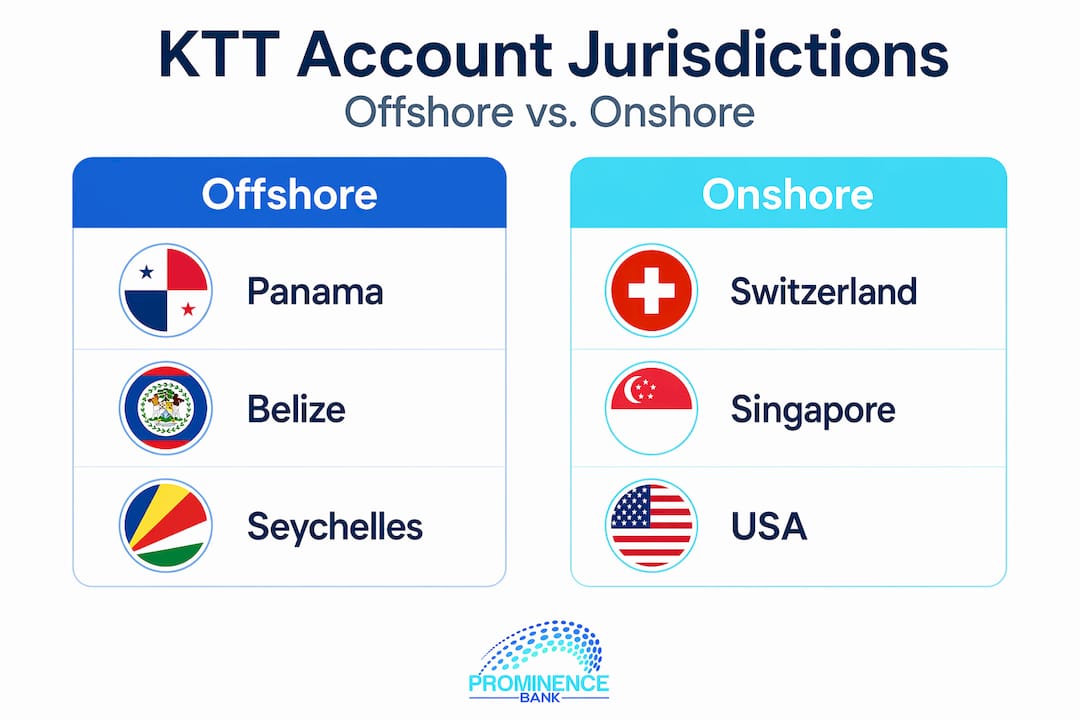
Banking secrecy is significantly limited by CRS (Common Reporting Standard) in most participating jurisdictions. If genuine financial privacy is a priority for your corporation, you need legal residency or incorporation in a non-CRS jurisdiction, not just an account there.
Here is a comparison of key features across account types and jurisdictions:
| Jurisdiction | Typical Minimum Deposit | CRS Member | KTT Infrastructure | Privacy Level |
|---|---|---|---|---|
| Panama | $2,500 | No | Limited | High |
| Switzerland | $500,000+ | Yes | Strong | Medium |
| Seychelles | $5,000 | No | Moderate | High |
| Singapore | $100,000+ | Yes | Strong | Medium |
| UAE (DIFC) | $50,000+ | Yes (partial) | Strong | Medium-High |
Minimum deposits for offshore corporate accounts start around $2,500, with SWIFT transaction fees typically ranging from $15 to $50 per transfer. For KTT-specific accounts requiring specialized infrastructure, expect significantly higher entry costs.
The factors that should drive your jurisdiction decision include:
- Strength of the local banking regulator and oversight framework
- Existing correspondent banking relationships of the target institution
- Whether the jurisdiction participates in automatic information exchange under CRS
- Local licensing requirements for corporate entities and beneficial owners
- Practical banking access, including digital platforms and multi-currency functionality
Pro Tip: Don’t confuse a jurisdiction’s reputation for privacy with actual banking capability. A bank in a secrecy jurisdiction that lacks real correspondent relationships is worse than a compliant bank in a transparent jurisdiction when it comes to KTT settlement.
Risks, limitations, and common pitfalls
KTT banking has a disproportionately large fraud surface compared to other banking products. Understanding why protects you from costly mistakes.

Setup fees for KTT-capable accounts can reach $62,500 and are non-refundable by design, covering compliance onboarding and infrastructure setup. Paying this fee does not mean funds will arrive. It means the bank has prepared the account to receive them if a legitimate, funded sender initiates the transfer. That is a critical distinction most fee agreements fail to emphasize.
The numbered pitfalls most businesses encounter follow a recognizable pattern:
- Paying setup fees to entities without banking licenses. Non-bank entities like trust companies cannot settle KTT transfers regardless of the messaging they can generate. A KTT message from a finance house carries no enforceable payment rights.
- Accepting sender documentation at face value. Verification of sender authenticity requires direct communication with the alleged correspondent bank, not just documents provided by the sender. Fraudulent actors produce convincing paperwork.
- Mistaking KTT pre-advice messages for guaranteed funds. A pre-advice message signals intent. It is not proof of funded capacity.
- Skipping audited financial verification. Confirming correspondent banking relationships and audited financials of the sending entity is non-negotiable due diligence. Any sender who resists this request is a red flag.
- Assuming that compliance onboarding equals fund security. Your bank’s compliance process protects the bank. It does not verify the sender’s funding position.
Pro Tip: Ask the sending bank for their SWIFT BIC code and independently verify it through the SWIFT directory. Then call the correspondent bank directly and ask them to confirm the relationship. Fraudulent senders cannot pass this test.
Opening and managing a corporate KTT account
The practical process of opening a legitimate corporate KTT account is more structured than most financial products. Banks offering genuine KTT financial institution services require thorough corporate documentation before any account setup begins.
Step-by-step process
- Prepare your corporate documentation package. This includes your Certificate of Incorporation, Articles of Association, shareholder register, UBO identification documents, and a detailed business plan explaining the expected source and use of funds.
- Submit to KYC and AML compliance review. Every corporate account undergoes beneficial owner verification and source-of-funds analysis. Prominence Bank normally completes account opening within 48 to 72 hours after all required KYC/AML procedures have been completed and all requested information and documentation have been received, verified, and accepted. This is an estimated processing period, not a guaranteed deadline. Additional time may be required if further compliance, verification, or due-diligence review is necessary. Submitting an enquiry, application, or payment does not start the estimated processing period and does not guarantee account approval or activation.
- Establish your multi-currency framework. For businesses managing international transactions, setting up multi-currency sub-accounts at the outset prevents operational delays when funds arrive in different denominations.
- Clarify transaction fee structures in writing. Beyond setup costs, a 1.5% processing fee is common on received KTT transactions post-verification. Understand the total cost of receiving a transfer before committing.
- Set up ongoing compliance reporting. Regulatory obligations do not end at account opening. Annual beneficial owner confirmations, transaction reporting, and source-of-funds declarations are standard for KTT corporate accounts.
Beyond documentation, the ongoing management of a KTT account requires attention to:
- Transaction monitoring and flagging of unusual patterns
- Regular review of correspondent banking relationships for continuity
- Currency exposure management across multi-currency holdings
- Periodic KYC refresh as business structure or ownership changes
- Legal review of jurisdictional changes to CRS or local banking law
For businesses integrating a KTT account into broader treasury operations, you should treat it as a specialized instrument with its own compliance lifecycle, not as a general operating account. Read through a full offshore account opening guide to understand the documentation requirements by jurisdiction before approaching a bank.
Strategic benefits for privacy and asset protection
When properly structured, a corporate KTT bank account delivers advantages that standard corporate accounts cannot match, particularly for businesses operating across multiple jurisdictions with large-value international transfers.
The core strategic benefits include:
- Enhanced transaction privacy. While CRS limits absolute secrecy, accounts in non-participating jurisdictions offer meaningful privacy for business-to-business transfers when combined with proper legal structuring.
- Asset protection from litigation and creditor risk. Offshore corporate accounts are legally effective for asset protection when backed by proper documentation and jurisdiction choice. Separation of assets across jurisdictions creates structural protection that domestic accounts cannot provide.
- Large-value transfer capacity. KTT accounts are specifically designed for high-value inter-bank settlements. This makes them appropriate for corporations moving significant capital internationally where standard SWIFT wires are insufficient or flagged at lower thresholds.
- Integration with treasury management. Multi-currency KTT accounts can anchor a corporate treasury function, allowing businesses to hold, convert, and deploy capital across markets from a single institutional relationship.
“Banking privacy is not dead, but it requires legal architecture, not just account selection. The businesses that benefit most from corporate KTT accounts are those that treat them as part of a deliberate financial structure, not a shortcut.”
The key caveat: these benefits materialize only with a genuinely compliant, licensed banking partner. Review your banking privacy strategy periodically as international reporting standards continue to evolve in 2026 and beyond.
My perspective on the realities of KTT banking
I’ve spent years watching businesses arrive at KTT banking with outsized expectations, and I’ll be direct: the marketing around KTT accounts often outpaces the reality by a wide margin. The number of corporations I’ve seen pay five-figure setup fees to vendors who could send a telex but had no correspondent infrastructure to back it is genuinely alarming.
The uncomfortable truth is that KTT banking is not a special tier of banking unlocked by the right connections or the right vendor relationship. It is a technical process requiring real licensed banks, real funded correspondent accounts, and real compliance. The due diligence burden is on you as the receiving corporate entity, not on the sending bank’s assurances.
What I’ve found actually works is treating the sender verification process with the same rigor you would apply to a major vendor contract. Call the correspondent bank directly. Request audited financials. Insist on SWIFT BIC confirmation. If a vendor frames this as unnecessary or excessive, they are telling you something important about whether the funds will ever arrive.
The businesses that succeed with KTT accounts are not the ones who found a more persuasive vendor. They are the ones who did the unsexy work of confirming every claim before any money changed hands.
— Harold
Why Prominencebank is built for this
Prominencebank operates with licensed banking infrastructure and active correspondent banking relationships specifically designed to support KTT-compliant corporate accounts. If you are a business looking to receive high-value transfers with genuine settlement capability, the distinction between a marketing claim and a funded correspondent network matters more than anything else you will read in a brochure.
Prominencebank’s corporate banking division offers multi-currency corporate accounts built for international KTT transaction management, with full KYC and AML onboarding, ongoing compliance support, and direct access to global banking infrastructure. For businesses ready to move beyond vendor promises and into a properly structured account, explore Prominencebank’s corporate account setup options and find the right structure for your operational needs.
FAQ
What is a corporate KTT bank account?
A corporate KTT bank account is a business banking account at a licensed financial institution capable of receiving Key Tested Telex transfers, which requires active correspondent banking relationships and funded nostro accounts to actually settle payments.
Does paying a KTT account setup fee guarantee I will receive funds?
No. Setup fees cover compliance onboarding and infrastructure only. Whether funds actually arrive depends entirely on whether the sending party has a legitimate banking license and funded correspondent account.
Which banks accept KTT transfers?
No public list of KTT-accepting banks exists. Acceptance is determined case by case based on the sender’s regulatory standing, the quality of their correspondent relationships, and the receiving bank’s compliance policies.
What documents are needed to open a corporate KTT account?
You will typically need a Certificate of Incorporation, Articles of Association, a shareholder register, UBO identification, and a business plan documenting your expected transaction activity and source of funds.
How do I verify a legitimate KTT sending bank?
Contact the correspondent bank directly and independently confirm the sender’s relationship. Do not rely solely on documents provided by the sender, as fraudulent actors routinely produce convincing but unverifiable paperwork.