
TL;DR:
- Financial institution licensing is a mandatory regulatory process that authorizes firms to offer specific financial services within a jurisdiction. The process involves stages like scoping, documentation, assessment, and ongoing compliance, with timelines varying widely by country and complexity. Licensing ensures legal operation, customer protection, system stability, and builds reputational credibility for financial firms.
Financial institution licensing is defined as the mandatory regulatory authorization a firm must obtain before legally offering specific financial services within a given jurisdiction. Without this authorization, no bank, payment provider, or investment firm can legally accept deposits, extend credit, or manage client assets. The licensing framework differs by country, service type, and regulator, which makes understanding financial regulation a non-negotiable skill for any financial professional or business owner operating across borders. Key bodies like the Financial Conduct Authority (FCA) in the UK, the Financial Markets Authority (FMA) in New Zealand, and the European Central Bank (ECB) each set distinct rules. Prominencebank operates as a fully licensed digital institution, which means it has cleared exactly this process to serve high-net-worth clients and international businesses with confidence.
What does the financial licensing process typically involve?
The financial licensing process follows a structured sequence that regulators use to assess whether a firm is fit to operate. The stages generally move from scoping and pre-application through documentation, formal submission, regulator assessment, and finally authorization or rejection.

Stage 1: Scoping and pre-application
Before submitting anything, a firm must identify the exact regulated activities it intends to perform. This determines which regulator has jurisdiction and which license category applies. Getting this wrong wastes months and significant legal fees.
Stage 2: Documentation and preparation
Regulators require evidence-based applications documenting governance, AML/KYC controls, and leadership qualifications rather than just business model presentations. Fit and proper checks on directors and senior managers are standard. Business plans must show financial projections, risk management frameworks, and operational resilience.
Stage 3: Formal submission and assessment
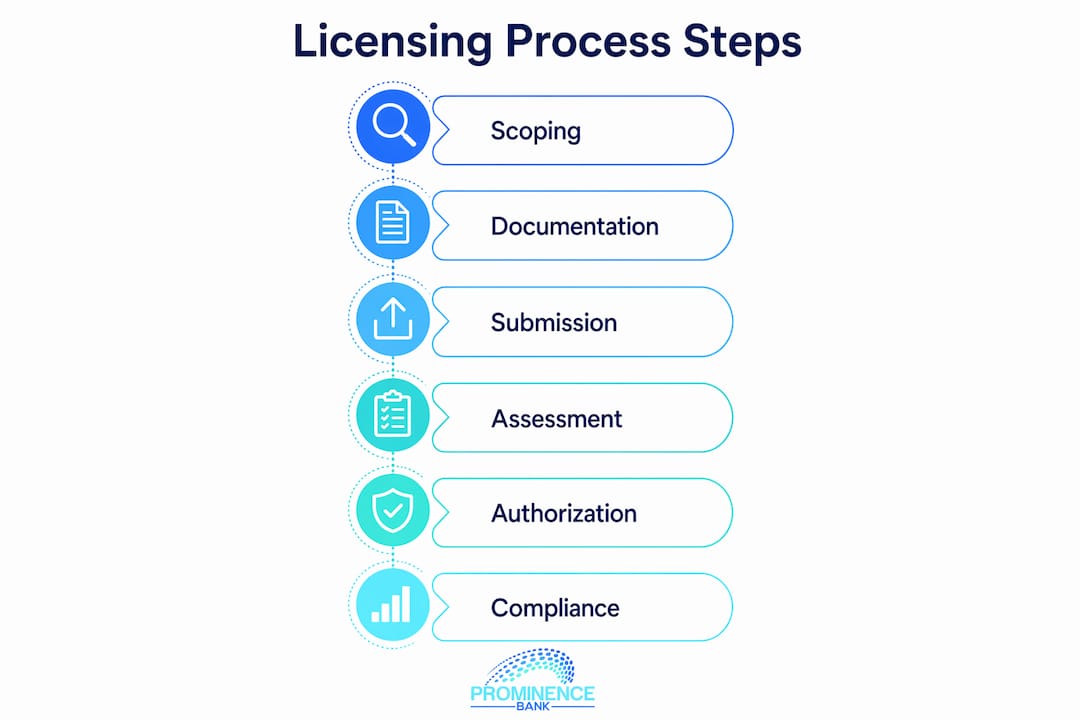
The regulator reviews the application, often requesting additional information or clarification. The Bank of England, for example, structures onboarding for new financial market infrastructure firms into four stages: risk assessment, authorization, mobilization, and scaling. That staged model reflects how regulators think about controlled market entry.
Stage 4: Authorization and ongoing compliance
Authorization is not the finish line. Licensed firms must maintain compliance obligations, report to regulators, and update their permissions when services change.
The UK FCA authorization timeline typically runs between 9 and 15 months, with costs ranging from low five-figures to seven-figure sums depending on complexity. That range reflects how much preparation quality affects total cost. In New Zealand, the base application fee for a financial institution license is approximately $1,025 NZD, with additional fees per authorized body listed on the application.
One practical option worth knowing is authorized or appointed representative status. Authorized body status allows a firm to perform regulated activities under a sponsor’s existing license. This reduces upfront cost and speeds market entry, though compliance responsibility remains with the license holder.
Pro Tip: Engage the regulator informally before submitting. Most regulators offer pre-application meetings. Use them to confirm your license category and flag any structural issues before they become formal objections.
What are the key requirements for financial institution licensing across major jurisdictions?
Licensing requirements vary significantly by jurisdiction, but three categories appear in every framework: capital adequacy, governance standards, and conduct or prudential oversight.
Capital requirements
EU credit institutions must hold a minimum initial capital of EUR 5 million, but regulators generally expect firms to hold significantly more based on their risk profile. Minimum regulatory capital is rarely sufficient on its own. Firms must demonstrate capital adequacy that includes buffers for operational risks and business complexity. A firm launching a basic payment service faces a lower capital bar than one offering credit or custody services.
Governance and leadership standards
Every major regulator demands documented governance structures. This means defined board responsibilities, clear reporting lines, and qualified senior management. The “fit and proper” standard requires evidence of competence, integrity, and financial soundness for each key person. A weak governance file is one of the fastest ways to receive a regulator rejection.
Regulatory models by jurisdiction
New Zealand employs a twin peaks regulatory model where conduct and prudential regulation are handled by separate authorities. The FMA oversees conduct, while the Reserve Bank handles prudential licensing. Understanding distinct regulatory roles is critical in jurisdictions with split responsibility. Filing with the wrong body, or missing one entirely, creates compliance gaps that can invalidate an application.
The table below summarizes key differences across three major jurisdictions.
| Jurisdiction | Primary regulator | Minimum capital | Timeline |
|---|---|---|---|
| United Kingdom | FCA | Varies by license type | 9–15 months |
| European Union | ECB / national authority | EUR 5 million (credit institutions) | 12–24 months |
| New Zealand | FMA + Reserve Bank | Set per license category | Varies by application |
Pro Tip: Do not treat the minimum capital figure as your target. Regulators assess capital adequacy against your business plan. Build in a buffer of at least 25–50% above the stated minimum to demonstrate financial soundness.
Why is financial institution licensing essential for business operations and customer protection?
Licensing is not a bureaucratic formality. It is the mechanism regulators use to control who enters the financial system and on what terms.
The core functions licensing serves include:
- Legal permission to operate. A firm without a license cannot legally accept deposits, manage investments, or process payments in most jurisdictions. Operating without authorization exposes directors to criminal liability.
- Consumer protection. Licensed firms must meet capital adequacy standards, maintain segregated client funds, and follow conduct rules. These requirements protect clients from fraud, insolvency, and mismanagement.
- Financial system stability. Regulators use licensing to prevent undercapitalized or poorly governed firms from creating systemic risk. The 2008 financial crisis accelerated global regulatory tightening precisely because weak oversight allowed dangerous practices to spread.
- Reputational credibility. A license signals to clients, counterparties, and correspondent banks that a firm meets recognized standards. Without it, accessing global financial infrastructure becomes practically impossible.
The regulatory environment continues to evolve in response to financial innovation. Digital assets, embedded finance, and cross-border payment platforms have prompted regulators in the EU, UK, and US to expand licensing frameworks. Firms that treat licensing as a one-time event rather than an ongoing obligation find themselves out of compliance faster than they expect. For context on how regulated digital banking fits into this picture, the standards are equally demanding for digital-first institutions.
How to strategically navigate and successfully complete the financial licensing process?
Successful licensing applications share one common trait: they treat the process as a project, not a form-filling exercise.
The most common reasons applications fail or stall include:
- Incomplete beneficial ownership documentation. Poor preparation such as missing beneficial ownership records or absent key personnel causes regulator delays that can set a project back by six months or more.
- Wrong jurisdiction selection. Choosing a jurisdiction based on perceived ease rather than business fit creates long-term compliance problems. The right jurisdiction aligns with your client base, product type, and operational infrastructure.
- Insufficient capital buffers. Applying with capital at the regulatory minimum signals to reviewers that the firm has not modeled its actual risk exposure.
- Siloed preparation. Licensing requires integrated project planning across legal, compliance, finance, IT, and operations. Teams that work in isolation produce inconsistent applications that fail internal consistency checks.
The authorized body route deserves serious consideration for firms entering regulated markets for the first time. Operating under a sponsor’s license while building a compliance track record reduces capital requirements and shortens time to market. The trade-off is that the sponsor retains oversight authority, so governance alignment between the two firms matters.
A clear critical path review, scheduled at least 90 days before submission, allows teams to identify documentation gaps and resolve them without delaying the application. Proactive regulator engagement at this stage also sets realistic expectations on both sides.
Pro Tip: Map your critical path from day one. Assign a single project owner who coordinates across legal, compliance, and finance. Fragmented ownership is the single biggest cause of preventable delays.
For firms operating across multiple markets, the international banking process adds another layer of coordination that requires the same disciplined approach.
Key Takeaways
Financial institution licensing is a mandatory, jurisdiction-specific authorization that requires documented governance, adequate capital, and ongoing compliance to obtain and maintain.
| Point | Details |
|---|---|
| Licensing is mandatory | No firm can legally offer regulated financial services without authorization from the relevant regulator. |
| Capital minimums are a floor | EU credit institutions need at least EUR 5 million, but regulators expect buffers well above the stated minimum. |
| Timelines vary widely | UK FCA authorization takes 9–15 months; EU processes can run 12–24 months depending on complexity. |
| Preparation quality drives outcomes | Incomplete documentation and siloed teams are the leading causes of application delays and rejections. |
| Authorized body status is a viable shortcut | Firms can operate under a sponsor’s license to enter markets faster while building their own compliance track record. |
What I’ve learned from watching licensing projects succeed and fail
Most licensing failures I’ve observed share the same root cause: the applicant treated the process as a compliance exercise rather than a business-critical project. They assigned it to a single lawyer, set a deadline, and waited. Regulators do not work on your timeline. They work on theirs.
The firms that succeed plan 18 months out, even when the regulator’s stated timeline is 9 months. They build governance structures before they apply, not during the review. They hire compliance officers with regulator-side experience, because those people know what reviewers actually look for in an application file.
The other mistake I see repeatedly is underestimating post-authorization obligations. Getting licensed is the beginning of a continuous compliance relationship with your regulator. Firms that coast after authorization face enforcement action, license conditions, or revocation. The regulatory relationship requires active management, not passive maintenance.
My honest view is that licensing should be treated as a strategic asset. A well-structured license in the right jurisdiction opens correspondent banking relationships, attracts institutional clients, and creates a defensible market position. Firms that invest properly in the process gain a durable competitive advantage. Firms that cut corners spend years managing the consequences.
— Harold
Prominencebank: banking built for licensed financial institutions
Licensed financial institutions operate in a world where banking infrastructure must match the complexity of their compliance obligations. Prominencebank is a fully licensed digital banking institution built specifically for this environment, serving high-net-worth clients, international businesses, and institutional clients who require discretion, global reach, and compliance-grade infrastructure.
Prominencebank offers multi-currency account solutions designed for firms managing cross-border operations across multiple regulatory jurisdictions. Its corporate banking solutions support complex structures with AML/KYC-compliant onboarding and direct access to global financial infrastructure. For licensed institutions that need a banking partner that understands their regulatory environment, Prominencebank provides the infrastructure to operate with confidence.
FAQ
What is financial institution licensing?
Financial institution licensing is the mandatory regulatory authorization that allows a firm to legally offer specific financial services such as deposit-taking, lending, or investment management within a defined jurisdiction.
How long does the financial licensing process take?
Timelines vary by jurisdiction. The UK FCA process typically takes 9–15 months, while EU bank licensing can run 12–24 months depending on the complexity of the application and the regulator’s workload.
What are the main requirements for financial licenses?
The core requirements are minimum capital adequacy, documented governance structures, fit and proper leadership checks, and AML/KYC controls. Capital minimums vary, with EU credit institutions required to hold at least EUR 5 million as a starting floor.
What happens if a firm operates without a license?
Operating without authorization exposes directors to criminal liability and subjects the firm to regulatory enforcement, fines, and reputational damage that can permanently close off access to correspondent banking and institutional clients.
What is authorized body status in financial licensing?
Authorized body status allows a firm to perform regulated activities under an existing license holder’s authorization. It reduces upfront capital requirements and speeds market entry, but compliance responsibility remains with the sponsoring license holder.