
TL;DR:
- SKRs are formal bank-issued confirmations of asset custody, not ownership transfer documents.
- Verifying an SKR’s legitimacy requires direct contact with the issuing bank through official channels.
- The trustworthiness of an SKR depends on the issuing institution’s security features and regulatory standing.
Safe Keeping Receipts, or SKRs, rank among the most misunderstood documents in high-value international banking. Many sophisticated investors and corporate treasurers confuse them with certificates of deposit, bank guarantees, or negotiable instruments, and that confusion can be genuinely costly. An SKR is something far more specific: a formal, bank-issued confirmation that a valuable asset is being held in custody on your behalf. Understanding exactly what that means, and what it does not mean, is foundational to protecting wealth at scale and navigating the complex landscape of global asset security.
Table of Contents
- What is an SKR in banking?
- SKR vs. other banking documents: How does it compare?
- How banks handle SKRs: The process, validation, and security
- Benefits and potential risks of SKRs for high-value clients
- SKRs in practical banking: Real-world scenarios and applications
- What most experts miss about SKRs: The real test of banking trust
- Discover secure banking solutions that support SKRs
- Frequently asked questions
Key Takeaways
| Point | Details |
|---|---|
| SKR defined | An SKR is a receipt from a bank confirming that valuable assets are held in custody, not a negotiable instrument. |
| SKR vs other documents | SKRs differ significantly from certificates of deposit or letters of credit and should not be confused. |
| Bank verification critical | Always confirm SKR authenticity directly with the issuing institution using official verification processes. |
| Ideal for secure transactions | SKRs play a vital role in safeguarding high-value assets and enabling international collateral deals. |
| Trustworthy partners matter | The full value of an SKR depends on the reliability and transparency of the bank issuing it. |
What is an SKR in banking?
An SKR, or Safe Keeping Receipt, is a formal document issued by a custodian bank that confirms it holds a specific asset on behalf of a client. The document serves as legal evidence of custody, not ownership transfer. The bank is saying, in legally binding terms, “we have this asset, it belongs to you, and we are holding it securely.” That distinction matters enormously in practice.
The assets covered under an SKR can vary significantly. Precious metals like gold and silver bars, sovereign bonds, high-value legal contracts, bearer instruments, and select real property documents all commonly appear in SKR arrangements. The document names the asset, describes it precisely, identifies the custodial institution, and specifies the terms under which the asset is held.
“An SKR provides legally recognized evidence of custody without altering the underlying ownership structure of the asset, making it one of the most precise instruments available to high-value wealth holders.”
What an SKR is not is equally important. It is not a certificate of deposit, which is a savings product that earns interest. It is not a promissory note or a negotiable instrument that circulates in secondary markets. And it is certainly not a blank paper promise. An authentic SKR has legal standing, but only when issued by a recognized custodial bank operating within proper regulatory frameworks.
Key elements you should expect to find in any legitimate SKR:
- Full identification of the custodial institution and its jurisdiction
- Precise description of the asset held (type, quantity, grade, serial numbers where applicable)
- Client identification details (legal name, account number)
- Date of deposit and expected custody duration
- Reference number and official bank seal
- Authorized signatory details from the issuing bank
Pro Tip: Before accepting any SKR in a transaction, independently verify the issuing bank’s standing and contact their compliance or custody department directly. A genuine institution will confirm the document’s existence and validity through official channels without hesitation.
SKR vs. other banking documents: How does it compare?
Confusing an SKR with other commonly used banking instruments is not just an academic mistake. It can expose you to fraud, failed transactions, and serious legal liability. Here is a clear side-by-side comparison of how SKRs differ from other instruments frequently used in high-value banking.
| Feature | SKR | Certificate of Deposit | Letter of Credit | Bank Guarantee |
|---|---|---|---|---|
| Primary purpose | Custody confirmation | Savings/interest | Trade payment assurance | Performance/payment security |
| Asset ownership | Unchanged | Transferred to bank | N/A | N/A |
| Transferability | Not transferable | Varies by product | Transferable (sometimes) | Not transferable |
| Earns interest | No | Yes | No | No |
| Used as collateral | Yes (with conditions) | Yes | Indirect | Yes |
| Fraud risk level | High if unverified | Moderate | Moderate | Moderate |
The banking security features protecting each of these instruments also differ considerably. SKRs rely entirely on the integrity of the issuing custodian, whereas letters of credit involve multiple banking counterparties, which distributes the verification burden. Understanding this architecture matters when you are structuring a large international transaction.
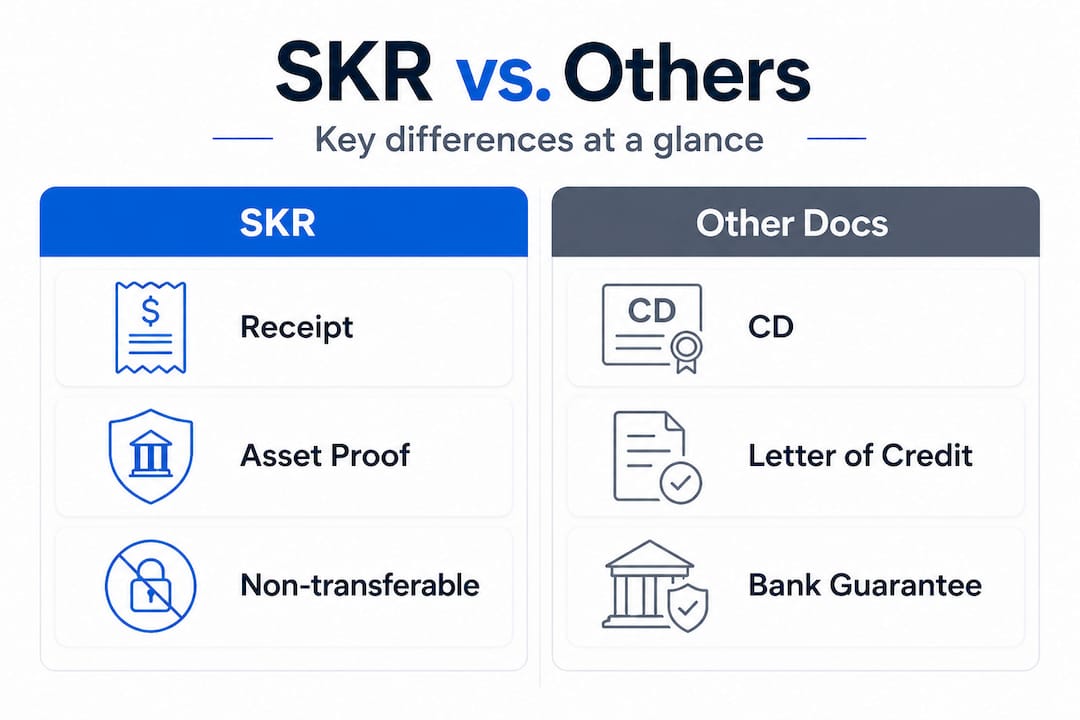
SKRs are preferable in specific situations. When you need to prove asset existence for a financing arrangement without liquidating the asset, an SKR provides that proof cleanly. When a counterparty requires documented custody as a transaction condition, an SKR satisfies that requirement. When you are operating across multiple jurisdictions and need a standardized custody record, an SKR provides a recognized format.
Risks of confusing SKRs with other documents include:
- Accepting a CD as proof of asset custody when it legally represents a deposit product, not a held asset
- Attempting to use an SKR as a negotiable instrument in a SWIFT transfer process where only proper financial instruments qualify
- Misrepresenting an SKR in a collateral arrangement, triggering contract disputes or fraud allegations
- Relying on an unverified SKR from an unrecognized institution, which carries zero legal weight
Always align document type with your transaction’s actual requirements. Working with legal counsel familiar with security tips for international banking is the best way to avoid these costly mismatches before they become problems.
How banks handle SKRs: The process, validation, and security
The issuance of an SKR follows a structured process. Banks do not generate these documents casually. Each step involves verification, internal approval, and formal documentation that creates a clear audit trail.
Here is how a legitimate SKR issuance typically unfolds:
- Asset presentation: The client presents the asset or documentation of the asset to the custodial bank in person or through a verified intermediary.
- Asset appraisal and identification: The bank independently verifies the asset’s existence, authenticity, quantity, and condition, often using third-party specialists for complex assets.
- Client KYC completion: Full AML and KYC verification of the client is completed, with all documentation recorded and retained.
- Custody agreement execution: A formal custody agreement is signed, detailing the terms, fees, duration, and responsibilities of both parties.
- SKR issuance: The bank generates the SKR document with all required details, assigns a unique reference number, and applies appropriate authentication features.
- Secure delivery: The original SKR is delivered to the client through a secure, traceable channel, whether physically or through encrypted digital means.
- Registry update: The bank records the SKR in its internal registry so that verification requests can be processed accurately.
The documents verification process at a competent institution goes well beyond visual inspection. Authentic SKRs often incorporate encrypted watermarks, holographic seals, unique serialization, and cryptographic authentication that can be verified through official bank portals or secure communications.
| Validation feature | Standard banks | Advanced digital banks |
|---|---|---|
| Document serialization | Manual | Automated with audit trail |
| Real-time verification portal | Rare | Standard |
| Authentication watermarks | Basic | Multi-layer cryptographic |
| Third-party appraisal | Optional | Required for high-value assets |
| Response time for verification | Days | Hours or real-time |
Fraud in the SKR space is persistent. Sophisticated forgeries circulate in international markets, and some are difficult to detect without direct bank contact. The cheque handling procedures analogy is apt: a sophisticated forgery looks real until you contact the issuing institution directly, at which point the discrepancy becomes obvious.
Pro Tip: Never rely solely on visual inspection of an SKR. Insist on real-time digital verification through the issuing bank’s secure portal or officer-to-officer communication before committing to any transaction involving the document.
Benefits and potential risks of SKRs for high-value clients
SKRs offer genuine, practical advantages for wealth holders and corporate entities with complex asset structures. But they also carry specific risks that are easy to underestimate without proper guidance.
Top benefits of SKRs:
- Security without liquidation: You can use an SKR as proof of asset backing in financing arrangements without selling or moving the underlying asset
- Collateral flexibility: Many institutional lenders and private banks accept SKRs as part of a structured collateral package, especially in large-scale or cross-border deals
- Asset confidentiality: SKRs allow you to demonstrate asset existence without publicly disclosing full ownership details, which matters significantly in high-value negotiations
- Global recognition: When issued by a credible institution, SKRs are recognized across financial jurisdictions as formal custody evidence
- Portfolio documentation: For estate planning, wealth reporting, and institutional investment reviews, SKRs provide clean, auditable proof of held assets
The international banking benefits that apply to offshore and multi-jurisdictional banking extend naturally to SKR arrangements, particularly for clients who maintain assets in more than one country.
Statistic callout: According to global wealth management research, high-net-worth individuals holding diversified international assets increasingly demand formal custody documentation as part of their overall asset security strategy, with SKR-backed arrangements growing in private banking portfolios across Asia, the Middle East, and Europe.
Potential risks to manage:
- Counterfeit SKRs: Forgeries are a real threat. Fraudsters issue fake SKRs from non-existent or shell institutions to extract fees or appear credible in transactions
- Misuse in financial schemes: SKRs have historically appeared in Ponzi schemes and prime bank fraud scenarios, where promoters claim the documents can generate impossible returns
- Custodian risk: If the issuing bank faces insolvency or regulatory sanctions, the SKR’s practical value can be compromised even if legally valid
- Legal enforceability gaps: SKRs issued in jurisdictions with weak rule-of-law environments may not hold up in international disputes
Pro Tip: In transactions involving SKRs above a certain value threshold, always engage independent legal counsel alongside the issuing institution. A second set of expert eyes is not overcautious. It is standard practice among serious wealth holders.
SKRs in practical banking: Real-world scenarios and applications
Knowing the theory behind SKRs is useful. Seeing how they actually function in real banking environments makes that knowledge actionable.
A high-net-worth individual holding physical gold stored in a Swiss or Singapore vault frequently uses SKRs to access liquidity without selling the metal. The SKR documents the custody arrangement, and the client presents it to a private bank or structured finance provider as supporting evidence for a collateral loan. The gold stays in the vault. The client receives the financing they need.
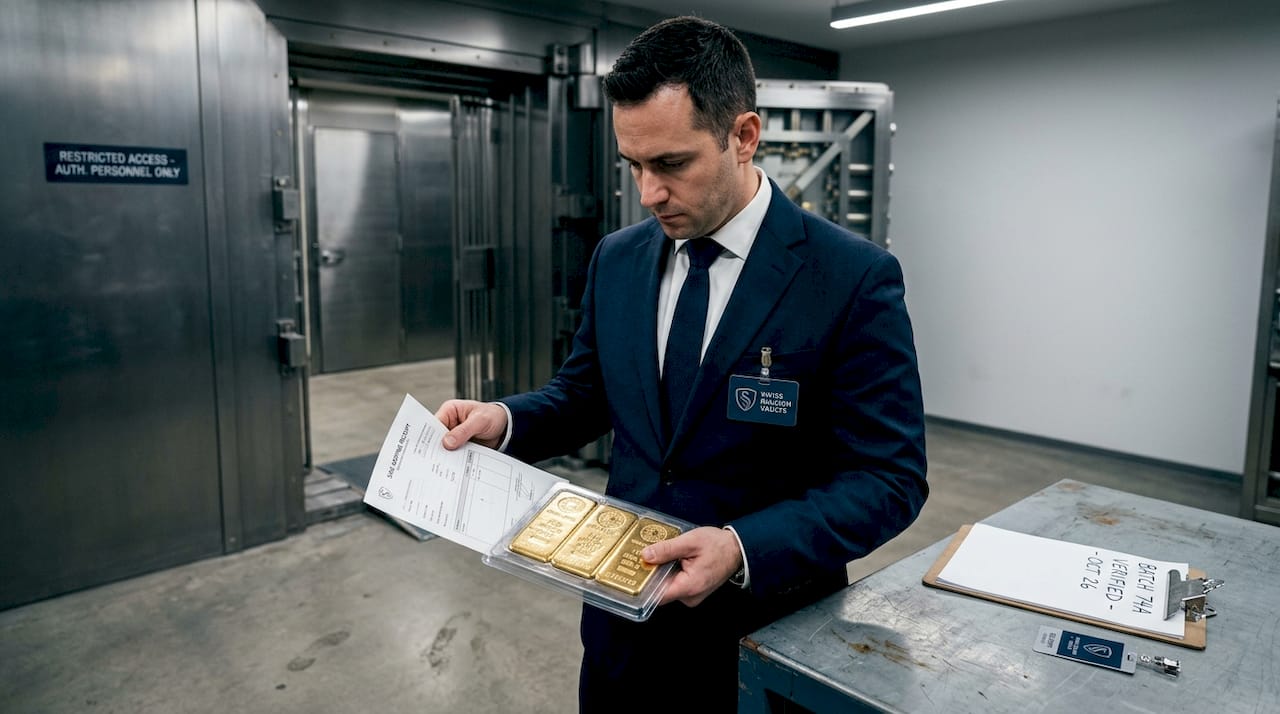
In interbank deals and large corporate transactions, SKRs appear as part of due diligence packages. When one institution is evaluating a counterparty’s asset backing before extending credit lines or entering joint ventures, an SKR issued by a recognized custodian provides independent confirmation of what is actually held and where.
The range of SKR applications in modern international finance is broad:
- Proof of asset backing in private placement memoranda and capital raises
- Documentation for family office wealth audits and estate planning structures
- Collateral support in trade finance and commodity-backed lending
- Evidence of asset existence in cross-border merger and acquisition due diligence
- Part of structured product offerings in institutional investment frameworks
- Supporting documentation for offshore account setup where asset disclosure requirements apply
Regulations across major financial centers continue to evolve, and SKR usage is increasingly subject to AML review as part of broader asset reporting requirements. Institutions and clients alike need to ensure that SKR arrangements are fully documented, transparently reported, and managed by custodians with current regulatory standing.
What most experts miss about SKRs: The real test of banking trust
Here is what the standard industry commentary on SKRs consistently misses: the document itself is not the security. The institution behind it is.
SKR fraud is not primarily a document forgery problem. It is a trust architecture problem. Scammers succeed because clients evaluate a piece of paper rather than the institution issuing it. The watermarks, reference numbers, and official-looking language are deliberately designed to pass visual scrutiny. What they cannot withstand is direct, real-time verification through a bank that actually exists, has operational compliance staff, and operates under genuine regulatory oversight.
We have seen this pattern repeatedly. A client receives an impressively formatted SKR. It references an institution with a real-sounding name. The document uses all the right language. But when you try to verify it through official channels, the trail goes cold. The bank either does not exist, cannot be contacted through any verified number, or has no record of the document. At that point, the damage may already be done.
The best SKR is worth exactly as much as the bank that issued it, and not one dollar more. This means the quality standard for an SKR is really a question about banking security features: Does the issuing bank have real-time verification infrastructure? Does it have named compliance officers who can be reached through published contact channels? Does it operate transparently under a recognized regulatory framework with published standards?
Paper alone has never protected wealth. Process, technology, and institutional integrity do. If your banking partner cannot demonstrate all three, no document they produce should be trusted regardless of how it looks. Demand more. Your wealth security depends on the quality of the institution, not the quality of the printing.
Discover secure banking solutions that support SKRs
Armed with a clear understanding of SKRs, the next step is finding a banking partner genuinely equipped to issue, verify, and support these instruments at the level your wealth structure demands.
Prominence Bank combines digital banking for HNWIs with the institutional infrastructure required for SKR-backed arrangements, multi-currency custody, and sophisticated offshore services. Our clients benefit from real-time document verification, AML-compliant custody processes, and direct access to banking officers who understand the complexity of high-value international transactions. Whether you are securing corporate banking arrangements or managing assets across multiple jurisdictions through multi-currency account options, Prominence Bank provides the transparency and security that serious wealth holders require. Connect with our team to explore how we support your full asset security strategy.
Frequently asked questions
Can SKRs be transferred or sold?
No. SKRs serve as evidence of safekeeping and are not negotiable instruments, meaning they cannot be transferred, endorsed, or sold independently of the underlying asset.
How do I verify the authenticity of an SKR?
Contact the issuing bank directly using independently verified contact details and request confirmation through their official documents verification channels rather than relying on contacts provided by the party presenting the document.
Are SKRs commonly used for international collateral loans?
Yes. SKRs are widely accepted as supporting proof of asset backing in large-scale cross-border financing, particularly where the underlying asset cannot be liquidated or moved during the transaction period.
What types of assets can be covered by an SKR?
SKRs can cover a range of high-value assets including precious metals, sovereign and corporate bonds, legal documents, bearer instruments, and in some cases, property-related documentation.
What are the main risks associated with SKRs?
The primary risks include forgeries, fraudulent issuers presenting themselves as legitimate banks, and misuse of SKR language in investment scams that promise impossible returns backed by purported custody documents.
Recommended
- Secure Banking Checklist: Global Privacy & Wealth Protection
- Top Security Tips for High-Net-Worth Banking (2026)
- Top banking security features for high-value clients
- Secure Online Banking: Step-by-Step Guide for HNWIs