
TL;DR:
- Online account opening for sophisticated clients involves multiple verification and compliance steps using advanced technology.
- Thorough documentation and transparent wealth narratives support a complete, well-documented approval review but do not guarantee approval or a deadline.
- Despite digital efficiencies, complex structures and opaque profiles may require longer manual review periods.
Most people assume opening a bank account online takes five minutes and a selfie. For high-net-worth individuals, international businesses, and institutional clients, the reality is far more layered. The process involves identity verification, compliance screening, risk assessment, and in many cases, enhanced due diligence that no algorithm can shortcut. Getting it right the first time matters because preparation can reduce avoidable follow-up, but it does not guarantee approval or a deadline. This article walks through what online account opening actually means in a sophisticated banking context, how the workflow operates, what compliance demands you should expect, and how to prepare a complete, review-ready application without treating speed as an approval guarantee.
Prominence Bank normally completes account opening within 48 to 72 hours after all required KYC/AML procedures have been completed and all requested information and documentation have been received, verified, and accepted. This is an estimated processing period, not a guaranteed deadline. Additional time may be required if further compliance, verification, or due-diligence review is necessary. Submitting an enquiry, application, or payment does not start the estimated processing period and does not guarantee account approval or activation.
Table of Contents
- Defining online account opening in modern banking
- How the secure online onboarding workflow works
- Navigating compliance: eKYC, AML, and risk management for HNWIs and businesses
- Benefits and limitations of digital-first account opening for sophisticated clients
- Expert perspective: Why balancing technology and security matters
- Explore secure, premium online account opening with Prominence Bank
- Frequently asked questions
Key Takeaways
| Point | Details |
|---|---|
| Online onboarding explained | Online account opening lets you start and finish onboarding remotely, but complex accounts may face extra steps. |
| Automated and manual review | While most processes are automated, human checks are mandatory for large, cross-border, or sensitive clients. |
| Compliance is critical | eKYC, AML, and ongoing risk management are central for high-value individuals and global business accounts. |
| Efficiency plus oversight | Digital-first systems offer remote access and cost savings, but security and compliance always take priority for sophisticated stakeholders. |
Defining online account opening in modern banking
Online account opening is not simply filling out a web form. As a fully digital process for creating bank accounts remotely, it involves automated data capture, identity verification through eKYC, KYC/AML screening, risk assessment, approvals, and account activation only after compliance review; submitting an enquiry, application, or payment does not start the estimate or guarantee approval or activation. The technology stack behind this includes optical character recognition (OCR) for document reading, artificial intelligence for anomaly detection, and biometric tools for liveness checks.
For straightforward retail accounts, this process can feel seamless. For cross-border accounts, corporate structures, or clients with significant asset bases, each stage carries additional weight. The system must verify not just who you are, but where your funds originate, what jurisdictions you operate in, and whether your ownership structure is transparent enough to satisfy international standards.
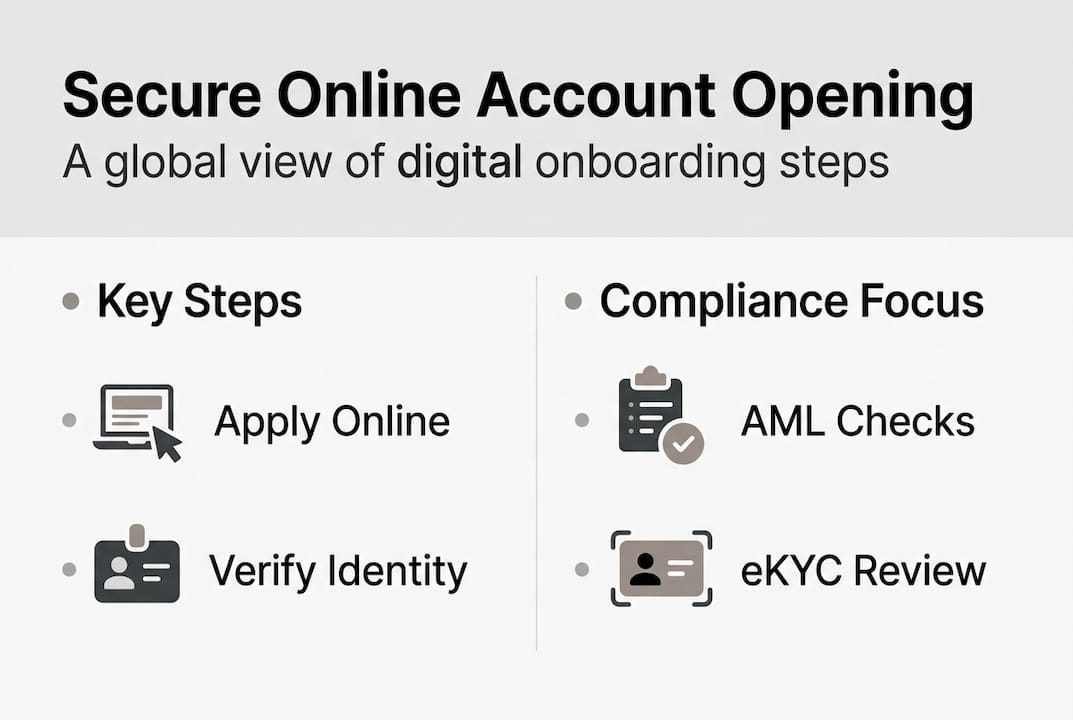
Key steps and the technologies behind them:
| Step | Technology used |
|---|---|
| Application data entry | Web/mobile platform, autofill APIs |
| Identity verification | eKYC, biometrics, liveness detection |
| Document review | OCR, AI-assisted extraction |
| KYC/AML screening | Risk scoring engines, sanctions databases |
| Compliance approval | Rule-based automation, human review |
| Account activation | Provisioning after approval or manual release |
Institutions are moving toward digital onboarding for clear reasons:
- Reduced operational costs and branch dependency
- Business access begins only after approval and activation
- Scalable compliance processes across jurisdictions
- Improved audit trails and regulatory reporting
- Better client experience through self-service portals
When you open an account online with a bank that serves international clients, expect the process to be thorough rather than instant. The documents verification stage alone can involve multiple document types, cross-referencing against global watchlists, and confirmation of beneficial ownership.
Pro Tip: Automation supports document handling, but your document readiness remains essential. Having certified translations, notarized ownership structures, and source-of-funds evidence ready before you start reduces avoidable follow-up but does not guarantee approval or a deadline.
How the secure online onboarding workflow works
With those foundations in mind, let’s break down how secure online onboarding actually works and where human expertise intersects with automation.
Prominence Bank normally completes account opening within 48 to 72 hours after all required KYC/AML procedures have been completed and all requested information and documentation have been received, verified, and accepted. This is an estimated processing period, not a guaranteed deadline. Additional time may be required if further compliance, verification, or due-diligence review is necessary. Submitting an enquiry, application, or payment does not start the estimated processing period and does not guarantee account approval or activation.
Perpetual KYC monitoring may be applied afterward. The workflow is not a single path but a branching decision tree.
Stages from application to active account:
- Submit application with personal or corporate details
- Upload required identity and supporting documents
- eKYC verification, including biometric liveness check
- Automated AML screening against sanctions and PEP lists
- Risk scoring and tier assignment
- Enhanced due diligence (EDD) triggered if risk threshold is crossed
- Compliance officer review for flagged cases
- Approval or rejection decision issued
- Account activated and credentials delivered
Low-risk vs. high-risk onboarding comparison:
| Factor | Low-risk applicant | High-risk/complex applicant |
|---|---|---|
| Processing type | Straight-through (STP) | Manual review required |
| Prominence Bank account-opening estimate | 48–72 hours after complete and accepted KYC/AML information and documentation* | 48–72 hours after complete and accepted KYC/AML information and documentation* |
| Document requirements | Standard ID, proof of address | Full UBO disclosure, source of funds, EDD |
| Human involvement | Minimal | Compliance officer review |
| Ongoing monitoring | Periodic review | Perpetual KYC |
Prominence Bank normally completes account opening within 48 to 72 hours after all required KYC/AML procedures have been completed and all requested information and documentation have been received, verified, and accepted. This is an estimated processing period, not a guaranteed deadline. Additional time may be required if further compliance, verification, or due-diligence review is necessary. Submitting an enquiry, application, or payment does not start the estimated processing period and does not guarantee account approval or activation.
For high-net-worth individuals and cross-border entities, the hybrid model is standard. Technology in private banking handles the data-heavy lifting, but experienced compliance professionals make the final calls on complex cases. This is not a weakness in the system. It is a feature that protects both the institution and the client.

If you are opening a personal account as an international client, expect your application to be treated with the same rigor as a corporate submission if your asset profile or geographic footprint triggers elevated risk flags.
Pro Tip: Submit your full documentation package upfront, including any supplementary evidence of wealth origin. Incomplete submissions are the primary cause of EDD-related delays, not the complexity of your profile itself.
Navigating compliance: eKYC, AML, and risk management for HNWIs and businesses
Understanding the workflow makes the next question obvious: why do some applicants require follow-up, while others face hurdles or rejections? The answer lies in compliance and risk management.
KYC and AML requirements are not one-time checkboxes. They apply at onboarding and continue throughout the relationship. For international accounts, the compliance burden is higher because the risk surface is wider. Multiple jurisdictions, layered corporate structures, and diverse asset classes all require deeper scrutiny.
Major compliance triggers that slow or block applications:
- Politically exposed person (PEP) status or family/business association with a PEP
- Nationality or residency in a high-risk or sanctioned jurisdiction
- Complex ownership structures with multiple layers or nominee arrangements
- Opaque or undocumented sources of wealth or funds
- Prior adverse media or regulatory history
- Cryptocurrency holdings without documented transaction trails
Opaque wealth sources and complex structures cause rejection rates exceeding 50% in cross-border private banking cases. PEPs and high-risk nationalities trigger enhanced due diligence, video verification, or in-person meetings. Some institutions, including certain Swiss banks, prohibit new PEP relationships entirely.
Perpetual KYC is increasingly standard for HNWI and institutional accounts. This means your profile is not static. Changes in ownership, jurisdiction, or asset base can trigger fresh reviews at any time. Banks that serve sophisticated clients treat compliance as an ongoing relationship, not an entry gate.
The most effective strategy for businesses and individuals is radical transparency. Clear corporate charts, documented wealth narratives, and proactive disclosure of anything that might look unusual support a complete compliance review but do not guarantee approval or a deadline. For accounts involving digital currency, documented blockchain transaction histories and exchange records are increasingly required as standard.
Benefits and limitations of digital-first account opening for sophisticated clients
Having explored the compliance challenges, let’s look at the tangible benefits and any limitations digital-first onboarding brings to your organization.
The efficiency case for digital onboarding is strong. Digital-first platforms reduce costs by 60 to 70 percent compared to traditional branch-based processes. For institutions, that translates to more scalable workflows and lower per-client overhead. For clients, it means access to global banking infrastructure without needing to physically travel to a jurisdiction.
Benefits and challenges for HNWIs and businesses:
- Benefit: 24/7 application access from any jurisdiction
- Benefit: Efficient review for complete, well-documented profiles
- Benefit: Reduced paperwork through digital document submission
- Benefit: Account activation only after approval
- Challenge: Further compliance or due-diligence review may extend the estimate.
- Challenge: Documentation standards are high and non-negotiable
- Challenge: Not all digital platforms support multi-currency or corporate structures
- Challenge: Rejection rates are higher for opaque or high-risk profiles
The advantages of digital banks are most visible when the client profile is clean and the documentation is complete. When complexity enters the picture, the digital layer becomes a gateway to human expertise rather than a replacement for it.
For sophisticated clients, the right expectation is not “instant account” but “efficient, secure, and globally compliant account.” Those are different things, and the distinction matters when your financial operations span multiple countries and asset classes.
Expert perspective: Why balancing technology and security matters
Most commentary on digital account opening focuses on technology as the bottleneck: OCR, AI, and mobile interfaces. That framing misses the real issue entirely.
The actual constraint is not technical. It is the gap between what clients disclose and what compliance teams need to see. Additional review in complex onboarding cases often arises from documentation gaps, unclear ownership narratives, or risk factors the applicant assumed would not matter. The technology is ready. The documentation rarely is.
For large international accounts, the expectation that digital means instant is the single biggest source of friction. Clients who arrive with complete, well-organized documentation, clear wealth narratives, and transparent corporate structures are better prepared for review than profiles with missing information. Complexity is not the enemy. Opacity is.
The smartest approach is to treat your onboarding package like a legal brief. Anticipate the questions, answer them before they are asked, and provide context for anything unusual. That mindset, combined with a bank that has genuine compliance depth, is what supports a sound, well-documented compliance review for sophisticated accounts. You can start the process with that preparation already in hand.
Pro Tip: Start with full transparency and be ready to provide supplemental information proactively. This single habit reduces avoidable follow-up, but does not guarantee approval or a deadline.
Explore secure, premium online account opening with Prominence Bank
Prominence Bank is built for exactly the clients this article describes: high-net-worth individuals, international businesses, and institutional clients who need secure, fully digital banking with genuine compliance depth.
Our business banking solutions and corporate banking services are designed for complex structures, multi-currency operations, and cross-border financial management. Whether you are an individual with international assets or a corporation with layered ownership, our team combines advanced digital infrastructure with experienced compliance professionals. When you are ready to move forward, start your online application and experience what sophisticated, private banking looks like in practice.
Frequently asked questions
How long does online account opening take for high-net-worth individuals?
Prominence Bank normally completes account opening within 48 to 72 hours after all required KYC/AML procedures have been completed and all requested information and documentation have been received, verified, and accepted. This is an estimated processing period, not a guaranteed deadline. Additional time may be required if further compliance, verification, or due-diligence review is necessary. Submitting an enquiry, application, or payment does not start the estimated processing period and does not guarantee account approval or activation.
What documents are needed to open an account online for a business?
Typically required documents include proof of company registration, beneficial ownership disclosures, government-issued IDs for all signatories, and documented justification of the source of funds and wealth.
Why are some applications for online accounts rejected?
Accounts are most often rejected due to incomplete documentation, high-risk nationalities, PEP status, or opaque ownership structures and unspecified wealth sources that exceed the institution’s risk tolerance.
Is online account opening secure for international transactions?
Yes. Leading institutions use layered eKYC and AML systems to detect and prevent fraud, though large-value or cross-border accounts are subject to enhanced security checks as a standard protective measure.