
TL;DR:
- Account separation involves holding assets in legally distinct accounts to protect wealth and reduce financial risks. Regulatory rules like FCA CASS and SEC Rule 15c3-3 mandate segregation to prevent commingled assets from becoming vulnerable during insolvency. Proper titling and monthly reconciliation are essential for effective separation, which also boosts privacy, asset protection, and FDIC insurance coverage.
Account separation is defined as the deliberate practice of holding assets in distinct, legally titled accounts to protect wealth, preserve privacy, and reduce exposure to financial risk. For high-net-worth individuals and financial professionals, this is not a bookkeeping preference. It is a foundational wealth management strategy with direct legal, regulatory, and financial consequences. Regulations like FCA CASS rules and SEC Rule 15c3-3 exist precisely because commingled assets become vulnerable the moment a firm faces insolvency. Understanding why high-net-worth account separation works, and how to implement it correctly, is the difference between protected wealth and recoverable losses.
Why high-net-worth account separation is driven by regulation
Account segregation is not optional in most professional financial contexts. Regulators built mandatory separation rules into law because commingled assets disappear into a firm’s general estate when that firm fails.
The UK’s FCA CASS framework requires that client money stays separate from a firm’s own assets at all times. When a firm enters insolvency, a primary pooling event is triggered and all segregated client funds are distributed pro-rata among clients. Clients whose funds were properly segregated recover assets. Clients whose funds were not properly separated bear the losses directly.
In the United States, SEC Rule 15c3-3 requires broker-dealers to maintain physical possession or control of customer securities and cash. The rule prevents firms from using customer assets to finance their own operations or trading positions. Violations carry severe regulatory penalties, including license revocation.
Fiduciary contexts carry equally strict requirements. Anti-commingling rules require attorneys and trustees to hold client funds in dedicated trust accounts with monthly three-way reconciliations. Each reconciliation matches bank statements, internal trust registers, and client sub-ledgers to confirm that every dollar is accounted for. The American Bar Association enforces these rules with suspensions and disbarments for violations.
- FCA CASS: Mandates client money separation from firm assets; insolvency triggers pro-rata distribution.
- SEC Rule 15c3-3: Requires broker-dealers to segregate customer property and maintain possession or control.
- ABA trust accounting rules: Require dedicated trust accounts and monthly three-way reconciliations for fiduciaries.
- Crypto asset custody: Broker-dealers holding crypto securities must document secure custody and governance under evolving SEC standards.
Pro Tip: Request written confirmation from any financial institution that your assets are held in a segregated account, not pooled with firm assets. This single document matters enormously in an insolvency scenario.
What are the practical benefits of account separation for high-net-worth clients?
The regulatory case for separation is clear. The practical benefits for high-net-worth individuals go further, covering privacy, deposit insurance, and protection from operational failures at financial institutions.

Privacy is the first benefit most high-net-worth clients cite. Keeping personal funds, business income, trust assets, and investment capital in separate accounts limits the visibility of your total financial picture to any single institution. Discreet banking practices built around account separation reduce the risk of data exposure and make it harder for third parties to map your full net worth. Prominencebank’s approach to discreet banking for wealth reflects exactly this principle.
Deposit insurance coverage is the second major benefit, and it is widely misunderstood. FDIC insurance covers up to $250,000 per depositor, per bank, per ownership category. That limit means a single account at a single bank leaves most high-net-worth cash balances uninsured. Spreading deposits across multiple banks and ownership categories multiplies that protection significantly.
Programs like CDARS (Certificate of Deposit Account Registry Service) and ICS (Insured Cash Sweep) allow high-net-worth clients to consolidate insured deposits across a network of banks while managing everything through a single institution. These programs exist specifically to solve the coverage gap that large cash balances create.
Key benefits of proper account separation:
- Privacy: Limits total wealth visibility to any single institution or counterparty.
- Asset protection: Keeps personal assets out of reach of business creditors and vice versa.
- Deposit insurance: Multiplies FDIC coverage by spreading deposits across banks and ownership categories.
- Insolvency protection: Segregated assets are not absorbed into a firm’s general estate during bankruptcy.
- Reconciliation integrity: Separate accounts make errors and unauthorized transactions easier to detect.
Pro Tip: Use different ownership categories, such as individual, joint, and revocable trust, at the same bank to increase FDIC coverage without opening accounts at multiple institutions. Titling matters as much as the number of accounts.
How to implement effective account separation
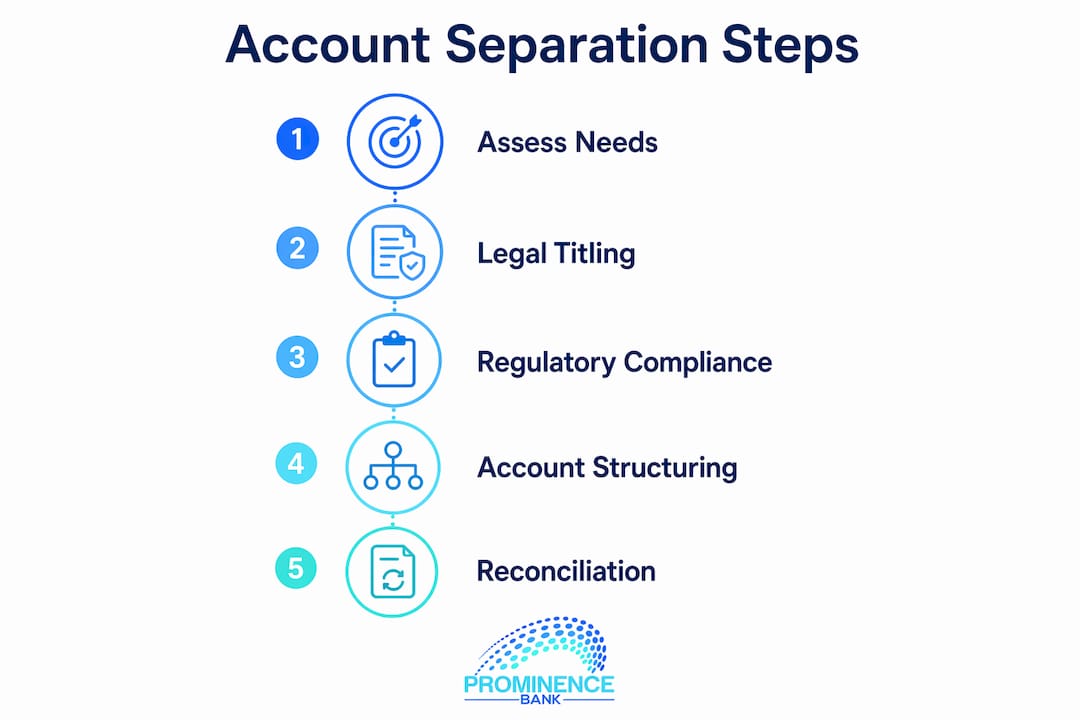
Structuring accounts correctly requires more than opening multiple accounts. Legal titling, account type selection, and ongoing reconciliation discipline all determine whether separation actually protects you.
Account types and their roles
| Account Type | Primary Purpose | Key Protection |
|---|---|---|
| Personal checking/savings | Daily expenses and liquid reserves | FDIC coverage per individual |
| Business operating account | Revenue, payroll, and vendor payments | Separates personal liability from business risk |
| Trust account | Fiduciary assets held for beneficiaries | Anti-commingling compliance; estate planning |
| Escrow account | Transaction-specific funds held temporarily | Prevents premature access or misuse |
| Custody account | Investment securities held by a custodian | SEC Rule 15c3-3 segregation compliance |
| Multi-currency account | International transactions across currencies | Jurisdiction and currency risk separation |
Each account type serves a distinct legal and operational function. Mixing funds across these categories, even temporarily, creates commingling risk and can invalidate the protections each account type provides.
Correct legal titling is the most overlooked element of high-net-worth account management. An account titled in your personal name, your revocable trust’s name, and your LLC’s name each represents a separate ownership category for FDIC purposes. Ownership titling is the mechanism that converts multiple accounts into genuinely expanded insurance coverage.
Reconciliation is the operational discipline that proves separation is real. Effective fiduciary segregation requires monthly three-way reconciliations matching bank statements, internal registers, and client sub-ledgers. For high-net-worth portfolios with multiple accounts across jurisdictions, automated reconciliation tools reduce the risk of human error and flag discrepancies before they become compliance failures.
For clients with international holdings, dedicated accounts by jurisdiction and asset class add another layer of protection. A multi-currency account structure allows you to hold euros, dollars, and other currencies in distinct sub-accounts while maintaining centralized oversight. This approach reduces foreign exchange exposure and simplifies cross-border reporting.
Common challenges and misconceptions about account separation
The most expensive misconception in high-net-worth financial planning is that opening multiple accounts at the same bank automatically increases FDIC coverage. Multiple accounts at the same bank do not increase insured coverage unless the accounts are differentiated by ownership category. Two personal checking accounts at the same bank share the same $250,000 limit.
Other common mistakes and misconceptions include:
- Incomplete reconciliation: Segregation that is not continuously reconciled fails to protect clients in insolvency. Failures in reconciliation reduce client recoveries pro-rata, even when accounts were nominally separate.
- Mixing personal and business funds: This is the most common commingling error. It exposes personal assets to business creditor claims and can pierce the liability protection of an LLC or corporation.
- Ignoring regulatory nuances: FCA CASS and SEC Rule 15c3-3 apply in different jurisdictions with different mechanics. Assuming one framework covers all accounts is a compliance risk.
- Crypto asset custody gaps: Broker-dealers holding crypto securities must document blockchain risk assessments and demonstrate control of private keys. Standard custody practices do not automatically satisfy SEC requirements for digital assets.
- Cost concerns overriding protection: Managing multiple accounts adds administrative complexity. The cost of proper separation is always lower than the cost of recovering assets from an insolvent firm.
Ethical accounting practices reinforce why separation is not just a compliance checkbox. Commingling is inherently risky regardless of intent. The documentation and reconciliation discipline that separation requires is what makes the protection real and provable.
Key Takeaways
High-net-worth account separation protects wealth through legal titling, regulatory compliance, and continuous reconciliation across distinct account structures.
| Point | Details |
|---|---|
| Regulation drives separation | FCA CASS and SEC Rule 15c3-3 mandate segregation to protect clients from firm insolvency. |
| Titling determines coverage | FDIC protection multiplies only when accounts are correctly titled across different ownership categories. |
| Reconciliation makes it real | Monthly three-way reconciliations are required to prove separation and prevent pro-rata losses in insolvency. |
| Commingling carries severe consequences | Mixing personal and business funds exposes assets to creditor claims and triggers regulatory penalties. |
| Crypto adds new complexity | Digital asset custody requires documented governance and key control to meet evolving SEC standards. |
Account separation is the foundation, not the finish line
The clients I see struggle most with account separation are not the ones who ignore it entirely. They are the ones who set it up once and never revisit it. A trust account opened five years ago may be titled incorrectly for today’s estate plan. A business account that started as a clean separation may have absorbed personal expenses over time. Separation is a structure that requires maintenance, not just creation.
What I find genuinely underappreciated is how much separation does for privacy beyond asset protection. When your investment accounts, operating accounts, and personal reserves sit at different institutions under different legal structures, no single bank has a complete picture of your net worth. That is not evasion. That is prudent financial architecture. The private banking strategies that work best in 2026 treat privacy and protection as the same goal, not separate ones.
The complexity concern is real but overstated. Yes, managing five accounts across three institutions requires discipline. The alternative, a single commingled account that becomes part of a firm’s general estate in insolvency, is far more complex to unwind. I have never met a high-net-worth client who regretted the administrative overhead of proper separation. I have met several who regretted not having it.
— Harold
How Prominencebank supports structured account separation
High-net-worth account separation requires banking infrastructure that matches the complexity of your portfolio.

Prominencebank offers multi-currency account structures designed for clients who need distinct accounts across currencies, jurisdictions, and legal entities without sacrificing centralized oversight. The bank’s corporate and institutional account options support the legal titling and segregation discipline that FCA CASS and SEC Rule 15c3-3 demand. For clients managing digital assets alongside traditional holdings, Prominencebank’s cryptocurrency account services address the custody and governance requirements that standard banking platforms do not. Every account structure is backed by AML/KYC compliance and direct access to global financial infrastructure.
FAQ
What is high-net-worth account separation?
Account separation is the practice of holding assets in legally distinct accounts across different institutions, ownership categories, or legal structures. It protects wealth from creditor claims, firm insolvency, and regulatory violations.
Does opening multiple accounts at the same bank increase FDIC coverage?
Not automatically. FDIC coverage increases only when accounts are differentiated by ownership category, such as individual, joint, or revocable trust. Account count alone does not expand protection.
What is the risk of commingling personal and business funds?
Commingling exposes personal assets to business creditor claims and can eliminate the liability protection of an LLC or corporation. Regulatory bodies like the ABA treat commingling as a disciplinary offense with penalties including suspension.
How does SEC Rule 15c3-3 affect account separation for investors?
SEC Rule 15c3-3 requires broker-dealers to maintain possession or control of customer assets and keep them separate from firm holdings. This rule prevents firms from using client funds to finance their own operations.
Why does reconciliation matter for account separation?
Reconciliation proves that separation is real and current. Segregation failures during insolvency reduce client recoveries pro-rata, meaning clients with nominally separate accounts can still lose assets if reconciliation was not maintained accurately.