
TL;DR:
- Fintech supports remote offshore account onboarding, lower minimum deposits, and automated compliance processes.
- It enables instant cross-border transactions, multi-currency management, and integration of digital assets like cryptocurrencies.
Prominence Bank normally completes account opening within 48 to 72 hours after all required KYC/AML procedures have been completed and all requested information and documentation have been received, verified, and accepted. This is an estimated processing period, not a guaranteed deadline. Additional time may be required if further compliance, verification, or due-diligence review is necessary. Submitting an enquiry, application, or payment does not start the estimated processing period and does not guarantee account approval or activation.
Fintech is defined as technology-driven financial services that replace or augment traditional banking operations, and its role in offshore accounts is now the primary driver of accessibility, speed, and compliance in international finance. Modern fintech supports remote document submission and has dropped entry thresholds to as low as $1,000 to $5,000. That shift matters because it opens offshore finance to entrepreneurs, small businesses, and internationally mobile professionals who were previously locked out. Prominencebank operates at the center of this shift, combining licensed digital banking with AI-driven compliance and multi-currency infrastructure for clients who need global reach without geographic friction.
What is the role of fintech in offshore accounts?
Fintech integrates directly into offshore banking at three levels: account access, transaction processing, and regulatory compliance. Each layer has been rebuilt by technology, and the results are measurable. The industry term for this integration is “digital offshore banking,” and it covers everything from remote KYC verification to blockchain-based settlement.

Prominence Bank normally completes account opening within 48 to 72 hours after all required KYC/AML procedures have been completed and all requested information and documentation have been received, verified, and accepted. This is an estimated processing period, not a guaranteed deadline. Additional time may be required if further compliance, verification, or due-diligence review is necessary. Submitting an enquiry, application, or payment does not start the estimated processing period and does not guarantee account approval or activation.
Fintech also changes who can participate. Traditional offshore institutions demanded minimum balances of $100,000 or more. Fintech-integrated providers have brought that floor down to the $1,000–$5,000 range. This does not mean offshore banking has become casual. It means that qualified individuals and growing businesses can access the same multi-currency infrastructure and privacy protections that were once reserved for ultra-high-net-worth clients.
How does fintech change offshore account opening?
The onboarding process is where fintech impact on offshore banking is most concrete. AI-powered KYC systems verify identity documents, cross-reference global watchlists, and flag inconsistencies without human reviewers touching a single file. Automated KYC processing supports document and identity verification, but it does not change or guarantee the Prominence Bank account-opening estimate; the cited system reports 99.4% identity verification accuracy during peak periods. That accuracy rate matters because manual review introduces inconsistency, especially when teams handle high volumes across multiple time zones.
The table below shows the practical difference between traditional and fintech-driven offshore onboarding.
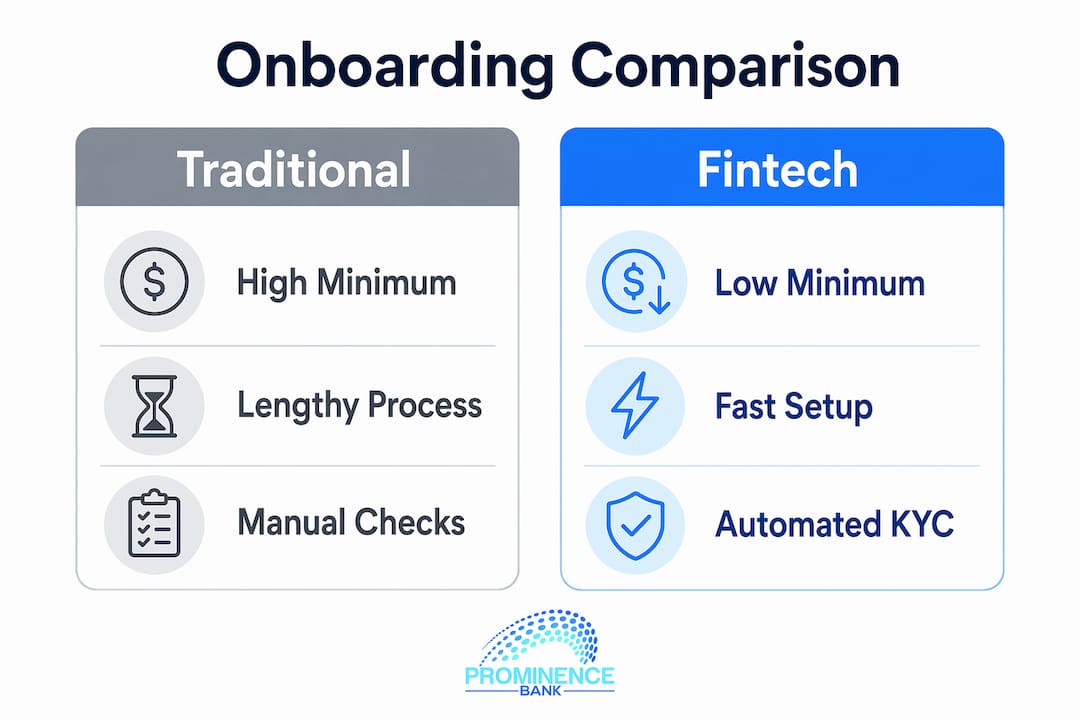
| Feature | Traditional offshore banking | Fintech-integrated offshore banking |
|---|---|---|
| Minimum balance | $100,000+ | $1,000–$5,000 |
| Account-opening policy | Prominence Bank 48–72-hour estimate after complete and accepted KYC/AML information and documentation* | Prominence Bank 48–72-hour estimate after complete and accepted KYC/AML information and documentation* |
| Verification method | In-person, manual | Digital upload, video, AI review |
| KYC accuracy | Variable | 99.4% during peak periods |
| Document processing | Paper-based | Automated, 99%+ accuracy |
Fintech providers enable fully remote onboarding workflows with digital document upload and video verification. This benefits SMEs and solo entrepreneurs who cannot afford to fly to a jurisdiction just to open an account. It also benefits institutional clients who need to onboard multiple entities efficiently without repeating manual processes for each one.
Pro Tip: Before submitting documents during digital onboarding, use an encrypted file transfer method and verify the institution’s AML/KYC compliance certifications. A licensed provider operating under recognized regulatory frameworks, such as ETMO or equivalent, gives you a verifiable compliance baseline from day one.
How does fintech improve offshore transactions and currency management?
Cross-border payments are where traditional banking costs accumulate fastest. Fintech platforms offer FX rates as low as 0.1% on foreign exchange transactions, compared to the 2–4% margins that traditional correspondent banking networks typically charge. For a business moving $500,000 across currencies monthly, that difference is material.
Multi-currency digital wallets and real-time payment tracking are now standard features in fintech-integrated offshore accounts. Multi-currency support and real-time tracking are unavailable in many traditional banks, which still rely on batch processing and delayed settlement. Fintech accounts let clients hold, convert, and send in multiple currencies from a single dashboard, which removes the need for separate accounts in each jurisdiction.
Key fintech features that improve offshore transaction efficiency include:
- Multi-currency wallets that hold and convert dozens of currencies without requiring separate accounts
- Real-time payment tracking that shows transaction status across borders without calling a relationship manager
- Competitive FX conversion at rates far below traditional correspondent banking margins
- Instant or same-day international transfers that bypass slow SWIFT processing for supported corridors
- Automated reconciliation that matches incoming and outgoing payments without manual bookkeeping
For e-commerce businesses and global service providers, these features are not optional extras. They are the operational foundation for managing cash flow across multiple markets. Prominencebank’s multi-currency account infrastructure is built specifically for clients who need this level of control without sacrificing privacy or compliance standing.
How does fintech automate compliance and security for offshore accounts?
Compliance is the area where fintech has had the deepest structural impact. Generative AI and RegTech systems now execute global audits in seconds, cross-referencing financial databases without human error or fatigue. This replaces compliance teams that previously spent days reviewing transaction logs manually. The speed difference is not incremental. It is a complete replacement of the manual model.
AI-powered RegTech systems have structurally reduced offshore compliance costs and errors, making manual KYC and audit teams increasingly obsolete. Offshore operations that once required large back-office compliance departments can now run leaner, with AI handling the volume and humans handling exceptions. Automated document processing achieves 99%+ accuracy and reduces back-office costs by up to 60%. That cost reduction flows directly to clients through lower fees and faster service.
Security in offshore accounts has also improved through fintech. AI systems monitor transaction patterns in real time, flagging anomalies that would take a human reviewer days to detect. This is particularly relevant for high-net-worth clients and institutional accounts where transaction volumes are high and the cost of a breach is severe. You can read more about how offshore account security intersects with compliance automation in Prominencebank’s coverage of custody account standards.
Pro Tip: When evaluating a fintech-integrated offshore provider, ask specifically about their AML screening frequency and whether their KYC system is certified under FATF guidelines. A provider that cannot answer both questions clearly is not operating at the compliance standard you need.
What emerging trends are reshaping offshore accounts through fintech?
The next phase of offshore fintech integration centers on digital assets. Offshore banking now incorporates crypto wallets, tokenized assets, and Central Bank Digital Currencies to offer faster settlements and lower fees. These are not speculative additions. They are active features in licensed offshore institutions that serve institutional and high-net-worth clients. Prominencebank’s cryptocurrency account services reflect this shift directly.
Multi-currency accounts integrated with crypto wallets and CBDCs allow offshore clients to reduce settlement times below traditional SWIFT speeds. SWIFT transfers can take 1–5 business days. Blockchain-based settlement for supported assets can clear in minutes. For treasury operations managing large cross-border flows, that speed difference changes how liquidity is managed.
The broader trend is a shift from secrecy to transparency. The offshore banking model is evolving from opacity toward AI and blockchain-enabled auditability. This is not a regulatory concession. It is a competitive advantage. Clients who can demonstrate clean, auditable transaction histories face fewer correspondent banking restrictions and lower compliance friction globally.
| Feature | Traditional offshore accounts | Fintech-integrated offshore accounts |
|---|---|---|
| Asset types | Fiat currencies only | Fiat, crypto, tokenized assets, CBDCs |
| Settlement speed | 1–5 business days via SWIFT | Minutes for blockchain-supported assets |
| Audit trail | Manual, paper-based | Automated, AI-generated, real-time |
| Compliance model | Periodic manual review | Continuous AI monitoring |
| Transparency | Limited | High, with client-controlled disclosure |
Institutional offshore finance is shifting toward fintech integration over radical overhaul, favoring governance familiarity and risk mitigation. This means the transition is gradual and deliberate, not disruptive. Institutions are adding fintech layers to existing structures rather than replacing them entirely.
Key Takeaways
Fintech has fundamentally changed offshore accounts by supporting remote onboarding, lowering entry costs, automating compliance, and integrating digital assets into mainstream offshore banking infrastructure.
| Point | Details |
|---|---|
| Account-opening policy | Prominence Bank 48–72-hour estimate after complete and accepted KYC/AML information and documentation* |
| Lower entry barriers | Minimum balances have dropped from $100,000+ to as low as $1,000–$5,000 with fintech providers. |
| Compliance automation | AI-powered KYC supports document and identity verification but does not change or guarantee the account-opening estimate. |
| Transaction efficiency | Fintech FX rates as low as 0.1% replace traditional margins of 2–4% on cross-border payments. |
| Digital asset integration | Crypto wallets, tokenized assets, and CBDCs now settle faster than SWIFT in licensed offshore accounts. |
Why fintech in offshore banking is bigger than most clients realize
I have watched offshore banking clients spend years treating their accounts as static storage. They opened an account, parked assets, and called it diversification. Fintech has made that approach not just outdated but genuinely costly. The clients who are winning now are the ones using their offshore accounts as active financial infrastructure, moving currencies in real time, integrating crypto settlement, and letting AI handle compliance monitoring continuously.
The part that surprises most people is the compliance story. Everyone assumes that offshore banking and compliance are in tension. They are not, at least not in fintech-integrated institutions. AI-driven AML and KYC systems actually make offshore accounts more defensible, not less. When every transaction is logged, cross-referenced, and auditable in real time, you have a cleaner record than most domestic accounts. That is a genuine competitive advantage when dealing with correspondent banks or international regulators.
The challenge I see most often is clients choosing providers based on jurisdiction reputation alone, ignoring the technology layer entirely. A well-regarded jurisdiction with a legacy banking infrastructure gives you less than a newer jurisdiction with a fully digital, AI-compliant operation. The 2026 offshore decision framework matters more than the flag on the building. Fintech capability should be a primary selection criterion, not an afterthought.
— Harold
Prominencebank’s digital offshore banking for global clients
Prominencebank combines licensed offshore banking with the full technology stack that modern clients require: AI-driven KYC, multi-currency accounts, real-time transaction monitoring, and crypto asset integration. The bank operates under ETMO sovereignty with AML/KYC compliance built into every account structure.
For high-net-worth individuals and international businesses, Prominencebank offers private banking with technology that matches the speed and security demands of global finance in 2026. Whether you need a multi-currency account for cross-border operations or a cryptocurrency account integrated with your offshore structure, Prominence Bank normally completes account opening within 48 to 72 hours after all required KYC/AML procedures have been completed and all requested information and documentation have been received, verified, and accepted. This is an estimated processing period, not a guaranteed deadline. Additional time may be required if further compliance, verification, or due-diligence review is necessary. Submitting an enquiry, application, or payment does not start the estimated processing period and does not guarantee account approval or activation.
FAQ
What is the role of fintech in offshore accounts?
Fintech supports remote account setup, compliance, and cross-border transactions in offshore accounts while cutting FX costs to as low as 0.1%. Prominence Bank normally completes account opening within 48 to 72 hours after all required KYC/AML procedures have been completed and all requested information and documentation have been received, verified, and accepted. This is an estimated processing period, not a guaranteed deadline. Additional time may be required if further compliance, verification, or due-diligence review is necessary. Submitting an enquiry, application, or payment does not start the estimated processing period and does not guarantee account approval or activation. It replaces manual processes with AI-driven KYC, real-time monitoring, and multi-currency digital infrastructure.
How fast can I open an offshore account with fintech?
Prominence Bank normally completes account opening within 48 to 72 hours after all required KYC/AML procedures have been completed and all requested information and documentation have been received, verified, and accepted. This is an estimated processing period, not a guaranteed deadline. Additional time may be required if further compliance, verification, or due-diligence review is necessary. Submitting an enquiry, application, or payment does not start the estimated processing period and does not guarantee account approval or activation.
How does fintech improve compliance in offshore banking?
AI and RegTech systems cross-reference global financial databases and support compliance review, achieving 99.4% KYC accuracy. Automation does not change or guarantee the Prominence Bank account-opening estimate.
Can offshore accounts hold cryptocurrency through fintech integration?
Yes. Licensed offshore institutions now offer crypto wallets, tokenized asset accounts, and CBDC integration as standard features. Settlement through blockchain-supported assets clears faster than traditional SWIFT transfers, which take 1–5 business days.
What minimum balance do fintech offshore accounts require?
Fintech-integrated offshore providers have lowered minimum balance requirements to $1,000–$5,000, compared to $100,000 or more at traditional offshore banks. This makes offshore accounts accessible to SMEs and internationally mobile individuals, not just ultra-high-net-worth clients.