
TL;DR:
- Discrete banking isolates financial activities within corporate groups to safeguard confidentiality and ensure compliance. It prevents operational failures like outdated signatory records and leaks during sensitive transactions such as mergers and acquisitions. Proper governance of banking structures enhances treasury resilience, legal compliance, and operational speed across jurisdictions.
Discrete banking is the practice of isolating banking activities and information flows within corporate groups to maintain confidentiality, control, and compliance across multiple entities and jurisdictions. For corporate executives managing multinational structures, the question of why corporate groups need discrete banking has a direct answer: without it, sensitive transaction data leaks, compliance breaks down, and treasury operations stall. The industry term most often used alongside this practice is “confidential execution,” which covers how banks and corporations control information flows during sensitive financial activities. This article covers the operational, regulatory, and strategic reasons discrete banking is a governance requirement, not an optional upgrade.
Why corporate groups need discrete banking: the operational case
Corporate banking for a multinational group is not a single account. It is a network of accounts, signatories, documentation cycles, and KYC/AML obligations spread across dozens of entities and jurisdictions. Mercator describes corporate bank accounts as a financial nervous system, where missing visibility can delay routine treasury decisions. That framing is accurate. When one node in the network fails, the whole system slows.
The operational complexity that makes discrete banking necessary includes:
- KYC/AML renewals across entities. Each subsidiary has its own documentation cycle. A missed renewal in one jurisdiction can freeze accounts group-wide.
- Signatory management. Executive changes, board resolutions, and power-of-attorney updates must be tracked and filed with each bank. Gaps create authorization failures.
- Account lifecycle hygiene. Neglecting signatory updates and documentation renewals can halt payments and delay decisions, even when cash is available.
- Multi-bank coordination. Large corporate groups typically hold relationships with multiple banking partners. Without discrete structures, information bleeds across those relationships.
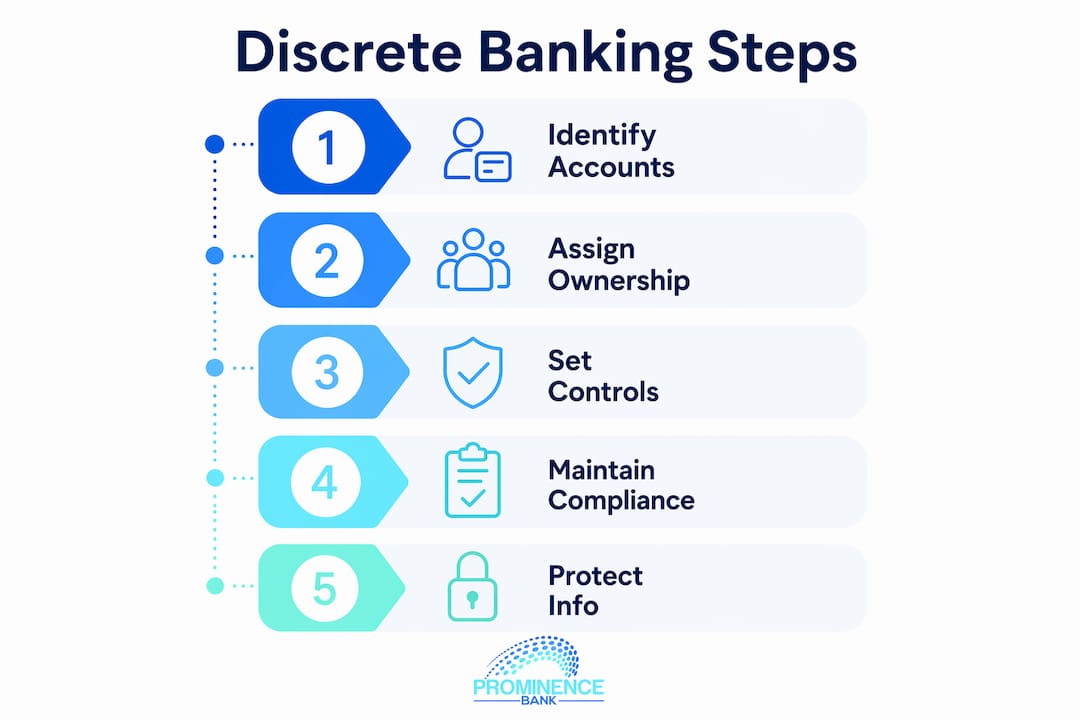
Discrete banking addresses each of these by assigning clear ownership, access controls, and information boundaries to every account and relationship in the group.
Pro Tip: Assign a dedicated account lifecycle owner for each banking relationship in your group. This single change prevents the most common cause of payment delays: expired documentation that nobody tracked.

The cost of poor account maintenance is not theoretical. A payment blocked by an outdated signatory record during a time-sensitive acquisition can cost far more than the entire annual cost of maintaining proper banking hygiene. Discrete banking builds the governance layer that prevents those failures.
How does discrete banking protect sensitive corporate information?
Confidential execution is the practice of controlling information flows during sensitive corporate finance activities such as mergers, acquisitions, and large financing rounds. Bridge Connect defines confidential execution as controlling information flows and discretion as managing banker behavior to prevent leaks. Both concepts sit at the core of why discrete banking matters for corporate groups.
The mechanisms that protect sensitive information in a discrete banking structure follow a clear sequence:
- Information barriers (Chinese walls). Chinese walls restrict access to sensitive data internally and across banking partners, reducing competitive leakage and misuse risks. A banker advising on a potential acquisition should not have visibility into the target company’s treasury account.
- Purpose-limited data sharing. Banks operating under discrete banking frameworks share only the data necessary for a specific transaction. Nothing beyond that scope moves between parties.
- Controlled banker behavior. Discretion is an active management task. Corporate groups that specify confidentiality requirements in their banking mandates get measurably better outcomes during sensitive transactions.
- Segmented account structures. Separating accounts by entity, function, or transaction type limits the blast radius if any single account or relationship is compromised.
“Discretion in banking is not about hiding information. It is about controlling who sees what, when, and for what purpose.” — Bridge Connect, Finance Fundamentals
The competitive stakes are high. A financing round that leaks before closing can move market prices. An acquisition target that learns of a buyer’s interest too early can demand a higher price or walk away. Discrete banking structures prevent both outcomes by treating information control as a first-order operational priority. For executives managing confidentiality in private banking, these controls are the difference between a clean execution and a costly one.
What regulatory frameworks govern discrete banking practices?
Discrete banking does not operate outside the law. It operates precisely within it. Regulatory frameworks in the United States and internationally define what data banks can collect, share, retain, and transmit, and under what conditions.
The USA PATRIOT Act Section 314(b) is the clearest example. FINCEN’s updated guidance under Section 314(b) specifies allowed data categories for sharing suspected fraud information, with legal protections for participating institutions. This means banks can share real-time fraud data under a safe harbor, but only for defined purposes and with strict governance controls. That is not a loophole. It is a model for how all discrete data sharing should work.
| Regulatory framework | Core requirement | Implication for corporate groups |
|---|---|---|
| USA PATRIOT Act 314(b) | Purpose-bound fraud data sharing | Banks may share AML data; corporate groups must understand what flows |
| GDPR / data protection rules | Legal basis, purpose, retention limits | Banks cannot collect data arbitrarily; clients have transparency rights |
| AML/KYC standards | Ongoing due diligence and renewal | Account lifecycle hygiene is a legal obligation, not just best practice |
| Contractual data controls | Governed sharing agreements | Corporate groups should specify data handling in banking mandates |
Paperjam reports that banks cannot collect data arbitrarily and must clearly communicate to customers, framing privacy as control rather than secrecy. This is the correct frame for corporate executives. Privacy in banking is a governance choice built on legal basis, purpose limitation, and customer transparency.
Pro Tip: Review your banking mandates annually to confirm they include explicit data handling and confidentiality clauses. Most standard bank agreements do not include these by default.
Discrete data flow means sharing only necessary, contractually authorized data under compliance safe harbors. This enables AML and fraud prevention without broad data exposure. Corporate groups that understand this distinction can negotiate better banking agreements and avoid inadvertently consenting to data sharing they did not intend. For executives managing online bank compliance, knowing these frameworks is not optional.
What are the practical benefits of discrete banking for treasury?
Treasury resilience is the clearest practical benefit of discrete banking. Corporate Finance Institute advises treasury leaders to design banking relationships with discrete, diversified structures. The reason is straightforward: a corporate group that concentrates all its banking with one institution faces a single point of failure. Discrete structures distribute that risk.
The practical benefits for corporate treasury and risk management include:
- Liquidity continuity. Discrete banking structures ensure that a relationship breakdown with one bank does not interrupt access to liquidity across the group. Each banking relationship operates independently.
- Reduced operational surprises. When account structures are well-maintained and information flows are controlled, treasury teams face fewer unexpected blocks on payments or account access.
- Efficient multi-bank management. Discrete structures give treasury teams a clear view of which accounts serve which purposes, reducing duplication and improving cash visibility.
- Stronger banking relationships. Banks trust corporate clients who manage their accounts well. Clean documentation, clear mandates, and controlled information flows signal a well-governed counterparty.
- Faster decision-making. When account ownership and authorization are clear, treasury decisions execute faster. There is no ambiguity about who can approve a transaction or access an account.
The advantages of discrete banking for multinational corporations extend beyond privacy. They include operational speed, compliance confidence, and the ability to act decisively during time-sensitive transactions. A corporate group that has invested in proper discrete banking structures can close a financing round, execute an acquisition, or respond to a liquidity event faster than one that has not. That speed is a competitive advantage.
Understanding what corporate treasury requires in terms of banking structure is the starting point for building these advantages. The investment in discrete banking pays off most visibly when something goes wrong elsewhere, and the group’s banking operations continue without interruption.
Key Takeaways
Corporate groups that treat discrete banking as a governance discipline, not a technical setup, gain measurable advantages in privacy, compliance, and treasury resilience across all jurisdictions.
| Point | Details |
|---|---|
| Operational complexity demands structure | KYC/AML renewals, signatory changes, and account lifecycles require clear ownership to prevent payment failures. |
| Confidential execution protects value | Information barriers and purpose-limited data sharing prevent leaks during M&A and financing activities. |
| Regulation defines the boundaries | Frameworks like FINCEN 314(b) and GDPR govern what data flows are permitted, making compliance a design requirement. |
| Treasury resilience depends on diversity | Discrete, diversified banking structures prevent single points of failure and reduce operational surprises. |
| Privacy is governance, not secrecy | Controlled data collection, purpose limitation, and transparency rights define modern banking privacy. |
Discrete banking is a discipline, not a setting
I have spent years watching corporate groups treat banking as a back-office function. They set up accounts, hand them to finance teams, and assume the structure will hold. It rarely does past the first major organizational change.
The most common failure I see is not a security breach or a regulatory fine. It is a blocked payment during a critical transaction because a signatory record was never updated after a board change two years earlier. That is an account lifecycle failure. It is entirely preventable, and it happens constantly.
What surprises executives most is that discrete banking is not primarily about technology or offshore structures. It is about governance. Who owns each banking relationship? Who tracks documentation renewals? Who controls what information each bank can see? These are management questions, not IT questions.
The regulatory environment is tightening. FINCEN’s real-time fraud data sharing guidance, evolving GDPR enforcement, and stricter AML requirements all point in the same direction: banks will share more data with regulators and with each other, under controlled conditions. Corporate groups that have not designed their banking structures with this in mind will face surprises. Those that have will find the new environment manageable.
My advice to any CFO or treasury leader reading this: treat your banking structure as a governance document. Review it annually. Assign ownership. Build the information barriers before you need them. The cost of doing this proactively is a fraction of the cost of fixing it after a leak or a compliance failure.
— Harold
Prominencebank’s corporate banking solutions for discrete finance
Corporate groups managing complex, multi-entity structures need a banking partner that understands the governance requirements of discrete banking from the start.
Prominencebank is a fully licensed digital banking institution operating under the Extraterritorial Trade Mission Office (ETMO), built specifically for international businesses and institutional clients that require privacy, control, and global reach. Its corporate banking solutions include multi-currency business accounts, KTT-enabled account opening, and dedicated support for complex corporate structures across jurisdictions. For corporate groups ready to build a properly structured banking framework, Prominencebank offers the global corporate account setup and account management expertise to do it right.
FAQ
What is discrete banking for corporate groups?
Discrete banking is the practice of isolating banking activities and information flows within a corporate group to maintain confidentiality, compliance, and operational control across multiple entities and jurisdictions. It covers account structure, information barriers, data governance, and account lifecycle management.
How does discrete banking differ from standard corporate banking?
Standard corporate banking focuses on account access and transaction processing. Discrete banking adds a governance layer that controls who sees what information, how data flows between banks and entities, and how account structures are maintained over time.
What is the biggest operational risk discrete banking prevents?
Account lifecycle failures such as outdated signatories and expired documentation are the most common cause of blocked payments in corporate groups. Discrete banking assigns clear ownership to prevent these failures before they occur.
Are there legal requirements for discrete banking practices?
Yes. Frameworks including the USA PATRIOT Act Section 314(b), GDPR, and international AML/KYC standards define what data banks can collect, share, and retain. Corporate groups must design their banking structures to comply with these requirements in every jurisdiction where they operate.
How does discrete banking support M&A confidentiality?
Information barriers and purpose-limited data sharing prevent transaction details from reaching parties who should not have them. This protects deal pricing, counterparty negotiations, and market integrity during sensitive corporate actions.