
TL;DR:
- Trade credit insurance, purchase order financing, and invoice factoring offer cost-effective and flexible alternatives to SBLCs for managing trade risks. Choosing the appropriate instrument depends on transaction size, legal environment, collateral availability, and speed requirements. Prominencebank provides digital, multi-currency banking solutions to support structured financial guarantees for international and institutional clients.
What are the best alternatives to SBLC solutions?
If you’re looking for financial guarantee options beyond a standby letter of credit, three instruments dominate the US market: trade credit insurance, purchase order financing, and invoice factoring. Each one solves a different version of the same problem, and picking the wrong one costs you more than just fees.
A standby letter of credit (SBLC) is a bank’s conditional promise to pay a beneficiary if you default on a contract. It’s widely used in international trade, lease agreements, and project finance. The catch is cost: SBLC fees consist of issuance fees usually ranging from 0.5% to 3% annually, plus service fees that can reach 1% to 10% depending on transaction complexity. This creates a substantial working capital burden for many businesses.
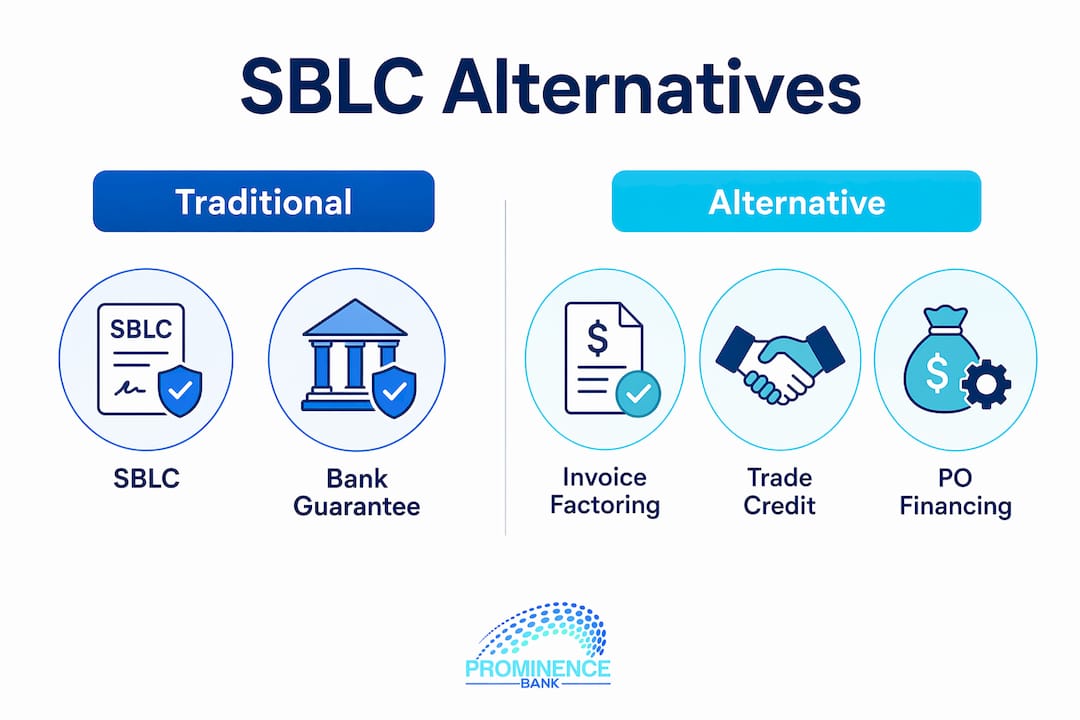
Here’s a quick map of the main alternatives:
- Trade credit insurance: Ongoing non-payment protection, typically cheaper than a one-time letter of credit. Best for businesses with recurring buyer relationships.
- Purchase order financing: A finance company pays your supplier directly; you repay when your customer pays. Best for fulfilling large orders without tying up cash.
- Invoice factoring: Sell your receivables at a discount, receiving a 70%–90% advance upfront. Best for immediate cash flow needs.
- Bank guarantee (BG): A simpler, often cheaper instrument for local or domestic contracts, governed by local law rather than international ICC rules.
The right choice depends on whether you need a one-time transaction backstop or an ongoing credit management partnership.
Table of Contents
- How do SBLC alternatives compare on cost, speed, and collateral?
- How to choose the right SBLC alternative for your business
- Real-world examples of businesses using SBLC alternatives
- What regulations govern SBLC alternatives in the US?
- What are the real drawbacks of each SBLC alternative?
- Why the conventional wisdom on SBLC alternatives misses the point
- Key Takeaways
- Prominencebank offers a direct path to structured financial guarantees
- FAQ
How do SBLC alternatives compare on cost, speed, and collateral?
The differences between these instruments go well beyond price. Legal framework, triggering mechanism, and collateral flexibility all shape which one actually works for your deal.

| Instrument | Cost/Fees | Processing Time | Collateral Requirements | Legal Framework | Best For |
|---|---|---|---|---|---|
| SBLC | 0.5%–3% issuance fees annually; 1%–10% total service fees | 3–7 days via SWIFT MT760 | Cash or liquid securities (traditional banks) | ISP98 or UCP 600 (ICC) | International trade, credit enhancement |
| Bank Guarantee | ~4%/year | 5–7 days | Cash or local assets | URDG 758, local law | Domestic contracts, bid bonds |
| Trade Credit Insurance | Lower than LC | Days to weeks (policy setup) | None (insurance product) | Insurance contract law | Recurring buyer relationships |
| PO Financing | Fee on transaction | Days | Purchase order as collateral | Commercial contract law | Large order fulfillment |
| Invoice Factoring | Discount on invoice value | 24–72 hours | Receivables | Commercial contract law | Immediate cash flow |
Collateral flexibility is where alternative providers genuinely outpace traditional banks. While major US banks typically require cash or highly liquid securities, alternative SBLC providers accept real estate, equipment, and other asset classes. That matters enormously for businesses that hold substantial fixed assets but can’t afford to lock up cash.
On the legal side, SBLCs governed by ISP98 require documentary evidence to trigger payment, while bank guarantees under URDG 758 can pay on first demand without complex documentation. SBLCs are generally more expensive than bank guarantees, with overall annual fees from 1% to 10%, compared to about 4% for BGs, largely due to additional documentary requirements.
Suitability by business type:
- Small and mid-size businesses with tight cash flow: invoice factoring or PO financing
- Exporters and importers needing counterparty assurance: trade credit insurance or SBLC
- Contractors and project developers in domestic markets: bank guarantee
- High-net-worth individuals and institutional clients needing credit enhancement: SBLC or alternative provider structures with flexible collateral
Pro Tip: Match the legal instrument to the transaction trigger before you negotiate fees. An SBLC under ISP98 requires specific documentary evidence to pay out. If your contract doesn’t generate those documents cleanly, you may end up with an instrument that never triggers when you need it.
How to choose the right SBLC alternative for your business
The decision framework comes down to five factors: transaction size, legal environment, collateral availability, cost sensitivity, and how fast you need the instrument in place.
Start with the legal environment. If your counterparty is overseas, an SBLC under ISP98 or UCP 600 gives you internationally recognized protection. For domestic US contracts, a bank guarantee or trade credit insurance policy is often faster and cheaper to arrange. Successful SBLC procurement requires a detailed closing plan that covers underwriting, KYC compliance, regulatory checks, and structured collateral arrangements. That process takes time and expertise most businesses don’t have in-house.
Decision criteria to work through:
- Transaction size: PO financing and factoring work well for mid-market deals. SBLCs and bank guarantees scale to large institutional transactions.
- Collateral availability: If you can’t pledge cash, look for providers accepting real estate or equipment. Explore alternative financing structures that use diverse asset classes.
- Processing speed: Invoice factoring can fund in 24–72 hours. An SBLC via SWIFT MT760 typically takes 3–7 days under optimal conditions.
- Ongoing vs. one-time need: Trade credit insurance functions as a continuous partnership, not a single transaction. If you’re managing a portfolio of buyers, that model is far more efficient.
- Cash flow impact: Factoring and PO financing affect your balance sheet differently than an SBLC. Factoring converts receivables to cash immediately but at a discount; an SBLC is a contingent liability that only activates on default.
For businesses working with Prominencebank’s multi-currency corporate accounts, the digital-first structure means KTT-enabled account workflows can align directly with SBLC issuance timelines, reducing the friction that typically slows down cross-border guarantee arrangements.
Real-world examples of businesses using SBLC alternatives
Consider a US-based manufacturer that wins a $2M contract to supply components to a European buyer. The buyer wants payment security, but the manufacturer can’t afford to lock up cash in an SBLC for 18 months. Trade credit insurance covers the non-payment risk at a fraction of the cost, and the manufacturer keeps its working capital free for production.
A different scenario: a US importer needs to fulfill a large purchase order from a new overseas supplier who won’t ship without upfront payment. PO financing steps in, with the finance company paying the supplier directly. The importer repays once the customer pays, and the deal closes without the importer touching its credit lines.
Invoice factoring shows up most often in staffing, logistics, and construction, where payment cycles are long and cash needs are immediate. A logistics company with $500,000 in outstanding invoices can factor them for an advance of 70%–90% of invoice value—$350,000 to $450,000—within 48 hours, covering payroll and fuel costs while waiting on slow-paying clients.
These aren’t edge cases. They reflect how businesses across the US actually use these instruments day to day, often without ever needing a formal SBLC.
What regulations govern SBLC alternatives in the US?
Each instrument operates under a distinct regulatory framework, and getting this wrong creates real legal exposure.
SBLCs in the US fall under the Uniform Commercial Code (UCC) Article 5 for domestic issuance, while international SBLCs follow ICC rules, primarily ISP98 or UCP 600. Bank guarantees issued for US domestic contracts are governed by state contract law and the UCC, with international guarantees falling under URDG 758. Trade credit insurance is regulated at the state level by insurance commissioners, meaning policy terms and claims processes vary by state.
Invoice factoring and PO financing are commercial lending products, regulated under state usury laws and the UCC. The Consumer Financial Protection Bureau (CFPB) has expanded oversight of commercial financing disclosures in recent years, requiring clearer fee disclosure for small business borrowers in several states. Compliance with KYC and AML requirements applies across all instruments when a licensed financial institution is involved, and any SBLC issued via SWIFT MT760 must pass sanctions screening and KYB checks on all parties.
What are the real drawbacks of each SBLC alternative?
Trade credit insurance sounds ideal until you read the policy exclusions. Most policies exclude pre-existing disputes, political risk in certain markets, and buyers below a credit threshold. The insurer also controls the claims process, which can take months.
PO financing carries a transparency risk: your supplier and your customer both know a third party is involved, which can signal cash flow pressure to clients who might otherwise assume you’re financially stable. Invoice factoring carries the same perception risk, and depending on contract terms, it may not protect against non-payment at all.
Bank guarantees are cheaper than SBLCs but less portable. They’re governed by local law, which means a guarantee issued under US law may not be recognized or enforceable in a foreign jurisdiction without additional legal work. SBLCs themselves are expensive and documentation-heavy. Using the wrong rule set, such as applying UCP 600 to a transaction that should follow ISP98, can result in a rejected claim at exactly the moment you need payment.
Why the conventional wisdom on SBLC alternatives misses the point
Most guides frame this as a cost comparison. Pick the cheapest instrument, get the deal done. That framing is wrong in a way that costs businesses real money.
The actual decision is about matching the instrument’s legal trigger to the transaction’s failure mode. A trade credit insurance policy protects you when a buyer can’t pay. It does nothing if the buyer disputes the invoice. An SBLC under ISP98 pays on documentary demand regardless of the underlying dispute, which is a fundamentally different kind of protection. Choosing between them based on annual fee percentage is like choosing a lock based on its weight.
The other thing most guides skip: the partnership model. Trade credit insurance works best when the insurer has ongoing visibility into your buyer portfolio. That relationship generates credit intelligence you can’t buy separately. Businesses that treat it as a one-off transaction miss the compounding value of that data over time.
For institutional clients and high-net-worth individuals, the choice of provider matters as much as the choice of instrument. A licensed digital banking institution with multi-currency infrastructure and AML/KYC compliance built into its account workflow removes the operational friction that makes complex guarantee structures expensive to manage.
Key Takeaways
The most effective approach to SBLC alternatives is matching the instrument’s legal trigger and cost structure to your specific transaction type, not simply choosing the cheapest option available.
| Point | Details |
|---|---|
| Cost range for SBLCs | Issuance fees from 0.5% to 3% annually; overall service fees from 1% to 10%. Bank guarantees average around 4%, making them cheaper for domestic deals. |
| Invoice factoring advance | Factoring delivers an advance on receivables, with funding typically available within a few days. |
| Legal framework matters | SBLCs follow ISP98 or UCP 600; bank guarantees use URDG 758 or local law. Using the wrong rule set risks a rejected claim. |
| Collateral flexibility | Alternative providers accept real estate and equipment, not just cash, opening access for asset-rich businesses. |
| Prominencebank’s role | Prominencebank’s KTT-enabled multi-currency accounts and AML/KYC-compliant digital framework support structured SBLC alternative arrangements for institutional and international clients. |
Prominencebank offers a direct path to structured financial guarantees
If the alternatives covered here fit your transaction type but you need a licensed institution to structure and support the arrangement, Prominencebank is built for exactly that. Unlike a traditional correspondent bank relationship, Prominencebank’s fully digital, multi-currency corporate banking platform gives institutional clients and international businesses direct access to financial infrastructure without the overhead of legacy banking processes.
The bank’s KTT-enabled account workflow and full AML/KYC compliance mean onboarding moves faster than a conventional bank, and its multi-currency accounts handle the cross-border complexity that makes SBLC alternatives operationally difficult to manage. For businesses that need corporate banking solutions aligned with trade finance instruments, Prominencebank provides the institutional-grade framework to structure, hold, and manage those arrangements securely. Set up your corporate account with Prominencebank to get started.
FAQ
What is the cheapest alternative to an SBLC?
Trade credit insurance is generally the most cost-effective option, since its cost is absorbed into the transaction rather than charged as a separate bank fee. Bank guarantees, at around 4% annually, are cheaper than SBLCs for domestic contracts.
How fast can I get an SBLC alternative in place?
Invoice factoring can fund within 24–72 hours. An SBLC via SWIFT MT760 typically takes 3–7 days. Trade credit insurance policy setup varies but usually takes days to a few weeks depending on the insurer and buyer portfolio size.
Does invoice factoring protect against non-payment?
Not always. Invoice factoring may not protect against non-payment depending on the contract terms. Recourse factoring puts the credit risk back on you if the buyer doesn’t pay; non-recourse factoring absorbs that risk but costs more.
What collateral do I need for an SBLC alternative?
Traditional banks require cash or liquid securities. Alternative providers often accept real estate, equipment, or other asset classes as collateral, which makes structured financing accessible for businesses that hold fixed assets rather than liquid capital.
Can Prominencebank help structure SBLC alternatives?
Yes. Prominencebank’s digital corporate banking platform, multi-currency accounts, and KTT-enabled account workflow are designed to support institutional and international clients navigating complex financial guarantee structures, including alternatives to traditional SBLCs.