
TL;DR:
- A corporate trust account is a fiduciary account managed by a neutral trustee to hold assets for investors or creditors. It requires strict compliance with regulations, proper documentation, and disciplined operations to prevent violations and protect assets. Trusted institutions with transaction-specific expertise provide key advantages like asset protection, operational continuity, and regulatory confidence.
A corporate trust account is a fiduciary financial account managed by a neutral third-party trustee to hold and administer assets or obligations on behalf of investors or creditors. Business owners and corporate executives who want to explain corporate trust accounts to their boards or legal teams need to understand three things: who controls the assets, what rules govern their use, and what happens when those rules break down. The Office of the Comptroller of the Currency (OCC) and the Federal Deposit Insurance Corporation (FDIC) both set standards for how these accounts operate in the United States. Getting this structure right protects your business from insolvency risk, regulatory sanctions, and creditor disputes.
What does it mean to explain corporate trust accounts?
Corporate trusts legally transfer assets or financial obligations to a neutral third-party trustee for the benefit of investors or creditors. This is fundamentally different from a personal trust, where an individual holds assets for family members. In a corporate context, the trustee is typically a licensed financial institution or trust company, not a person.

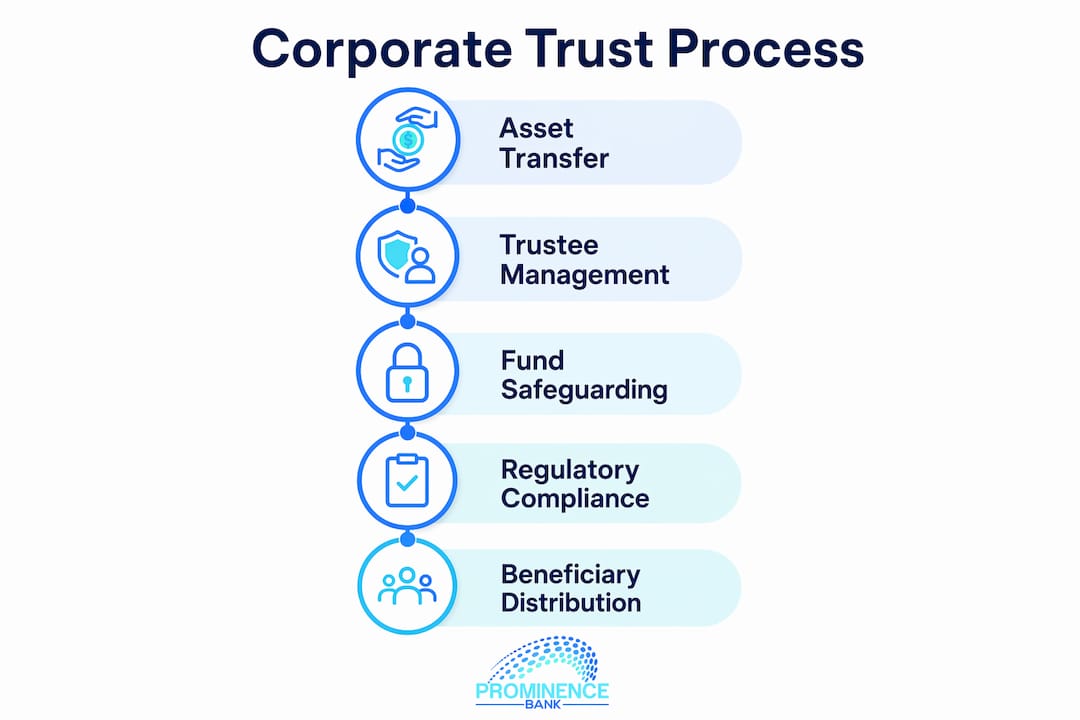
The three parties in any corporate trust are the grantor (the corporation transferring assets), the trustee (the neutral administrator), and the beneficiaries (investors, creditors, or counterparties). Each party has defined rights and obligations set out in a governing document, most commonly a trust indenture or trust deed. The trustee holds legal title to the assets but has no right to use them for its own benefit.

Regulatory oversight comes from bodies like the OCC, which supervises national bank trust departments, and state banking regulators for state-chartered institutions. The FDIC provides deposit insurance protections that apply to certain trust account structures. Understanding this oversight layers matters because violations carry consequences that go well beyond a fine.
How do corporate trust accounts work in practice?
Corporate trust accounts serve several distinct functions depending on the transaction type. The most common roles a corporate trustee fills are the indenture trustee in bond offerings, the escrow agent in mergers and acquisitions, and the administrator in asset-backed securities.
Indenture trustee in bond transactions
When a corporation issues bonds, the indenture trustee holds the legal agreement between the issuer and bondholders. The trustee monitors covenant compliance, collects interest payments, and distributes them to bondholders. If the issuer defaults, the trustee acts on behalf of all bondholders to enforce remedies under the indenture.
Escrow agent in M&A transactions
In a merger or acquisition, the escrow agent holds purchase price funds until all closing conditions are met. Neither buyer nor seller can access those funds unilaterally. This structure protects both parties from counterparty risk during the period between signing and closing.
Collateral and asset-backed securities administration
In structured finance, the corporate trustee holds collateral pools backing securities issued to investors. The trustee verifies that cash flows from the collateral are distributed according to the waterfall structure in the governing documents. Fiduciary responsibility and impartiality are non-negotiable in this role.
Key duties a corporate trustee performs across all these functions:
- Enforcing the terms of the governing indenture or agreement
- Maintaining segregated accounts for each trust or transaction
- Distributing funds only as authorized by the governing documents
- Reporting to beneficiaries and regulators on schedule
- Acting with impartiality between competing classes of beneficiaries
Pro Tip: Before appointing a corporate trustee, review their track record in your specific transaction type. An institution experienced in bond indentures may have limited expertise in M&A escrow administration.
What are the regulatory requirements for corporate trust accounts?
Compliance is the area where most businesses encounter problems. The rules are specific, and the consequences of getting them wrong are severe.
-
Separate client funds from operating funds. Regulatory bodies require that trust funds never mix with the corporation’s own operating capital. This anti-commingling rule applies at all times, not just at month-end.
-
Deposit funds within the required window. Regulators generally require entrusted funds to be deposited within 1 to 3 business days of receipt. Missing this window is a compliance violation even if the funds are eventually deposited correctly.
-
Title the account correctly. The account name must include a designation such as “as trustee for” to make the fiduciary relationship legally clear. Opening a corporate trust account requires a trust deed, authorized signatory identification, formal board resolutions, and proper account titling. Missing any of these documents delays opening and can void the account’s legal status.
-
Conduct periodic reconciliations. Reconciliations must match the bank statement, the master trust ledger, and individual client or beneficiary ledgers. Discrepancies at any level are red flags in regulatory audits.
-
Submit to annual audits. Trust account audits are required for entities handling trust money, with submissions due by specific deadlines depending on jurisdiction. In some jurisdictions, the deadline falls by september 30 following the audit period.
Violations of these rules can result in disciplinary proceedings, civil liability, or criminal charges. The OCC has authority to remove officers and directors of national banks that breach fiduciary duties. State regulators carry equivalent powers for state-chartered institutions.
Statistic callout: Regulatory bodies generally require entrusted funds to be deposited within 1 to 3 business days. That window is shorter than most executives expect, and missing it even once creates a compliance record.
How do you manage corporate trust funds without common pitfalls?
Operational errors cause most corporate trust account violations. The rules are clear on paper but break down in daily practice when transaction volume is high or staff turnover disrupts institutional knowledge.
The most dangerous pitfall is disbursing funds before deposited checks clear. Disbursing funds before deposited checks clear creates a risk of using other clients’ money. This is not a theoretical risk. It is the leading cause of trust shortfalls and the most common trigger for regulatory investigations. Always wait for bank-verified clearance before authorizing any disbursement.
The second major pitfall is the anti-commingling violation. The anti-commingling rule forbids mixing trust account funds with operating capital, and even minor infractions such as paying bank fees from trust funds constitute violations. Many organizations maintain a small firm float in the trust account specifically to cover bank fees, keeping those charges from touching client funds.
The third pitfall is poor reconciliation discipline. Reconciliation is a three-way process among bank statements, the master trust ledger, and individual client ledgers. Client ledger mismatches are the leading red flags in regulatory audits, and they almost always trace back to poor transaction documentation rather than fraud.
| Pitfall | Root cause | Correct practice |
|---|---|---|
| Premature disbursement | Assuming deposits clear immediately | Wait for bank-confirmed clearance |
| Commingling funds | Using trust account for operating expenses | Maintain a separate firm float |
| Reconciliation gaps | Incomplete transaction records | Three-way reconciliation at every period close |
| Improper authorization | Verbal or informal disbursement approvals | Require written authorization for every transaction |
Pro Tip: Assign one dedicated person to trust account reconciliation. When multiple staff members share the task without a clear owner, discrepancies go undetected until an audit surfaces them.
Businesses must not use one client’s funds for another’s disbursement or for operating expenses. Every trust transaction must benefit the relevant client or matter and carry proper written authorization. This principle is the foundation of fiduciary duty, and regulators treat any departure from it as a serious breach.
What are the real benefits of corporate trust accounts for businesses?
Corporate trust accounts deliver value well beyond regulatory compliance. For executives managing complex capital structures or multi-party transactions, they are a core risk management tool.
“Trust accounts function as proactive risk-management tools beyond compliance, providing legal clarity and financial protection in complex business situations.” — Business Trust Accounts Explained
The key benefits corporate executives should understand:
- Asset protection in disputes. Segregated trust funds are legally distinct from the corporation’s assets. In an insolvency or creditor dispute, those funds cannot be seized to satisfy the corporation’s general debts.
- Audit readiness. Trust accounts create a documented, auditable record showing the business never treated client or investor funds as its own. This is a powerful defense in regulatory reviews.
- Investor and creditor confidence. Counterparties in bond transactions or M&A deals are more willing to transact when a neutral trustee holds funds. The trustee’s impartiality removes the need for each party to trust the other.
- Operational continuity. Corporate trustees provide professional continuity that individuals cannot. If a key executive dies or becomes incapacitated, the trust continues operating without interruption. This matters especially for complex or multi-generational structures.
- Reduced personal liability. When a licensed corporate trustee administers the account, personal liability risk for individual directors is substantially lower than in self-administered arrangements.
For businesses operating across borders, the asset protection dimension is even more significant. Prominencebank works with international corporations that use trust structures specifically to protect assets from jurisdictional risk. Understanding offshore trust structures is a natural extension of understanding domestic corporate trust accounts.
Why most executives underestimate trust account complexity
Most business owners I have worked with treat corporate trust accounts as a compliance checkbox. They set one up because their lawyer said to, hand it to an administrator, and move on. That approach works until it doesn’t.
The executives who get into trouble are almost always the ones who assumed their trustee was handling reconciliation. In reality, the trustee handles legal administration. The corporation’s finance team is still responsible for transaction-level documentation and internal controls. When those two responsibilities blur, you get the exact conditions that produce audit failures.
The other misunderstanding I see constantly is around cleared funds. Executives approve disbursements based on the available balance shown in their banking portal. That balance often includes uncleared deposits. One premature disbursement against an uncleared check can create a trust shortfall that triggers a full regulatory investigation, even if the check clears two days later.
My honest recommendation: treat your corporate trust account like a separate legal entity with its own controls, its own reconciliation schedule, and its own documentation standards. Do not share staff, systems, or approval workflows with your operating accounts. The separation that feels like administrative overhead is exactly what protects you when a dispute or audit arrives.
Choosing an experienced corporate trustee matters as much as the internal controls. A trustee with deep experience in your transaction type, whether bond indentures, M&A escrow, or structured finance, will catch procedural issues before they become violations. That expertise is worth more than a lower fee from a generalist institution.
— Harold
Prominencebank’s corporate banking solutions for trust structures
Corporate trust account management requires a banking partner that understands complex structures, multi-party transactions, and cross-border compliance. Prominencebank provides corporate banking solutions built for exactly this kind of complexity, serving international businesses and institutional clients that need discretion, security, and global reach.

Prominencebank’s multi-currency accounts support corporations managing trust-related cash flows across multiple jurisdictions, removing the friction of currency conversion and correspondent banking delays. The bank’s compliance framework aligns with international AML/KYC standards, making it a practical fit for corporations that need their banking infrastructure to support, not complicate, their fiduciary obligations. Executives looking to structure or expand their corporate finance arrangements can connect with Prominencebank’s team directly through its digital platform.
FAQ
What is a corporate trust account?
A corporate trust account is a fiduciary account where a licensed third-party trustee holds and administers assets or financial obligations on behalf of investors or creditors. The trustee acts under a governing document such as a trust indenture or trust deed.
How does a corporate trust account differ from a personal trust?
A corporate trust involves a corporation as the grantor and typically serves investors or creditors as beneficiaries, while a personal trust is set up by an individual for family members. Corporate trusts are governed by stricter regulatory oversight from bodies like the OCC and FDIC.
What documents are needed to open a corporate trust account?
Opening a corporate trust account requires a trust deed, authorized signatory identification, formal board resolutions, and correct account titling that includes a designation such as “as trustee for.”
What happens if trust account funds are commingled?
Commingling trust funds with operating capital violates fiduciary duty and regulatory rules. Consequences range from disciplinary action and civil liability to criminal charges, depending on the jurisdiction and severity of the violation.
Why do businesses use corporate trustees instead of managing trust accounts internally?
Corporate trustees provide professional continuity, impartiality, and regulatory expertise that internal staff typically cannot match. They also eliminate the risk of interruption from executive incapacity or turnover, which is critical for long-term or complex trust structures.
Key takeaways
Corporate trust accounts protect assets and satisfy regulatory requirements only when fund segregation, documentation, and reconciliation are treated as non-negotiable daily disciplines, not periodic tasks.
| Point | Details |
|---|---|
| Core structure | A trustee holds legal title to assets and administers them solely for the benefit of designated beneficiaries. |
| Compliance window | Funds must be deposited within 1 to 3 business days; missing this deadline is a violation regardless of intent. |
| Anti-commingling rule | Trust funds must never mix with operating capital, even for minor expenses like bank fees. |
| Three-way reconciliation | Match bank statements, the master ledger, and individual client ledgers at every period close to catch discrepancies early. |
| Continuity advantage | Corporate trustees maintain uninterrupted administration through executive changes, incapacity, or death. |