What is structured corporate account management?
Structured corporate account management is the deliberate, programmatic discipline of managing a company’s most important clients through formalized processes rather than individual, ad-hoc effort. The goal is simple: protect and grow the revenue that matters most. As a formal practice, it typically focuses on the top 20% of accounts that have the potential to drive 80% of revenue, applying dedicated resources, defined processes, and executive attention where the financial stakes are highest.

This is distinct from general account management, which covers a broad book of business. Structured corporate account management narrows the lens to a small, high-value portfolio and treats each relationship as a long-term investment, not a series of transactions to close.
The structured approach includes five core elements:
- A dedicated account owner who manages the relationship fully, focusing on multi-year growth.
- A living account plan that is regularly updated to reflect the client’s goals, stakeholders, opportunities, and risks.
- Executive sponsorship with senior leaders maintaining peer relationships to prevent over-reliance on a single contact.
- Multi-threaded relationships built across various levels of the client organization.
- Regular business reviews aligned with client outcomes to identify future opportunities.
Why structured account management drives business growth
The business case for formalizing account management comes down to where revenue growth is cheapest to generate. Expanding inside an account you’ve already won requires no qualification cycle, no legal setup from scratch, and no trust-building from zero. The result is a shorter, more efficient path to new revenue than traditional sales hunting.

Structured account management also shifts the posture from reactive to proactive. Teams that operate without a formal program spend most of their time responding to client requests and firefighting. Teams with a structured model know what they’re working toward in each account, which means they spot expansion opportunities before the client thinks to ask.
The strategic benefits of a structured approach include:
- Revenue concentration protection. When the top accounts drive the majority of revenue, losing one is catastrophic. A structured program reduces that risk through deeper relationships and early warning systems.
- Shorter sales cycles. Existing vendor relationships mean legal frameworks are already in place and trust is established, so expansion opportunities close faster.
- Higher retention rates. Proactive engagement and regular business reviews catch dissatisfaction before it becomes churn.
- Whitespace conversion. Structured account plans surface products the client doesn’t use, geographies not yet sold into, and business units not yet reached.
- Organizational alignment. A formal program forces internal teams, sales, customer success, technical, and executive sponsors, to coordinate around shared account goals.
How account management differs from sales
The confusion between account management and sales is common, and it costs organizations real money when the wrong person is put in the wrong role. Sales is fundamentally transaction-oriented: the job is to acquire new customers, move opportunities through a pipeline, and close deals. Success is measured in quarterly bookings.
Account management, particularly the structured corporate variety, is relationship- and growth-oriented. The account manager owns clients the company has already won and is measured on multi-year revenue expansion, executive relationship depth, and the durability of the account plan. As Gartner defines it, key account management requires a substantial investment of both time and resources, representing a clear shift from transactional selling to long-term collaborative partnership.
The practical differences:
- Primary objective. Sales: acquire new customers. Account management: retain and grow existing ones.
- Success metrics. Sales: quarterly closed revenue. Account management: multi-year net revenue retention and expansion.
- Activities. Sales: prospecting, qualifying, closing. Account management: account planning, stakeholder mapping, executive engagement, renewal forecasting.
- Mindset. Sales: win the deal. Account management: grow the partnership.
- Relationship depth. Sales: often single-threaded with a buyer. Account management: multi-threaded across procurement, IT, business owners, and executive sponsors.
A strong salesperson is not automatically a strong account manager. The muscle is different.
What does a structured corporate account manager actually do?
The strategic account manager role sits at the intersection of three disciplines: sales, program management, and executive consulting. The portfolio is small, focused on a limited number of high-value accounts, but the engagement depth is greater than that of a standard account manager who handles a larger book of business.
Key responsibilities include:
- Account plan ownership. Building and maintaining a living document for each account that maps client goals, stakeholder relationships, expansion whitespace, and risks, reviewed on a quarterly cadence.
- Stakeholder mapping. Maintaining a current view of who matters inside the client organization: who buys, who influences, who sponsors the relationship, and where coverage is thin.
- Cross-functional coordination. Orchestrating internal resources, customer success, sales engineers, product specialists, and executive sponsors, around a unified account strategy.
- Revenue forecasting. Owning the renewal and expansion pipeline for each account, reviewed monthly against the account plan with risks called out explicitly.
- Whitespace analysis. Identifying products the client doesn’t use, business units not yet reached, and geographies not yet sold into, then running the prospecting motion to convert them into pipeline.
- Executive relationship management. Maintaining credible senior relationships on both sides of the partnership, so the account isn’t dependent on a single contact.
- Risk mitigation. Monitoring for signals of dissatisfaction, competitive threats, or organizational changes that could disrupt the relationship.
Pro Tip: Build your stakeholder map as a living record in your CRM, not a slide deck. When a key contact leaves the client organization, which happens constantly, a structured map means the relationship survives the departure.
Skills that separate strong structured account managers
The skill profile for structured corporate account management is genuinely different from what makes a great salesperson or a great customer success manager. It’s a hybrid role, and the practitioners who struggle are usually those who lean too hard on one discipline at the expense of the others.
The critical skills:
- Stakeholder mapping and multi-threaded relationship building. Managing a strategic account with 20 or more relevant contacts across procurement, IT, and executive leadership requires a systematic approach, not memory.
- Executive communication. The account manager has to be credible at the client’s senior table, talking about the client’s strategy, not just the product. This is a consultative skill, not a sales pitch skill.
- Program and project management. Running a multi-year account plan across a complex buying organization is a coordination problem. The account manager orchestrates resources, timelines, and messaging across internal and client teams.
- Data literacy and account planning. Maintaining a living account plan requires comfort with CRM data, revenue forecasting, and whitespace analysis, not just relationship intuition.
- Negotiation and conflict resolution. Complex accounts generate complex problems. The account manager needs to resolve issues without damaging the relationship or the commercial terms.
- Adaptability. Client organizations reorganize constantly. The account manager who can’t adapt their plan and relationships to a new org structure loses ground fast.
The structured account management process: best practices for 2026
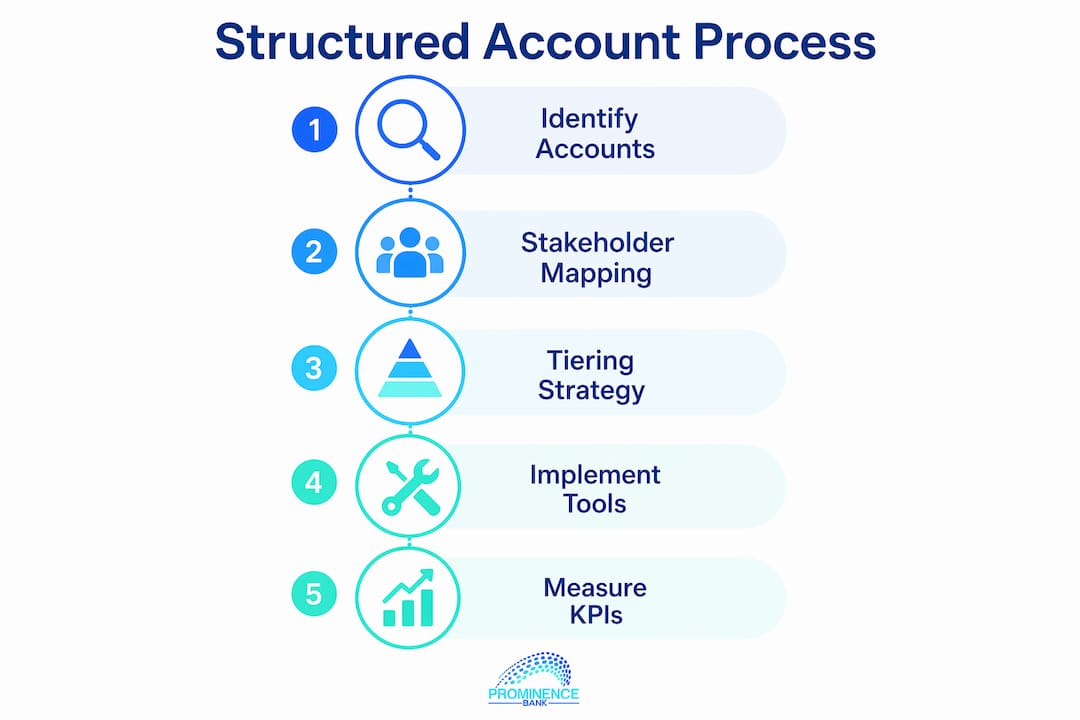
The five operational requirements
Moving to a structured model requires five things to be in place simultaneously. A dedicated account owner, a living account plan, executive sponsorship, multi-threaded relationship mapping, and a regular cadence of business reviews. Any one of these missing and the program degrades back toward ad-hoc management.
Customer tiering
Not every account deserves the same depth of attention. Tiering accounts into categories such as Good, Better, and Best defines how resources are allocated. A Best-tier account might receive quarterly in-person executive business reviews, while a Good-tier account gets a video call. Without tiering, teams spread attention evenly across accounts with wildly different revenue potential, which is how high-value relationships get neglected.
Technology and tools
CRM systems are the system of record for account plans, stakeholder maps, and revenue forecasts. Spreadsheet- and slide-based plans are common starting points but rarely survive a rep transition or a client reorganization. Relationship mapping tools help account managers track organizational changes at the client in real time. AI-assisted planning tools are increasingly used in 2026 to draft stakeholder updates and flag account health signals before they become problems. For corporations managing multi-currency accounts across multiple entities, centralized digital systems add a layer of reconciliation and compliance transparency that manual processes can’t sustain.
KPIs and measurement
Metrics that matter in structured account management include customer satisfaction scores, net revenue retention, expansion pipeline value, stakeholder coverage depth, and renewal forecast accuracy. The key is embedding these metrics into the technology platform so they’re visible to both the account manager and leadership, creating a feedback loop rather than a once-a-year review.
Common pitfalls to avoid
- Single-champion dependency. If the account rests on one contact and that person leaves, the relationship is at risk. Multi-threading is the structural fix.
- Static account plans. A plan updated annually and then ignored is worse than no plan, because it creates false confidence. Quarterly reviews keep the plan relevant.
- Over-labeling accounts as strategic. When too many accounts carry the “strategic” designation, resources get diluted and the program loses its edge.
- Bureaucratic overload. Formalizing account management improves outcomes, but excessive process kills agility. The account manager needs room to solve complex client problems without clearing every action through a committee.
Pro Tip: Review your account tier list every six months. Accounts that no longer meet the criteria for strategic designation should be moved down, freeing resources for accounts that do.
Structured account management in practice
Technology sector: protecting a concentrated revenue base
A mid-sized B2B software company discovers that its top eight accounts represent roughly 60% of annual recurring revenue. The company formalizes a structured program: each account gets a dedicated account manager, a quarterly business review cadence, and an executive sponsor paired with a senior contact on the client side. Within the first year, the account team identifies expansion whitespace in two business units the company had never sold into at its largest account. The result is a new pipeline that would have been invisible under a reactive, transactional model.
The lesson isn’t that the company worked harder. It’s that the structured program made the opportunity visible and gave someone clear ownership to pursue it.
Financial services: multi-entity account complexity
A corporate banking client operates across six jurisdictions with separate legal entities, [currency needs](https://coreysavard.com/2026/07/08/como evitar mora en prestamos-guia practica-2026), and compliance requirements. Without a structured account management approach, the relationship fragments across product teams, each managing their slice without a unified view of the client’s goals or risks. With a structured model, a single account owner maintains the living account plan, coordinates internally across treasury, compliance, and relationship banking teams, and runs quarterly reviews that align the bank’s services to the client’s evolving priorities. For organizations managing this kind of complexity, resources like Prominencebank’s corporate account structuring checklist offer a practical starting framework.
Professional services: the single-champion risk
A consulting firm loses a major account when its primary contact, a VP who championed the relationship internally, leaves for a competitor. Post-mortem analysis reveals the account team had no relationships above or below that VP. The firm rebuilds its account management program with explicit multi-threading requirements: every strategic account must have documented relationships at three organizational levels before the next annual review. The policy costs time upfront and pays back in account durability.
Types of structured corporate account management models
Different organizations structure their account management programs differently, depending on their size, client complexity, and go-to-market model. The main models in use in 2026:
Dedicated strategic account manager model
One senior account manager owns a small portfolio of 3–10 accounts end to end. This is the most common model for enterprise B2B companies where individual accounts generate enough revenue to justify dedicated coverage. The account manager is part seller, part program manager, and part executive relationship owner. This model produces the deepest client relationships but requires the most investment per account.
Pod or team-based model
A cross-functional pod, typically an account manager, a customer success manager, a solutions engineer, and an executive sponsor, jointly owns a strategic account. Roles are clearly defined, handoff processes are documented, and the pod meets on a regular cadence to coordinate. This model works well when accounts are complex enough that no single person can cover all the required disciplines. It also reduces single-point-of-failure risk inherent in the dedicated model.
Tiered coverage model
Accounts are segmented into tiers (Strategic, Key, and Named, for example), and the depth of structured management scales with the tier. Strategic accounts get the full program: dedicated owner, executive sponsor, quarterly in-person reviews, and a living account plan. Key accounts get an assigned owner and regular reviews but share resources. Named accounts get basic coverage. This model lets organizations apply structured discipline where it matters most without over-investing in accounts that don’t justify it.
Global account management model
Used by multinational organizations managing clients that operate across multiple geographies. A global account manager coordinates strategy and executive relationships at the headquarters level, while regional account managers handle local execution. The challenge is maintaining a unified account plan and consistent client experience across time zones, legal entities, and cultural contexts. Centralized digital infrastructure, including platforms that handle global corporate account complexity, is essential for this model to work at scale.
Industry vertical model
Account managers are organized by industry rather than geography or account size. Each manager develops deep expertise in a specific sector, which allows for more consultative client conversations and faster identification of expansion opportunities. This model is particularly effective when the product or service requires significant customization by industry, and when clients value a partner who understands their competitive environment, not just their contract terms.
Key Takeaways
Structured corporate account management is a formal, resource-intensive discipline that protects concentrated revenue and converts existing client relationships into predictable growth engines.
| Point | Details |
|---|---|
| Top accounts drive most revenue | The top 20% of accounts typically hold the potential to generate 80% of revenue, making structured coverage a financial priority. |
| Five elements define the model | Dedicated owner, living account plan, executive sponsorship, multi-threaded relationships, and regular business reviews must all be in place. |
| Account management differs from sales | Sales targets new acquisition; structured account management targets multi-year retention and expansion inside existing clients. |
| Tiering allocates resources correctly | Segmenting accounts into tiers (Good/Better/Best) prevents high-value relationships from being neglected by spreading attention evenly. |
| Bureaucracy undermines the program | Formalizing processes improves outcomes, but excessive process reduces agility and the ability to solve complex client problems. |
FAQ
What is corporate account management?
Corporate account management is the practice of maintaining and growing relationships with a company’s most important existing clients, focusing on retention, satisfaction, and revenue expansion rather than new customer acquisition.
How does structured account management differ from regular account management?
Structured account management applies formalized processes, dedicated resources, living account plans, and executive sponsorship to a small portfolio of high-value accounts, whereas regular account management typically covers a broader book of business with less process depth.
Is account management a stressful job?
It can be, particularly in structured corporate roles where the account manager coordinates multiple internal teams, manages executive relationships on both sides, and owns multi-year revenue forecasts for accounts that represent a significant share of company revenue.
Are structured account management programs worth the investment?
Yes, because expanding inside existing accounts is faster and cheaper than acquiring new ones: legal frameworks are already in place, trust is established, and qualification cycles are shorter, which produces more efficient revenue growth.
What is the difference between key account management and strategic account management?
The terms are often used interchangeably. When organizations distinguish between them, strategic accounts are the top tier: clients considered critical to long-term growth that receive a dedicated cross-functional team and executive sponsorship, not just an assigned account manager.