
TL;DR:
- Private banking onboarding transforms into a trusted partnership rather than a bureaucratic process for high-net-worth individuals and institutions.
- Prominence Bank normally completes account opening within 48 to 72 hours only after all required KYC/AML procedures are complete and all requested information and documentation are received, verified, and accepted; this is an estimate, not a guarantee, and further review may require more time. Submitting an enquiry, application, or payment does not start the estimate and does not guarantee approval or activation.
- While technology automates many steps, expert judgment and a human touch remain essential for building long-term client trust and managing complex structures securely.
Opening a private banking relationship should feel like the beginning of a trusted partnership, not a bureaucratic obstacle course. Yet for high-net-worth individuals, family offices, and international corporations, the onboarding process can require additional compliance, verification, or due-diligence review beyond the estimate. Stringent regulatory requirements, multi-jurisdictional compliance checks, and the need for absolute confidentiality create a layered review process. This guide maps every critical stage clearly, so you know exactly what to prepare, what to expect, and how to protect your privacy throughout.
Table of Contents
- What you need before starting private banking onboarding
- Step-by-step: The private banking onboarding process explained
- Navigating compliance challenges: Risk management and confidentiality
- How technology supports (but doesn’t replace) expert onboarding
- Why the human touch remains the ultimate differentiator
- Explore secure, global banking solutions for your needs
- Frequently asked questions
Key Takeaways
| Point | Details |
|---|---|
| Prepare documentation | Gathering all required documents upfront supports a complete onboarding review but does not start or guarantee the estimate. |
| Human input is essential | Complex structures and global clients always require expert personal oversight. |
| Stay compliant | Strict regulatory checks protect your assets but may require extra steps, especially for PEPs or complicated structures. |
| Tech helps, but isn’t everything | Automation supports document handling, yet cannot replace bespoke service in private banking onboarding. |
What you need before starting private banking onboarding
Before moving into the onboarding process, it pays to understand what information and materials you must prepare to ensure a smooth experience.
Incomplete or mismatched documentation means the estimated processing period has not started and may require follow-up. Banks are not being difficult for the sake of it. They operate under strict anti-money laundering (AML) and Know Your Customer (KYC) obligations that require them to verify not just who you are, but how you built your wealth and through what structure you hold it. Getting these materials right before day one is where you gain real leverage.
Core documents you should prepare:
- Proof of identity: Government-issued passport, national ID, and in some cases biometric verification
- Proof of residence: Utility bills, bank statements, or official correspondence dated within 90 days
- Source of wealth documentation: Tax returns, audited financial statements, sale agreements for businesses or property, inheritance documentation
- Legal entity paperwork: Certificate of incorporation, memorandum and articles of association, shareholder registers, and ultimate beneficial owner (UBO) declarations
- Regulatory references: Existing banking relationships, prior compliance correspondence, or letters from legal counsel in relevant jurisdictions
The jurisdiction of your account matters enormously. A bank must comply with both its home regulatory framework and the international standards of the jurisdictions where your assets are held or your entities are registered. As Finantrix notes, onboarding requires jurisdiction-aware document screening for international clients, and while 60 to 70% of onboarding work can be automated, complex structures require significantly more manual preparation.
For clients operating through trusts, foundations, or family offices, expect an expanded requirements list. Trustees, protectors, settlors, and beneficiaries may all need to be individually verified, and the trust deed itself will be scrutinized closely. Refer to our private banking setup guide for a deeper breakdown of structural considerations, and review our bank compliance essentials page to understand what compliance teams are looking for at each stage.
| Document category | Individual client | Corporate or trust |
|---|---|---|
| Government-issued ID | Required | Required for all directors/UBOs |
| Source of wealth | Required | Required with audited evidence |
| Proof of address | Required | Registered office and UBO address |
| Entity formation documents | Not applicable | Certificate of incorporation, trust deed |
| UBO declaration | Not applicable | All beneficial owners above threshold |
| Tax residency documentation | Required | Per jurisdiction of entity |
You should also review compliance steps from adjacent regulated industries, since the logic behind layered verification is consistent across high-value international transactions.
Pro Tip: Prepare certified translations of any document not in your bank’s primary operating language before submission. Even a single untranslated page can trigger a hold on your entire file.
Step-by-step: The private banking onboarding process explained
Once all materials are gathered, you can move confidently into the onboarding process itself.
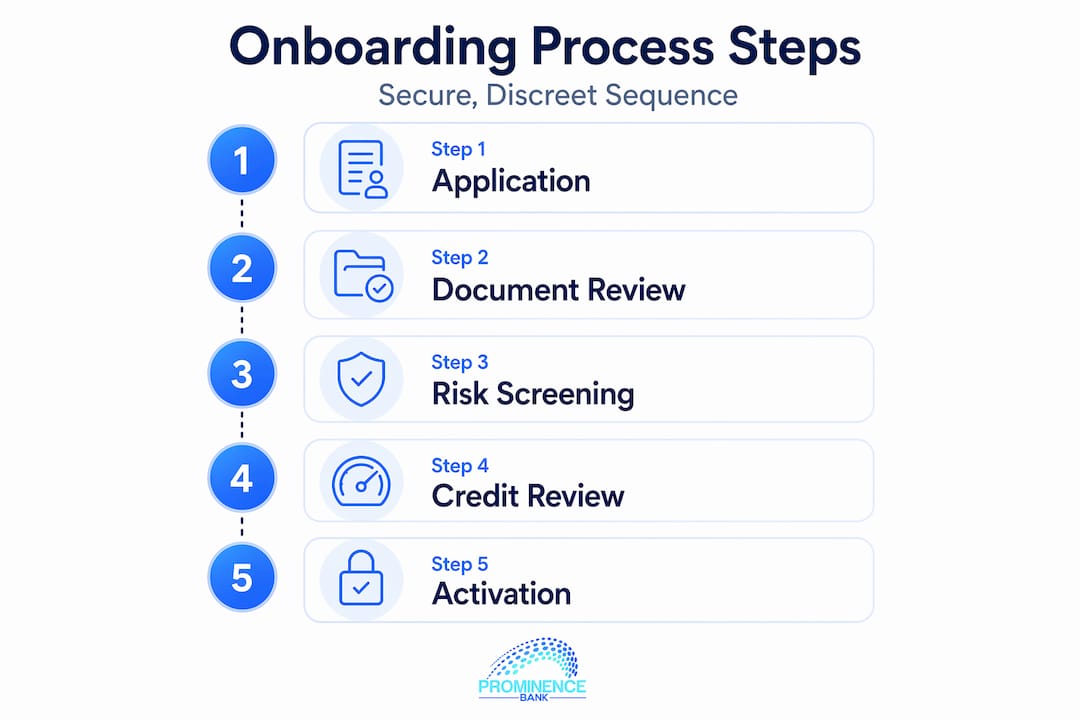
Private banking onboarding is a structured sequence of gates with defined decision criteria; the Prominence Bank estimate and conditions are stated below. Understanding the full journey removes anxiety from the process and gives you the ability to manage it proactively rather than reactively.
Step 1: Application and initial consultation
This is where you express intent to open an account and present your basic profile. For most institutions, this involves a relationship manager conversation, either in person, by video, or through a secure digital intake form. The bank assesses whether you fall within its target client segment before proceeding.
Step 2: KYC and documentation review
All submitted documents are verified against global watchlists and sanctions databases. Your identity is confirmed through primary source checks. Any gaps at this stage are returned to you as ‘Not In Good Order’ (NIGO) items. They do not restart the estimate, because it begins only after KYC/AML is complete and all requested information and documentation are received, verified, and accepted.
Step 3: Risk assessment, PEP and adverse media screening
The bank assigns you a risk classification based on your profile. Factors include country of residence, nature of your business, public profile, and whether you are classified as a politically exposed person (PEP). Adverse media checks scan for any negative news coverage linking you to financial crime, corruption, or sanctioned networks.
Step 4: Internal credit and suitability review
For clients seeking asset management or investment services, this stage assesses your risk tolerance, investment objectives, and the suitability of proposed products. For corporate accounts, this may include a review of existing banking relationships and turnover history.
Step 5: Final compliance sign-off and account activation
Senior compliance officers approve or escalate the client file. Once cleared, accounts are activated with access credentials and onboarding documentation confirmed. For a detailed look at opening accounts within a fully digital framework, see our secure online account opening guide, and for jurisdiction-specific nuances, the offshore account steps breakdown is particularly useful.
According to InvestGlass, complex cross-border structures may require additional review beyond Prominence Bank’s estimate, particularly when family offices or trusts are involved. Efficient cross-border financial workflows reduce this risk, especially when account managers are briefed to escalate incomplete files before they fall into review queues.
Pro Tip: Ensure all documents are complete and every certification is current before you submit. A single expired document or missing notarization can push your NIGO rate up and require additional review time beyond the estimate.
Navigating compliance challenges: Risk management and confidentiality
Each step of onboarding is shaped by careful checks around risk and privacy. Here is how banks manage this balance.

Compliance is not just a box-ticking exercise. For private banking clients, it is the mechanism through which trust is established between you and your financial institution. But it also represents one of the most sensitive intersections in banking: the point where your privacy meets the bank’s legal obligations.
Key compliance red flags that trigger enhanced due diligence:
- Classification as a politically exposed person (PEP) or close associate of a PEP
- Residence in or transactions involving high-risk or sanctioned jurisdictions
- Adverse media linking the client to financial crime, corruption, or reputational controversy
- Unexplained cash flows or inconsistent source of wealth narrative
- Ownership structures designed to obscure beneficial ownership
A real-world example of what happens when institutions fall short: HSBC’s Swiss private bank was forced to cut ties with high-risk PEP-linked clients and faced regulatory action from FINMA, including a prohibition on onboarding certain new PEPs until compliance standards were materially improved. This outcome is not unique. Across private banking, the consequence of weak due diligence is not just financial penalty. It is reputational damage that clients on both sides of the relationship absorb.
“Client confidentiality is not at odds with compliance. The strongest institutions demonstrate that discretion and rigor are two sides of the same standard, not competing forces.” — Prominence Bank
For you as a client, the implication is clear. Confidentiality in banking does not mean obscuring information from your institution. It means that the information you provide is handled with absolute discretion, shared only within the legal and regulatory framework, and protected against unauthorized access. Our approach to confidentiality in private banking reflects this balance directly.
Banks protect client data through encrypted communications, role-based access controls, and compartmentalized client files. If you want to verify what a secure institution should have in place, our secure banking checklist provides a practical framework. You should also review any institution’s risk disclosure policy to understand how they handle client data under legal challenge.
How technology supports (but doesn’t replace) expert onboarding
In a field where privacy, risk, and regulations are paramount, technology is invaluable, but also limited.
Modern private banking onboarding uses digital tools to support the mechanical parts of the process. Identity verification software performs document authentication in minutes. Automated screening engines cross-reference your profile against global sanctions lists in real time. Risk scoring algorithms flag potential issues before a human reviewer sees the file. These tools are genuinely powerful.
What technology handles well:
- Document capture and optical character recognition (OCR) validation
- Automated sanctions and watchlist screening
- Digital identity verification via biometric comparison
- Risk classification scoring based on predefined parameters
- Workflow routing and audit trails for compliance records
Where technology falls short:
- Interpreting nuanced ownership structures across multiple jurisdictions
- Evaluating the credibility of a complex source of wealth narrative
- Making judgment calls on borderline PEP classifications
- Managing sensitive relationship conversations with high-profile clients
- Resolving escalated compliance scenarios that require regulatory interpretation
Finantrix’s analysis confirms that 60 to 70% of onboarding tasks can be automated, yet full straight-through digital processing remains rare for complex or cross-jurisdictional cases. That remaining 30 to 40% is where experienced relationship managers and senior compliance officers are irreplaceable.
For clients using offshore entities, multi-currency structures, or operating across three or more jurisdictions simultaneously, the expectation should be that a significant portion of your onboarding will involve direct human review. Technology supports the early stages of that process. It does not replace the judgment at the end of it. Read how technology in private banking is reshaping service delivery without eliminating the human dimension.
Pro Tip: At the start of your engagement, ask your bank directly which parts of their onboarding are fully digital and which require personal input from a compliance officer. Knowing this upfront lets you plan your availability and prepare for follow-up accordingly.
Why the human touch remains the ultimate differentiator
Now that you know how technology helps, it is worth examining what actually separates good onboarding outcomes from truly excellent ones for sophisticated clients.
Clear requirements and transparent review conditions are legitimate expectations in private banking onboarding. Institutions earn long-term trust by getting the details right, asking the right questions, and treating each financial profile with genuine analytical rigor rather than template-driven processing. Prominence Bank’s estimate and conditions are stated above.
The best onboarding relationships we have seen involve a relationship manager who functions more like a trusted advisor than a data collector. That person understands the regulatory environment across your relevant jurisdictions. They anticipate compliance questions before they escalate. They know when to escalate a nuanced case to a senior officer rather than letting it stall in a standard queue.
For international clients with complex wealth structures, onboarding is also the first real test of how a bank will behave when something unexpected happens later. A bank that handles a complex trust structure with precision and discretion during onboarding is demonstrating what it will do when a regulatory inquiry arrives, when currency controls shift in a key jurisdiction, or when a family governance event requires rapid account restructuring.
We believe the true value of expert onboarding is not a promised account-opening deadline. It is a relationship foundation that holds up under pressure. The secure wealth setup insights we share with clients reflect this philosophy: preparation and precision at the start save significant cost and complexity later.
Digital tools improve consistency. Senior expertise protects your interests. The combination of both is what you should expect from any institution worthy of your long-term banking relationship.
Explore secure, global banking solutions for your needs
Once you know what exceptional onboarding looks like, partnering with the right provider becomes your final, most important step.
Prominence Bank was built specifically for clients who cannot accept a one-size-fits-all banking experience. We serve high-net-worth individuals, international corporations, and institutional clients who need a fully digital, deeply discreet banking partner capable of handling complex structures across multiple jurisdictions.
Our global business banking solutions are designed for clients who demand both clarity and precision in account setup, with compliance capabilities that meet international AML and KYC standards. For those who want to understand exactly how our personalized banking technology enhances security and service delivery, that overview is a useful starting point. Reach out directly to begin your tailored onboarding consultation.
Frequently asked questions
How long does private banking onboarding usually take?
Prominence Bank normally completes account opening within 48 to 72 hours after all required KYC/AML procedures have been completed and all requested information and documentation have been received, verified, and accepted. This is an estimated processing period, not a guaranteed deadline. Additional time may be required if further compliance, verification, or due-diligence review is necessary. Submitting an enquiry, application, or payment does not start the estimated processing period and does not guarantee account approval or activation.
What documents are required for private banking onboarding?
You will typically need proof of identity, source of wealth evidence, structural documents for any trust or entity, and sometimes tax filings. Jurisdiction-aware document screening means requirements can vary significantly based on where your assets are held.
Can the onboarding process be fully automated?
Automation handles 60 to 70% of onboarding tasks, but complex cases involving multi-jurisdictional structures or nuanced source-of-wealth narratives still require direct human review and intervention.
Why are politically exposed persons (PEPs) treated differently during onboarding?
Banks must perform enhanced due diligence for PEPs to comply with AML and regulatory standards. As demonstrated when HSBC’s Swiss private bank faced restrictions on new PEP onboarding, the consequences of insufficient PEP checks can include regulatory sanctions and forced client exits.
What are the consequences of incomplete or incorrect onboarding documents?
Incomplete files mean the 48-to-72-hour estimate does not begin until the file is complete and accepted, and additional review may require more time.