TL;DR:
- Relying solely on domestic banks exposes wealth to political, legal, and currency risks.
- International banking structures with legal entities protect assets and offer operational advantages.
- Multi-currency accounts and real-time transactions reduce costs and improve global liquidity management.
Most high-net-worth individuals and global corporations assume their domestic bank is built for their ambitions. It is not. Single-jurisdiction banking exposes your wealth to political volatility, currency risk, legal seizures, and regulatory gaps that compound quietly until they become catastrophic. International business banking offers a fundamentally different architecture, one built around asset diversification, multi-currency efficiency, and discretion that local institutions simply cannot match. This guide walks through why the structure of your banking matters as much as the size of your balance, and how the right global framework actively protects and amplifies wealth.
Table of Contents
- The risks of relying on domestic banking for global wealth
- How international business banking protects assets
- Efficient global transactions and multi-currency management
- Privacy, compliance, and discretion in global banking
- Why sophisticated banking strategies go beyond simple offshoring
- Take the next step with trusted international banking partners
- Frequently asked questions
Key Takeaways
| Point | Details |
|---|---|
| Asset protection | International business banking shields wealth from local risks by spreading assets across jurisdictions. |
| Global transaction efficiency | Multi-currency accounts and international platforms reduce fees and speed up cross-border payments. |
| Discreet, compliant service | Sophisticated institutions offer privacy without compromising legal and regulatory obligations. |
| Beyond offshoring | Modern strategies combine technology, compliance, and global reach for superior financial management. |
The risks of relying on domestic banking for global wealth
The assumption that a well-established domestic bank is inherently safe is one of the most expensive misconceptions in wealth management. For high-net-worth individuals and corporations operating across borders, a single-country banking relationship creates concentrated risk that few fully account for until something goes wrong.
Here are the most serious vulnerabilities:
- Legal seizure risk: Domestic courts can freeze or seize assets with limited warning, especially in politically unstable environments.
- Currency devaluation: Holding wealth in a single currency exposes you to sovereign monetary policy decisions that can erode value overnight.
- Regulatory vulnerability: Local regulators can impose sudden capital controls or reporting mandates that restrict your ability to move funds internationally.
- Limited market access: Domestic banks rarely offer sophisticated cross-border instruments, FX hedging, or real-time settlement for global trade.
- Privacy gaps: Many domestic institutions have limited confidentiality frameworks, making sensitive transactions visible to third parties.
“Asset protection through diversified jurisdictions shields HNWIs and corporations from local legal, political, and economic risks via structures like trusts, LLCs, and offshore accounts.”
Global banking structures are not just convenience tools. They function as legal and financial shields. When you spread assets across multiple jurisdictions using purpose-built entities, you make it structurally harder for any single government, creditor, or court to access everything at once.
This matters more in 2026 than ever before. Geopolitical friction, rapid regulatory shifts in major economies, and increased scrutiny on domestic wealth holders mean the risk environment for single-jurisdiction banking has intensified. Relying on global discreet banking frameworks provides the kind of insulation that no domestic bank can replicate.
For international businesses, the operational cost of domestic-only banking also adds up. Wire delays, currency conversion markdowns, and compliance friction on cross-border payments all represent real money. The solution is not just diversification for safety’s sake. It is about accessing secure global banking solutions that are purpose-designed for the scale and complexity of your activity.
How international business banking protects assets
Understanding the risks, we can now explore exactly how advanced banking strategies protect your wealth. The mechanics rely on layering legal structures across multiple jurisdictions so that no single point of failure can compromise the whole.
The four core structures used by sophisticated clients are compared below:
| Structure | Primary benefit | Jurisdiction flexibility | Privacy level |
|---|---|---|---|
| Trust | Shields assets from personal liability | High | Very high |
| LLC | Separates business and personal risk | High | High |
| Multi-currency account | Reduces FX exposure | Medium | Medium |
| Offshore account | Diversifies legal/political exposure | Very high | Very high |
Each structure plays a distinct role. Trusts are particularly powerful for estate planning and protecting generational wealth because assets placed in a properly structured trust are legally separated from the settlor’s personal estate. LLCs provide a clean firewall between operational business risk and personal wealth. Offshore accounts, held in stable and privacy-respecting jurisdictions, add a layer of geographic insulation.
The international banking benefits extend beyond protection into operational advantage. Confidentiality is a core feature of reputable international institutions. This means transaction data, account balances, and beneficial ownership information are handled with far greater discretion than most domestic banks provide.

Setting up corporate accounts abroad within well-chosen jurisdictions gives corporations a direct hedge against domestic regulatory overreach. Combined with a thoughtful private banking setup, these structures create a resilient financial architecture.
Pro Tip: Do not rely on a single offshore account or structure. The most effective protection comes from combining at least two or three legal entities across different jurisdictions, each serving a specific function. Think of it as a portfolio of legal shields rather than one large safe.
Efficient global transactions and multi-currency management
Asset protection is just one side of international business banking. Transaction and operational advantages are equally compelling, especially for corporations that move large sums across borders regularly.
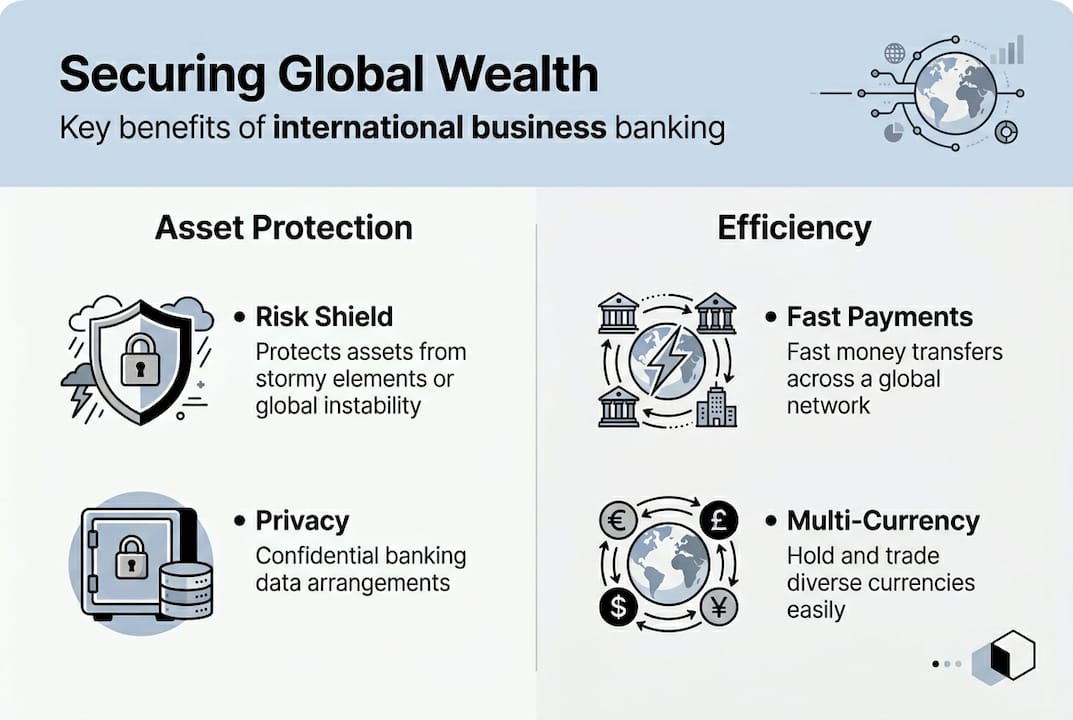
The numbers tell a clear story. Major international banks facilitate approximately 80% of global trade finance, a figure that reflects just how central international banking infrastructure is to the world economy. If you are routing payments through domestic systems for cross-border trade, you are working around this infrastructure rather than through it.
See how the two approaches compare:
| Feature | Domestic banking | International multi-currency platform |
|---|---|---|
| Settlement speed | 2 to 5 business days | Real-time or same day |
| FX conversion fees | 2% to 4% per transaction | 0.1% to 0.5% per transaction |
| Currency access | Single or limited | 20 to 50+ currencies |
| Visibility | Limited reporting | Real-time dashboards |
| Trade finance tools | Basic or none | Full suite available |
The gap between domestic and international platforms is not marginal. For a company processing $10 million per month in cross-border payments, shaving even 1.5% off FX conversion costs means $150,000 in annual savings. That is before accounting for settlement delays that affect cash flow.
Core features that corporate banking solutions at the international level typically provide include:
- Real-time settlement across major currency pairs
- FX hedging instruments to lock in favorable rates
- Cash pooling to optimize liquidity across entities and regions
- Multi-currency accounts that hold and transact in 20 or more currencies natively
- Automated reconciliation for high-volume international trade
For corporations managing supply chains, international payroll, or investment capital across multiple countries, these features are not luxuries. They are requirements. A well-structured offshore banking setup that includes multi-currency capabilities can reduce operational friction significantly while improving financial visibility.
Privacy, compliance, and discretion in global banking
Operational capabilities are powerful, but privacy and regulatory confidence are non-negotiable for global clients. The misconception that privacy and compliance are opposites is one worth correcting immediately.
Reputable international banking institutions operate under frameworks such as FATCA, the Common Reporting Standard (CRS), and global KYC/AML standards. These regulations exist to prevent financial crime, not to eliminate privacy. The best international banks have built systems that satisfy all reporting obligations while still providing clients with the discretion and confidentiality they expect.
Here are the key steps for ensuring your global banking arrangement maintains both privacy and compliance:
- Choose a licensed institution that operates under a recognized regulatory framework with clear AML and KYC policies.
- Structure accounts correctly from the start, using appropriate legal entities to separate beneficial ownership from operational accounts.
- Establish a clear reporting protocol with your banking partner so transaction reporting obligations are met automatically.
- Review your structure annually as regulations evolve, particularly CRS reporting thresholds and FATCA disclosure requirements.
- Use secure digital channels for all communication and documentation, ensuring that sensitive data does not travel through unprotected mediums.
Compliance-ready international banking actually strengthens your position. When regulators or counterparties request documentation, a well-organized international structure produces clean, traceable records that satisfy scrutiny quickly. This is the opposite of what most people assume about offshore or international accounts.
For HNWIs specifically, online bank compliance frameworks built around discretion mean that your financial activity stays between you and your institution. The discreet banking advantages available through purpose-built international platforms go far beyond what standard retail or corporate banking provides.
Pro Tip: Always ask a prospective international bank how they handle compliance reporting for your specific jurisdictions. A bank that offers personalized guidance rather than generic documentation is worth far more. Institutions offering secure online banking with dedicated compliance support reduce your regulatory exposure substantially.
Why sophisticated banking strategies go beyond simple offshoring
There is a version of international banking that people practiced twenty years ago: move money offshore, keep it quiet, and hope geography alone provided insulation. That approach is not just outdated. It is a liability.
The real competitive edge in 2026 comes from institutions that combine platform security, active compliance management, real-time transaction capabilities, and currency optimization in a single integrated framework. It is the difference between storing gold in another country and managing a dynamic, responsive financial system that adapts as your needs and the regulatory landscape evolve.
At Prominence Bank, we see this distinction clearly across our client base. The most protected and financially effective clients are not simply the ones with accounts in the most jurisdictions. They are the ones who treat their banking structure as a living strategy, one that is reviewed, adjusted, and optimized regularly.
International banking is now about orchestration, not just safety.
For clients who want to build that kind of architecture, secure global access requires choosing partners who understand both the technical and regulatory dimensions of global wealth management. The banks that thrive in this environment are tech-enabled, compliance-robust, and deeply experienced in serving clients whose needs do not fit standard templates.
Take the next step with trusted international banking partners
If you are ready to move from information to implementation, the gap between reading about international banking and actually building a secure, efficient global structure is smaller than you think.
Prominence Bank offers tailored solutions across advanced corporate banking options, including multi-currency accounts, offshore structures, and institutional-grade privacy frameworks. Whether you are a high-net-worth individual looking to protect generational wealth or a corporation streamlining cross-border transactions, our specialists can map the right structure to your goals. Explore our digital currency services or start with our step-by-step offshore account setup guide to understand exactly what is involved.
Frequently asked questions
What is the main benefit of international business banking?
International business banking protects assets by spreading them across multiple jurisdictions and delivers seamless global transactions with lower fees and significantly stronger privacy than domestic alternatives.
How does a multi-currency account help businesses?
Multi-currency accounts save on FX conversion costs, accelerate cross-border payments, and provide real-time cash flow visibility, making them essential for any firm trading or operating internationally.
Are international business bank accounts legal?
Yes. When structured properly and operated in compliance with regulations such as FATCA, CRS, and AML standards, international business accounts are fully legitimate and widely used by leading corporations worldwide.
What privacy advantages do international banks offer?
International banks provide discreet account structures, confidential transaction handling, and personalized compliance support that domestic institutions rarely match, all while remaining fully compliant with applicable reporting requirements.
Recommended
- Benefits of international banking: Secure wealth, global access
- Global banking explained: Secure, tailored solutions
- Private banking benefits for global wealth in 2026
- Top advantages of discreet banking for global wealth
- Working Abroad Jobs: Why International Health Insurance is Essential for Global Professionals