
TL;DR:
- Banking privacy for high-net-worth individuals has shifted from traditional secrecy due to global reporting standards like CRS and FATCA. Effective protection now relies on proper jurisdiction choice, cybersecurity, entity structuring, and operational controls to address government disclosure, cyber threats, and internal leaks. Combining compliant structures, multi-jurisdictional banking, and advanced digital security ensures genuine privacy without violating international laws.
Banking privacy for high-net-worth individuals and corporations has been fundamentally redefined over the past decade. The global rollout of the Common Reporting Standard (CRS) and the U.S. Foreign Account Tax Compliance Act (FATCA) effectively ended traditional banking secrecy as most clients once understood it. Yet powerful, fully lawful strategies for protecting your financial information from public exposure, competitive intelligence gathering, and unauthorized access remain not only possible but more sophisticated than ever. This guide walks through every critical layer: threat mapping, jurisdictional selection, cybersecurity controls, and compliant entity structuring.
Table of Contents
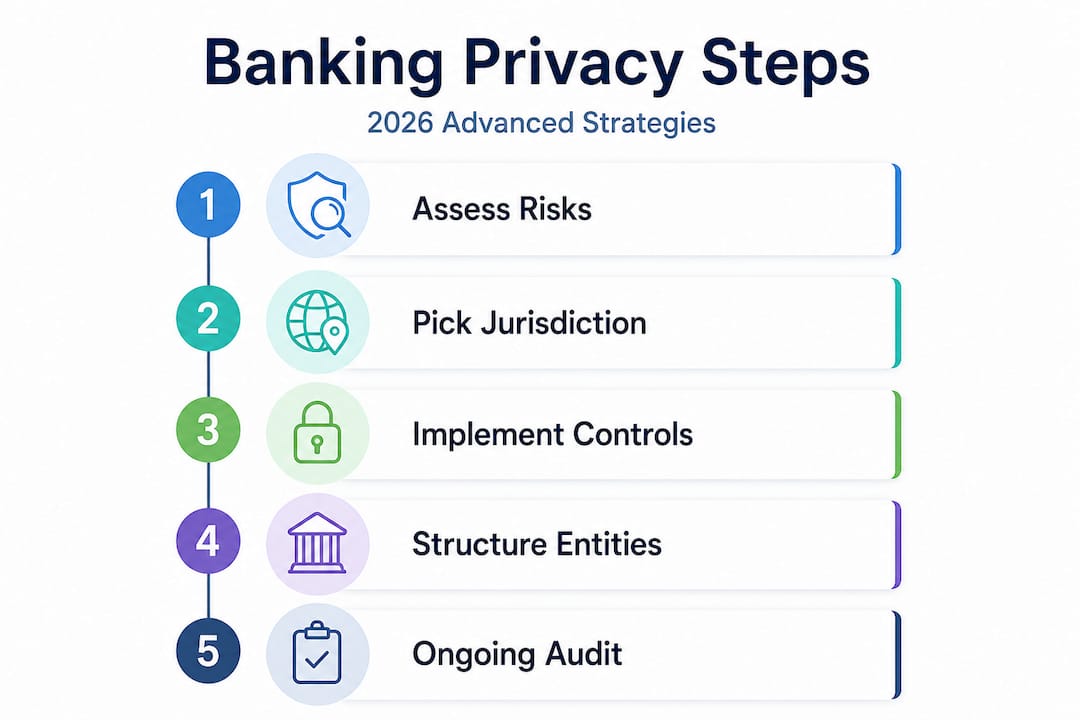
- Assess your privacy threats and compliance requirements
- Choose the right jurisdiction for privacy and asset protection
- Implement advanced cybersecurity and operational controls
- Separate personal and corporate structures for effective privacy
- The new era of privacy: what most still get wrong
- Secure your banking privacy with specialized solutions
- Frequently asked questions
Key Takeaways
| Point | Details |
|---|---|
| Compliant privacy is vital | Effective banking privacy in 2026 is about lawful separation, not secrecy from authorities. |
| Jurisdiction selection matters | Choosing the right banking hub balances privacy laws and regulatory compliance. |
| Cybersecurity is non-negotiable | Advanced encryption and operational controls are essential for digital asset protection. |
| Structure separates risk | Clear separation of personal and entity accounts maximizes privacy and limits liability. |
| Expert guidance pays off | Specialized providers help navigate new privacy, regulatory, and technical landscapes efficiently. |
Assess your privacy threats and compliance requirements
With the context established, the first step is to understand exactly what risks and rules matter for your specific situation. Not all privacy threats look alike, and conflating them leads to expensive, misdirected solutions.
Common threats to banking privacy fall into three broad categories:
- Regulatory disclosure: Automatic information exchange under CRS and FATCA means your home jurisdiction’s tax authority receives account data from banks in over 100 partner countries. This is government-to-government and non-public, but it is unavoidable without full compliance.
- Cyberattacks and data breaches: Financial institutions remain among the most targeted organizations globally. A single breach can expose account balances, transaction histories, beneficial ownership structures, and personal identifiers.
- Internal leaks: Disgruntled employees, inadequate access controls, or poor vendor management create exposure that no amount of offshore structuring will fix.
The most important myth to dispel early: privacy from the government is not the same as secrecy from the public or your creditors. Under CRS and FATCA, reporting is confidential and exchanged only between tax authorities. Your business rivals, litigation opponents, and the general public do not have access to that data. That distinction is everything. Compliant clients often enjoy greater practical privacy than those who attempt non-disclosure, because non-disclosure triggers investigations that genuinely expose you.
Entity structure adds another layer of complexity. Trusts, foundations, and holding companies alter the reporting chain under CRS because the definition of a “controlling person” varies by entity type. A discretionary trust with a professional trustee in a compliant jurisdiction may report differently than a nominee-held company. Understanding exactly where your structure sits in the reporting chain, before regulators examine it, is foundational.
| Threat type | Primary exposure risk | Compliance requirement | Applicable region |
|---|---|---|---|
| Regulatory disclosure | Tax authority data exchange | CRS/FATCA filings | Global (100+ countries) |
| Cyber breach | Account and identity data | ISO 27001, AML/KYC controls | All jurisdictions |
| Internal leak | Ownership structure, balances | Access controls, NDAs | All jurisdictions |
| Litigation discovery | Entity beneficial ownership | Compliant segregation | Common law jurisdictions |
| Third-party vendor risk | Transaction and identity data | Vendor due diligence | All jurisdictions |
Understanding banking confidentiality in detail gives you a clearer picture of what your bank is legally required to protect and what it cannot shield you from under international law.
Choose the right jurisdiction for privacy and asset protection
Once you map your exposure, the next pivotal move is deciding where to bank and how legal frameworks actually differ in practice.

Jurisdictional arbitrage does not mean finding a place that ignores global rules. It means selecting banking hubs where privacy laws are robustly enforced at the private level, even while the jurisdiction fully participates in international reporting. As banking privacy analysis confirms, the strongest frameworks today are found in Singapore, Switzerland, Liechtenstein, and Luxembourg, each of which combines strict bank secrecy laws for non-governmental parties with full CRS/FATCA compliance.
Here is what distinguishes these jurisdictions in practice:
Singapore operates under the Banking Act, which criminalizes unauthorized disclosure to private parties. It is a top-tier financial center with a stable political environment, deep liquidity, and zero tolerance for non-compliant actors, which paradoxically makes it safer for compliant clients.
Switzerland retains civil and criminal liability for bank staff who disclose client information to private parties without legal basis. Post-FATCA, Swiss banks report to the IRS and partner tax authorities, but Swiss banking secrecy survives in its original form for commercial and civil exposure.
Liechtenstein is smaller but excels for trust and foundation structures. Its legal framework offers unique protection for family office assets and discretionary structures, and its depth of expertise in fiduciary services is difficult to match.
Luxembourg serves institutional clients exceptionally well. Its investment fund infrastructure, combined with EU-level regulatory stability, makes it a natural hub for corporations managing complex multi-currency treasury structures.
Pro Tip: Do not concentrate all assets in a single jurisdiction, no matter how favorable the laws. A multi-jurisdiction structure spreads regulatory risk, provides optionality during periods of political or legal change, and creates stronger separation between personal and business assets. Three jurisdictions is often the practical minimum for sophisticated clients.
Common pitfalls in jurisdictional selection:
- Choosing based purely on perceived secrecy rather than genuine legal framework quality
- Ignoring the stability and creditworthiness of local banking institutions
- Failing to account for treaty networks and how they affect your specific citizenship and tax residency
- Selecting jurisdictions with weak AML enforcement, which raises correspondent banking risk and can cut you off from dollar-clearing networks
- Overlooking the practical ability to move funds quickly when circumstances change
Implement advanced cybersecurity and operational controls
Even with the best legal frameworks in place, banking privacy can be undermined entirely by poor digital hygiene and weak operational procedures. Regulators are not your only threat vector.
A structured approach to digital privacy involves the following steps:
- Encrypt everything at rest and in transit. Any communication with banking partners, advisors, or trustees should use end-to-end encryption. Documents stored on cloud platforms require encryption keys that your institution controls, not the cloud provider.
- Enforce multi-factor authentication (MFA) across every access point. Single-factor login to banking portals, email, or document platforms is unacceptable at any asset level. Hardware tokens offer stronger protection than SMS-based codes, which are vulnerable to SIM-swap attacks.
- Implement network segmentation. For family offices and corporate treasury teams, internal networks that access banking systems should be physically or logically separated from general corporate IT infrastructure. This limits blast radius if a breach occurs elsewhere in the organization.
- Manage third-party and vendor risk actively. As financial cybersecurity best practices make clear, third-party vendors represent one of the most consistently underestimated attack surfaces. Every law firm, accounting provider, and fiduciary service with access to your financial data should be subject to a formal security review.
- Use cold storage for significant digital asset holdings. Hardware wallets disconnected from the internet eliminate remote attack vectors for cryptocurrency and tokenized asset positions. Operational funds can remain in a hot wallet, but treasury positions belong offline.
- Apply cloud and SaaS compliance controls. If your office uses cloud document platforms, ensure data residency, access logging, and retention policies align with your jurisdictional requirements and privacy goals.
Cybersecurity for wealthy individuals and institutions is not primarily a technology problem. It is an organizational problem. The weakest link is almost always a human being, not a firewall.
Pro Tip: Conduct a formal internal audit of all entities, access points, and vendor relationships at least once per year. Beyond improving security posture, documented audit trails signal to regulators that you take compliance seriously. This dramatically reduces the probability of an intrusive regulatory examination.
For a detailed framework, the secure online banking guide covers step-by-step protocols tailored to high-net-worth clients. Additionally, for clients managing automated trading systems alongside banking operations, crypto and forex cybersecurity tips address automation-specific vulnerabilities. Use the secure banking checklist as an operational baseline before onboarding with any new financial institution.
Separate personal and corporate structures for effective privacy
The next layer of banking privacy lies in how you set up your entities and manage the distinction between ownership and control. This is where many high-net-worth clients and corporations leave significant protection on the table.
The core principle is straightforward: modern privacy comes from compliant structures that separate personal finances from entity finances, not from opacity. Segregation achieves several things simultaneously. It creates clean audit trails that satisfy regulators without exposing personal wealth to commercial creditors or litigation opponents. It distributes risk across multiple legal personalities. And it enables different jurisdictional treatments for different asset classes.
A practical walkthrough for setting up segregated structures:
- Establish the holding structure first. Whether you use a holding company, a trust, or a foundation depends on your domicile, tax residency, and succession planning goals. Engage advisors in both your home jurisdiction and the target banking jurisdiction before opening accounts.
- Open separate banking relationships for each entity. A personal account, a trading company account, and a holding company account should ideally sit in different institutions or at minimum in clearly segregated divisions of the same institution.
- Document beneficial ownership precisely and file it correctly. Attempting to obscure beneficial ownership invites scrutiny. Filing accurate beneficial ownership information with relevant registries and your bank’s KYC process is the single best way to prevent unauthorized third-party exposure, because compliant banks treat that data as confidential.
- Appoint professional trustees where warranted. For complex family structures or multigenerational wealth transfer plans, a professional trustee operating across multiple jurisdictions adds both legal protection and operational credibility.
Pro Tip: When selecting corporate trustees, prioritize those with licensing in multiple jurisdictions and documented compliance programs. A trustee who operates only in one jurisdiction is a concentration risk, both legally and practically.
Full segregation also matters for digital banking growth at the institutional level. As digital banking platforms increasingly serve as the primary interface for complex corporate structures, the ability to manage multiple entity relationships through a single secure portal represents a genuine operational advantage.
For entities that include trading or investment activities, applying formal privacy and risk management frameworks within each entity prevents operational decisions from creating unintended privacy exposures.
The new era of privacy: what most still get wrong
The most persistent error in thinking about banking privacy is the belief that privacy equals invisibility. It does not. In fact, clients who pursue invisibility in 2026 are more exposed than compliant ones, not less.
As CRS banking analysis explicitly states, absolute avoidance is both risky and illegal, while legitimate privacy is fully operational in transparent systems. A client who files accurately, structures properly, and communicates clearly with their bank and regulators is practically invisible to the parties that actually matter: competitors, litigation opponents, and the general public.
The old playbook, which relied on numbered accounts, nominee shareholders, and jurisdictions that refused to cooperate with international information exchange, is not just obsolete. It is actively dangerous. Banks that still operate in non-compliant jurisdictions face being cut off from correspondent banking networks, which means your funds can become stranded or inaccessible overnight.
What we consistently observe is that the highest-privacy outcomes in 2026 belong to clients who invest in compliant structures and strong cybersecurity rather than those chasing legal grey zones. The regulator who receives your CRS report does not share it with your creditors. The hacker who breaches your unencrypted email does.
The practical priority list for this year should be: full regulatory transparency to authorities, rigorous operational security at every digital touchpoint, and complete discretion with commercial counterparties. That combination is more powerful than any secrecy law ever was.
Understanding how technology enables private banking at scale helps clarify why modern digital institutions can offer stronger practical privacy than legacy offshore banks ever could, through architecture rather than legal fiction.
Secure your banking privacy with specialized solutions
To put these privacy strategies into action, expert help and tailored infrastructure can make the difference between theory and execution.
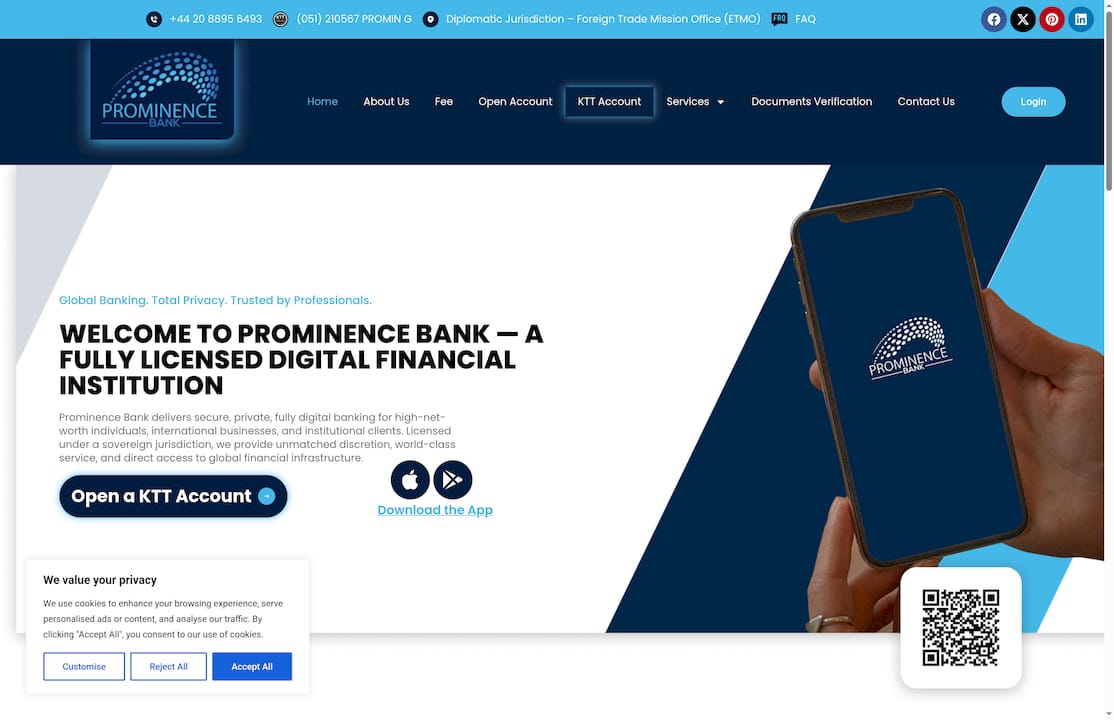
Prominence Bank combines full regulatory compliance with the operational discretion that high-net-worth individuals and global corporations actually need. From advanced banking solutions designed for complex corporate structures to multi-currency banking that supports global treasury operations, the platform is built from the ground up for clients who demand both privacy and security. Every account relationship is governed by strict AML/KYC compliance, meaning your banking privacy is legally grounded, not legally exposed. Use the secure banking strategies framework to benchmark your current setup and identify where targeted improvements will have the highest impact.
Frequently asked questions
What is the difference between privacy and secrecy in banking?
Privacy protects your financial information from public access, creditors, and commercial parties, while secrecy from tax authorities is now illegal under CRS/FATCA. Compliant privacy is robust and enforceable. Non-compliant secrecy triggers the investigations that destroy it.
Which countries offer the strongest banking privacy in 2026?
Singapore, Switzerland, Luxembourg, and Liechtenstein provide the strongest frameworks, combining domestic bank secrecy laws for private parties with full CRS/FATCA compliance. Each excels for different client profiles and asset types.
Is absolute banking privacy possible?
Absolute privacy from governments is no longer legal under international frameworks, but lawful operational privacy protects you from every other meaningful threat, including litigation, competitors, and unauthorized access, when properly structured.
How can digital assets be privately held in 2026?
Use segregated custody and cold storage for significant digital asset positions, pair them with cloud platforms that have rigorous compliance controls, and avoid any public-facing custody arrangements that create unnecessary exposure.