TL;DR:
- Digital wealth management involves sophisticated, automated, and integrated platforms that go beyond simple robo-advisors to serve high-net-worth clients with privacy, multi-asset oversight, and real-time control. These platforms facilitate end-to-end processes from onboarding and data aggregation to strategic decision-making, emphasizing personalized reporting, security, and discretion. The most valuable outcome for clients is maintaining control over their financial narrative, supported by technology that enhances, rather than replaces, human judgment.
Your most valuable assets are almost certainly managed by technology you’ve never seen, running on platforms you’ve never logged into, executing decisions at speeds no human advisor could match. That reality sits quietly behind the scenes of modern wealth management, and most high-net-worth individuals interact with only the polished surface of it. The assumption that digital wealth management means a robo-advisor shuffling ETFs is not just wrong, it’s dangerously limiting. The real picture is far more sophisticated, far more private, and far more relevant to complex, multi-jurisdictional portfolios than most guides acknowledge.
Table of Contents
- Defining digital wealth management
- How digital platforms shape the wealth management process
- Robo-advisors, hybrid models, and the evolution for HNW clients
- Advanced features: Data, privacy, and holistic portfolio views
- What most wealth management guides miss: Expertise meets discretion
- Explore discreet banking and digital solutions for high-net-worth portfolios
- Frequently asked questions
Key Takeaways
| Point | Details |
|---|---|
| More than robo-advisors | Digital wealth management goes far beyond basic automation, embracing full-service platforms for HNW portfolios. |
| Privacy and data control | Advanced digital platforms offer superior privacy, security, and data aggregation for high-value clients. |
| Hybrid advantage | Combining automation with human expertise produces the best outcomes for complex wealth management needs. |
| Holistic asset view | Top digital solutions provide an integrated view of investments, private assets, and lifestyle holdings. |
| Discreet solutions available | HNW individuals can access discreet, tailored banking and wealth management services for global portfolios. |
Defining digital wealth management
Digital wealth management is not a product. It’s an operating model. Digital wealth management refers to managing and advising investments using digital technology, often automated algorithms and data-driven tools, to personalize advice, optimize portfolio allocation, and support ongoing tasks like rebalancing and reporting. That definition is broader than most people expect.
The tools involved range from algorithmic engines that monitor portfolio drift in real time to secure client portals that aggregate positions across multiple custodians. Routine tasks that once required weekly calls with an advisor, such as tax-loss harvesting, rebalancing triggers, and performance attribution, now run automatically in the background. What’s left for human advisors is the genuinely complex work: estate structuring, cross-border tax strategy, philanthropic planning, and relationship management.
A critical misconception worth addressing directly: digital wealth management is not synonymous with mass-market robo-advisory apps. Those tools serve a purpose for retail investors, but they represent only one narrow slice of a much larger technology ecosystem. The digital banking growth for HNWIs reflects an entirely different tier of capability, one built for complexity, confidentiality, and scale.
“The most sophisticated digital wealth platforms don’t replace advisors. They free advisors to do the work that actually requires judgment.”
Key capabilities that define genuine digital wealth management at the high-net-worth level include:
- Real-time portfolio monitoring across all asset classes, including alternatives and private equity
- Automated compliance workflows that track regulatory requirements across multiple jurisdictions
- Secure document management with encrypted access for advisors, attorneys, and trustees
- Personalized reporting that reflects the client’s actual financial picture, not a generic template
- Data-driven scenario modeling for liquidity events, generational transfers, and market stress tests
The distinction matters because choosing the wrong platform means accepting limitations that were designed for someone else’s financial life.
How digital platforms shape the wealth management process
Understanding what digital wealth management is only gets you so far. The more important question is how these platforms actually function end to end, because the architecture of the platform determines what’s possible for your portfolio.
End-to-end digital platforms connect client engagement, portfolio management, data, and core operations for wealth and private banking into a single, unified system. That integration is what separates a genuine wealth management platform from a collection of disconnected tools. When your advisor updates a risk parameter, it should propagate instantly through your investment policy statement, your rebalancing rules, and your reporting dashboard, without anyone manually copying data between systems.

The benefits of digital banks at this level include omnichannel access, meaning you can review positions, approve transactions, and communicate securely with your advisory team from any device, in any time zone, without compromising the integrity of the data.
Here’s how the major platform features translate into real client experience:
| Platform feature | Impact on HNW client experience |
|---|---|
| Unified data aggregation | Single view of all assets, including alternatives and real estate |
| Automated rebalancing | Maintains target allocation without manual intervention |
| Secure collaboration tools | Advisors, attorneys, and trustees work from the same data |
| Real-time performance dashboards | Eliminates lag between market events and client awareness |
| Regulatory reporting automation | Reduces compliance burden across multiple jurisdictions |
| Encrypted document vault | Sensitive documents accessible only to authorized parties |
The lifecycle of digital wealth management follows a logical progression:
- Onboarding and data aggregation: All financial accounts, private holdings, and liability positions are connected and consolidated into the platform.
- Investment policy configuration: Risk parameters, asset class targets, liquidity requirements, and constraints are established and encoded.
- Ongoing monitoring: Algorithms track portfolio drift, market events, and tax optimization opportunities continuously.
- Rebalancing and execution: Trades are proposed or executed automatically within pre-approved parameters.
- Reporting and review: Customized reports are generated for clients, advisors, and relevant third parties on a scheduled or on-demand basis.
- Strategic advisory sessions: Human advisors engage on complex decisions, informed by the platform’s data rather than starting from scratch.
Pro Tip: When evaluating any digital wealth platform, ask specifically whether it provides a single, always-current view of your total net worth, including private investments, real estate, and lifestyle assets. Platforms that only aggregate brokerage accounts are giving you an incomplete picture, and incomplete pictures lead to poor decisions.
For clients who also want to understand how privacy and wealth protection integrate into the platform architecture, that question should be asked before onboarding, not after.
Robo-advisors, hybrid models, and the evolution for HNW clients
The robo-advisor conversation is worth having precisely because it’s so often misapplied to high-net-worth situations. Robo-advisors use algorithmic, automated portfolio construction and asset allocation targeted at retail investors, positioned as a middle ground between DIY platforms and traditional wealth managers. That positioning tells you exactly who they’re built for.
The scale data confirms it. In 2024, robo-advisor assets were estimated between $634 billion and $754 billion globally, which sounds substantial until you measure it against the total addressable market for wealth management, which runs into the tens of trillions. Robo-advisors are a meaningful innovation, but they represent a small fraction of actual assets under management.
For high-net-worth individuals, the relevant evolution is the hybrid model. Hybrid advisory combines automated efficiency for routine tasks with human expertise for decisions that require judgment, context, and relationship. The automation handles rebalancing, tax-loss harvesting, and reporting. The human advisor handles the conversation about whether to sell the family business, how to structure a trust for a special-needs beneficiary, or how to navigate a sudden liquidity event.
| Dimension | Robo-advisor | Hybrid model for HNW clients |
|---|---|---|
| Portfolio complexity | Simple, diversified ETF portfolios | Multi-asset, multi-jurisdiction, alternatives included |
| Minimum assets | Typically under $500K | Often $1M and above |
| Human access | Limited or none | Dedicated advisor with direct access |
| Tax strategy | Basic tax-loss harvesting | Comprehensive tax planning across entities |
| Privacy controls | Standard consumer-grade | Institutional-grade, jurisdiction-aware |
| Customization | Template-based | Fully bespoke to client goals |
What high-net-worth clients genuinely need beyond standard digital offerings includes:
- Consolidated views that include private equity stakes, direct real estate, and collectibles
- Multi-entity management covering personal accounts, trusts, foundations, and corporate structures
- Cross-border tax intelligence that accounts for residency, citizenship, and treaty implications
- Discreet communication channels that protect sensitive financial discussions
- Succession and legacy planning integrated into the investment framework, not treated as a separate conversation
It’s also worth noting that some clients are exploring equity crowdfunding platforms as a supplementary allocation strategy, particularly for exposure to early-stage private companies. These positions require platforms capable of tracking non-standard assets alongside traditional holdings, which is another reason why HNW-grade aggregation matters.
The private banking benefits that sophisticated clients expect go well beyond what any retail robo-advisor can offer. The technology should serve the relationship, not replace it.
Advanced features: Data, privacy, and holistic portfolio views
The highest tier of digital wealth management is defined by what it can see and what it can protect. For HNW and ultra-high-net-worth clients, digital wealth management often emphasizes a single, always-current view of total net worth and more comprehensive support beyond investment accounts, covering cash flow, private investments, and legacy and lifestyle data. That’s a fundamentally different scope than tracking a brokerage account.
Data aggregation at this level means pulling information from custodians, private equity fund administrators, real estate management platforms, lending facilities, and even insurance policies into a unified view. The goal is not just visibility. It’s the ability to make decisions with complete information rather than partial snapshots.
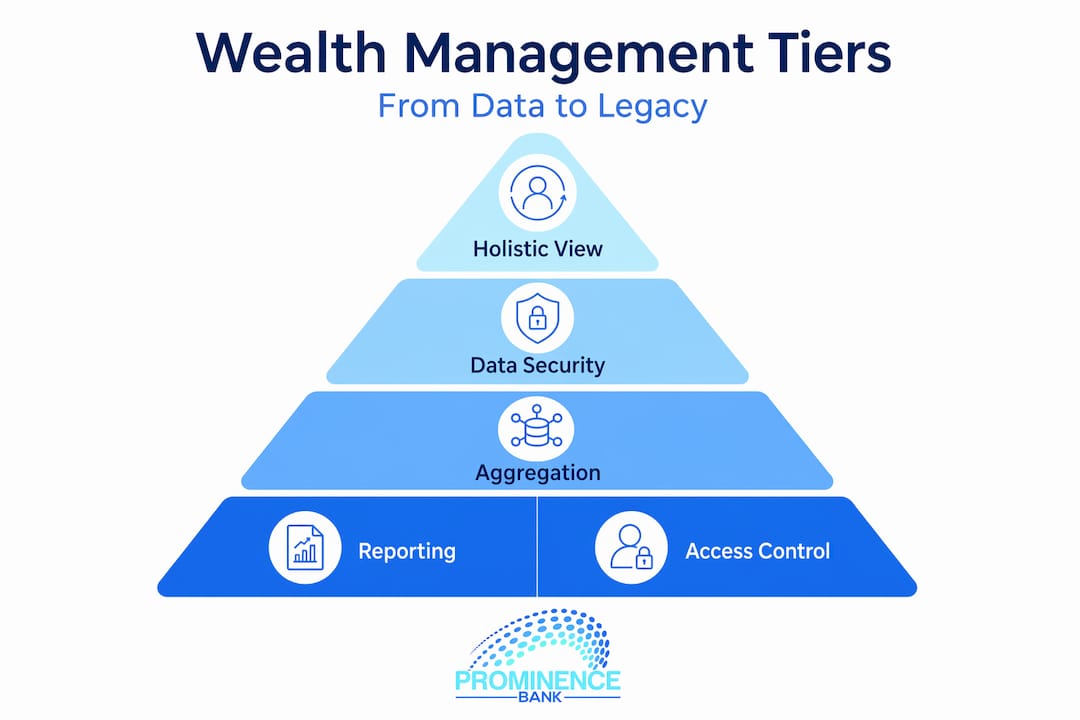
A key methodology shift in wealth management digitization is coupling business, technology, and data priorities end to end, so the firm can modernize core operations and use data for competitive advantage. For clients, that translates into advisors who arrive at every conversation already informed, with current data, scenario analysis already run, and recommendations grounded in your actual financial position rather than last quarter’s report.
Privacy deserves its own emphasis here. Secure workflows are not just a feature. They’re a requirement for anyone managing significant wealth across multiple jurisdictions. The right platform should offer:
- Role-based access controls that limit what each advisor, attorney, or family member can see
- Encrypted data transmission for all communications and document sharing
- Audit trails that log every access event and data modification
- Jurisdiction-aware compliance that adapts to the regulatory environment of each asset location
- Secure client portals that eliminate the need to transmit sensitive information via email
Understanding the security tips for HNW banking that apply specifically to digital platforms is essential before committing to any provider. Similarly, compliance for HNW clients is a moving target, and your platform should evolve with it.
The holistic view extends to lifestyle and legacy assets as well. Art collections, private aircraft, yacht ownership, and philanthropic endowments all have financial implications that a complete wealth picture must capture. Platforms that ignore these categories are not managing wealth. They’re managing a subset of it.
Pro Tip: When assessing a digital wealth platform’s data capabilities, ask whether business priorities, technology architecture, and data strategy were designed together or bolted together over time. Platforms built with integrated intent outperform those assembled from acquisitions and third-party integrations in both reliability and security. You can also explore diversifying digital investments as a framework for thinking about how alternative and non-traditional assets fit into your overall allocation.
What most wealth management guides miss: Expertise meets discretion
Here’s the perspective most guides skip entirely: the technology is not the point. The point is what the technology makes possible for clients who require both sophistication and discretion.
Digital wealth management is commonly framed as a substitute for traditional advisory, but established industry views stress hybrid operating models, using automation for routine portfolio and information tasks while keeping human judgment for complex decisions and relationship elements. That framing is accurate, but it still understates something important.
For high-net-worth individuals, the most valuable outcome of digital wealth management is not efficiency. It’s control. Control over who sees your data, control over how decisions are made, control over the narrative of your financial life. The best platforms give you that control without requiring you to become a technology expert to exercise it.
We’ve observed that clients who get the most from digital wealth management are those who treat the platform as infrastructure, not as the relationship itself. The platform should handle the operational complexity so that every conversation with your advisor is focused on strategy, not status updates. That’s the real value proposition.
The advantages of discreet banking become most apparent when the technology and the advisory relationship are genuinely aligned. Discretion is not just about keeping information private. It’s about ensuring that every touchpoint in your financial life reflects your actual priorities, not a generic template designed for the average client.
Pro Tip: Don’t accept a platform that forces you to choose between technological capability and personalized service. The best digital wealth management solutions deliver both. If a provider can’t articulate how their technology supports a genuinely individualized client experience, that’s a signal worth taking seriously.
Explore discreet banking and digital solutions for high-net-worth portfolios
The gap between knowing what digital wealth management should deliver and finding a provider that actually delivers it is wider than most people expect.
Prominence Bank was built specifically for high-net-worth individuals, international businesses, and institutional clients who require both technological sophistication and genuine discretion. Our global banking solutions support multi-currency portfolios with the kind of real-time access and privacy controls that complex wealth structures demand. For clients with corporate and institutional needs, our advanced corporate banking solutions are designed for exactly the kind of multi-entity, multi-jurisdictional complexity that standard platforms can’t handle. And for those who prioritize confidentiality above all, our approach to discreet wealth management reflects a commitment to privacy that is built into every layer of our platform, not added as an afterthought.
Frequently asked questions
What distinguishes digital wealth management from traditional services?
Digital wealth management uses technology for automation, real-time advice, and end-to-end data integration, while traditional services rely heavily on manual processes and face-to-face interaction. The key advantage is that digital platforms can monitor, analyze, and act on portfolio data continuously rather than periodically.
Do high-net-worth clients benefit from robo-advisors?
Robo-advisors provide efficient automation for routine tasks, but HNW clients typically need hybrid advisory models that combine algorithmic efficiency with human expertise for complex, multi-jurisdictional decisions. Standard robo-advisory tools were designed for retail investors and lack the customization and privacy controls that significant wealth requires.
How do digital platforms handle privacy and security for HNW portfolios?
Advanced platforms prioritize robust data aggregation and secure collaboration workflows, including role-based access controls, encrypted communications, and jurisdiction-aware compliance. Privacy at this level is an architectural decision, not a feature toggle.
Can digital wealth management cover non-investment assets?
Yes. The most capable platforms provide visibility and management over private investments, cash flow, and lifestyle and legacy assets including real estate, art, and philanthropic holdings. A platform that only tracks brokerage accounts is providing an incomplete picture of your actual net worth.
How quickly are digital wealth solutions being adopted?
Adoption is growing steadily, but robo-advisor assets between $634 billion and $754 billion in 2024 represent only a small fraction of the broader asset management market, confirming that hybrid and advanced digital solutions are emerging but have not yet displaced traditional models at the high-net-worth level.
Recommended
- Digital banking for high-net-worth individuals: 4.2% growth
- Top Security Tips for High-Net-Worth Banking (2026)
- Online Bank Compliance: What High-Net-Worth Clients Must Know
- Secure Banking Checklist: Global Privacy & Wealth Protection