
TL;DR:
- Confidential business accounts use internal codes to protect high-net-worth individuals and firms from internal exposure while complying with US laws. They do not create legal anonymity but restrict staff access to client identities through strict controls and segregated documentation. Proper provider vetting and structured account segmentation are essential to maintain operational privacy and full regulatory transparency.
Confidential business accounts give high-net-worth individuals and international businesses institutional-grade internal privacy while remaining fully transparent to U.S. regulators. They do not create legal anonymity. What they do is limit who inside a financial institution can see your name, your balances, and your counterparties — and that distinction matters operationally.
The short version:
- Internal bank policy replaces your name with a numeric or alphanumeric code in routine systems; only a small, authorized group can access the identity file behind it.
- Confidentiality is an internal control layer. The Bank Secrecy Act, FATCA, and AML/KYC obligations remain fully intact.
- The primary benefits are protection from social engineering, reduced internal exposure of strategic cash flows, and clean separation of operational banking from wealth management.
- Recommended next step: Ask any shortlisted provider to walk you through their internal access controls, staff authorization tiers, and AML/KYC procedures before you commit.
If you are a principal, treasurer, or family office executive managing complex cross-border finances, a confidential business account is worth serious consideration — provided you choose a licensed institution with documented compliance.
Table of Contents
- What is the role of confidential business accounts?
- Primary roles and use cases for HNWIs and international businesses
- How does confidentiality interact with U.S. law?
- What account variants and technologies support confidentiality?
- How should you structure accounts to minimize exposure?
- How do you evaluate a provider for confidential business accounts?
- How do you open and maintain a confidential business account in the U.S.?
- Key Takeaways
- The case for treating privacy as governance, not secrecy
- Prominencebank: confidential accounts built for institutional-grade privacy
- Useful sources
- FAQ
What is the role of confidential business accounts?
A confidential business account, often called a numbered account or private business account, is defined by one core mechanism: the account holder’s identity is stored in a separate, access-restricted file while internal systems use only a numeric or alphanumeric code. Routine bank staff see the code. A small group of senior staff and compliance officers see the name behind it.
This is not a loophole. It is a deliberate internal architecture.
“A numbered bank account provides protection against data theft by corrupt bank employees and reduces the risk of sensitive information being compromised. It offers a secure way to manage your finances discreetly.” — CGAA, Understanding Numbered Accounts
Three operational mechanisms make this work: role-based access controls (RBAC) that restrict which staff roles can query the identity file; coded account references used in all internal communications and transaction logs; and segregated identity documentation held in a separate, audited system. The bank retains full documentation. Regulators can access it. Your counterparties and most bank employees cannot.
A few terms worth knowing: a numbered account uses a code instead of a name in internal records; a lockbox is a designated collection account that routes receivables without exposing the underlying business relationship; confidential factoring (also called non-notification factoring) keeps a financing arrangement invisible to customers; and selective disclosure refers to sharing specific verified attributes with a counterparty without revealing the full account record.
For a deeper look at how numbered accounts work globally, the legal framework varies by jurisdiction, but the internal mechanics are consistent.
Primary roles and use cases for HNWIs and international businesses
The importance of private business accounts comes down to three practical problems they solve.

Reducing internal exposure. Visible account flows inside a poorly segmented institution reveal strategy, holdings, and counterparties. This creates real risk: public transaction visibility enables profiling of high-value targets, increasing phishing and social engineering attacks. A coded account structure limits that surface area.
Separating operational banking from wealth management. Financial professionals consistently recommend distinct account types for operational cash flow versus private investment portfolios. Mixing them creates unnecessary cross-departmental visibility and complicates auditing.
Protecting strategic commercial relationships. Specific use cases include:
- Celebrity and politically exposed person (PEP) finances, where public association with a counterparty carries reputational risk.
- Treasury accounts for multinational businesses conducting sensitive M&A or cross-border negotiations.
- Confidential factoring arrangements, where a substantial portion of invoice value is advanced while the financing relationship stays invisible to the customer.
- Lockbox accounts that accept customer payments under the seller’s identity while routing funds to a designated account controlled by a factor or trustee.
A dedicated business account also creates a clean financial boundary between company and owner, which eases access to financing and simplifies auditing — benefits that apply whether or not the account carries confidentiality features.
How does confidentiality interact with U.S. law?
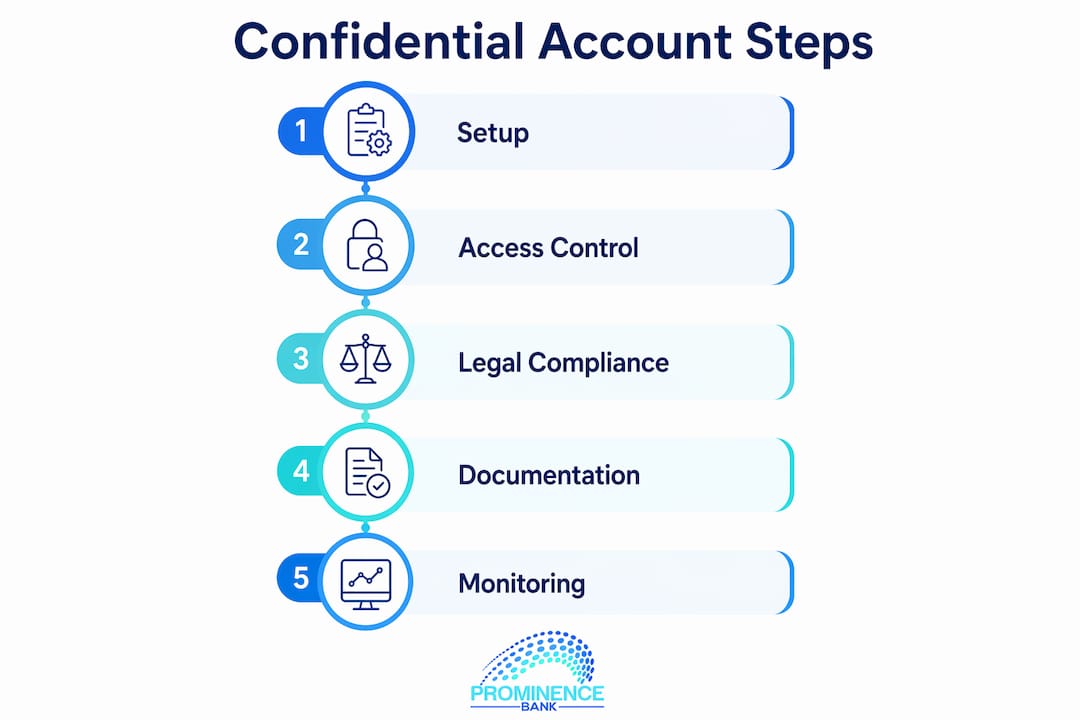
Confidentiality is an internal control layer. It does not alter your reporting obligations by one line.
Under the Bank Secrecy Act, U.S. financial institutions must file Suspicious Activity Reports (SARs) and Currency Transaction Reports (CTRs) regardless of whether an account uses coded identifiers. FATCA requires U.S. persons to report foreign financial accounts and assets. AML/KYC rules mandate that banks collect, verify, and retain beneficial ownership information for all business accounts. None of these obligations are suspended by a confidentiality designation.
Numbered or confidential accounts are internal privacy controls. Reporting to tax authorities and law-enforcement disclosure under legal process remain fully intact — the identity documentation is always available to regulators.
Lawful disclosure triggers include: a federal subpoena or court order, a Mutual Legal Assistance Treaty (MLAT) request from a foreign government, a direct law enforcement demand under the BSA, and a tax authority request under FATCA or a tax information exchange agreement (TIEA). When any of these arrive, the bank discloses. The coded account structure does not slow that process.
Pro Tip: Document your source of funds thoroughly before onboarding and maintain that documentation as your financial profile evolves. Proactive AML cooperation — responding promptly to compliance requests, updating beneficial ownership records, and flagging structural changes — keeps your confidentiality arrangement aligned with your legal obligations rather than in tension with them.
What account variants and technologies support confidentiality?
The market for confidential financial services now spans traditional private banking and modern digital custody, combining regulatory compliance with advanced cryptography and API-driven access controls.
Technologies such as zero-knowledge proofs, shielded pools, and selective disclosure let institutions validate rules or eligibility without exposing full transaction details — a meaningful shift from older confidentiality models that relied purely on policy.
Common variants today include:
- Traditional numbered accounts: coded internal identifiers, restricted staff access, paper-based or digital identity files.
- Virtual multi-currency accounts: segregated account numbers for each currency or counterparty, with consolidated reporting available only to authorized principals. Useful for global banking operations that span multiple jurisdictions.
- Lockbox and trust accounts: designated collection accounts for confidential receivables, common in confidential factoring structures.
- Custodial safekeeping receipts (SKR): documented proof of asset custody held by a licensed institution, used in structured finance and trade finance.
- KTT-enabled accounts: Key Tested Telex connectivity that allows authenticated, secure interbank messaging for high-value transfers.
For treasury operations, virtual multi-currency accounts and KTT connectivity are the most practical combination. Wealth management structures benefit more from custodial arrangements and SKR documentation. Operational accounts typically use lockbox or confidential factoring setups. Prominencebank’s digital currency custody capabilities extend these options into crypto-asset management for clients who hold digital assets alongside traditional holdings.
How should you structure accounts to minimize exposure?
Account segmentation is the single most effective operational control. Keep at least three distinct account layers: an operational account for day-to-day payables and receivables, a treasury account for cash management and short-term instruments, and a private investment account for wealth management assets. Never run all three through the same account number.
- Designate a lockbox or collection account for confidential receivables. Route customer payments here rather than directly into your main operating account.
- Apply least-privilege access at every level. Staff who process invoices do not need visibility into treasury balances. Implement RBAC and review permissions quarterly.
- Enable transaction-level masking in your accounting system for accounts flagged as confidential. SAP Business One, for example, allows accounts to be marked confidential so that unauthorized users cannot view, access, or record data to those accounts.
- Require dual sign-off for transfers above a defined threshold. This is both a fraud control and an audit trail requirement.
- Schedule periodic access reviews. Quarterly at minimum; monthly for accounts with high transaction volume or PEP-adjacent ownership.
A structured corporate account checklist can help executives formalize these controls before onboarding with any provider.
Pro Tip: Engage an independent auditor to review your access control architecture annually. Internal reviews catch process drift; external audits catch structural gaps that internal teams normalize over time.
How do you evaluate a provider for confidential business accounts?
The decision checklist for secure banking for businesses covers six areas: licensing and jurisdiction, AML/KYC rigor, internal access controls, third-party audits, custody arrangements, and fee transparency.
| Evaluation milestone | Relation to Prominence Bank estimate |
|---|---|
| Initial inquiry and eligibility screening | Does not start the 48–72-hour estimate. |
| Document submission (entity docs, IDs, source-of-funds) | Does not start the estimate; documents must first be received, verified, and accepted. |
| Enhanced due diligence (EDD) for PEPs or complex structures | May require additional time beyond the estimate. |
| Sanctions screening and compliance review | Normally within the estimate once all start conditions are met; further review may require more time. |
| Account activation | Only after approval; the estimate is not guaranteed. |
Prominence Bank normally completes account opening within 48 to 72 hours after all required KYC/AML procedures have been completed and all requested information and documentation have been received, verified, and accepted. This is an estimated processing period, not a guaranteed deadline. Additional time may be required if further compliance, verification, or due-diligence review is necessary. Submitting an enquiry, application, or payment does not start the estimated processing period and does not guarantee account approval or activation.
Providers offering enhanced due diligence and higher documentation thresholds are the norm for genuine confidential accounts — treat a promise of approval with minimal documentation as a red flag, not a convenience.
Red flags to watch for:
- Vague or unverifiable AML/KYC policies with no written procedures available on request.
- Refusal to share audit summaries or third-party certification documentation.
- Custody claims that cannot be verified through independent documentation (e.g., no SKR or custodian confirmation).
- Opaque fee structures where account opening, maintenance, and transaction costs are not disclosed in writing before commitment.
- Promises of approval before complete KYC/AML and accepted documentation — proper EDD may require additional review time.
Account-structure decisions also carry risk beyond the bank itself. Understanding how prop firm structures compare to personal accounts in terms of liability and operational risk is useful context when deciding how to layer trading or investment activity within a confidential structure.
How do you open and maintain a confidential business account in the U.S.?
- Preliminary eligibility check. Confirm the provider accepts your entity type, jurisdiction, and ownership structure before preparing documents.
- Legal entity documentation. Articles of incorporation or formation, certificate of good standing, and operating agreement or bylaws.
- Beneficial ownership identification. Government-issued IDs and proof of address for all beneficial owners holding 25% or more, per FinCEN’s Customer Due Diligence rule.
- Source-of-funds documentation. Audited financials, tax returns, or a written source-of-funds statement supported by evidence. This is the most scrutinized element for HNWIs.
- Sanctions screening. The provider screens all principals against OFAC, UN, and EU sanctions lists. PEP status triggers enhanced due diligence automatically.
- Enhanced due diligence (EDD). For complex ownership structures, trusts, or PEP-adjacent principals, expect additional document requests and a longer review period.
- Account activation and access setup. Once approved, configure RBAC, set transaction thresholds, and document your internal access policy.
Ongoing obligations include responding promptly to periodic review requests (typically annual), updating beneficial ownership records within 30 days of any structural change, and cooperating with transaction monitoring queries. For a full international setup walkthrough, Prominencebank’s international account setup guide covers cross-jurisdictional documentation requirements in detail.
Key Takeaways
Confidential business accounts provide internal institutional privacy through coded identifiers and restricted access controls, while full regulatory transparency to U.S. authorities under the Bank Secrecy Act, FATCA, and AML/KYC rules remains unchanged.
| Point | Details |
|---|---|
| Internal privacy, not legal anonymity | Coded identifiers limit staff visibility; identity documentation is always available to regulators. |
| Compliance obligations are unchanged | BSA, FATCA, and AML/KYC reporting apply fully regardless of confidentiality designation. |
| Account segmentation is the core control | Separate operational, treasury, and investment accounts to minimize cross-departmental exposure. |
| Provider vetting is non-negotiable | Verify licensing, AML/KYC rigor, third-party audits, and fee transparency before committing. |
| Prominencebank offers licensed confidential accounts | Multi-currency, numbered, and KTT-enabled accounts with documented AML/KYC onboarding for HNWIs and international businesses. |
The case for treating privacy as governance, not secrecy
The executives who get the most out of confidential account structures are the ones who treat privacy as a governance discipline rather than a workaround. They document everything, cooperate fully with compliance requests, and use internal access controls to protect operational data from casual internal exposure — not to obscure anything from regulators.
The conventional wisdom frames confidential banking as a tool for the ultra-wealthy to hide assets. That framing is both legally wrong and strategically counterproductive. What confidential accounts actually do is reduce the attack surface for social engineering, protect negotiating positions during M&A, and prevent the kind of internal information leakage that creates reputational and operational risk. Those are governance problems, not secrecy problems.
The clients who run into trouble are the ones who confuse the two. They treat the coded account number as a shield against disclosure rather than as an internal access control. When a subpoena or regulatory request arrives, the shield disappears — and if the account structure was built on the assumption of anonymity, the compliance gap becomes a liability.
Build the structure on the assumption of full transparency to regulators and zero transparency to everyone else. That posture holds up.
Prominencebank: confidential accounts built for institutional-grade privacy
For HNWIs and international businesses that need more than a standard business account, Prominencebank delivers multi-currency business accounts, private numbered accounts, custodial safekeeping receipts, and KTT-enabled onboarding under a fully licensed, ETMO-sovereign institution with documented AML/KYC procedures and third-party security controls.
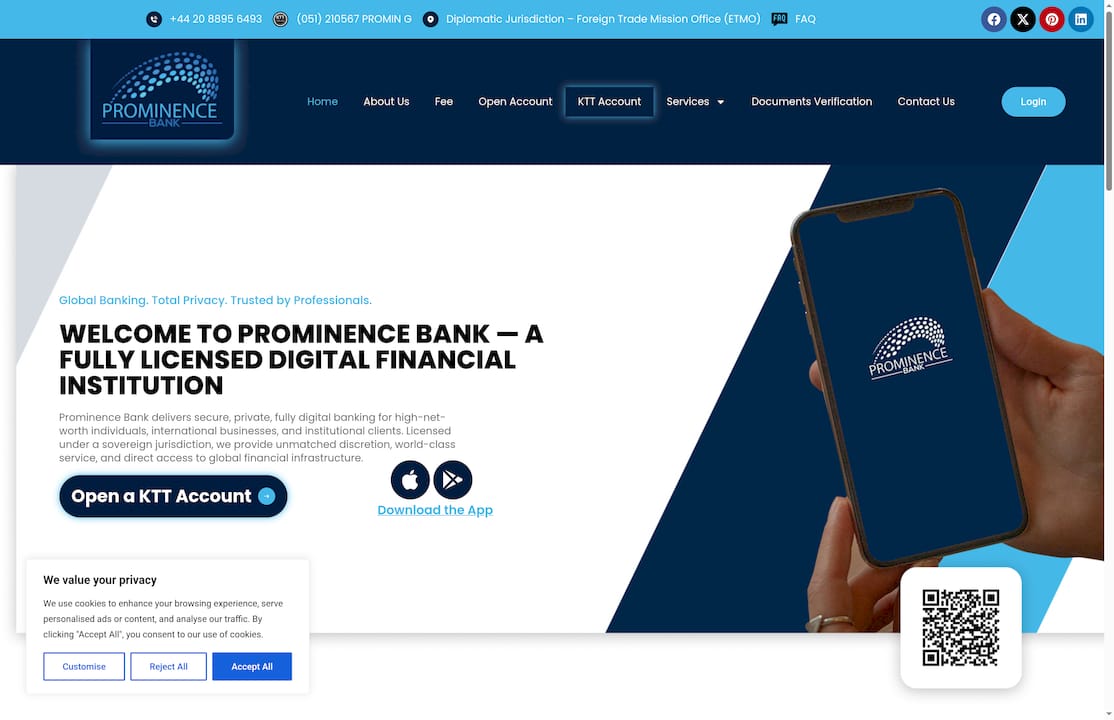
The concrete difference: Prominencebank’s onboarding is structured around enhanced due diligence from the start, under this documented policy: Prominence Bank normally completes account opening within 48 to 72 hours after all required KYC/AML procedures have been completed and all requested information and documentation have been received, verified, and accepted. This is an estimated processing period, not a guaranteed deadline. Additional time may be required if further compliance, verification, or due-diligence review is necessary. Submitting an enquiry, application, or payment does not start the estimated processing period and does not guarantee account approval or activation. The service also provides segregated access controls and institutional custody options that most digital banks do not offer. You get a corporate banking solution designed for complex ownership structures, cross-border treasury operations, and clients who require both operational privacy and full regulatory compliance. To open a confidential multi-currency business account or discuss your structure with Prominencebank’s onboarding team, visit the multi-currency account page and submit your preliminary inquiry.
This article is general information, not legal, tax, or financial advice. Confirm current regulatory requirements with a qualified professional for your specific situation.
Useful sources
- Open a Business Bank Account — U.S. Small Business Administration: Foundational guidance on business account requirements and legal protections under U.S. law.
- Swiss Numbered Bank Accounts: What They Are and Who Can Open One — Goldblum & Partner: Detailed explanation of numbered account mechanics, access controls, and regulatory limits.
- Understanding Numbered Accounts — CGAA: Practical overview of how numbered accounts work and who uses them.
- What Is Confidential Factoring? — Zenith Group Advisors: Explains non-notification factoring structures, advance rates, and audit requirements.
- Private DeFi: Why On-Chain Finance Needs Confidentiality — Crypto Adventure: Covers zero-knowledge proofs, selective disclosure, and the threat model for visible transaction flows.
- Why and How to Keep Your Personal and Business Finances Separate — Bank of America Business: Practical guidance on account segmentation and operational risk reduction.
FAQ
What does a confidential business account actually do?
It replaces your name with a coded identifier in a bank’s internal systems and restricts access to your identity file to a small group of authorized staff. Your regulatory documentation remains fully intact and available to authorities.
Does a numbered account protect you from U.S. tax reporting?
No. FATCA, the Bank Secrecy Act, and AML/KYC rules apply regardless of whether an account uses coded identifiers. Banks retain full identity documentation and disclose it under lawful process.
Who should use a confidential business account?
HNWIs, politically exposed persons, multinational treasury teams, and businesses conducting sensitive negotiations benefit most. The account type suits anyone who needs to limit internal institutional visibility without reducing regulatory compliance.
How long does it take to open a confidential business account?
Prominence Bank normally completes account opening within 48 to 72 hours after all required KYC/AML procedures have been completed and all requested information and documentation have been received, verified, and accepted. This is an estimated processing period, not a guaranteed deadline. Additional time may be required if further compliance, verification, or due-diligence review is necessary. Submitting an enquiry, application, or payment does not start the estimated processing period and does not guarantee account approval or activation.
What are the biggest red flags when choosing a provider?
Vague AML/KYC policies, refusal to share audit documentation, unverifiable custody claims, opaque fees, and promises of approval before complete KYC/AML and accepted documentation all signal inadequate due diligence.