TL;DR:
- Private banks are transforming their operating models by simplifying processes and leveraging AI to focus on high-value advice.
- Clients should demand integrated, digital, and transparent systems that enhance decision-making, compliance, and product clarity.
Private banking’s reputation for white-glove service delivered slowly and quietly is colliding with a new reality. The institutions that have historically thrived on complexity, exclusivity, and relationship-only access are now being forced to rebuild their operating models from the ground up. In 2026, the convergence of agentic AI, digital asset infrastructure, sustainability mandates, and relentless profitability pressure is producing a fundamentally different kind of private bank. For high-net-worth individuals and institutional clients who depend on these institutions, understanding what is actually changing, versus what is simply being rebranded, is the most valuable analytical exercise you can do right now.
Table of Contents
- Simplification, automation, and the rise of digital journeys
- Artificial intelligence and agentic workflows reshape advice
- Private markets, sustainability, and digital asset evolution
- Profitability, credit risk, and regulatory realities
- What most trend summaries miss: A practical signal for HNW clients
- Explore advanced private banking solutions for 2026 and beyond
- Frequently asked questions
Key Takeaways
| Point | Details |
|---|---|
| Simplification enables new models | Banks simplify and automate to deliver high-conviction advice and digital journeys for affluent clients. |
| AI transforms advisory experience | Agentic AI reshapes workflow, from client meetings to personalized portfolio insights and compliance needs. |
| Sustainability now baseline | ESG and real-economy investing are now essential, impacting asset allocation and product innovation. |
| Profitability shapes innovation pace | Credit risk and profitability remain central constraints on product rollout and technology adoption. |
| Workflow clarity drives value | Clients should look beyond tech headlines to demand auditable, integrated processes for practical benefit. |
Simplification, automation, and the rise of digital journeys
Building from our opening, let’s examine how banking models are responding to new pressures.
The clearest structural shift in 2026 is not a single technology. It is a deliberate decision by leading private banks to strip away operational complexity and concentrate their human talent where it generates the highest return: curated, high-conviction advice for upper-affluent and HNW segments. Private banking operating models are under pressure to simplify and automate while reallocating capacity toward curated private markets and high-conviction advice. The implication for you, as a client, is significant.
When a bank automates routine account management, compliance reporting, and document generation, it frees experienced advisors to focus on the decisions that genuinely matter to your portfolio. Think of it as clearing the noise so the signal becomes sharper. The private banking benefits of this shift include faster execution, more focused advisory conversations, and a client experience that does not waste your time.
Here is how the old model compares to what high-performing institutions are building now:
| Dimension | Old model | New model (2026) |
|---|---|---|
| Onboarding | Paper-heavy process | Digital-first process; Prominence Bank policy below |
| Advisory delivery | Relationship manager intuition | AI-assisted, data-driven |
| Product range | Broad, often generic | Curated, conviction-based |
| Client access | In-branch or scheduled calls | Always-on digital portals |
| Reporting | Periodic printed statements | Real-time dashboards |
| Compliance | Manual review | Automated, auditable workflows |
Prominence Bank normally completes account opening within 48 to 72 hours after all required KYC/AML procedures have been completed and all requested information and documentation have been received, verified, and accepted. This is an estimated processing period, not a guaranteed deadline. Additional time may be required if further compliance, verification, or due-diligence review is necessary. Submitting an enquiry, application, or payment does not start the estimated processing period and does not guarantee account approval or activation.
The most competitive institutions are no longer differentiating on breadth. They are differentiating on clarity. A smaller, more precise product set paired with genuinely superior advice is outperforming the old “everything to everyone” model across virtually every profitability metric.
“Digital simplicity is no longer a differentiator. For HNW clients who manage complexity across jurisdictions, entities, and asset classes, it is the baseline expectation. Banks that cannot deliver it are losing the next generation of wealthy clients before the first meeting.”
For clients evaluating institutions, the question to ask is not whether a bank has a digital portal, but whether that portal is integrated into every part of your banking relationship. A secure banking setup that connects account management, compliance documentation, and advisory access in one place is the standard you should demand, not settle for.
Key features to expect from a simplified 2026 banking model:
- Automated KYC and AML refresh processes that do not require you to resubmit documents repeatedly
- Digital onboarding that handles complex multi-entity structures without requiring in-person visits
- Integrated reporting across all account types, currencies, and asset classes
- Advisor time that is reserved for strategy, not administration
Artificial intelligence and agentic workflows reshape advice
With operating models transforming, technology is central. Let’s focus on the critical role of AI-driven workflows.
The phrase “AI in banking” has been overused to the point of meaninglessness. But 2026 is different, because the nature of the AI being deployed has fundamentally changed. Agentic AI and workflow automation are moving into core banking and wealth tasks, from client experience to internal advisor productivity. This is not a chatbot answering FAQ questions. This is AI that initiates, executes, and documents multi-step processes across your banking relationship.
The practical example that illustrates this best is the advisory meeting journey. Client-facing AI is moving from chatbots to embedded advisory journeys that structure prep, meetings, summaries, tasks, and documentation, implying new compliance and consent mechanics. In plain language: AI is now handling the before, during, and after of every advisor interaction.
Here is how that advisory journey typically flows in a leading private bank today:
- Pre-meeting intelligence: AI aggregates your portfolio performance, recent market events affecting your holdings, and any outstanding action items from prior meetings. Your advisor walks in prepared, not catching up.
- Real-time guidance: During the conversation, AI surfaces relevant product opportunities, risk alerts, or compliance flags based on what is being discussed.
- Automated summarization: Post-meeting, the system generates a structured summary, assigns tasks, and logs decisions in an auditable record.
- Proactive follow-through: The system monitors for trigger events (rate changes, regulatory updates, portfolio thresholds) and initiates next steps without requiring manual prompting.
- Compliance documentation: Every action taken is logged with consent timestamps and rationale, creating an auditable trail that satisfies both internal governance and regulatory requirements.
The compliance angle here is not a footnote. It is a core challenge. When AI acts on your behalf within a banking workflow, consent frameworks become more sophisticated, and the burden on both the institution and the client to understand what has been authorized is genuinely higher.
Pro Tip: Before engaging with any bank’s AI-powered advisory tools, ask specifically how your client data is unified, stored, and used. Fragmented data across systems is the single biggest reason why secure, personalized private banking fails to deliver on its promise. Unified data is not just a technical requirement; it is the foundation of every compliant, personalized interaction.
| AI feature | Benefit for HNW clients | Compliance requirement |
|---|---|---|
| Portfolio intelligence summaries | Faster, better-informed advisory calls | Data access consent |
| Agentic task execution | Removes manual follow-up friction | Auditable action logs |
| Risk monitoring and alerts | Proactive protection across asset classes | Flagging and escalation protocols |
| Meeting documentation | Accurate record of all advice given | Regulatory record-keeping standards |
The online bank compliance implications of agentic AI are real and evolving. Clients who understand these mechanics are better positioned to negotiate the terms of their AI-assisted banking relationships.
Private markets, sustainability, and digital asset evolution
AI and automation shape workflow, but product demand is equally influenced by private markets and sustainability themes.
If operating model simplification is the structural story of 2026, then the product story is the convergence of private markets access, digital assets, and sustainability. Private markets and asset allocation demand is increasingly framed through technology-driven access through digitization, but also through sustainability and real-economy lenses that are becoming foundational rather than optional for serious wealth management.
The digital banking growth in private markets access is being driven by tokenization. Blockchain-based ownership structures are allowing HNW investors to access infrastructure funds, private credit, and real assets at entry points and liquidity terms that were simply unavailable five years ago. This is not speculative; it is operational at a growing number of regulated institutions.

Sustainability has simultaneously shifted from a marketing overlay to a due diligence requirement. ESG integration is no longer something a bank adds to a pitch deck. It is embedded in portfolio construction, stewardship reporting, and risk assessment. Net zero commitments from major asset owners are forcing private banks to rethink which products they offer and how they report on them.
Major product innovations reshaping private banking in 2026:
- Tokenized private market funds: Fractional ownership of infrastructure, private equity, and real estate via regulated digital securities
- Impact credit structures: Private credit vehicles specifically designed to finance decarbonization projects, often with favorable regulatory capital treatment
- ESG-integrated treasury solutions: Corporate treasury products that screen for sustainability criteria and automate stewardship reporting
- Digital asset custody: Regulated institutional custody for Bitcoin, Ethereum, and other major digital assets alongside traditional holdings
- Carbon-linked structured products: Returns partially indexed to verified carbon credit performance for clients with net zero mandates
The adoption numbers are striking. Institutional allocations to digital assets at regulated custodians grew meaningfully through 2025, and 2026 is seeing that trend accelerate as regulatory clarity improves in key jurisdictions. Meanwhile, privacy and wealth protection concerns remain central to how HNW clients evaluate digital asset custody.
Pro Tip: When a bank pitches sustainability-aligned products, ask for the underlying strategy document and the third-party reporting framework being used. Words like “green” and “responsible” mean nothing without verifiable reporting against a recognized standard such as SFDR, GRI, or TCFD. The digital bank advantages in this space include more transparent, real-time reporting than legacy institutions can typically provide.
Profitability, credit risk, and regulatory realities
Beyond client demand and digital innovation, private banks must navigate profitability, credit risk, and regulatory restrictions.
Every trend discussed above exists within a constraint system that many headline-grabbing trend reports choose to ignore. Credit risk and bank profitability outlooks for 2026 remain a key constraint on private banking’s product capacity. Regulators and capital allocation considerations interact directly with technology investments in AI, private credit, and digital assets. In practical terms, this means that not every bank promising innovation will be able to deliver it at the pace or scale they suggest.
The profitability squeeze is real. Net interest margin compression, which results from lower base rates in several major economies, has reduced the easy income that once cushioned investment budgets. Banks are compensating through fee and commission income, which changes the incentive structure of the advice you receive. An advisor whose institution depends on fee income has different motivations than one operating on a flat advisory model.
Technology investment priorities shaped by regulatory and capital constraints:
- AI infrastructure spending is being prioritized where it directly reduces compliance cost, not just where it improves client experience
- Private credit platforms are receiving capital where regulatory treatment is favorable, creating geographic variation in product availability
- Digital asset custody is expanding but remains limited by jurisdiction-specific licensing requirements
- Cybersecurity investment is non-negotiable and is consuming a growing share of technology budgets across all institutions
The private bank strategy implications are direct. Institutions with stronger capital positions and cleaner balance sheets are making bolder technology investments. Institutions under profitability pressure are cutting corners in ways that may not be visible to clients until a crisis materializes.
“The global banking system enters 2026 with adequate buffers, but asset quality, funding costs, and the pace of regulatory change create differentiated outcomes across institutions. Credit risk is not a 2024 story that has been resolved. It remains a live constraint on what banks can promise and what they can deliver.”
Bank confidentiality standards and the ability to invest in genuinely secure infrastructure are also directly tied to profitability. Institutions under margin pressure cut technology and compliance budgets in ways that expose clients to risks that are difficult to assess from the outside. When evaluating bank alternatives, ask specifically about capital ratios, audit results, and technology investment commitments.
What most trend summaries miss: A practical signal for HNW clients
With the main industry changes laid out, let’s challenge what many trend guides gloss over and offer practical advice for decision-makers.
Here is the uncomfortable truth about most “2026 private banking trends” content: it is written from the supply side. It describes what banks are building, not what actually changes for the person sitting across the table from an advisor. The methodology behind trend interpretation matters enormously. Most sources blend macro scenario framing, operating model changes, and product demand themes into a single narrative, but for HNW clients, the practical signal is less the headline technology and more how it changes decision workflows: meeting prep, summaries, client data governance, and auditable action design.
The distinction between “AI is coming to banking” and “here is how AI changes your advisory meeting next quarter” is the distinction between marketing and reality. We focus on the latter.
AI personalization at scale only works commercially and compliantly when firms can unify client data and embed actions into auditable workflows. Multiple sources emphasize integration into advisor workflows and systems of record and action rather than bolting AI onto fragmented systems or read-only data. If your bank cannot show you how your data flows through their advisory systems, that is a governance gap, not a technology gap.
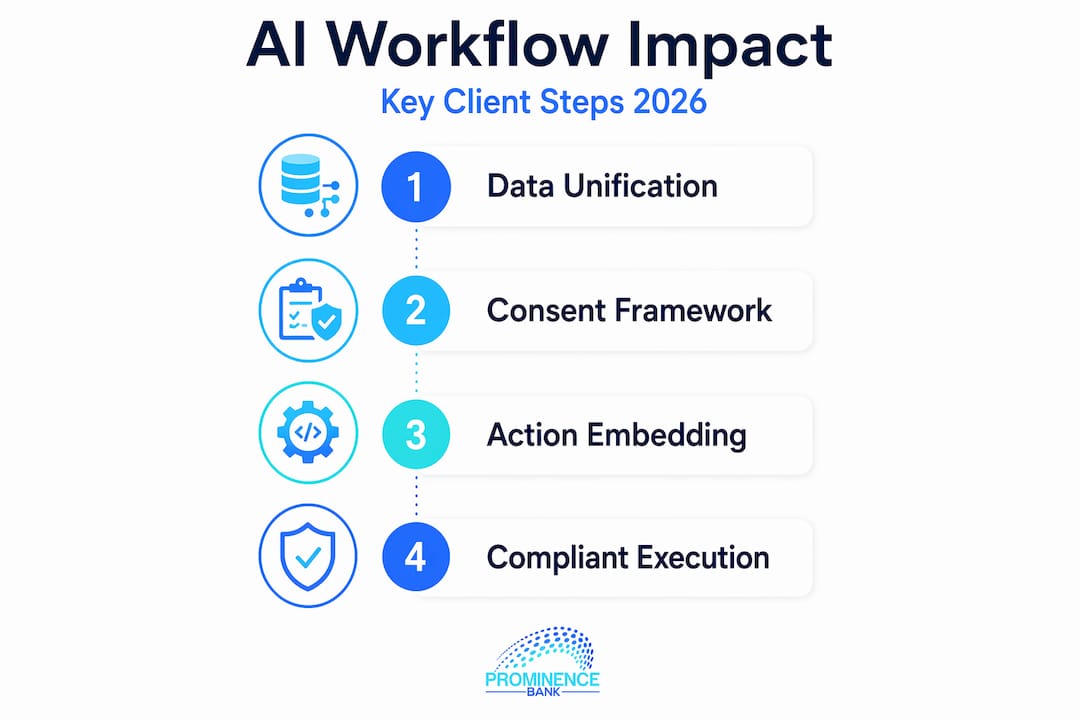
And critically, banking profitability pressures mean that AI and tokenization timelines are conditional, not guaranteed. Macro uncertainty, inflation volatility, and geopolitical shocks can slow rollout far faster than any technology roadmap anticipates. Treat vendor timelines as aspirational and ask for contractual commitments instead.
The practical questions every HNW client should be asking their institution right now: What actions can your AI take on my behalf without explicit real-time consent? How are those actions logged and reversible? Who has access to my unified client data and under what legal framework? These are not paranoid questions. They are the governance questions that define whether secure tech actually protects you or simply reassures you.
Pro Tip: Demand a written summary of your bank’s AI governance framework, including consent mechanics, data access controls, and audit trail procedures. If they cannot produce one, the technology is ahead of the compliance infrastructure, and that is your risk to bear.
Explore advanced private banking solutions for 2026 and beyond
For those ready to put these trends into action, explore solutions that reflect where top private banks are headed.
The trends covered in this article are not abstract. They are the criteria by which sophisticated clients are already evaluating their banking relationships in 2026. Whether the need is multi-jurisdictional account access, digital asset integration, or corporate treasury management, the standard for what “good” looks like has risen sharply.
Prominence Bank is built for exactly this moment. Our multi-currency accounts provide instant access to global financial infrastructure with the discretion and security that HNW clients and institutional clients require. For clients navigating digital assets alongside traditional holdings, our cryptocurrency bank accounts provide regulated custody and transactional capability under one roof. Complex international structures benefit from our corporate account setup process, designed to handle multi-entity, multi-jurisdiction requirements under clear compliance standards. Connect with our team to explore how Prominence Bank’s solutions align with where private banking is actually going.
Frequently asked questions
What are the top technology trends in private banking for 2026?
Simplification, automation, and agentic AI workflows are defining trends, with banks investing in digital advisory journeys that support the full client experience from onboarding through ongoing portfolio management.
How do sustainability and digital assets impact private banking strategies?
Both are now foundational, not optional. Private markets demand is being reshaped by tokenization and sustainability lenses, driving new product structures and asset allocation frameworks for HNW clients who expect both access and accountability.
What compliance challenges does AI introduce for private banks?
AI-driven advisory journeys require robust consent frameworks, unified client data infrastructure, and fully auditable action logs to satisfy both internal governance standards and evolving regulatory requirements.
Are profitability and credit risk limiting innovation in private banking?
Yes, materially. Profitability and credit risk constraints mean that capital allocation decisions directly influence which technologies get funded, which products get launched, and at what pace those rollouts actually occur.
Should clients expect rapid adoption of AI and tokenization?
Not necessarily. Rollout timelines are conditional on each institution’s risk appetite, regulatory environment, and macro conditions. Treat ambitious roadmaps with appropriate skepticism and ask for commitments rather than projections.