
TL;DR:
- KTT offers faster, more secure, and discreet cross-border transfers compared to SWIFT and RTGS.
- Proper preparation and complete documentation are critical for successful KTT transactions.
- Choice of banking partner with strong KTT expertise ensures reliable and efficient international transfers.
When a seven-figure wire transfer sits in limbo for days, or when the details of a sensitive cross-border transaction surface in ways that compromise your privacy, the limitations of conventional banking become impossible to ignore. High-net-worth individuals and corporate clients moving large sums internationally face real risks with mainstream methods: slow settlement cycles, broad correspondent banking chains, and insufficient confidentiality controls. KTT funds transfer exists precisely to solve these problems. This guide walks you through exactly what KTT is, what you need to prepare, how to execute a transfer step by step, how to verify results, and how to sidestep the most common pitfalls.
Table of Contents
- Understanding KTT funds transfer
- Requirements and prerequisites for KTT transfer
- Step-by-step guide to KTT funds transfer
- Troubleshooting and verification
- The untold truth about KTT funds transfer for global wealth
- Next steps: Secure your KTT transfer with Prominence Bank
- Frequently asked questions
Key Takeaways
| Point | Details |
|---|---|
| Elite transfer solution | KTT funds transfer is designed for high-net-worth individuals and corporations needing secure, fast, and discreet international transactions. |
| Clear prerequisites | Proper documentation and account setup are essential before initiating a successful KTT transfer. |
| Step-by-step process | Follow a precise sequence for KTT transfers to ensure speed, authenticity, and compliance. |
| Verification is critical | Always confirm the arrival and security of funds, addressing any issues promptly. |
| Expert support required | Engage specialists to navigate regulatory and technical challenges for high-value KTT transactions. |
Understanding KTT funds transfer
KTT stands for Key Tested Telex, a secured interbank communication and transfer protocol with roots in the era of encrypted telex messaging between financial institutions. While the name carries a vintage ring, the underlying principles — authenticated sender verification, encrypted communication channels, and direct bank-to-bank settlement — remain as relevant as ever for clients moving large sums across borders with discretion. Unlike consumer-facing wire services, KTT telex transfers operate within a framework designed specifically for institutional and high-value transactional relationships.
The advantages of KTT over conventional methods are concrete and meaningful. Speed is chief among them. Where standard SWIFT messages can take between one and five business days to reach final settlement, KTT transfers move through authenticated channels with minimal correspondent banking friction, often clearing significantly faster. Security is equally notable. The “key tested” element refers to a bilateral authentication system where both sending and receiving banks use pre-agreed cipher keys to verify the legitimacy of the transaction before funds are released. This creates a closed, verifiable loop that mainstream wire protocols do not replicate.
The KTT services benefits that matter most to serious clients include privacy, speed, security, and the capacity to move large transaction volumes without triggering the layered scrutiny often associated with retail or semi-institutional channels. The KTT account benefits for private banking clients are particularly well-suited to complex international portfolios.
Here is how KTT compares to other common transfer methods:
| Feature | KTT | SWIFT | RTGS |
|---|---|---|---|
| Settlement speed | Same day to 24 hours | 1 to 5 business days | Real-time, domestic |
| Privacy level | Very high | Moderate | Moderate |
| Transaction size | Typically large value | Flexible | Flexible |
| Authentication | Bilateral key testing | Standardized messaging | Central bank clearing |
| Ideal client | HNW, corporate, institutional | Broad commercial | Domestic interbank |
Key advantages that set KTT apart for discerning clients:
- Direct bank-to-bank settlement reduces counterparty exposure and speeds up clearance
- Bilateral encryption ensures only the intended recipient institution can authenticate the instruction
- High discretion in messaging structure limits unnecessary data sharing across correspondent chains
- Capacity for large transfers without triggering proportional overhead or processing bottlenecks
- Regulatory alignment with AML and KYC frameworks at both the originating and receiving institutions
Important: KTT transfers remain subject to international AML/KYC compliance standards. Prominence Bank operates under ETMO sovereignty and maintains strict compliance with these requirements. Engaging a bank with established KTT infrastructure ensures your transaction is both legitimate and protected.
The ideal users of KTT transfers are high-net-worth individuals managing multi-jurisdictional assets, corporate clients executing treasury operations across borders, and institutional investors requiring fast, confidential settlement of significant positions. If your financial life involves cross-border complexity at scale, KTT is worth understanding in detail.
Requirements and prerequisites for KTT transfer
Now that you grasp why KTT transfers matter, let’s ensure you’re fully prepared to begin the process. Preparation is where most delays actually originate. Not in the transfer itself, but in the documentation phase. Incomplete submissions or missing authorizations can halt a transaction before it even reaches the authentication stage.
For individual high-net-worth clients, the core documentation requirements include:
- Government-issued photo identification (passport preferred for international transactions)
- Proof of residential address dated within 90 days (utility statement or official bank correspondence)
- Source of funds documentation supporting the transfer amount
- Signed transfer instruction authorization
- Correspondent banking details of the receiving institution
For corporate entities, the requirements expand considerably. Corporate finance transactions through KTT demand additional layers of institutional verification to ensure the transfer aligns with both the originating and receiving bank’s compliance frameworks.
Corporate documentation typically includes:
- Certificate of incorporation and current standing
- Board resolution authorizing the transaction and the signatories
- Corporate ownership structure documentation (up to ultimate beneficial owner level)
- Authorized signatory list with specimen signatures
- Corporate banking credentials and account details for both sending and receiving accounts
Here is a structured overview of requirements by client type:
| Requirement | Individual Client | Corporate Client |
|---|---|---|
| Government ID | Required (passport) | Director/UBO ID required |
| Proof of address | Required | Registered address documentation |
| Source of funds | Required | Required with audited records |
| Board resolution | Not applicable | Mandatory |
| Beneficial owner disclosure | Self-declared | UBO register extract |
| Transfer authorization | Personal signed instruction | Multi-signatory if required |
Before your account is KTT-enabled, you will also need to confirm that your KTT bank account is properly configured for this transfer type. Some institutions require a separate account designation to enable KTT functionality. Additionally, reviewing KTT insights can clarify which account structures align best with your transaction profile.

For clients who also use IP 2 IP interbank transfer protocols, it is worth noting that while both methods emphasize direct bank-to-bank settlement, KTT relies on key-tested authentication while IP 2 IP operates on IP-based identification. They are complementary tools rather than direct substitutes.
Pro Tip: Compile your full documentation package before initiating any communication with the bank. Sending incomplete submissions causes internal queuing delays and can push your transaction into a secondary review cycle. A clean, complete submission moves through processing far more efficiently than a back-and-forth document exchange.
Step-by-step guide to KTT funds transfer
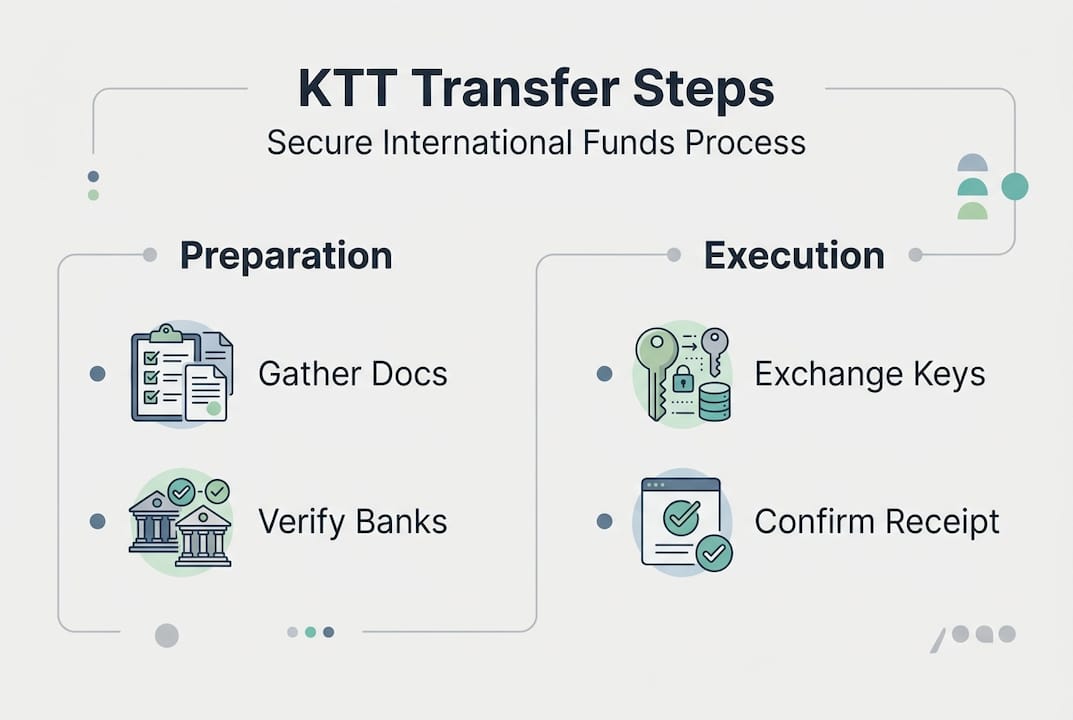
With all prerequisites met, you are ready to initiate a KTT transfer. Here is how to proceed, step by step, with precision.
Step 1: Contact your relationship manager or KTT specialist.
KTT transfers are not initiated through a self-service portal in the traditional sense. Open communication with a designated banking specialist who understands the protocol is the first critical move. This person will guide the authentication process on both ends.
Step 2: Submit your complete documentation package.
Forward all identity, authorization, and source-of-funds documentation simultaneously. Reference the requirements table from the previous section. Partial submissions create compliance holds, not temporary delays.
Step 3: Confirm receiving bank KTT capability.
Your receiving institution must also be KTT-enabled. Verify this before initiating. Request their SWIFT/BIC code, their correspondent bank details if applicable, and confirmation that they operate a key-tested telex receiving infrastructure.
Step 4: Exchange bilateral authentication keys.
This is the core of the KTT protocol. The sending bank and the receiving bank exchange pre-agreed cipher keys. This step confirms that both institutions recognize the transaction as legitimate before any funds move. It is the security layer that separates KTT from standard SWIFT messaging.
Step 5: Issue the formal transfer instruction.
Your signed, authorized transfer instruction is submitted. This document specifies the transfer amount, the receiving account details, the purpose of the transfer, and any relevant reference codes.
Step 6: Monitor the telex confirmation.
The sending bank issues a telex message authenticated with the cipher key. The receiving bank verifies it against the pre-agreed key. When the keys match, funds are released. This is the point of no return.
Step 7: Receive and archive confirmation documentation.
Both parties receive transaction confirmation documentation. Archive this immediately for audit and record-keeping purposes.
As noted in KTT services for corporate clients, completion timelines vary but typically fall within the same business day to 24 hours when documentation is clean and the receiving bank’s infrastructure is operational. Compare this to SWIFT bank transfers which average one to five days, or RTGS which is efficient but confined to domestic transactions. For international high-value transfers, KTT’s speed and authentication model are genuinely superior.
Statistic callout: When properly documented and authenticated, KTT transfers can achieve settlement confirmation within hours rather than days, a critical advantage for time-sensitive investment placements, M&A transaction funding, or treasury operations spanning multiple time zones.
For clients managing global investment portfolios, KTT financial triumph comes down to preparation and execution discipline. The protocol itself is reliable. The variable that determines speed and success is consistently the quality and completeness of the client’s documentation.
Pro Tip: Engage a compliance specialist or experienced banking relationship manager who has executed KTT transfers before. The authentication process, especially the key exchange step, requires institutional familiarity that generalist banking staff may not possess. A single misstep in the key testing phase can invalidate the transfer and require restarting from the authentication step.
Troubleshooting and verification
Once your transfer is underway, verifying completion and troubleshooting any issues is essential. Errors at this stage are rarer than during preparation, but they do occur, and how you respond determines how quickly funds reach their destination.
Confirming fund arrival and authenticity
The receiving institution should provide written confirmation once the authenticated telex message is processed and funds are credited to the destination account. This confirmation will reference the transaction ID, the authenticated cipher key code, and the credited amount. Cross-reference these details against your originating transfer instruction immediately.
If the receiving bank does not confirm within the expected timeframe, do not assume the transfer failed. Regulatory aspects of international transfers mean that compliance holds can pause fund release even after the authentication step is completed. This is normal in cases involving large amounts or first-time transfers between institutions.
Common issues and how to resolve them:
- Delay beyond 24 hours: Contact your relationship manager with the transaction reference and request a status inquiry through the interbank channel
- Authentication mismatch: This occurs when the cipher key exchange has an error. The transfer instruction is not executed. Restart the key exchange process with corrected credentials
- Compliance hold at the receiving institution: The receiving bank’s AML team may flag the transfer for manual review. Provide supplementary source-of-funds documentation proactively
- Incomplete clearance: Funds arrive but are held in a suspense account. This typically resolves within 24 hours once the receiving bank’s compliance team reviews the supporting documents
- Missing beneficiary account details: Even a single digit error in account number or IBAN can reroute funds to a suspense queue. Triple-check all numeric identifiers before submission
Security note: Never accept verbal confirmation as sole evidence of transfer completion. Always request and retain the official written confirmation with the authenticated transaction reference. This documentation is your legal and financial record of the transfer and is essential for audit, regulatory, and tax purposes.
Best practices for record-keeping after every KTT transfer:
- Store originating transfer instruction, signed and dated
- Retain all correspondence with the bank during the documentation phase
- Archive the telex confirmation message with the transaction ID
- File receiving bank’s written credit confirmation separately
- Maintain a transfer log that records amount, date, purpose, and both institution names
Audit readiness is not optional for clients operating at this level. Tax authorities, regulatory bodies, and counterparties may all require transfer documentation at short notice. A clean, organized record shortens any review process dramatically.
The untold truth about KTT funds transfer for global wealth
Most mainstream banking commentary either ignores KTT entirely or treats it as a legacy curiosity. That framing is simply wrong, and it costs clients who take it at face value. KTT is not old-fashioned. It is intentionally specialized, and the very characteristics that make it feel unfamiliar to retail banking observers are the same characteristics that make it powerful for institutional use.
The bilateral key-testing model, which critics sometimes call “outdated,” is actually its strongest security feature. It cannot be replicated through a browser-based portal because it requires direct, pre-negotiated trust between two financial institutions. For high-value transactions, that friction is a feature, not a flaw.
What we observe consistently among clients who move from conventional wire transfers to telex transfer expertise is a shift in confidence. They stop worrying about whether their transfer is sitting in a correspondent bank queue and start managing their capital movements with genuine precision.
The real risk is not KTT itself. It is using KTT without a banking partner that understands the protocol thoroughly. Not every institution advertising KTT capability has the relationships and compliance infrastructure to execute it cleanly. For global wealth management at scale, the choice of banking partner matters as much as the transfer method itself.
Next steps: Secure your KTT transfer with Prominence Bank
Ready to execute your next KTT transfer with the precision and discretion it demands?
Prominence Bank offers specialized KTT infrastructure designed specifically for high-net-worth individuals and corporate clients who require fast, authenticated, and fully discreet international transfers. Our team brings deep KTT expertise, established interbank relationships, and rigorous compliance frameworks under ETMO sovereignty. Whether you are funding an international investment, executing a corporate treasury operation, or managing a private cross-border settlement, we provide the specialized environment your transaction requires. Explore our advanced corporate banking solutions, open a KTT bank account, or learn more about our full service range at Prominence Bank today.
Frequently asked questions
What makes KTT funds transfer different from SWIFT or RTGS?
KTT transfers offer enhanced discretion, higher speed for large-value international transactions, and bilateral key-tested authentication that SWIFT and RTGS protocols do not replicate, making KTT particularly suited for high-net-worth and institutional clients.
Who can initiate a KTT funds transfer?
Both high-net-worth individuals and corporate entities with proper documentation and verified KTT account credentials can initiate KTT funds transfers, provided both sending and receiving institutions support the protocol.
How long does a typical KTT funds transfer take?
KTT transfers are generally completed faster than traditional wire methods. With correct documentation and receiving bank readiness, transfers often settle same day or within 24 hours.
What documents are required for a KTT funds transfer?
You will need proof of identity, bank account credentials, source-of-funds documentation, and signed transfer authorization. Corporate clients also require a board resolution and beneficial ownership disclosure.
Is KTT funds transfer safe for large investment transactions?
Yes. KTT transfers are considered more secure and discreet for large-value transactions, but proper verification, bilateral key authentication, and compliance checks at both institutions remain essential to a clean settlement.