
TL;DR:
- International custody account procedures involve managing assets across multiple countries through regulated processes and oversight. These steps include choosing a qualified custodian, completing KYC requirements, establishing and funding accounts, and ensuring asset segregation and proper settlement cycles. Proper documentation, continuous monitoring, and active compliance are essential to mitigate risks and maintain lawful cross-border asset management.
International custody account procedures are the structured steps and compliance measures required to securely hold and manage assets across multiple countries through global custodian networks and local sub-custodians. These procedures govern everything from initial account setup and identity verification to ongoing settlement, tax withholding, and reconciliation. Regulatory frameworks like SEC Rule 17f-5 define the legal obligations that institutions must meet when delegating custody to foreign agents. For high-net-worth individuals and businesses operating across borders, understanding these procedures is the foundation of sound cross-border asset management.
What prerequisites and requirements must be met before opening an international custody account?
Opening an international custody account starts with selecting a qualified global custodian. Global custodians manage assets in roughly 100 markets, which removes the need to establish separate banking relationships in each jurisdiction. That single point of access is the primary operational advantage of using a global custodian rather than managing local accounts independently.

Before any account opens, both the client and the custodian must satisfy a defined set of prerequisites.
Client-side requirements:
- Government-issued identification and proof of address for KYC compliance
- Source-of-funds documentation to satisfy AML standards
- Corporate formation documents for business clients (articles of incorporation, ownership structure, beneficial owner declarations)
- Tax identification numbers for all relevant jurisdictions
- Completed account application and risk profile assessment
Custodian-side requirements:
- Formal due diligence on each local sub-custodian, covering financial strength, operational capacity, and regulatory standing
- A signed Foreign Custody Manager agreement that defines delegation of authority, reporting obligations, and liability provisions
- Documented procedures for ongoing monitoring of sub-custodian performance
Under Rule 17f-5, institutions must designate a Foreign Custody Manager to oversee sub-custodians with documented due diligence including financial and operational reviews. This is not a one-time check. The Foreign Custody Manager carries continuous responsibility for sub-custodian oversight throughout the life of the account.
Pro Tip: Request a copy of your global custodian’s sub-custodian due diligence reports before signing. A custodian that cannot produce current, documented reviews of its local agents is a compliance liability, not a service provider.
Eligibility criteria vary by institution, but most global custodians require a minimum asset threshold for institutional accounts. Individual clients seeking global account access typically face stricter identity verification and source-of-wealth documentation requirements than corporate clients.
How do you execute the step-by-step process for setting up and managing international custody accounts?
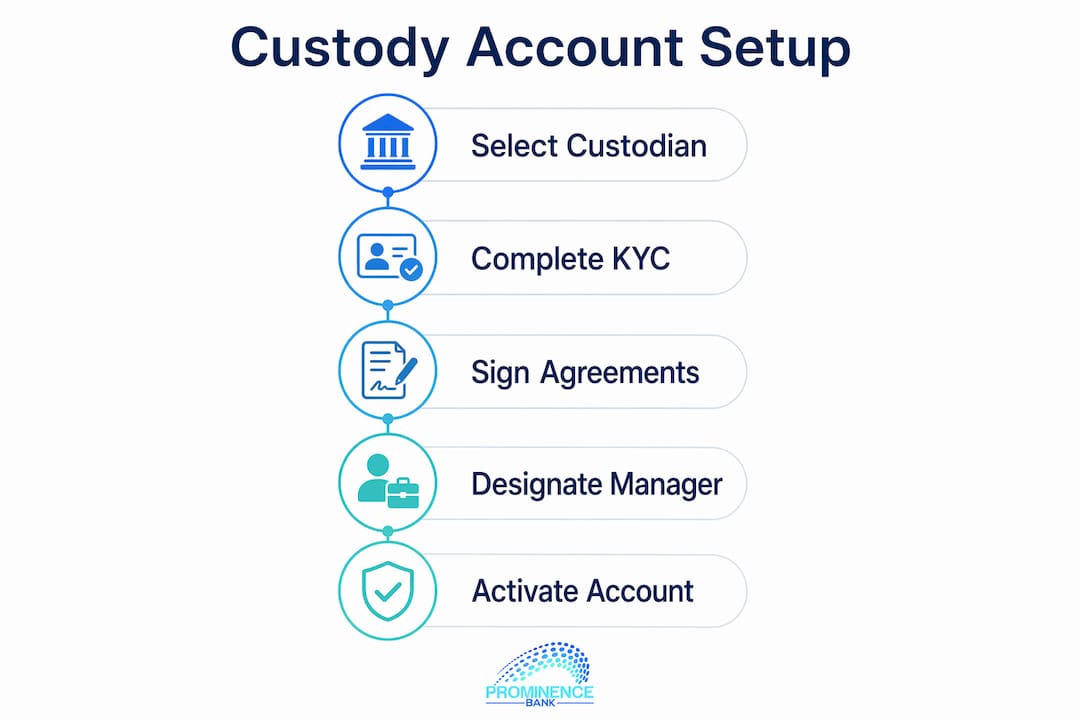
The account setup process follows a defined sequence. Skipping or rushing any step creates compliance gaps that surface later during audits or tax reclaims.
Step-by-step account setup:
- Select and contract a global custodian. Negotiate the custody agreement, confirm the sub-custodian network for your target markets, and finalize fee structures.
- Complete KYC and AML onboarding. Submit all required documentation. Prominence Bank normally completes account opening within 48 to 72 hours after all required KYC/AML procedures have been completed and all requested information and documentation have been received, verified, and accepted. This is an estimated processing period, not a guaranteed deadline. Additional time may be required if further compliance, verification, or due-diligence review is necessary. Submitting an enquiry, application, or payment does not start the estimated processing period and does not guarantee account approval or activation.
- Establish sub-custodian relationships. Your global custodian coordinates this. Confirm that each sub-custodian covers the specific markets where you intend to hold securities.
- Register assets under nominee name. Nominee name holding allows assets to be registered in the custodian’s name for operational efficiency while maintaining your legal owner rights. This structure facilitates swift trade settlement but requires strict segregation to protect your legal title.
- Fund the account and initiate asset transfers. Coordinate with your existing brokers or custodians to transfer securities and cash. Confirm settlement instructions for each market.
- Confirm asset segregation. Asset segregation legally separates client assets from the custodian’s balance sheet. This protects you in the event of custodian insolvency. Verify that your assets are held in a segregated account, not pooled with the custodian’s proprietary holdings.
- Activate reporting and reconciliation. Set up consolidated reporting across all markets and establish a daily reconciliation schedule.
Settlement cycles and FX coordination
Foreign security transactions settle under local market rules, typically within T+2 or T+3 cycles for currency delivery and share registration. That two-to-three-day window is where most operational failures occur. Your global custodian must instruct record updates in Central Securities Depositories and align cash payments to avoid trade failures.
Automated FX execution linked directly to trade settlement reduces counterparty and currency risk in cross-border operations. Without automated FX, manual currency conversion introduces timing gaps that can cause settlement failures or income repatriation delays.
| Process stage | Key action | Risk if skipped |
|---|---|---|
| Asset registration | Nominee name holding with segregation | Loss of legal title in insolvency |
| Trade settlement | T+2/T+3 coordination with CSD | Settlement failure, financial penalty |
| FX execution | Automated FX linked to settlement | Currency mismatch, delayed income |
| Corporate actions | Timely instruction to custodian | Missed dividends, proxy vote failures |
| Reconciliation | Daily three-way match | Undetected discrepancies, audit failures |
Ongoing asset servicing
After setup, the account requires active management. Corporate actions such as dividend payments, rights issues, and stock splits require timely instructions to your custodian. Income collection and tax withholding management are equally critical. Your custodian handles withholding tax at source, but you must supply the documentation needed to claim treaty benefits. Daily reconciliation between broker, global custodian, and sub-custodian records safeguards accuracy and prevents discrepancies from compounding.
Pro Tip: Set a calendar reminder for all corporate action deadlines in each market. Missing a response window on a rights issue or tender offer is a permanent financial loss that no amount of reconciliation can recover.
What are common compliance challenges and risk management strategies in international custody?
Compliance in cross-border custody is harder than it looks. Coordinating different legal systems, time zones, and tax regimes is the biggest operational challenge in global custody. Each layer of the custody chain introduces a new point of potential failure.
The most common compliance risks include:
- Counterparty risk from sub-custodians. A sub-custodian that fails or faces regulatory sanctions can freeze your assets. Ongoing due diligence, not just initial selection, is the only mitigation.
- Documentation mismatches. Chain of custody documentation is required for tax treaty benefits and withholding tax recovery. Inaccurate or incomplete records cause failed tax reclaims and regulatory rejections.
- Regulatory reporting gaps. Different jurisdictions require different disclosures. Missing a local reporting deadline can trigger penalties or account restrictions.
- FX and settlement failures. Manual FX processes introduce timing risk. A missed settlement instruction can result in financial penalties and forced buy-ins.
- Insolvency exposure. Without proper asset segregation, client assets can be treated as custodian assets in bankruptcy proceedings.
“A well-structured Foreign Custody Manager Agreement ensures proper oversight and liability allocation, reducing legal risk for institutional investors. The agreement defines the delegation of authority, due diligence standards, reporting obligations, and liability provisions that govern the entire sub-custodian relationship.”
The Foreign Custody Manager agreement is the legal instrument that drives fiduciary responsibility and regulatory oversight. Institutions that treat it as a formality rather than an active governance document expose themselves to liability for foreign custody risks they cannot see or control.
Geopolitical risk deserves specific attention. Markets can impose capital controls, freeze foreign holdings, or change settlement rules with little warning. A global custodian with deep local networks and real-time monitoring can identify these risks earlier than a client managing accounts independently.
How do you troubleshoot and avoid common mistakes in international custody account management?
Most procedural errors in international custody fall into four categories. Recognizing them early prevents costly corrections.
Common mistakes and how to fix them:
- Misunderstanding asset segregation. Many clients assume nominee name holding means the custodian owns their assets. It does not. The custodian holds legal title for operational purposes, but your beneficial ownership is protected by segregation. Confirm this structure in writing before transferring assets.
- Ignoring Foreign Custody Manager agreement obligations. The agreement is not a static document. It requires ongoing compliance, including periodic sub-custodian reviews and updated due diligence. Failing to meet these obligations can void the liability protections the agreement provides.
- Documentation mismatches in tax filings. Robust chain of custody documentation is critical for tax and regulatory compliance. A mismatch between the identity on a tax form and the registered holder in the CSD will cause a treaty benefit claim to fail. Audit your documentation chain before filing, not after a rejection.
- Skipping regular reconciliation. Reconciliation is not an annual audit task. Daily three-way matching between broker, global custodian, and sub-custodian records is the standard practice. Gaps compound quickly and become difficult to unwind.
- Underestimating geopolitical risk. A market that is stable today can impose capital controls within weeks. Clients holding concentrated positions in politically sensitive markets should maintain contingency plans with their custodian for asset repatriation.
Pro Tip: Request a full reconciliation report from your custodian at account opening, not just at year-end. Establishing a clean baseline on day one makes every subsequent reconciliation faster and more reliable.
For clients new to offshore custody structures, reviewing the offshore custody compliance framework before account opening reduces the risk of procedural errors that are expensive to correct after assets are transferred.
Key Takeaways
Successful international custody account management requires documented compliance at every stage, from Foreign Custody Manager agreements and asset segregation to daily reconciliation and automated FX settlement.
| Point | Details |
|---|---|
| Foreign Custody Manager agreement | This agreement governs sub-custodian oversight and defines liability; treat it as an active compliance document. |
| Asset segregation | Client assets must be legally separated from custodian holdings to protect against insolvency. |
| Settlement cycles | T+2/T+3 settlement requires coordinated FX execution and CSD instructions to avoid trade failures. |
| Chain of custody documentation | Accurate records are required for tax treaty claims; mismatches cause rejected reclaims and regulatory penalties. |
| Daily reconciliation | Three-way matching between broker, global custodian, and sub-custodian prevents discrepancies from compounding. |
What I’ve learned after years of watching custody structures succeed and fail
The most expensive mistakes I’ve seen in cross-border custody have nothing to do with market volatility. They come from treating compliance documents as paperwork rather than governance tools.
The Foreign Custody Manager agreement is the clearest example. Institutions sign it, file it, and forget it. Then a sub-custodian in a secondary market runs into financial trouble, and the institution discovers that its due diligence reviews lapsed two years ago. At that point, the liability protections the agreement was designed to provide are gone.
Technology has changed what is possible in custody monitoring. Real-time reporting across 100 markets used to require a team of operations staff. Today, a well-configured custody platform delivers consolidated position data, FX exposure, and settlement status in a single dashboard. Clients who do not demand this capability from their custodian are accepting operational risk they do not need to carry.
The other pattern I see repeatedly is underinvestment in documentation. Tax treaty reclaims fail not because the treaty does not apply, but because the chain of custody documentation cannot prove entitlement at every level of the holding structure. That is a recoverable problem before you file. It is not recoverable after a rejection.
My honest advice: choose a global custodian based on the depth of its local sub-custodian network and the quality of its reporting technology, not on fee schedules alone. The cheapest custody arrangement is rarely the most cost-effective one when you factor in settlement failures, failed tax reclaims, and compliance remediation.
— Harold
How Prominencebank supports your international custody needs
Prominencebank serves high-net-worth individuals and institutional clients who need a single, compliant platform for cross-border asset management. The bank’s multi-currency account framework consolidates holdings across currencies and markets, reducing the operational complexity of managing separate accounts in each jurisdiction.
Prominencebank’s compliance infrastructure covers AML and KYC requirements aligned with international standards, and its technology platform delivers consolidated reporting for real-time position monitoring. For clients building or restructuring international custody arrangements, Prominencebank’s corporate banking solutions provide the institutional-grade infrastructure needed to meet Foreign Custody Manager agreement obligations and maintain audit-ready documentation at every stage of the custody chain.
FAQ
What is an international custody account?
An international custody account is a financial account held through a global custodian that safeguards and administers securities and assets across multiple countries on behalf of the account holder.
What does a Foreign Custody Manager do?
A Foreign Custody Manager is the designated party responsible for selecting, overseeing, and conducting ongoing due diligence on foreign sub-custodians under SEC Rule 17f-5.
How long does international custody account setup take?
Prominence Bank normally completes account opening within 48 to 72 hours after all required KYC/AML procedures have been completed and all requested information and documentation have been received, verified, and accepted. This is an estimated processing period, not a guaranteed deadline. Additional time may be required if further compliance, verification, or due-diligence review is necessary. Submitting an enquiry, application, or payment does not start the estimated processing period and does not guarantee account approval or activation.
Why does asset segregation matter in custody accounts?
Asset segregation legally separates your holdings from the custodian’s balance sheet, which means the custodian’s creditors cannot claim your assets if the custodian becomes insolvent.
What causes international tax reclaims to fail?
Most failed tax reclaims result from documentation mismatches in the chain of custody, where the identity on a tax filing does not match the registered holder in the Central Securities Depository.